
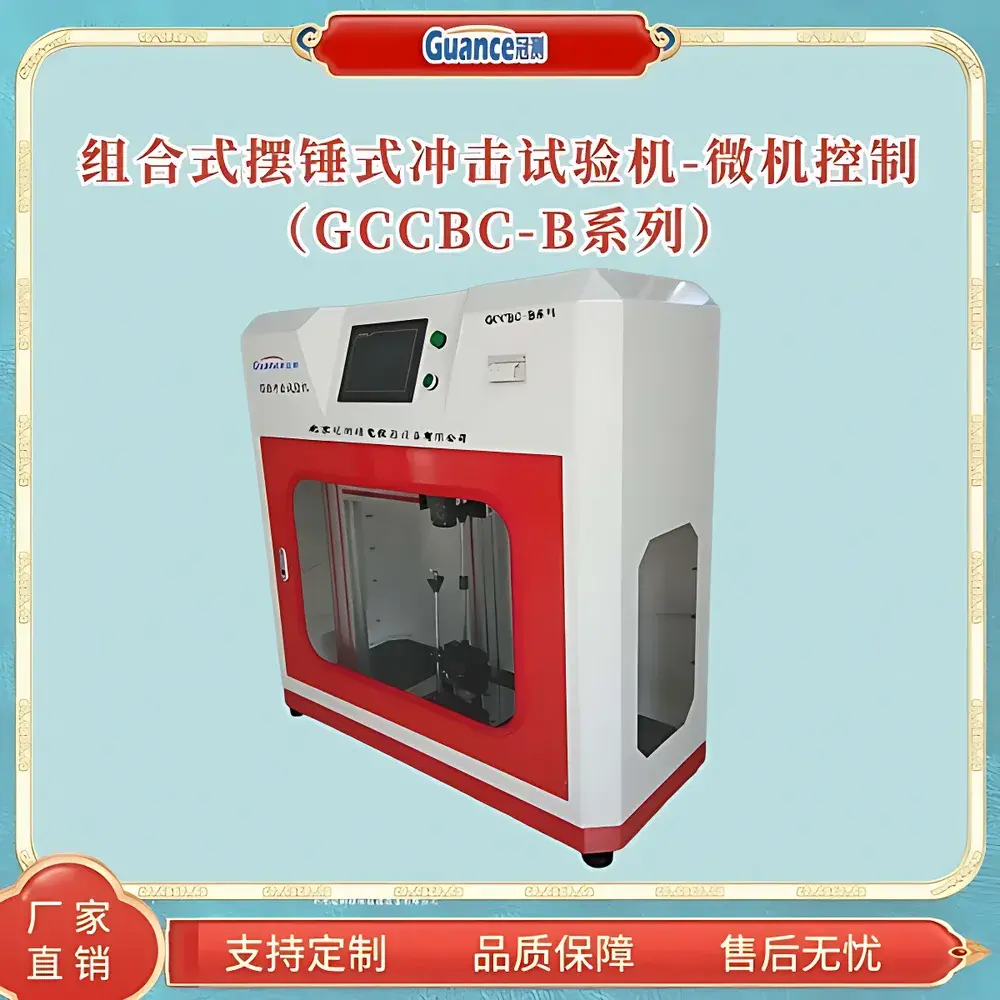
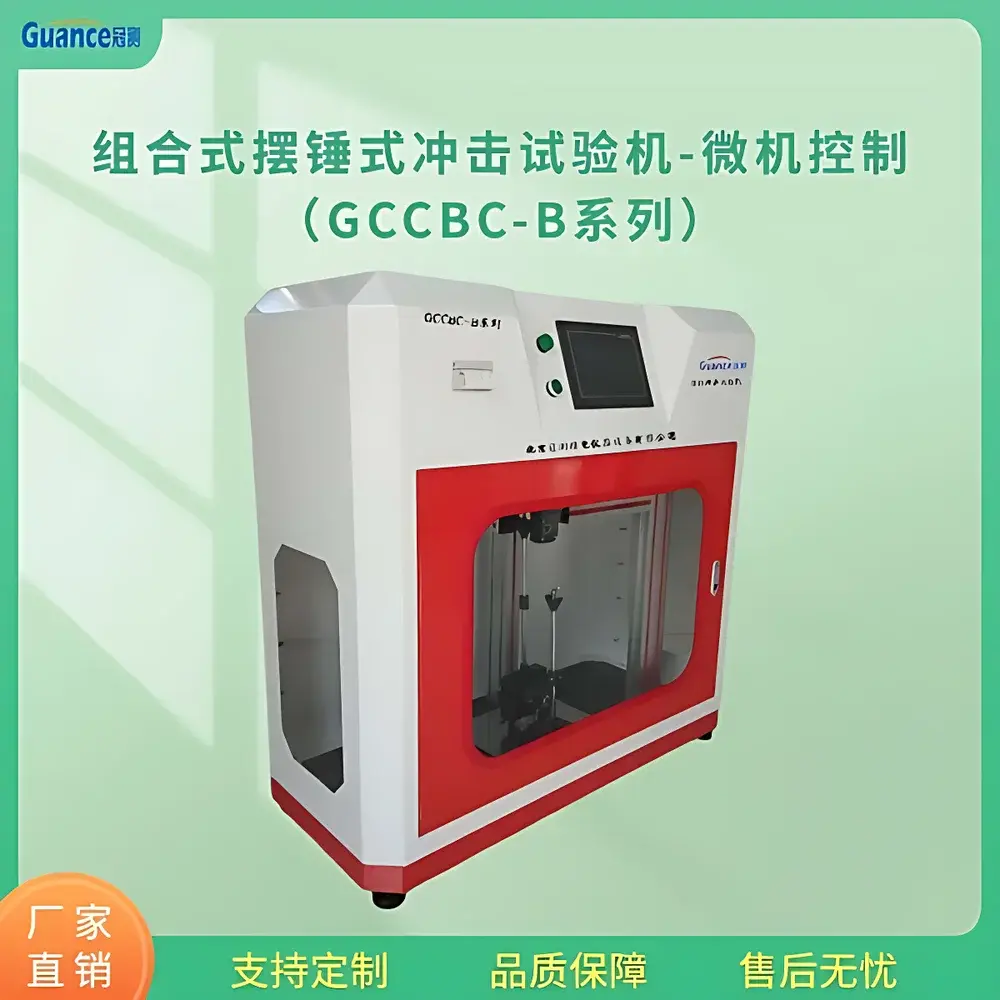
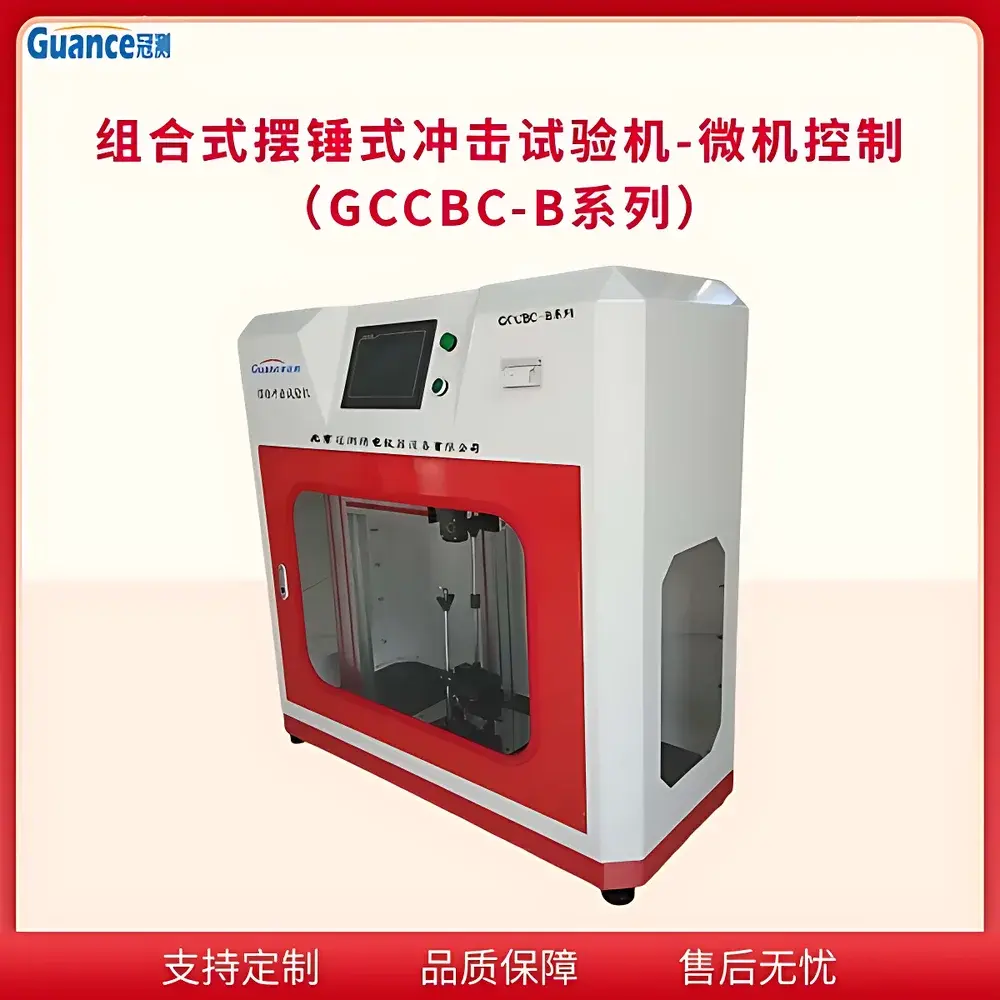
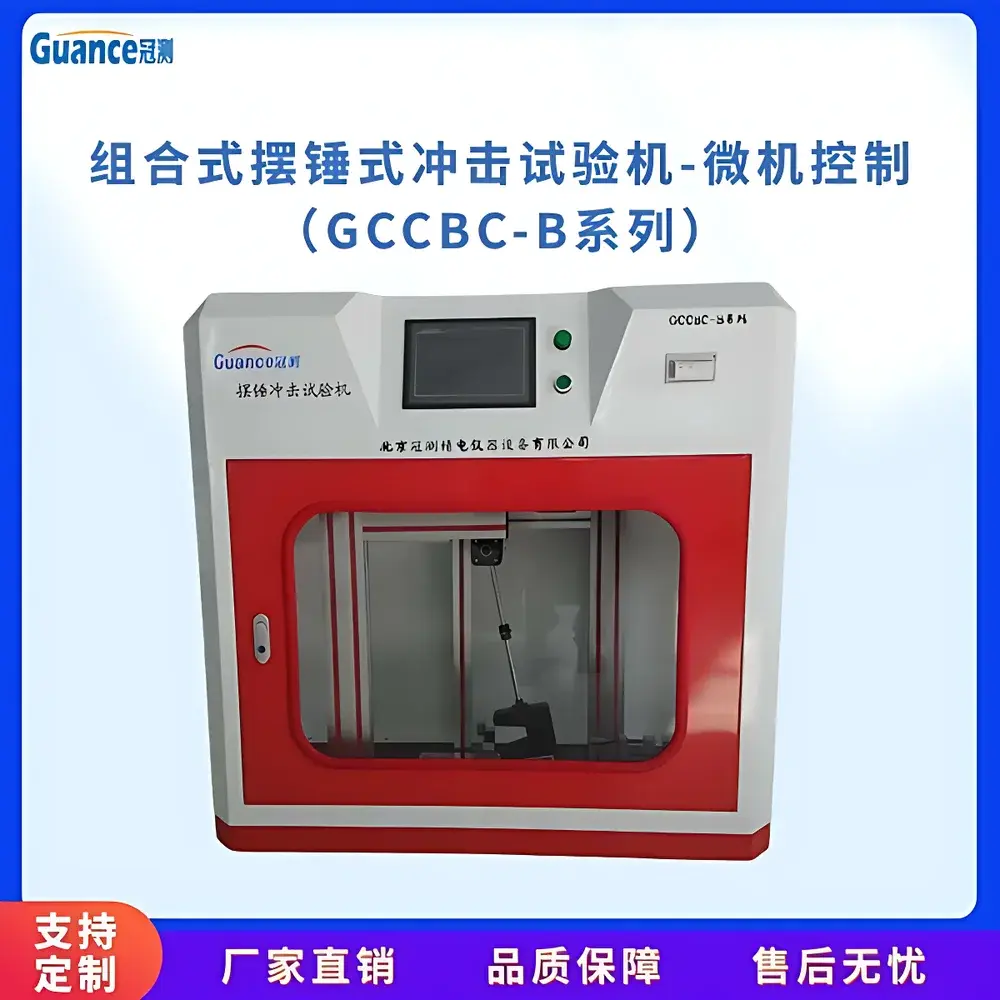
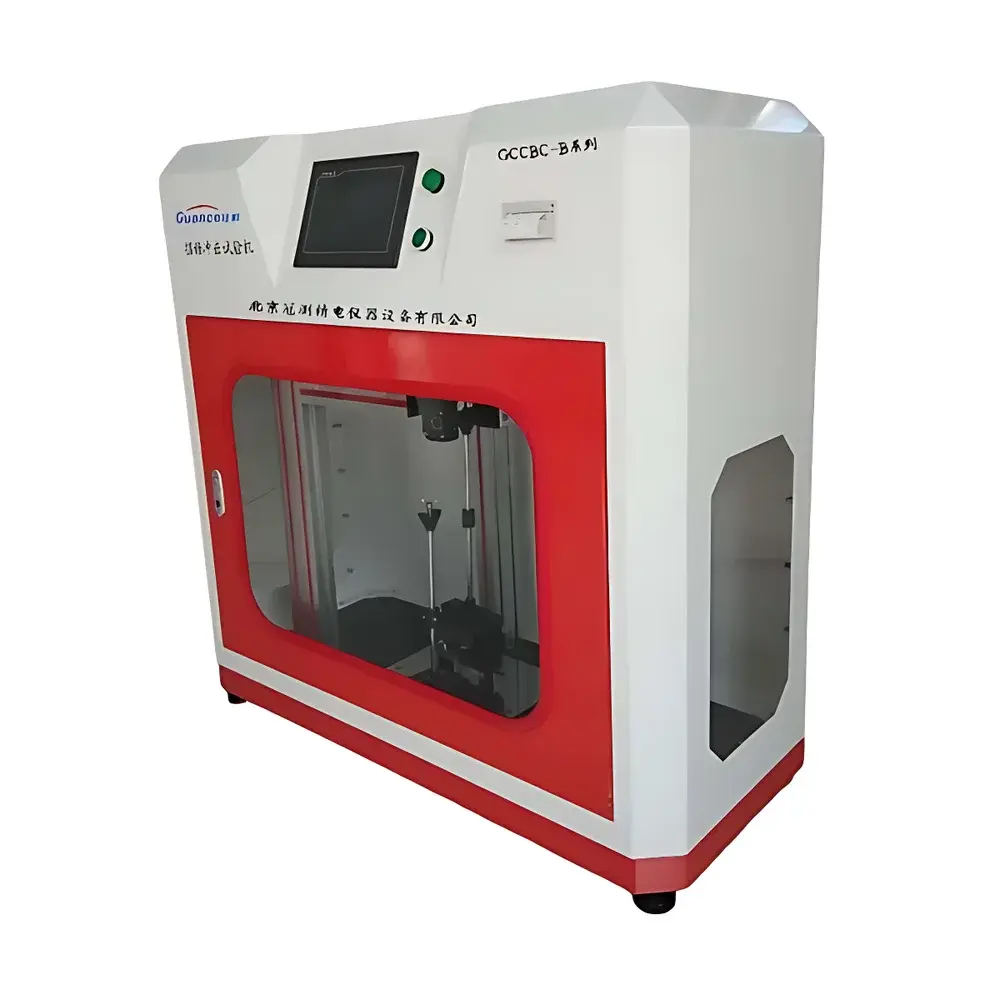
GuanCe GCCBC-B Series Combined Charpy & Izod Impact Testing Machine
| Brand | GuanCe Instruments |
|---|---|
| Origin | Beijing, China |
| Model | GCCBC-B Series |
| Impact Energy Options | 1 J / 5 J / 25 J / 50 J (Charpy) |
| Impact Velocity | ≤4 J: 2.9 m/s |
| ≥7.5 J | 3.8 m/s (Charpy) |
| Pendulum Moment (Impact Constant) | 18 N·m |
| Load Cell Range | 16 kN |
| Maximum Lifting Height | 150 mm |
| Support Span | 230 mm (Charpy), 335 mm (Izod) |
| Pre-lift Angle | 150° |
| Specimen Dimensions (Charpy) | 40–95 mm (L) × 4–15 mm (W) × 3–10 mm (T) |
| (Izod) | 61.5–82 mm (L) × 10–12.7 mm (W) × 3.2–12.7 mm (T) |
| Anvil Radius | R = 1 mm (Charpy), R = 0.8 mm (Izod) |
| Striking Edge Angle | 30° |
| Striking Edge Radius | R = 2 mm |
| Power Supply | 220 V AC, 200 W |
| Release Mechanism | Electromagnetic motor-driven release |
Overview
The GuanCe GCCBC-B Series Combined Charpy & Izod Impact Testing Machine is a dual-mode instrumented pendulum impact tester engineered for high-reproducibility mechanical characterization of polymeric, composite, and metallic materials under standardized dynamic loading conditions. It operates on the fundamental principle of conservation of mechanical energy in a calibrated pendulum system, where impact energy is derived from the difference between initial potential energy (defined by pre-lift angle α) and residual potential energy (reflected by rebound angle β), following the equation W = mgl(cosβ – cosα). Simultaneously, an integrated load cell—mounted directly at the striker tip—captures force-time history during specimen deformation, enabling full waveform digitization and post-test derivation of displacement-time, energy-time, and energy-displacement relationships. This dual-signal acquisition architecture supports quantitative analysis of fracture initiation, crack propagation, yield onset, and unstable crack growth—critical parameters for failure mode assessment in quality control, R&D, and regulatory compliance workflows.
Key Features
- Dual-standard configuration supporting both Charpy (simply supported beam) and Izod (cantilever beam) test geometries via interchangeable anvils, strikers, and specimen fixtures
- Electromagnetically actuated pendulum release mechanism ensuring precise, repeatable trigger timing with sub-millisecond synchronization to data acquisition
- High-resolution optical encoder (mounted on pendulum shaft) continuously tracking angular position throughout lift, impact, and rebound phases for accurate energy calculation
- Integrated 16 kN load cell embedded in the striker assembly, delivering force-time waveforms with sufficient bandwidth to resolve microsecond-scale events such as crack nucleation
- Touchscreen-based human-machine interface (HMI) eliminating external PC dependency for routine testing; optional USB export for advanced offline analysis
- Automated sequence control: auto-lift → specimen loading → impact → rebound capture → auto-rehang → energy recalibration — reducing operator intervention and inter-test variability
- Real-time invalid-test detection based on energy deviation thresholds, abnormal waveform morphology, or misalignment flags from optical alignment aids
- Comprehensive parameter output: 24 discrete metrics including absorbed energy, yield force, maximum force, unstable crack initiation/termination forces, time-to-peak, rise time, crack formation energy, and crack propagation energy
Sample Compatibility & Compliance
The GCCBC-B accommodates standardized thermoplastic, thermoset, elastomeric, and fiber-reinforced specimens per major international test protocols. Its mechanical design conforms to dimensional tolerances specified in ISO 179-1 (Charpy), ISO 180 (Izod), ASTM D256, GB/T 1043, GB/T 1843, GB/T 18743, and ISO 9854-1. Specimen support spans (230 mm for Charpy, 335 mm for Izod), anvil radii (R = 1 mm and R = 0.8 mm), and striker edge geometry (30° included angle, R = 2 mm radius) are maintained within ±0.05 mm tolerance. The system supports specimen thicknesses from 3 mm to 12.7 mm and widths up to 15 mm, covering standard ISO and ASTM specimen categories (e.g., Type 1A, Type 1B, Type 2). All hardware components—including load cell, encoder, and electromagnetic release solenoid—are traceably calibrated and documented per ISO/IEC 17025 requirements, with calibration certificates supplied upon delivery.
Software & Data Management
The embedded touchscreen controller runs deterministic real-time firmware optimized for synchronized analog/digital signal acquisition at 1 MHz sampling rate. Raw force-time and angular position data are stored in binary format compliant with ASTM E1776 annexes for long-term archival. Export options include CSV (for Excel or MATLAB import), PDF test reports with embedded curves (force-time, force-displacement, energy-time), and XML metadata files containing full test configuration, environmental conditions (ambient temperature/humidity logged at start), and operator ID. Audit trails record all user actions—including method changes, calibration events, and report generation—with timestamp and login credentials, satisfying GLP/GMP documentation requirements under FDA 21 CFR Part 11 when paired with network authentication. No proprietary runtime environments or dongle-based licensing are required; firmware updates are delivered via secure HTTPS download and verified using SHA-256 checksums.
Applications
This instrument serves laboratories engaged in polymer formulation development, pipe and fitting certification (particularly for PE, PP, and PVC pressure piping systems tested per ISO 9854-1), automotive interior component validation (dashboards, bumpers, trim), medical device packaging integrity evaluation, and academic fracture mechanics research. Its capacity to resolve four critical inflection points on the force-displacement curve—yield point, peak load, unstable crack initiation, and unstable crack arrest—enables correlation with microstructural features observed via SEM or CT scanning. In QC environments, it supports incoming raw material screening against supplier specifications, batch release testing per ISO 9001 clause 8.6, and root cause analysis of field failures through comparative waveform morphology analysis. The system’s repeatability (coefficient of variation < 2.5% for certified reference polymers per ISO 179-2) ensures statistical confidence in pass/fail decisions across multi-site manufacturing networks.
FAQ
Does the GCCBC-B comply with ISO/IEC 17025 calibration requirements?
Yes — all transducers (load cell, encoder) are factory-calibrated against NIST-traceable standards, and calibration certificates include uncertainty budgets, environmental conditions, and measurement procedures per ISO/IEC 17025:2017 Annex A.
Can test data be exported in machine-readable formats for LIMS integration?
Yes — CSV and XML exports contain structured metadata fields compatible with common laboratory information management systems (LIMS), including sample ID, test method, operator, date/time, and all 24 derived parameters.
Is the system suitable for testing brittle ceramics or thin metal foils?
The 1 J hammer option and adjustable specimen clamping allow controlled low-energy impacts; however, specialized fixtures (e.g., low-mass holders, ceramic-specific strikers) must be procured separately per application validation protocols.
What maintenance intervals are recommended for long-term accuracy retention?
Annual verification of pendulum moment, striker edge geometry, and load cell linearity is advised; biannual cleaning and lubrication of pivot bearings and release mechanism per the maintenance logbook included in shipment.
How is alignment verified before each test series?
An optical alignment gauge (included) checks striker-to-anvil concentricity and specimen centering; software also performs automated zero-force offset compensation prior to every impact cycle.



