
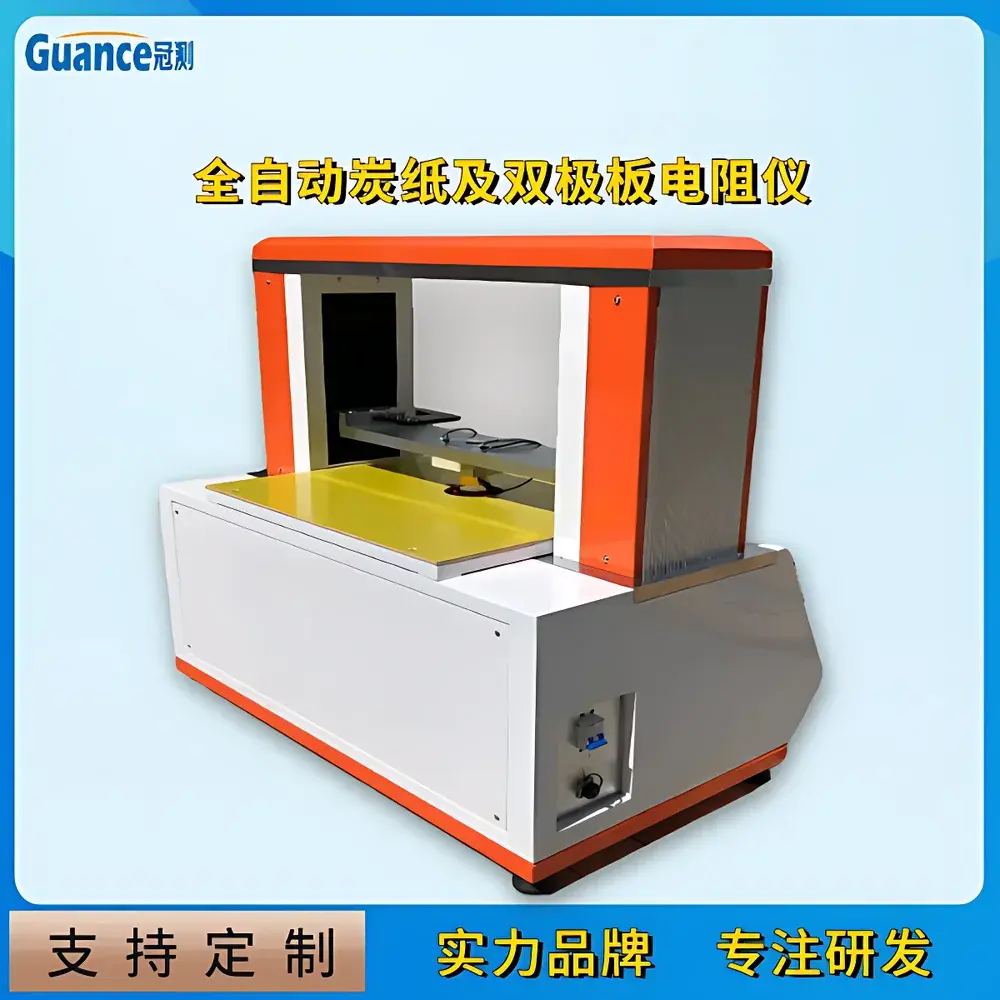
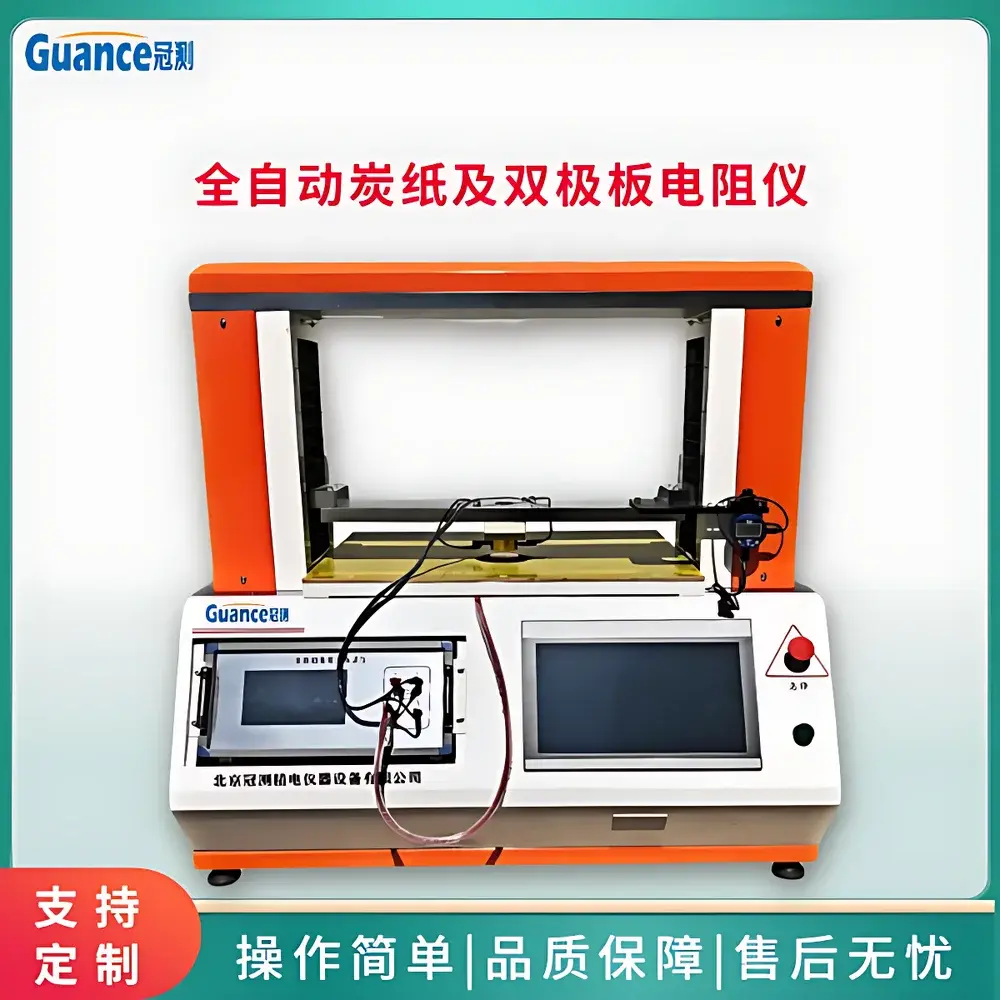


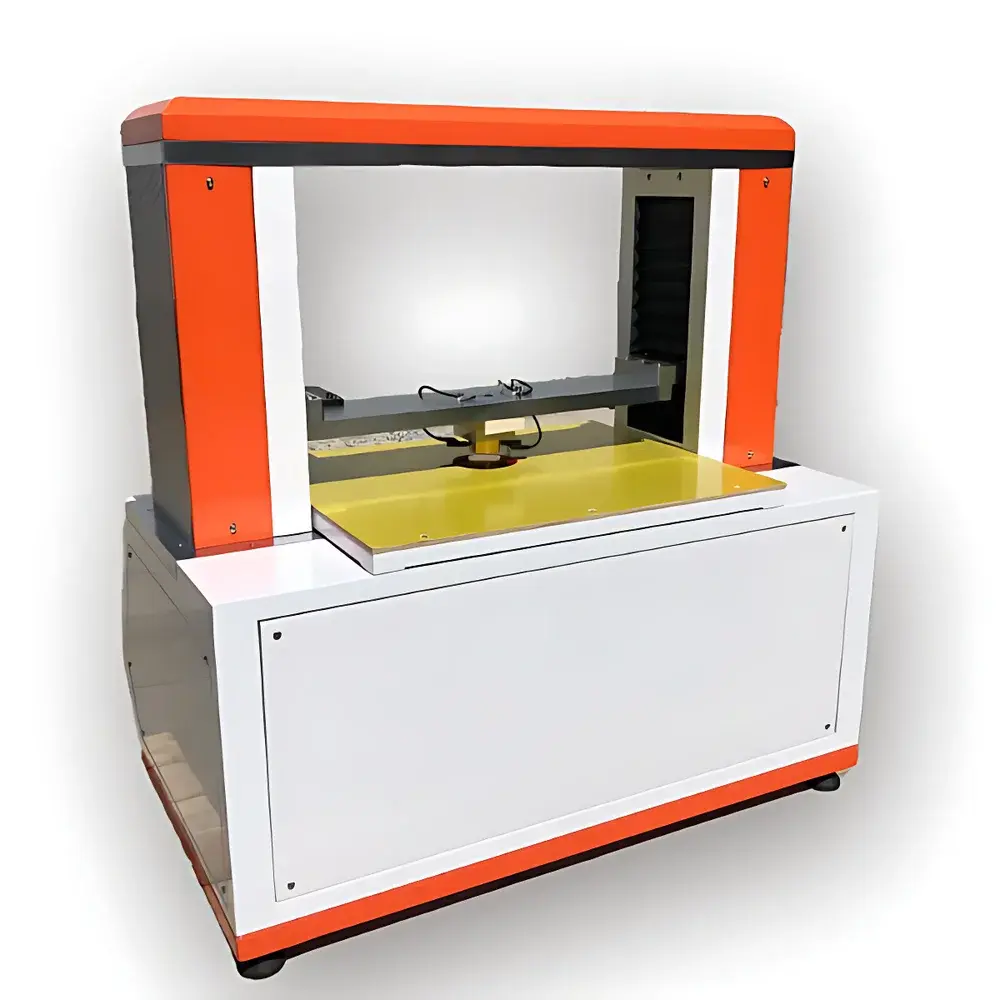
Guance GEST-20042G Automated Carbon Paper & Bipolar Plate Contact Resistance Tester
| Brand | Guance |
|---|---|
| Model | GEST-20042G |
| Origin | Beijing, China |
| Compliance | GB/T 20042.6–2011, GB/T 20042.7–2014 |
| Measurement Modes | Vertical (2-probe) & Horizontal (4-probe) Resistivity |
| Force Control | Servo-driven Loading System |
| Electrodes | 50 mm Gold-Plated |
| Display | 10-inch Touchscreen HMI |
| Data Output | Real-time Parameter Logging, Exportable CSV, On-Screen Print |
| Test Modes | Constant Force, Constant Pressure, Gradient Force, Gradient Pressure, Compression Ratio |
| Units | Ω·cm, Ω·m, S/m, mS/cm |
Overview
The Guance GEST-20042G Automated Carbon Paper & Bipolar Plate Contact Resistance Tester is an engineered solution for precise, repeatable measurement of interfacial electrical resistance and bulk resistivity in proton exchange membrane fuel cell (PEMFC) components—specifically carbon fiber paper (gas diffusion layers, GDLs) and graphite/composite bipolar plates (BPPs). It operates on the fundamental principle of controlled mechanical compression coupled with low-resistance four-terminal (Kelvin) and two-terminal DC resistance measurement. Unlike generic surface resistivity testers, the GEST-20042G is purpose-built to replicate the operational contact conditions between GDL and BPP under stack clamping loads, enabling quantification of contact resistance (Rc) as a function of applied pressure (kPa), compressive strain (%), and geometric orientation (in-plane vs. through-plane). Its architecture integrates servo-controlled force application with high-accuracy micro-ohmmeter circuitry, ensuring traceable, low-noise measurements across the 10 µΩ to 20 kΩ range—critical for evaluating material homogeneity, coating integrity, and interface stability in PEMFC R&D and quality control environments.
Key Features
- Servo-motor-driven loading system delivering precise, programmable force application from 0.1 N to 5,000 N with <±0.5% full-scale repeatability and silent continuous actuation
- Dual-mode measurement capability: vertical (through-plane) resistivity via two-probe configuration and horizontal (in-plane) resistivity using ASTM D4496-compliant four-point probe geometry
- 50 mm diameter gold-plated electrodes with surface roughness <0.1 µm Ra, minimizing contact resistance variability and oxidation-induced drift
- Integrated real-time parameter monitoring: compressive force (N), contact pressure (kPa), specimen thickness change (µm), compression ratio (%), voltage drop (mV), current (mA), resistance (Ω), resistivity (Ω·cm), and conductivity (S/m)
- Multi-mode test protocols including constant-force, constant-pressure, stepwise gradient force/pressure, and fixed-compression-ratio sequences—each fully programmable and reproducible
- Automated post-test reset and electrode retraction to prevent sample damage and ensure consistent start conditions across sequential runs
- 10-inch industrial-grade capacitive touchscreen HMI with intuitive GUI, onboard data visualization, and direct thermal printing of test reports
Sample Compatibility & Compliance
The GEST-20042G accommodates standard PEMFC component geometries: carbon paper sheets up to 100 × 100 mm and rigid bipolar plates up to 120 × 120 mm with thicknesses from 0.3 mm to 5.0 mm. Its mechanical and electrical design conforms to the metrological requirements specified in GB/T 20042.6–2011 (“Proton Exchange Membrane Fuel Cells – Part 6: Bipolar Plate Characterization”) and GB/T 20042.7–2014 (“Part 7: Carbon Paper Characterization”), both of which align structurally with ISO 14687-2:2019 (hydrogen fuel quality) and informally reference ASTM F2732 and IEC 62282-7-1 test philosophies. While not certified to GLP or ISO/IEC 17025 out-of-the-box, the instrument supports audit-ready operation when paired with external calibration records (force transducer & resistance standard), timestamped data logs, and user-accessible firmware versioning—enabling compliance with internal QC procedures and pre-certification validation workflows.
Software & Data Management
Data acquisition and control are managed via embedded Linux-based firmware with no external PC dependency. All test parameters—including force ramp rates, dwell times, measurement intervals, and unit preferences—are configurable via the touchscreen interface. Each test generates a timestamped CSV file containing synchronized time-series data for all 10 monitored variables. Files are stored internally (8 GB eMMC) and exportable via USB 2.0 port. The system supports firmware updates over secure HTTPS, preserving configuration integrity during version upgrades. Although native support for FDA 21 CFR Part 11 electronic signatures or audit trails is not implemented, raw data files contain unalterable metadata (test ID, operator ID, date/time, instrument serial number), facilitating manual traceability in regulated development labs. Optional API integration (RS-485/Modbus RTU) enables synchronization with LIMS or MES platforms for automated result ingestion.
Applications
- Quantifying contact resistance hysteresis in carbon paper under cyclic compression—key for durability assessment of gas diffusion layers
- Evaluating the effect of surface treatments (e.g., PTFE impregnation, graphitization, metallic coatings) on through-plane conductivity of bipolar plates
- Comparing resistivity anisotropy (σ∥/σ⊥) in molded graphite vs. metal-composite BPPs to guide stack design decisions
- Validating manufacturing consistency of coated titanium BPPs by mapping resistance gradients across sample surfaces
- Supporting DOE-compliant materials screening for next-generation low-resistance, corrosion-resistant interfaces
- Generating input data for electrochemical impedance spectroscopy (EIS) modeling of interfacial charge transfer losses
FAQ
What standards does the GEST-20042G directly support?
It implements the test methodologies defined in GB/T 20042.6–2011 and GB/T 20042.7–2014, including prescribed electrode spacing, pressure ranges (0–5 MPa), and reporting formats for contact resistance and bulk resistivity.
Can the instrument measure both in-plane and through-plane resistivity on the same sample without reconfiguration?
Yes—horizontal (4-probe) and vertical (2-probe) configurations are mechanically independent; switching requires only electrode alignment adjustment, not hardware replacement.
Is calibration traceable to national standards?
Force calibration uses NIST-traceable load cells; resistance calibration employs certified shunt resistors (0.01% tolerance). Full calibration certificates are provided with each unit.
Does the system support statistical analysis of multi-point gradient tests?
Yes—it automatically computes ΔR between adjacent pressure steps and expresses changes as absolute difference and relative percentage deviation from baseline.
What is the minimum resolvable resistance value at 1 A test current?
The system achieves 1 µΩ resolution under optimized 4-wire measurement conditions with stable thermal environment and low-noise cabling.



