
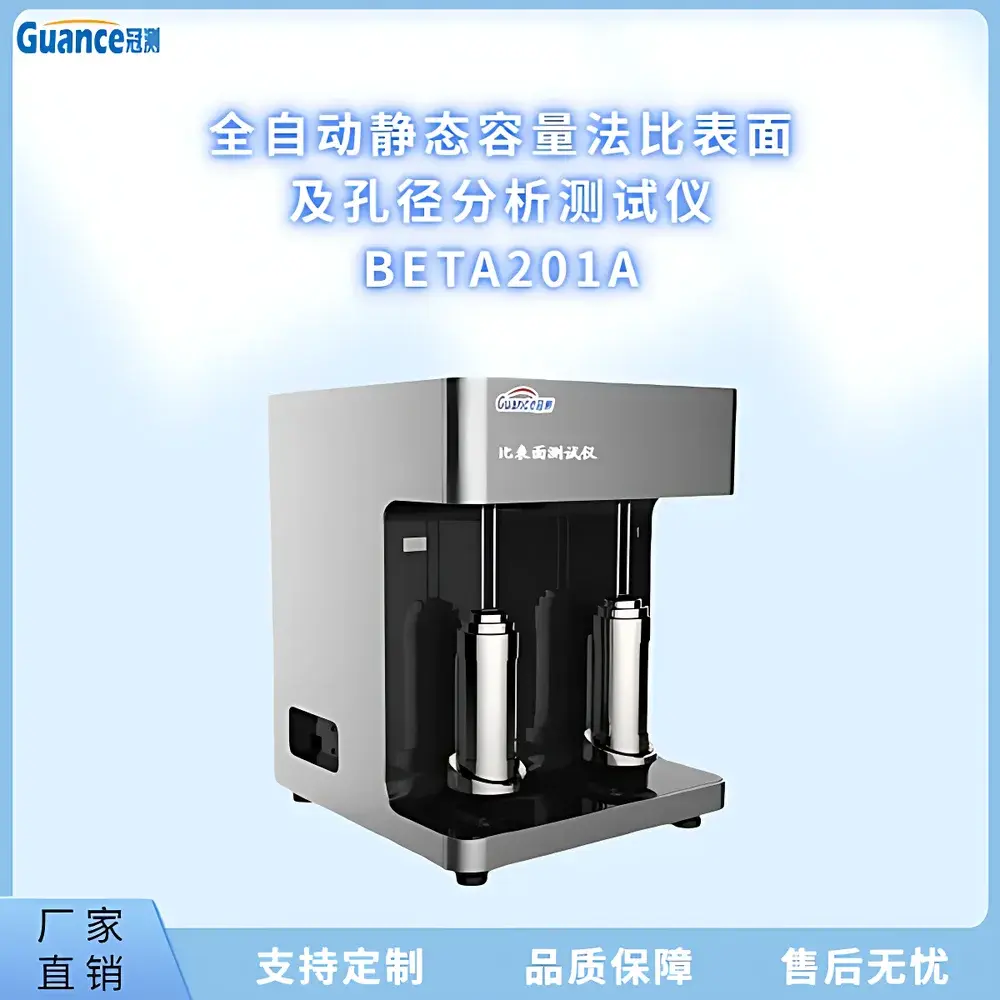
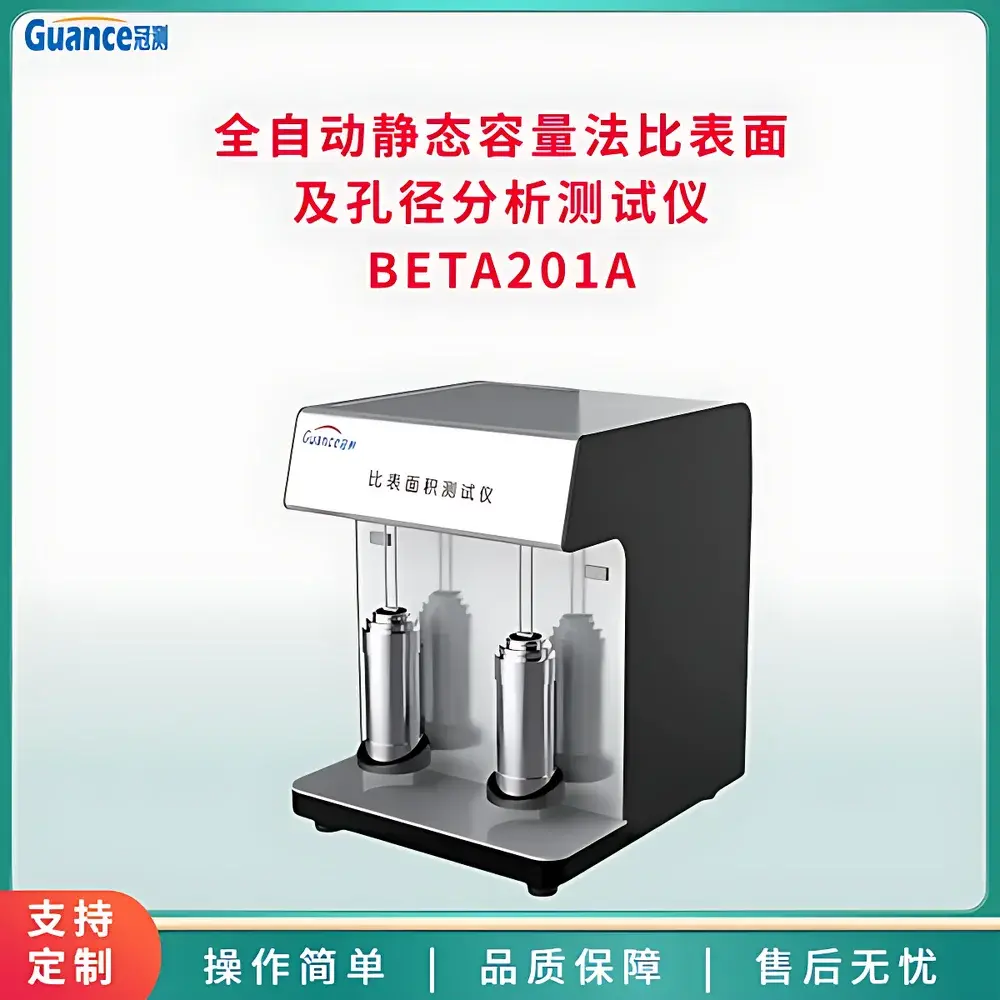
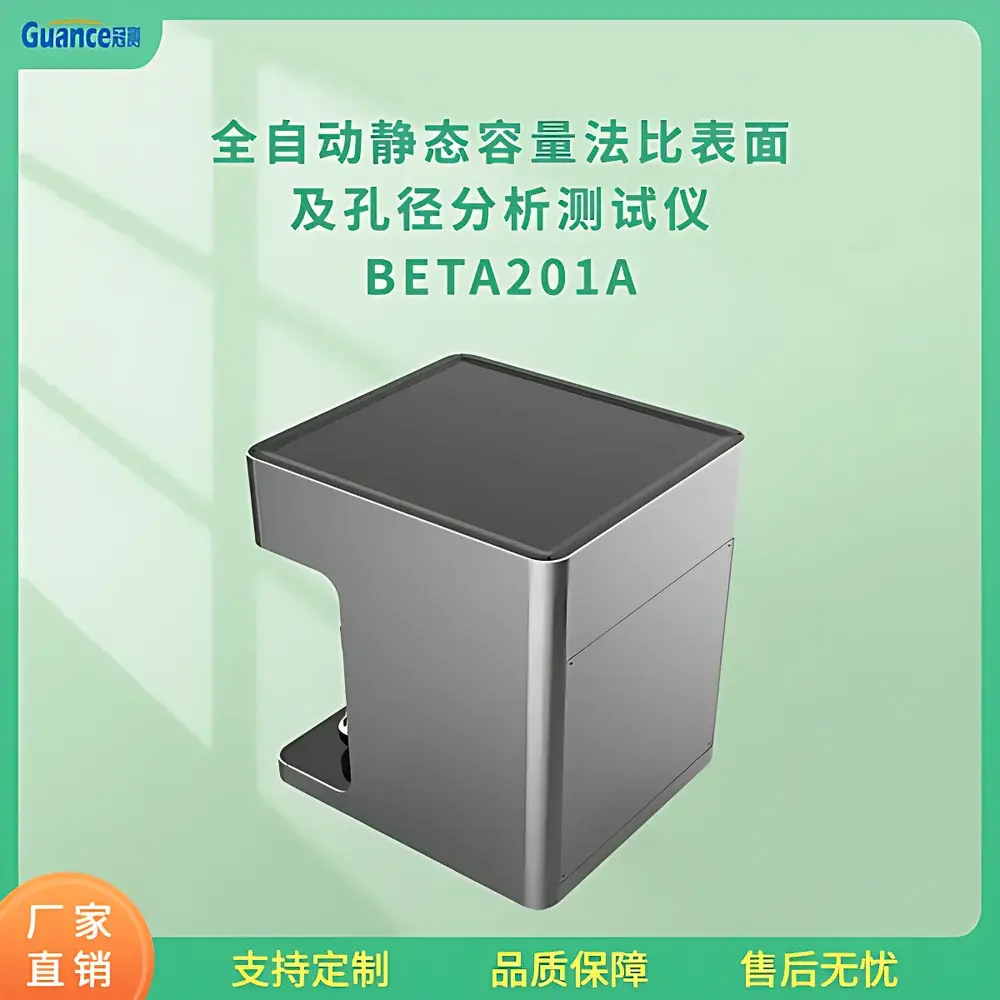
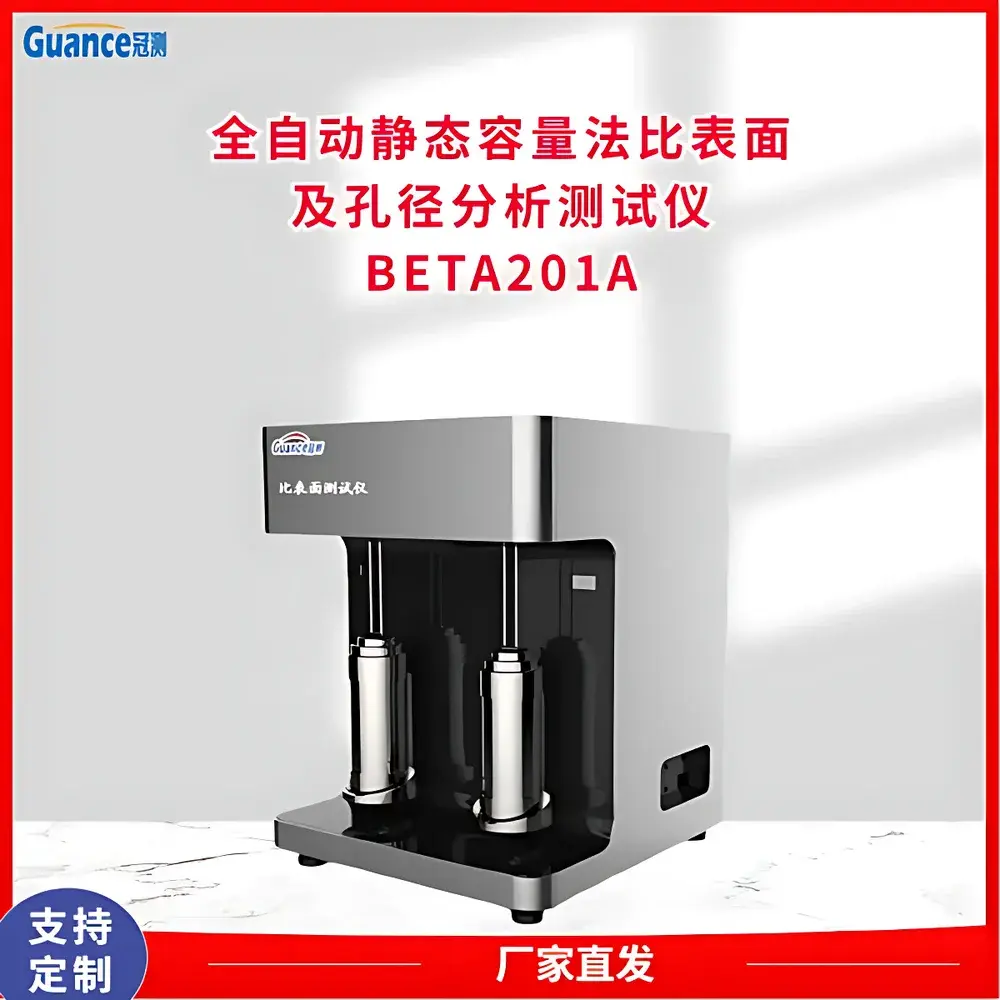
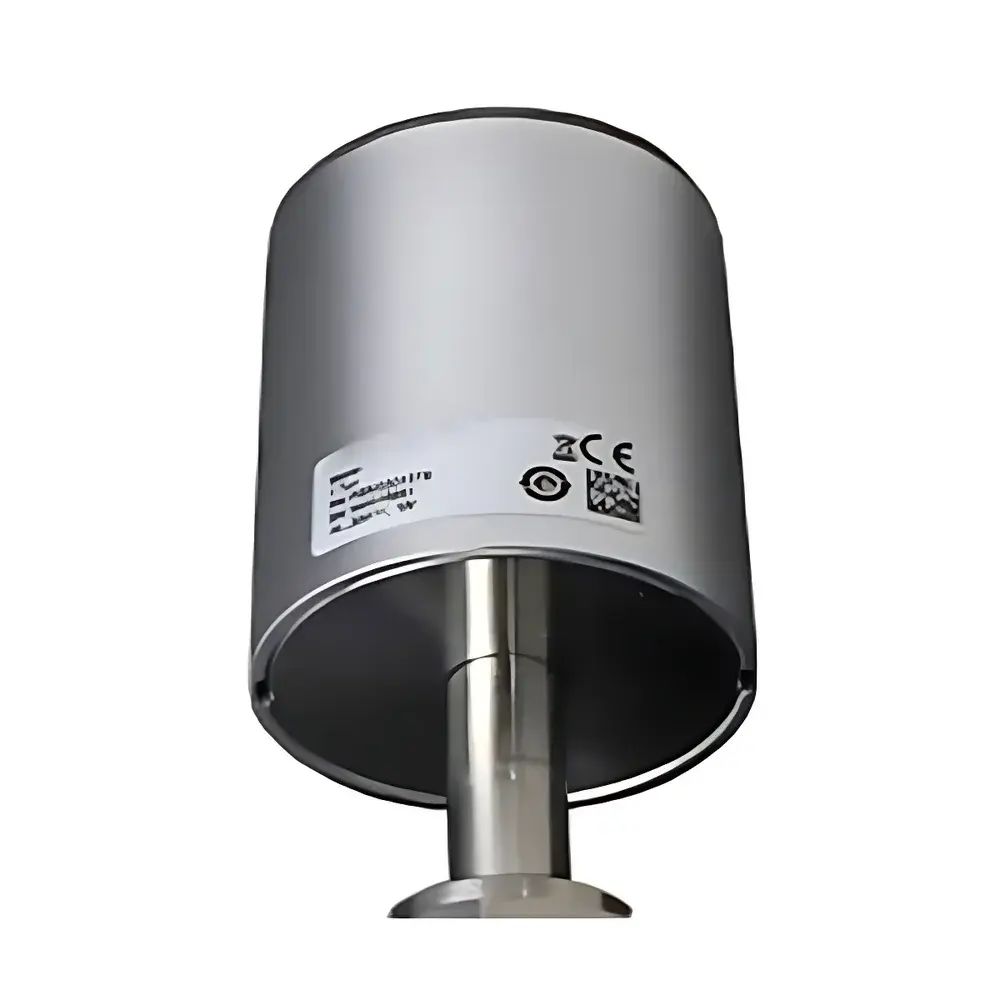
GuanCe Instruments BETA201A Multi-Point BET Specific Surface Area and Pore Size Analyzer
| Brand | GuanCe Instruments |
|---|---|
| Origin | Beijing, China |
| Manufacturer Type | Authorized Distributor |
| Product Category | Domestic |
| Model | BETA201A |
| Instrument Type | Specific Surface Area and Pore Size Analyzer |
| Measurement Principle | Static Volumetric Method (BET & BJH) with Dynamic Preconditioning Capability |
| Analysis Stations | 1 |
| Surface Area Range | 0.0001 m²/g (Kr adsorption) to unlimited |
| Pressure Range | 0–133 kPa (0–1000 Torr) |
| P/P₀ Resolution | Up to 0.9995 |
| Vacuum Level | ≤1×10⁻⁸ Torr (with optional molecular pump) |
| Repeatability | <±1% (standard N₂ adsorption on certified reference materials) |
| Adsorption Gases | N₂, Ar, Kr, CO₂, NH₃, H₂, CO, O₂, CH₄, C₄H₁₀ (non-corrosive only) |
| Analysis Time | ~25 min per surface area measurement |
| Cryogen Capacity | 70 h continuous operation with standard 3.5 L liquid nitrogen Dewar |
| Isothermal Jacket | Integrated liquid nitrogen isothermal sleeve for thermal stability |
| Data Acquisition | 24-bit ADC |
| Compliance | Designed for GLP-compliant labs |
Overview
The GuanCe Instruments BETA201A is a fully automated, single-station specific surface area and pore size analyzer engineered for precision gas sorption measurements based on the static volumetric principle. It implements the Brunauer–Emmett–Teller (BET) theory for specific surface area determination and the Barrett–Joyner–Halenda (BJH), Dollimore–Heal (DH), and Horvath–Kawazoe (HK) models for mesopore and micropore size distribution analysis. The system operates under ultra-high vacuum conditions (≤1×10⁻⁸ Torr, achievable with optional molecular pumping), enabling accurate characterization of low-surface-area materials—including battery cathode/anode powders, activated carbons, zeolites, metal–organic frameworks (MOFs), catalysts, pharmaceutical excipients, and geological samples—down to 0.0001 m²/g using krypton adsorption at 77 K. Its dual-transducer architecture—one dedicated exclusively to real-time P₀ monitoring—ensures thermodynamic consistency across isotherm acquisition, while integrated isothermal control via a liquid nitrogen sleeve maintains temperature stability within ±0.1 K over extended runs.
Key Features
- Ultra-high vacuum system featuring all-stainless-steel fluidic pathways, metal-sealed joints, silver-plated internal surfaces, and dual-layer vacuum shielding to minimize outgassing and thermal drift.
- Intelligent vacuum management: automatic pump cycling reduces operational noise, extends pump service life, and eliminates unnecessary power consumption during stable equilibration phases.
- Fail-safe operational architecture: auto-recovery from power interruption preserves raw isotherm data and resumes desorption/adsorption sequences without recalibration; emergency venting prevents sample loss or tube rupture.
- Dedicated P₀ reference tube with independent transducer ensures absolute pressure accuracy across the full range (0–10 Torr and 0–1000 Torr), critical for reliable relative pressure (P/P₀) calculation up to 0.9995.
- Integrated heating/de-gassing station co-located with analysis position—eliminating sample transfer contamination and enabling in-situ thermal treatment under controlled vacuum prior to analysis.
- Multi-gas compatibility: supports N₂, Ar, Kr, CO₂, NH₃, H₂, CO, O₂, CH₄, and C₄H₁₀ (non-corrosive only); Kr mode enables sub-0.1 m²/g surface area quantification without helium dependency.
- Fully remote-controllable via Ethernet interface: enables centralized fleet management, remote diagnostics, and multi-instrument synchronization through standard network infrastructure.
Sample Compatibility & Compliance
The BETA201A accommodates powdered, granular, fibrous, and monolithic specimens—including cementitious materials, graphene derivatives, MOFs, soil aggregates, polymer membranes, and pharmaceutical tablets—within standardized 6–12 mm OD sample tubes. Its modular design supports optional high-vacuum upgrades (e.g., turbomolecular pumping) for ultra-microporous material analysis requiring P/P₀ < 10⁻⁷. The instrument meets essential engineering benchmarks for regulated environments: vacuum integrity complies with ASTM D3663 and ISO 9277 for BET surface area; pressure transducer calibration traceable to NIST standards; data handling architecture compatible with 21 CFR Part 11 when deployed with electronic signature-enabled software and audit-trail configuration. All safety circuits—including overpressure, overcurrent, short-circuit, ground-fault, and software-initiated interlock protection—are independently certified to IEC 61010-1.
Software & Data Management
The proprietary GuanCe SorptionSuite™ software provides bilingual (English/Chinese) GUI, configurable test protocols, and hierarchical user access control. It stores >50 pre-validated analysis templates aligned with ISO 15901, ASTM D4641, and USP , and allows creation of custom isotherm acquisition sequences—including stepped P/P₀ targeting, variable equilibration timeouts, and multi-cycle degas profiles. Raw pressure vs. time datasets are archived with full metadata (temperature, gas purity, calibration history, operator ID). Export options include PDF reports with embedded isotherms and PSD curves, Excel-compatible .csv files, and cross-sample comparative overlays. Audit trails record all parameter modifications, run initiations, and data exports—supporting GLP/GMP documentation workflows. Optional cloud-sync module enables secure off-site backup and collaborative review across distributed R&D teams.
Applications
The BETA201A serves core characterization needs across advanced materials development, quality control, and academic research. In energy storage, it quantifies electrode-specific surface area and pore tortuosity in Li-ion and solid-state battery components. For catalysis, it resolves active site dispersion in supported metal nanoparticles and acidity-driven pore narrowing in sulfated zirconia. In pharma, it monitors crystallinity shifts and excipient surface hydration during lyophilization. Environmental labs use it to assess contaminant adsorption capacity of biochars and clay minerals. Its Kr-mode capability makes it indispensable for certifying low-area reference materials (e.g., fused silica, borosilicate glass) and validating SEM/TEM surface estimates. Routine QC applications include batch-to-batch consistency checks for carbon black, fumed silica, and precipitated calcium carbonate.
FAQ
Does the BETA201A require helium for free space calibration?
No. It employs an optimized, helium-free calibration protocol using nitrogen or argon, eliminating supply chain dependencies and operational cost overhead.
Can the system perform simultaneous P₀ and sample measurements?
Yes. Dual independent capacitance manometers enable concurrent, drift-compensated P₀ tracking and sample uptake quantification—critical for high-accuracy isotherm construction.
Is remote firmware update supported?
Yes. Over-the-air updates are delivered via encrypted HTTPS channel and applied during scheduled maintenance windows without interrupting active analyses.
What is the minimum detectable pore volume?
0.0001 cm³/g (measured via N₂ adsorption at 77 K, with optional high-vacuum configuration).
How does the instrument prevent contamination during sample transfer?
By integrating degassing and analysis in a single, sealed chamber—eliminating manual handling and atmospheric exposure between preconditioning and measurement steps.



