
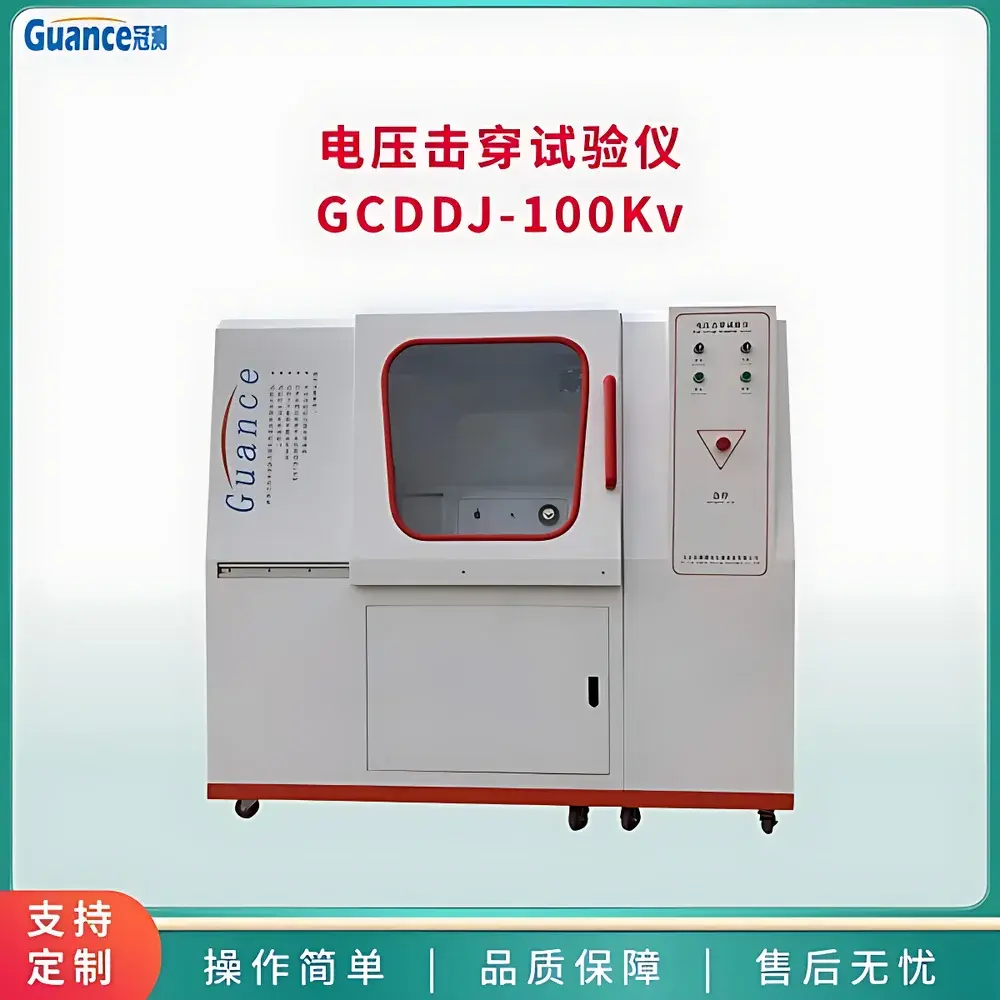
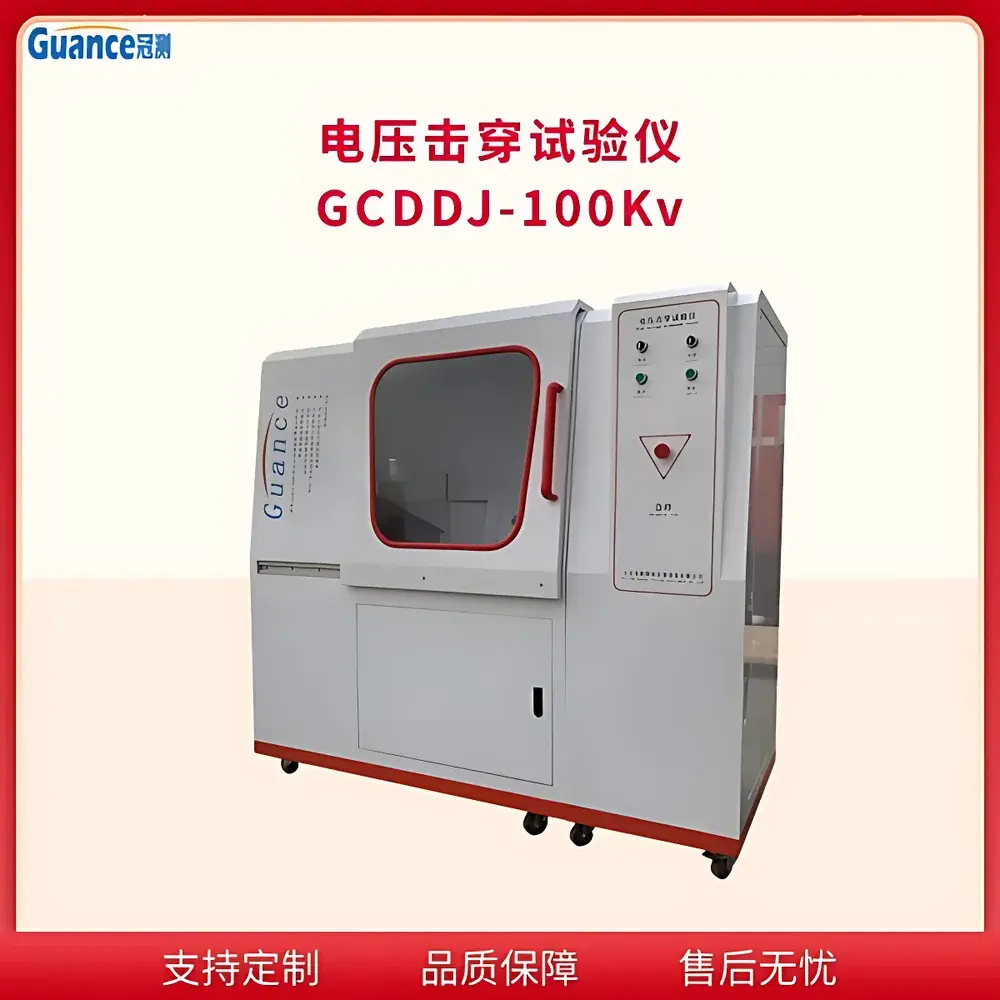
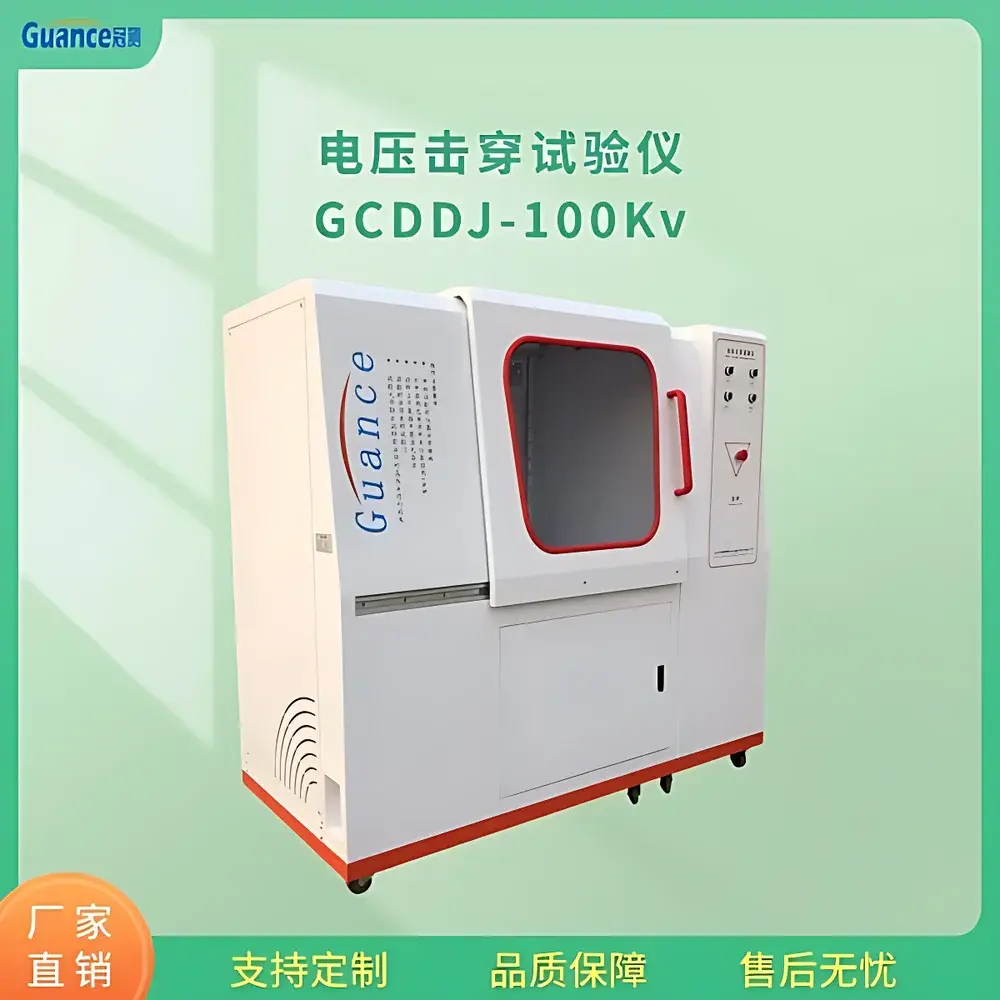
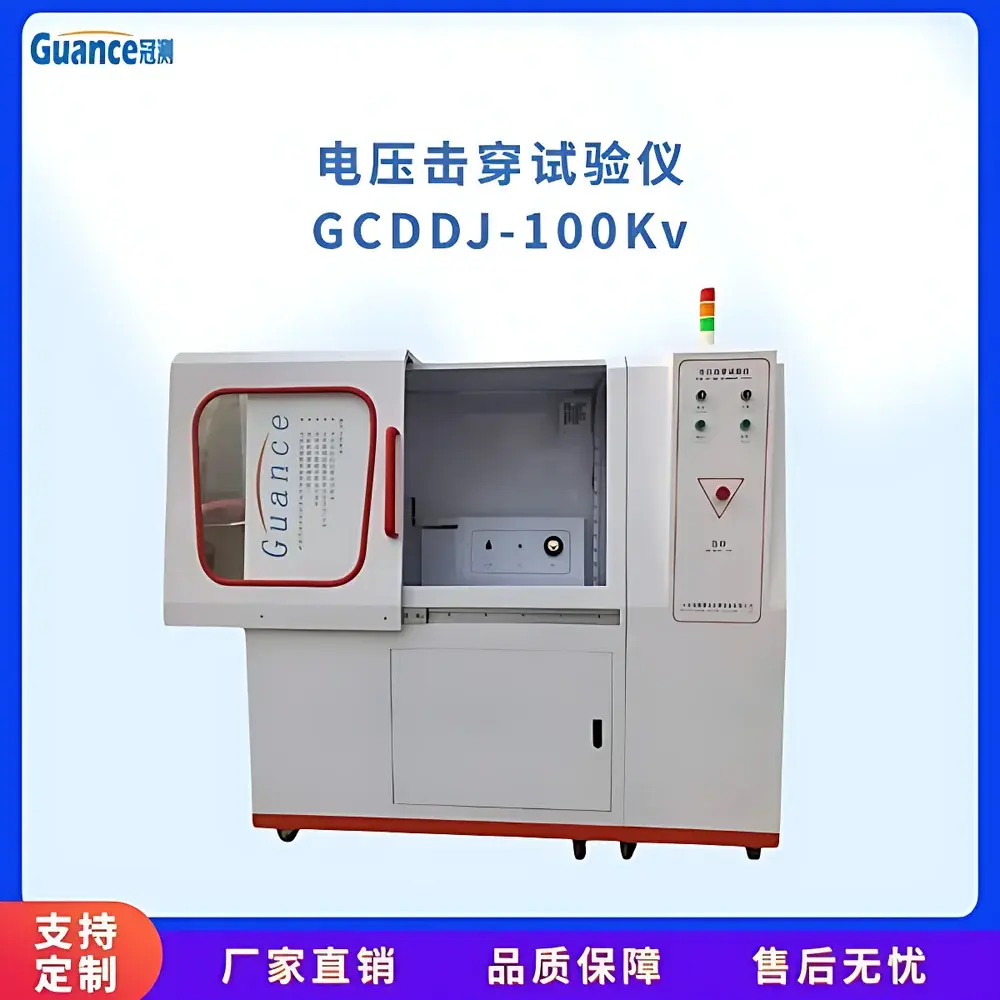
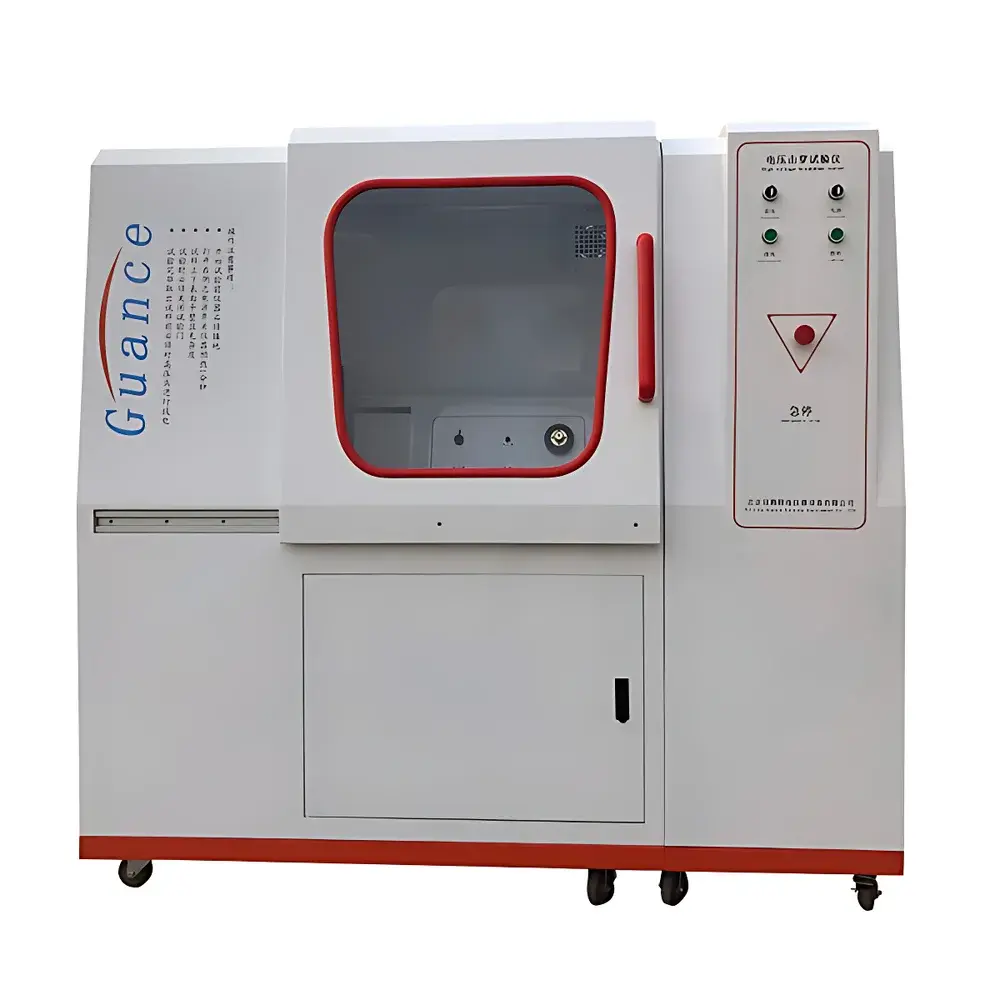
GuanCe Instruments GCDDJ-100kV1 Film Voltage Breakdown Tester
| Brand | GuanCe Instruments |
|---|---|
| Origin | Beijing, China |
| Manufacturer Type | Authorized Distributor |
| Country of Origin | China |
| Model | GCDDJ-100kV1 |
| Breakdown Voltage Range | 0–100 kV AC/DC |
| Electrical Capacity | 5 kVA |
| Input Voltage | AC 220 V / 50 Hz |
| Voltage Accuracy | ≤ ±1.5% |
| Rise Rate Adjustment | 0.1–5 kV/s (stepless, user-configurable) |
| Test Modes | Dielectric Strength (AC/DC), Withstand Voltage, Stepwise Ramp |
| Detection Method | Dual-threshold voltage & leakage current triggering |
| Leakage Current Range | 0–100 mA |
| Voltage Sensor Range | 0–100 V (scaled to 100 kV) |
| Electrode Options | φ25 mm (×2), φ75 mm (×1), custom electrodes available |
| Test Medium | Air, insulating oil (standard oil bath: 300 × 150 × 200 mm), optional high-temperature chamber |
| Safety Protections | Overvoltage, overcurrent, short-circuit, and ground-fault protection |
| Data Acquisition | Optically isolated digital I/O via Siemens PLC |
| Software Platform | Windows-based GUI with ASTM/IEC-compliant reporting engine |
| Dimensions (W × D × H) | 1500 × 850 × 1700 mm |
| Test Chamber Internal Dimensions | 750 × 600 × 800 mm |
| Observation Window | 550 × 600 mm tempered glass |
| Weight | ~250 kg |
Overview
The GuanCe Instruments GCDDJ-100kV1 Film Voltage Breakdown Tester is a precision-engineered high-voltage dielectric strength testing system designed for quantitative evaluation of electrical insulation performance in solid polymeric and ceramic materials. Operating on the principle of controlled voltage ramping under standardized electrostatic stress conditions, the instrument measures the critical electric field intensity at which dielectric failure—manifested as irreversible conduction path formation—occurs across a defined electrode geometry. It complies with core international test standards including ASTM D149 (Standard Test Method for Dielectric Breakdown Voltage of Solid Electrical Insulating Materials at Commercial Power Frequencies), IEC 60243-1 (Electrical Strength of Insulating Materials – Part 1: Tests at Power Frequencies), and GB/T 1408.1 (Chinese national standard equivalent). The system integrates a Siemens S7-series PLC-based control architecture with optically isolated analog signal acquisition, ensuring electromagnetic compatibility (EMC) robustness in industrial laboratory environments where variable-frequency drives or RF sources may be present.
Key Features
- Full AC/DC dual-mode operation up to 100 kV output with programmable rise rates from 0.1 to 5 kV/s—enabling compliance with both rapid breakdown and slow-ramp withstand protocols.
- Dual-trigger fault detection: simultaneous monitoring of voltage collapse and leakage current surge (0–100 mA range) ensures unambiguous event classification per IEC 60270 partial discharge criteria.
- Modular high-voltage generation subsystem featuring oil-immersed transformer core, EMI-suppressed cabling, and active corona shielding to minimize stray capacitance and measurement drift.
- Interlocked safety architecture: pneumatic door actuation, multi-point grounding verification, automatic post-test discharge (<5 s), and tower-light status indication conform to EN 61010-1 safety requirements for laboratory equipment.
- Configurable electrode station supporting standardized disk electrodes (φ25 mm × 2, φ75 mm × 1) and custom geometries for thin-film, laminated, or molded component testing.
- Integrated environmental management: built-in LED illumination, forced-air exhaust fan, and oil-bath reservoir with suspended sample holder facilitate reproducible conditioning and post-test handling.
Sample Compatibility & Compliance
The GCDDJ-100kV1 accommodates a broad spectrum of insulating solids—including thermoplastics (e.g., PET, PI, PTFE), elastomers (silicone rubber, EPDM), composites (GFRP, CFRP), ceramics (alumina, zirconia), glasses, varnishes, and layered assemblies—under ambient air, dielectric oil immersion (ASTM D877/D1816 compliant), or optional elevated-temperature conditions (up to 200 °C, with external furnace integration). All test configurations adhere to specimen thickness tolerances specified in ISO 2309 and UL 746A. The system’s optical isolation and PLC-controlled sequencing support GLP/GMP-aligned audit trails when paired with time-stamped data export and electronic signature-capable reporting modules.
Software & Data Management
Controlled via a native Windows application, the software provides real-time visualization of voltage ramp profiles and leakage current transients with ≥1 kHz sampling resolution. Users may define test sequences using ASTM D149 Mode A (short-time), Mode B (step-by-step), or Mode C (slow-rate), and configure pass/fail logic based on either voltage threshold (e.g., 80 kV hold for 60 s) or current excursion (>5 mA sustained for >100 ms). Export functionality includes CSV and Excel-compatible .xlsx formats, with metadata fields for operator ID, calibration certificate number, environmental logs (temperature/humidity), and instrument firmware version. Reports are structured to meet FDA 21 CFR Part 11 requirements for electronic records, including immutable timestamps, user authentication, and revision history tracking.
Applications
- Quality assurance of polymer films used in capacitors, battery separators, and flexible printed circuits.
- R&D validation of high-k dielectrics and nanocomposite insulation systems for EV traction inverters.
- Regulatory pre-certification testing for medical device housings (IEC 60601-1 Clause 8.8.3).
- Comparative aging studies of insulating materials exposed to thermal, UV, or humidity stress.
- Failure analysis of epoxy-encapsulated power modules and SiC-based power electronics packaging.
FAQ
What voltage accuracy does the GCDDJ-100kV1 achieve across its full range?
The system maintains ≤ ±1.5% reading accuracy referenced to full-scale 100 kV output, verified annually per ISO/IEC 17025-accredited calibration procedures using NIST-traceable high-voltage dividers.
Can the instrument perform stepwise withstand tests per IEC 60243-2?
Yes—software-defined step amplitude, dwell duration, and incremental voltage increments enable full implementation of IEC 60243-2 (impulse and step methods) and ASTM D3755 (polymer film withstand testing).
Is remote operation supported via Ethernet or industrial protocols?
The system supports Modbus TCP communication for SCADA-level integration and optional OPC UA gateway deployment, allowing centralized fleet monitoring in multi-station laboratories.
How is electrode alignment and gap consistency ensured during repeated testing?
Micrometer-adjustable vertical positioning, laser-sighted parallelism verification tools, and documented gap calibration routines (per ASTM D149 Annex A2) are provided with each delivery.
Does the software generate raw waveform files suitable for third-party spectral analysis?
Yes—binary .bin files containing synchronized voltage/current/time vectors are saved alongside summary reports, compatible with MATLAB, Python (NumPy), and LabVIEW for advanced transient characterization.



