
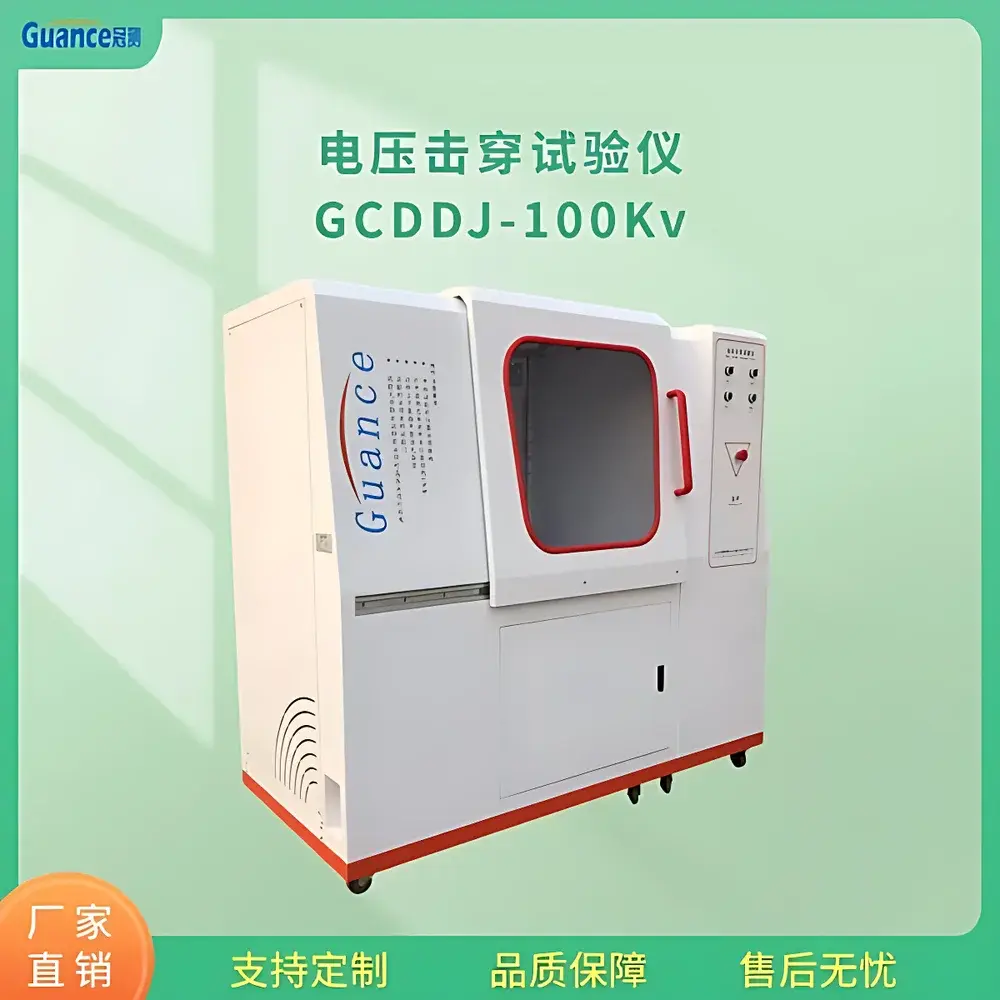
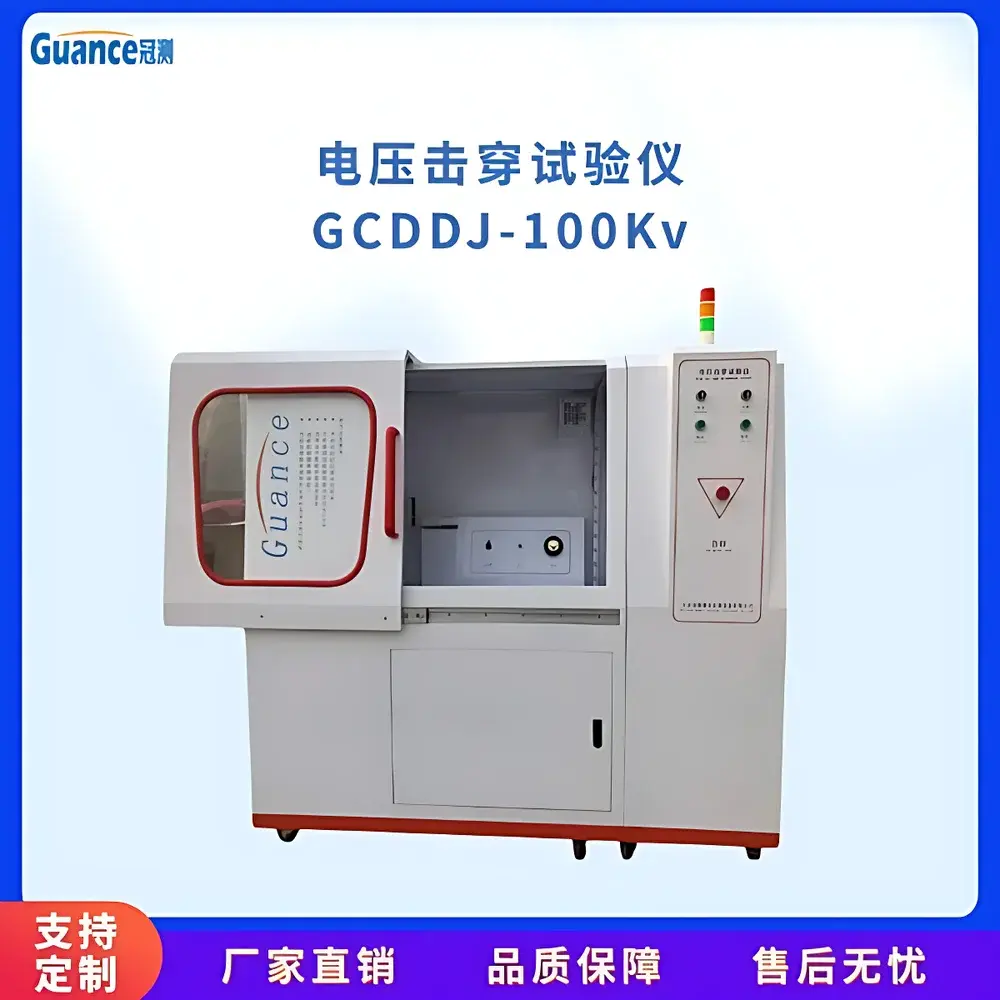
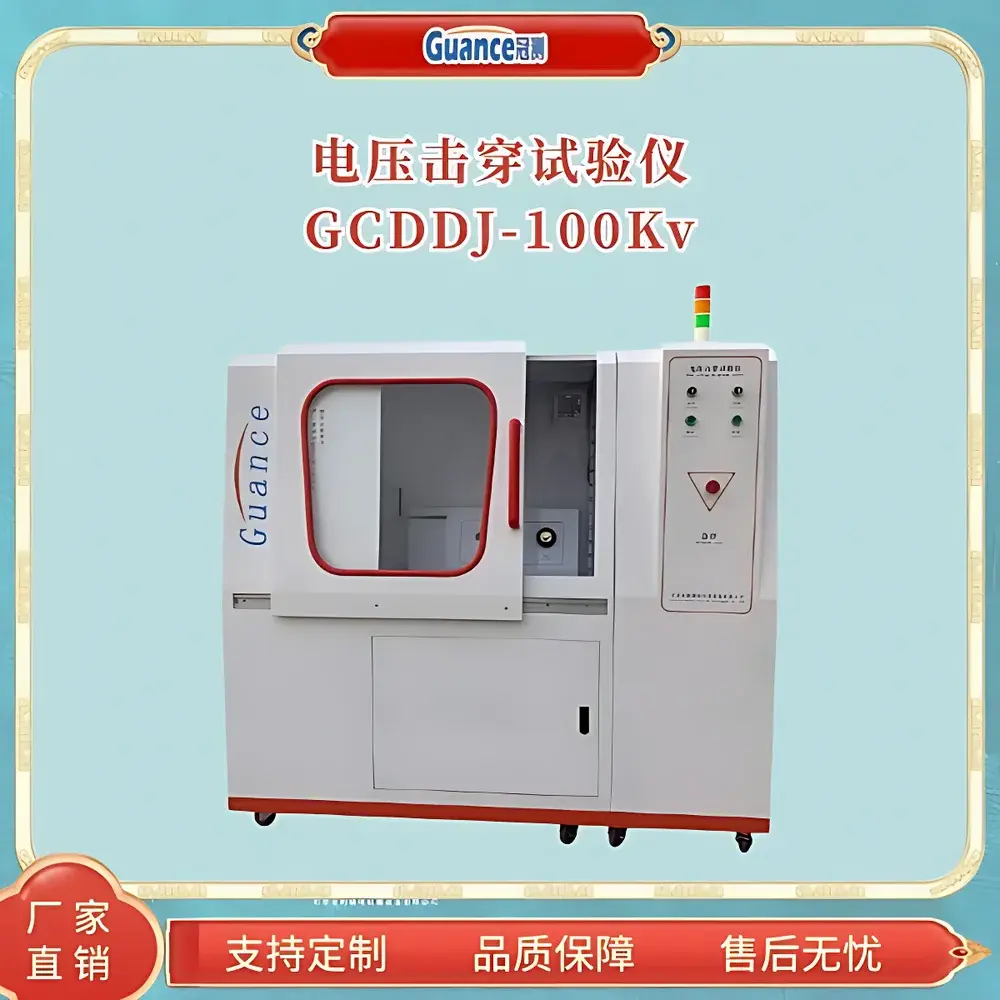
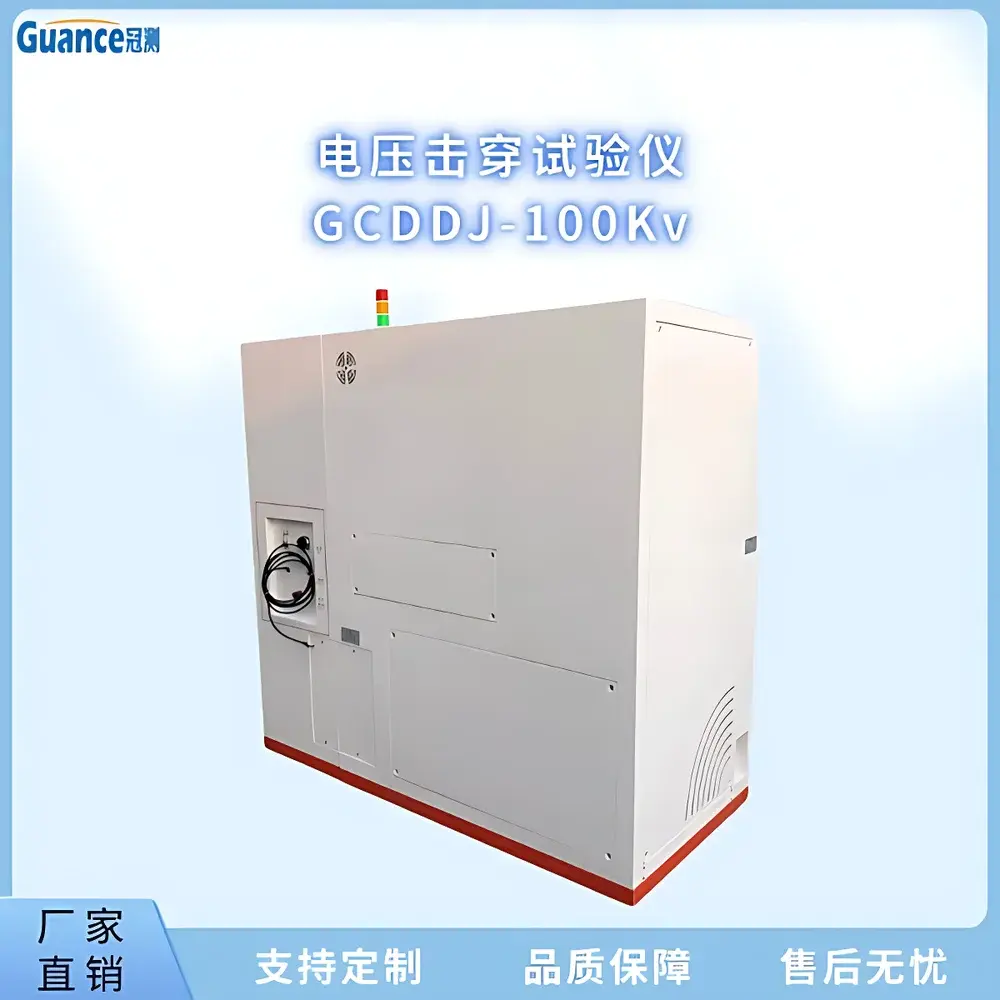
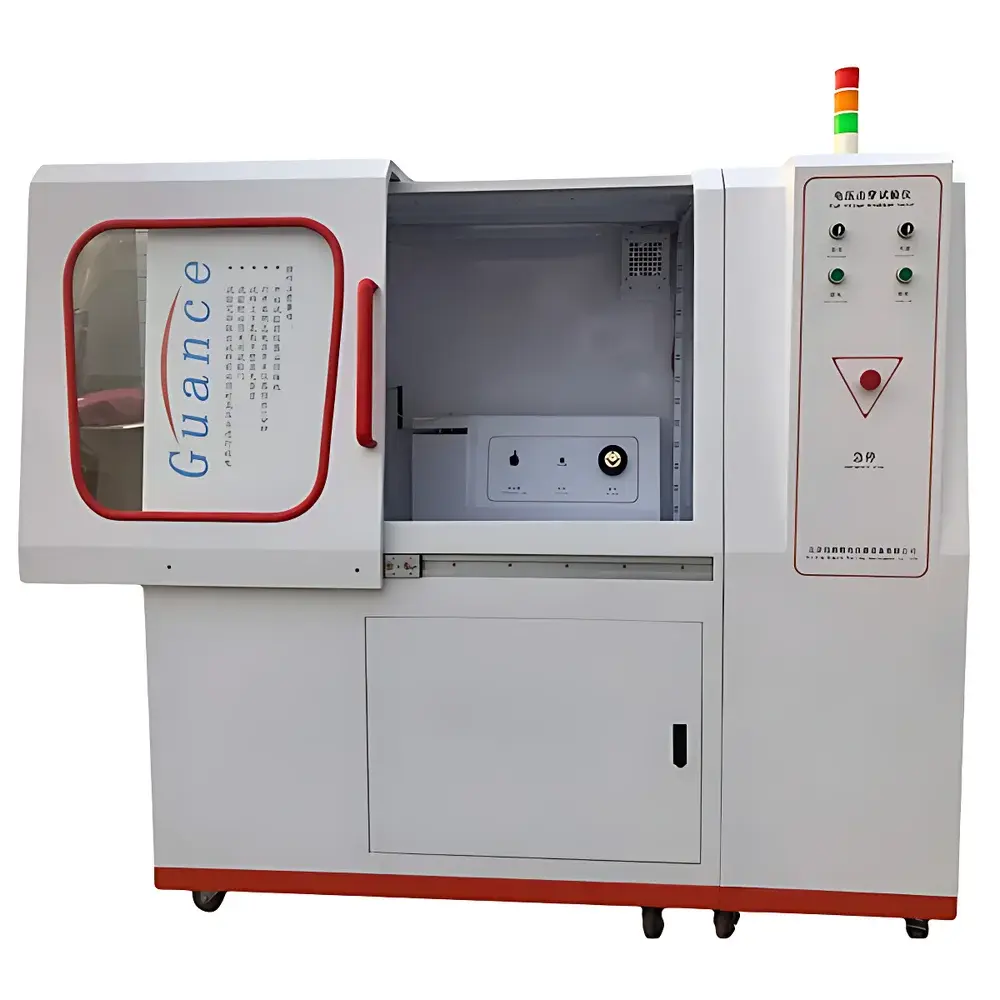
GuanCe Instruments GCDDJ-100kV4 Dielectric Strength Tester for Rubber and Plastic Insulating Materials
| Brand | GuanCe Instruments |
|---|---|
| Origin | Beijing, China |
| Manufacturer Type | Authorized Distributor |
| Country of Origin | China |
| Model | GCDDJ-100kV4 |
| Breakdown Voltage | 100 kV AC/DC |
| Electrical Capacity | 5 kVA |
| Input Voltage | AC 220 V / 50 Hz |
| Voltage Accuracy | ≤ ±1.5 % |
| Rise Rate Range | 0.1–5 kV/s (adjustable) |
| Leakage Current Range | 0–100 mA |
| Voltage Sensor Range | 0–100 V |
| Electrode Options | φ25 mm (×2), φ75 mm (×1), customizable |
| Test Chamber Dimensions | 750 × 600 × 800 mm |
| Overall Dimensions | 1500 × 850 × 1700 mm |
| Weight | ~250 kg |
| Safety Protections | Overvoltage, Overcurrent, Short-Circuit, Ground-Fault |
| Test Media | Air, Oil Bath (standard), High-Temperature Environment (optional) |
Overview
The GuanCe Instruments GCDDJ-100kV4 Dielectric Strength Tester is a precision-engineered high-voltage testing system designed for quantitative evaluation of the dielectric breakdown strength and voltage withstand capability of solid insulating materials under controlled AC or DC stress conditions. Operating on the principle of controlled voltage ramping until electrical failure occurs—defined as a rapid, irreversible increase in conduction current—the instrument complies with fundamental test methodologies outlined in ASTM D149, IEC 60243-1, GB/T 1408.1, and ISO 60243. It is widely deployed in R&D laboratories, quality control departments, and certification testing facilities evaluating polymers, elastomers, laminates, films, resins, ceramics, glass, varnishes, and molded insulating components. The system integrates a Siemens PLC-based real-time control architecture with optically isolated data acquisition to ensure signal integrity in electrically noisy industrial environments. Its dual-mode output (AC/DC up to 100 kV) and programmable rise rate (0.1–5 kV/s) enable strict adherence to standardized test protocols while supporting custom stress profiles for accelerated aging or comparative material screening.
Key Features
- Siemens S7-1200 PLC core controller with deterministic cycle time and integrated safety logic for repeatable test sequencing
- Optically isolated digital communication between PC host and measurement modules, eliminating ground-loop interference
- High-fidelity voltage and leakage current sensing via calibrated transducers (voltage accuracy ≤ ±1.5 %; current range 0–100 mA)
- Motor-driven variable-ratio autotransformer with mechanical zero-limit and upper-voltage cutoff for safe, stable voltage ramping
- Automated post-breakdown discharge circuit with <500 ms residual voltage decay to <5 % of peak test voltage
- Modular electrode configuration: standard stainless-steel disk electrodes (φ25 mm × 2, φ75 mm × 1); custom geometries available per ASTM D650 or user-defined specifications
- Integrated oil bath test chamber (300 × 150 × 200 mm) with suspended sample rack, internal LED illumination, and forced-air exhaust for thermal management
- Multi-level hardware interlocks including pneumatic door switch, overpressure cut-off, short-circuit detection, and earth-leakage monitoring compliant with IEC 61000-4-5 immunity requirements
- Real-time dual-channel oscillography: synchronized display of applied voltage and leakage current waveforms during test execution
Sample Compatibility & Compliance
The GCDDJ-100kV4 accommodates flat, rigid, or semi-flexible specimens conforming to standard thickness ranges (0.1–10 mm typical) and minimum lateral dimensions of 30 mm × 30 mm. Compatible material classes include thermoplastics (e.g., PE, PP, PVC), thermosets (epoxy, phenolic), elastomers (silicone, EPDM), composite laminates (GFRP, CFRP), ceramic substrates, and coated metallic foils. Testing may be performed in ambient air, transformer oil (ASTM D877-compliant), or optionally within a temperature-controlled chamber (−20 °C to +150 °C, external accessory). All operational firmware and software modules support audit-ready data handling per GLP and GMP principles. The system’s event logging—including timestamped operator ID, parameter set revision, environmental readings (temperature/humidity), and raw waveform capture—meets traceability requirements under FDA 21 CFR Part 11 when deployed with validated Windows OS configurations and electronic signature workflows.
Software & Data Management
Control and analysis are executed via a native Windows-based application built on .NET Framework 4.8, featuring a role-based access interface with configurable user permissions (Operator, Technician, Administrator). The software supports three primary test modes: (1) Dielectric Breakdown (voltage-ramp-to-failure), (2) Withstand Testing (fixed voltage hold for prescribed duration), and (3) Step-Stress Testing (incremental voltage stages with dwell periods). Each mode permits independent configuration of rise rate, hold time, pass/fail thresholds (voltage- or current-triggered), and electrode spacing. Real-time curve overlays are exportable in PNG/SVG formats; numerical results—including breakdown voltage (kV), normalized strength (kV/mm), time-to-failure (s), and peak leakage current (mA)—are stored in an encrypted SQLite database. Batch reporting allows cross-sample statistical analysis (mean, SD, CV%) and automated generation of PDF/Excel reports compliant with ISO/IEC 17025 documentation standards. Data export includes full metadata headers required for third-party LIMS integration.
Applications
- Quality assurance of polymer film insulation used in capacitors, cables, and flexible printed circuits
- Evaluation of dielectric performance degradation following thermal aging, UV exposure, or humidity cycling
- Comparative ranking of novel nanocomposite formulations (e.g., SiO₂-, Al₂O₃-, or BN-filled polymers)
- Validation of coating integrity on medical device substrates per ISO 10993-1 biocompatibility testing guidelines
- Supporting UL 746C recognition of polymeric materials for electrical equipment enclosures
- Research into partial discharge inception characteristics in low-permittivity elastomeric systems
- Verification of batch-to-batch consistency in high-purity silicone rubber gaskets for HV switchgear
FAQ
What international standards does this tester support?
It enables execution of test procedures aligned with ASTM D149, IEC 60243-1, GB/T 1408.1, ISO 60243, and UL 746C. Full compliance requires proper electrode geometry, conditioning environment, and specimen preparation per each standard’s annexes.
Can the system perform both AC and DC breakdown tests?
Yes—the high-voltage generator delivers sinusoidal 50 Hz AC or ripple-free DC up to 100 kV, with independent calibration certificates available for each mode.
Is high-temperature testing included as standard?
No—high-temperature capability (up to +150 °C) is an optional add-on requiring a separately validated environmental chamber and thermally rated electrodes.
How is data integrity ensured during long-duration withstand tests?
All analog signals are sampled at ≥10 kHz, buffered in non-volatile memory, and written to disk with CRC-32 checksum verification. Power-loss recovery preserves last-known state and resumes logging upon reboot.
Are custom electrode configurations supported?
Yes—GuanCe provides engineering consultation and CNC fabrication for non-standard electrode shapes (e.g., needle-plane, rod-plane, or multi-point arrays) per customer-specified drawings and dimensional tolerances.



