


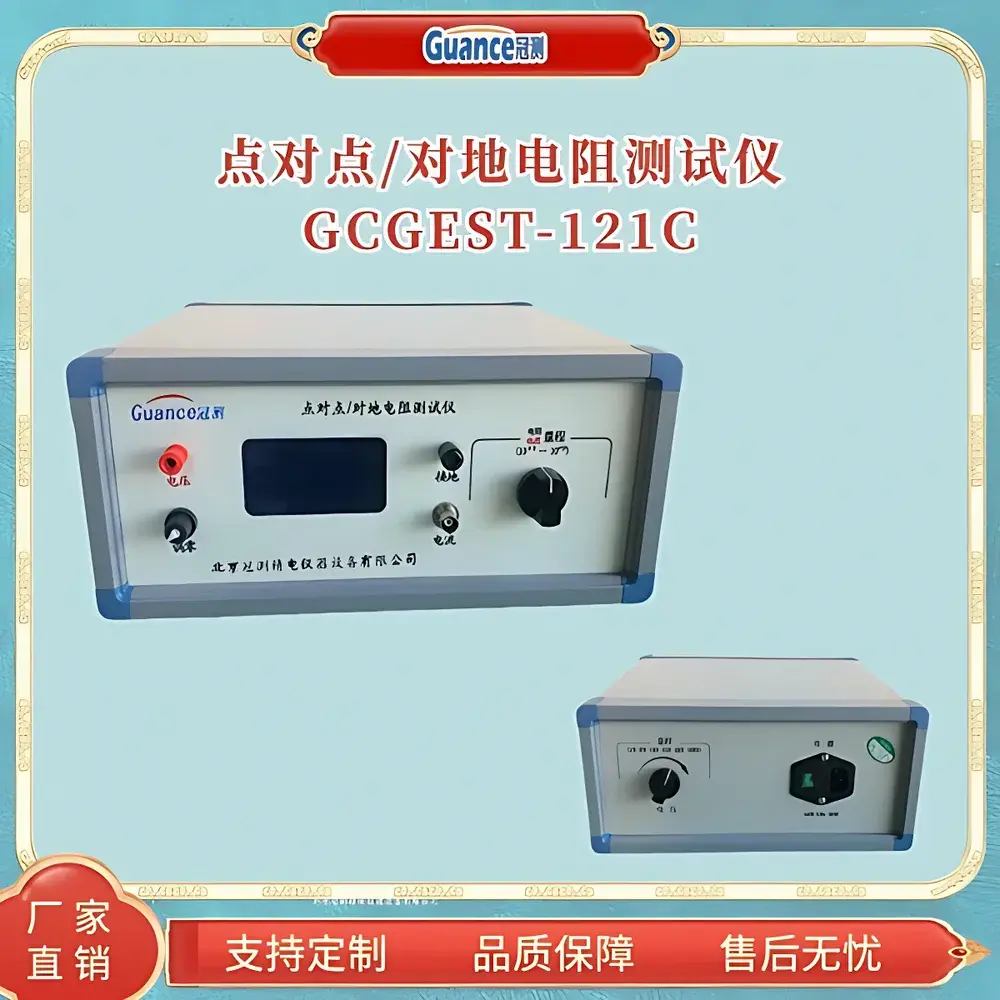

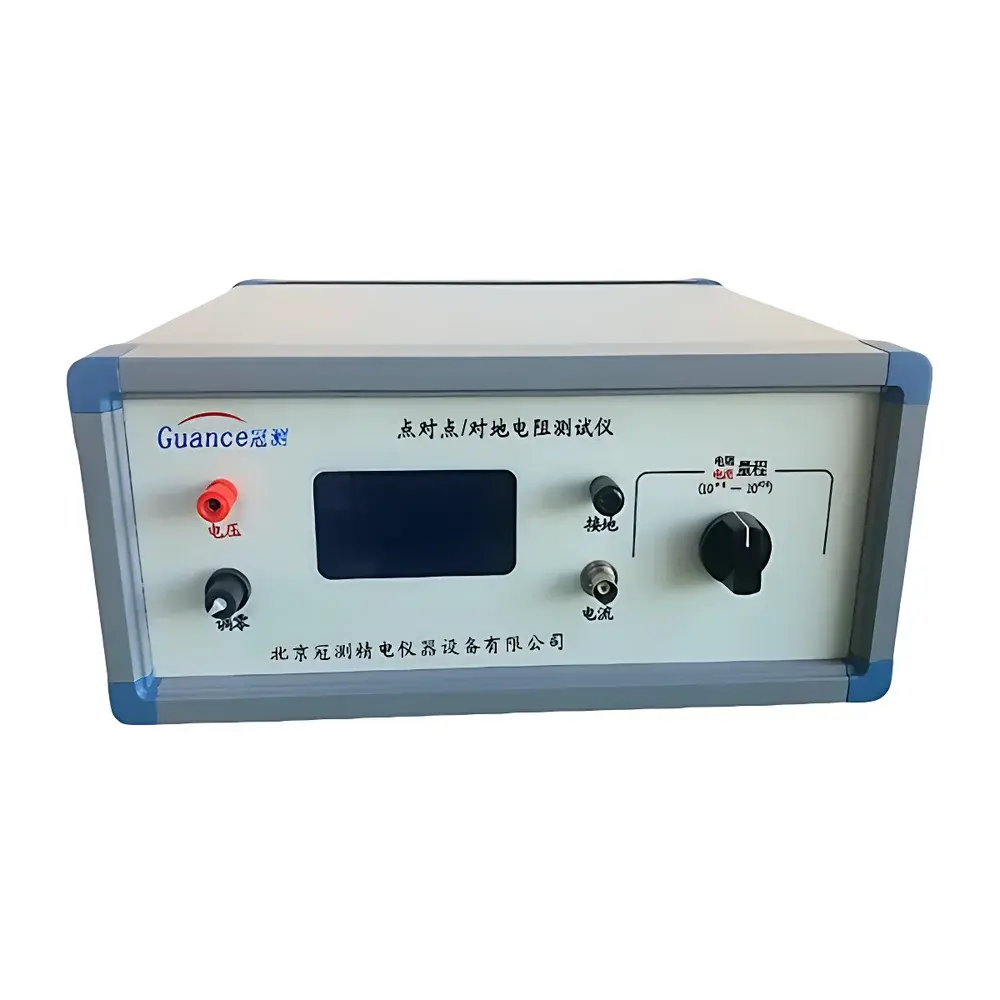
GuanCe Instruments GCGEST-121C Point-to-Point & Ground Resistance Tester for Electrostatic Dissipative Flooring Materials
| Brand | GuanCe Instruments |
|---|---|
| Origin | Beijing, China |
| Manufacturer Type | Authorized Distributor |
| Country of Origin | China |
| Model | GCGEST-121C |
| Test Voltage Range | 10 V, 50 V, 100 V, 250 V, 500 V, 1000 V |
| Resistance Measurement Range | 1×10⁴ Ω to 1×10¹⁸ Ω |
| Current Measurement Range | 2×10⁻⁴ A to 1×10⁻¹⁶ A |
| Measurement Accuracy | ±1% (≤1×10¹⁰ Ω), ±5–10% (>1×10¹⁰ Ω) |
| Display | Dual-line LCD showing simultaneous voltage, resistance, and current values |
| Power Supply | 220 V AC / 50 Hz |
| Power Consumption | 100 W |
| Dimensions (L×W×H) | 300 mm × 300 mm × 150 mm |
| Weight | ~5 kg |
| Standard Electrode | 63 mm diameter, 2.5 kg mass |
| Safety Feature | Interlocked shielded enclosure with automatic high-voltage cutoff upon lid opening |
| Compliance | SJ/T 11294–2018 (Annex A – Electrostatic Performance Test Methods for Antistatic Floor Coatings) |
Overview
The GuanCe Instruments GCGEST-121C is a precision-engineered point-to-point and ground resistance tester specifically designed for evaluating the electrostatic dissipation performance of conductive and antistatic floor coatings used in cleanrooms, electronics manufacturing facilities, pharmaceutical production suites, and ESD-sensitive laboratories. Unlike conventional high-resistance meters relying on fixed-voltage analog measurement principles, the GCGEST-121C implements a true four-terminal, dual-parameter digital measurement architecture: it simultaneously acquires both the applied test voltage (V) and the resulting current (I) across the sample, then computes resistance (R = V/I) via high-stability analog-to-digital conversion and embedded microprocessor arithmetic. This real-time calculation eliminates nonlinearity inherent in traditional moving-coil or logarithmic-scale instruments, enabling linear, direct-reading resistance values across its full 1×10⁴ Ω to 1×10¹⁸ Ω range — from low-conductivity dissipative materials to ultra-high-resistance insulative substrates.
Key Features
- Wide dynamic resistance range: Covers 14 decades (10⁴–10¹⁸ Ω), supporting evaluation of conductive (1×10⁹ Ω) flooring systems per ANSI/ESD S20.20 and IEC 61340-4-1 requirements.
- Multi-level programmable test voltages: Six discrete DC output levels (10 V, 50 V, 100 V, 250 V, 500 V, 1000 V) allow compliance with material-specific test protocols — e.g., 10 V for sensitive polymer coatings, 100 V for standard epoxy systems, and 500–1000 V for qualification of grounding integrity under worst-case conditions.
- Simultaneous triple-parameter display: Real-time digital readout of applied voltage, measured current, and calculated resistance eliminates manual interpretation or scaling errors associated with legacy analog meters.
- Integrated safety interlock system: The shielded test chamber automatically de-energizes all high-voltage circuits when the access lid is opened, meeting IEC 61010-1 Class II electrical safety requirements for laboratory instrumentation.
- Stable, low-drift measurement architecture: Precision voltage reference and guarded current sensing circuitry minimize thermal drift and electromagnetic interference, ensuring repeatability better than ±0.5% over 8-hour continuous operation at ambient temperatures (23 ± 2 °C).
Sample Compatibility & Compliance
The GCGEST-121C is optimized for standardized testing of cured floor coating specimens per SJ/T 11294–2018 Annex A, which defines electrode geometry, pressure application (2.5 kg standard electrode), dwell time (60 s minimum), and environmental conditioning (23 °C ± 2 °C, 50% RH ± 5%). Its 63 mm diameter stainless-steel electrode conforms to IEC 61340-2-3 and ASTM F150 specifications for surface resistivity measurement. The instrument supports both point-to-point (Rtt) and point-to-ground (Rtg) configurations using optional auxiliary grounding rods and banana-jack adapters. Data generated is suitable for inclusion in GLP-compliant validation reports and satisfies documentation requirements for ISO 9001:2015 Clause 7.1.5 (monitoring and measuring resources) and ISO 14644-1 cleanroom certification audits.
Software & Data Management
While the GCGEST-121C operates as a standalone benchtop instrument with no built-in data logging, its analog output port (0–5 V proportional to log10(R)) enables integration with external DAQ systems or SCADA platforms for automated batch reporting. All measurements adhere to traceable metrology practices: internal calibration constants are stored in non-volatile memory and can be verified using NIST-traceable resistance standards (e.g., Keysight B2900 series or IET Labs SR104). For regulated environments, users may implement manual audit trails per FDA 21 CFR Part 11 by recording instrument ID, operator name, test voltage, electrode configuration, environmental conditions, and raw R/V/I values in controlled laboratory notebooks or validated LIMS templates.
Applications
- Qualification and routine QC of epoxy, polyurethane, and vinyl-based antistatic floor coatings during production and installation.
- Verification of grounding continuity and system resistance in ESD-protected areas (EPAs) per ANSI/ESD S6.1 and IEC 61340-5-1.
- Failure analysis of flooring systems exhibiting inconsistent static decay or unexpected charge retention.
- Supporting ISO 14644-1 classification audits where floor resistivity must remain within specified limits (e.g., 1×10⁵–1×10⁹ Ω for Class 5 cleanrooms).
- Evaluation of aging effects on conductive filler dispersion in carbon-loaded polymer matrices under accelerated thermal/humidity cycling.
FAQ
Does the GCGEST-121C comply with international ESD standards such as ANSI/ESD S20.20 or IEC 61340?
Yes — while calibrated and validated per Chinese national standard SJ/T 11294–2018, its measurement methodology, electrode design, and test voltage options align fully with the technical requirements of ANSI/ESD S20.20 Annex B and IEC 61340-4-1 for surface and volume resistivity assessment.
Can this instrument measure human-body voltage or footwear-to-floor resistance?
No — the GCGEST-121C is configured exclusively for material-level resistance measurements using fixed electrodes. Human-system testing requires dedicated ESD simulators (e.g., wrist strap testers or walking test platforms) compliant with ANSI/ESD STM97.1/STM97.2.
Is external calibration required, and how often should it be performed?
Annual calibration against certified resistance standards is recommended for ISO/IEC 17025-accredited labs; in non-accredited settings, verification before each test session using a known reference resistor (e.g., 1×10⁹ Ω ±1%) is considered good practice.
What environmental conditions affect measurement accuracy?
Relative humidity below 30% RH or above 70% RH may induce surface conduction artifacts; temperature deviations >±2 °C from 23 °C require correction per SJ/T 11294–2018 Annex A. Always condition samples for ≥24 h at 23 °C/50% RH prior to testing.
Is the instrument suitable for field use in production facilities?
Its compact footprint (300 × 300 × 150 mm), lightweight chassis (~5 kg), and 220 V AC input make it portable for on-site verification; however, stable power supply and EMI-free environment are mandatory for sub-picoampere current resolution.



