
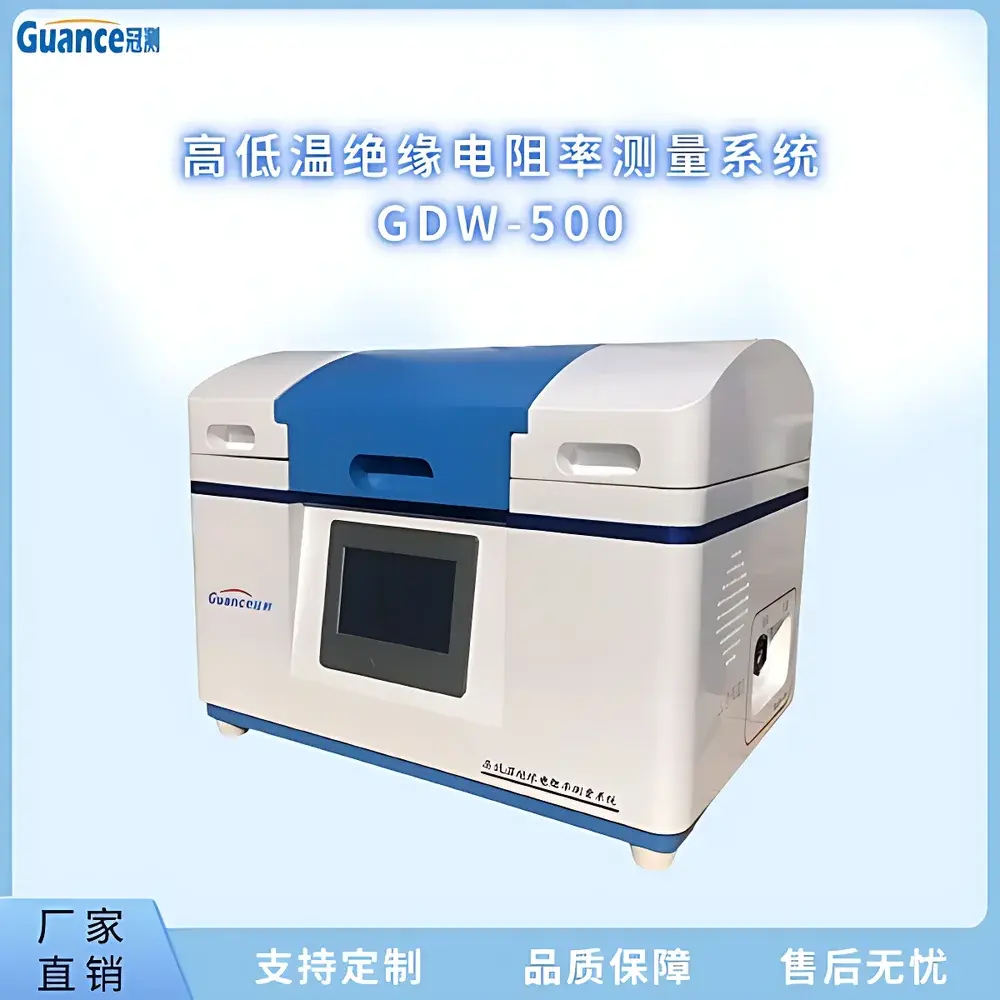
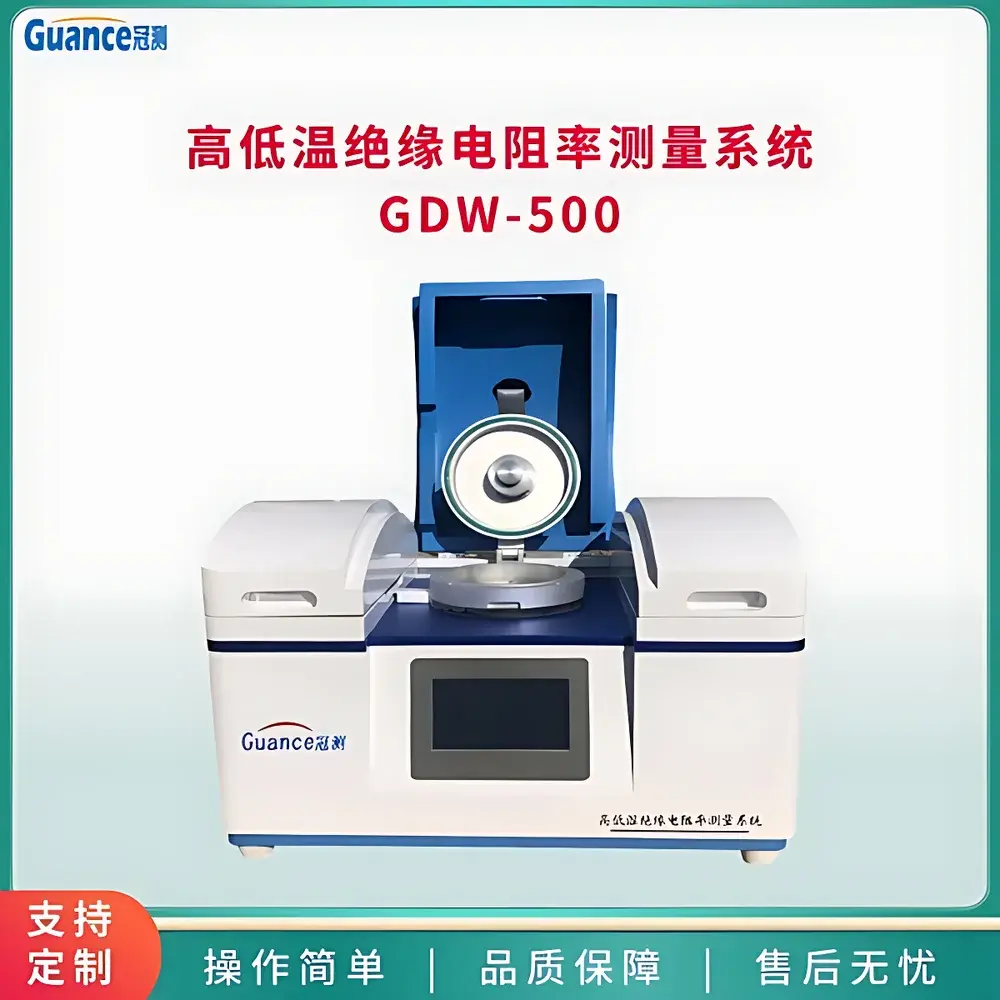
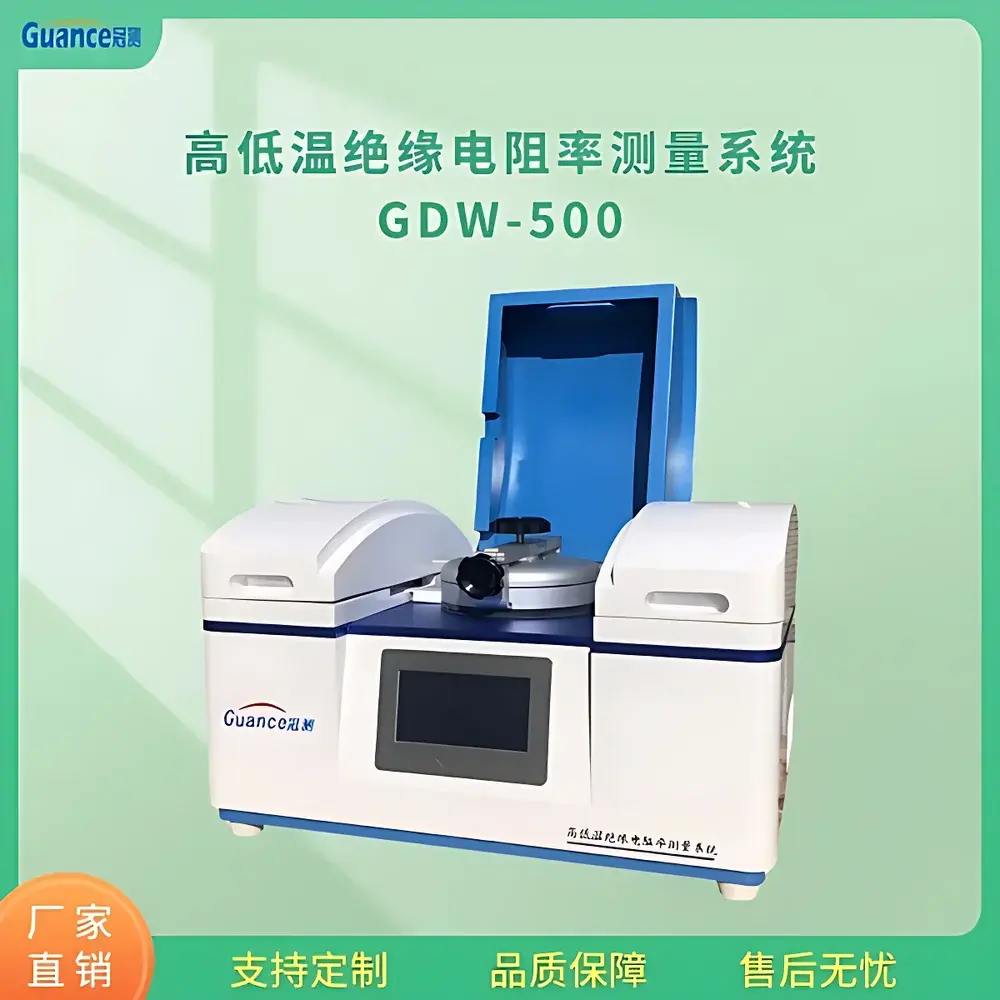
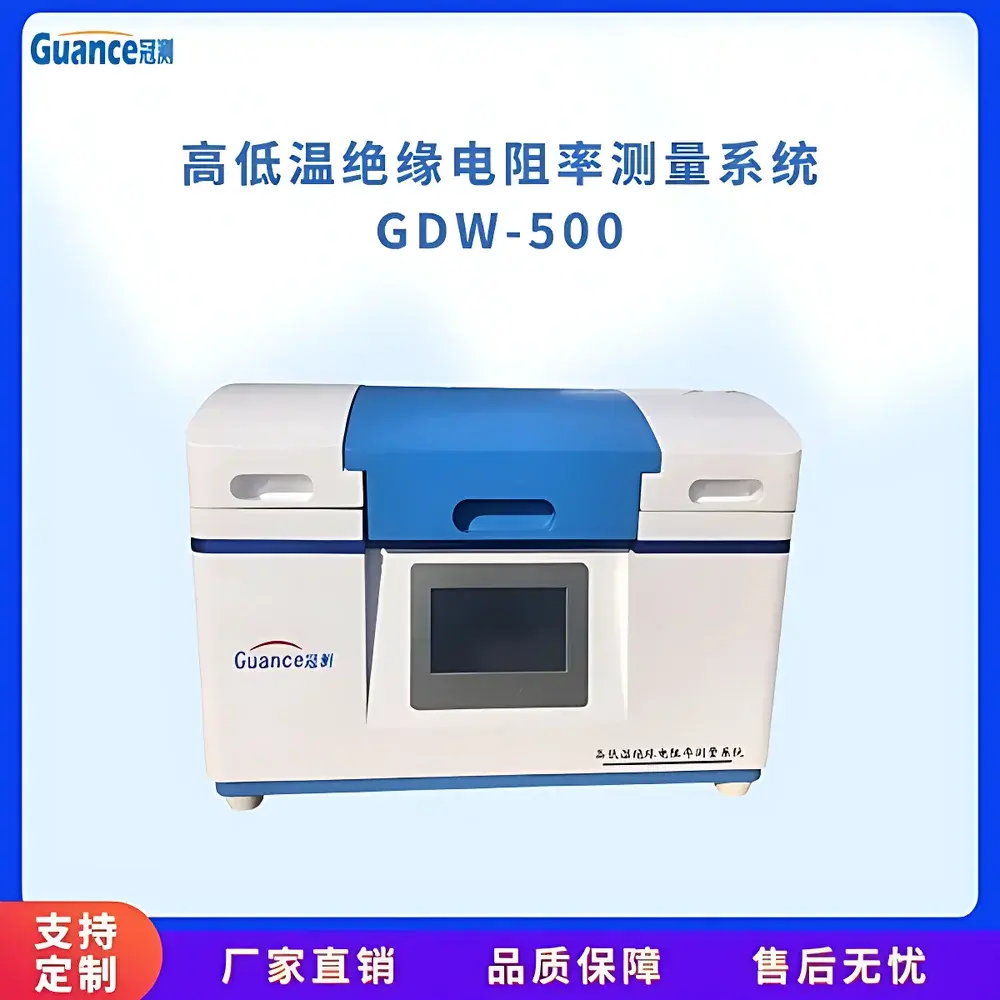
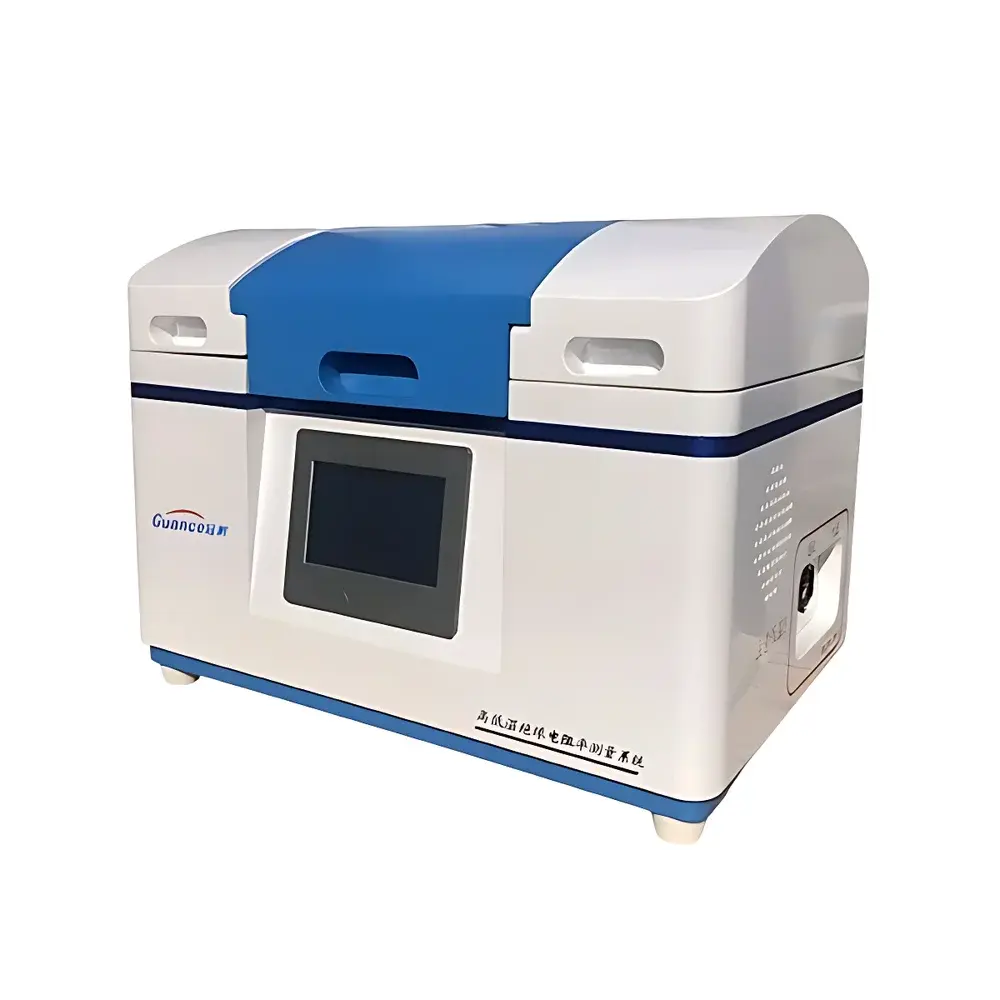
GuanCe Instruments GDW-500.3 High-Low Temperature Dielectric Constant and Resistivity Measurement System
| Brand | GuanCe Instruments |
|---|---|
| Origin | Beijing, China |
| Manufacturer Type | Authorized Distributor |
| Country of Origin | China |
| Model | GDW-500.3 |
| Price | USD 2,200 (FOB) |
| Temperature Range | −160 °C to +500 °C |
| Temperature Stability | ±0.5 °C |
| Electrode Material | Brass |
| Electrode Diameter | 25 mm |
| Test Frequency Range | 20 Hz – 2 MHz |
| Heating Method | Electric Resistance Heating |
| Cooling Method | Liquid Nitrogen Cryogenic Cooling |
| Compliance | GB/T 1409–2006, GB/T 1693–2007, ASTM D150, IEC 60250 |
Overview
The GuanCe Instruments GDW-500.3 High-Low Temperature Dielectric Constant and Resistivity Measurement System is an engineered solution for precise characterization of dielectric properties across extreme thermal conditions. It operates on the principle of impedance spectroscopy—applying a sinusoidal AC voltage across a sample sandwiched between parallel-plate electrodes and measuring the complex admittance (Y* = G + jωC) to derive permittivity (ε′, ε″), loss tangent (tan δ), capacitance (C), and volume resistivity (ρv). Unlike ambient-only dielectric analyzers, the GDW-500.3 integrates a cryogenic–high-temperature test chamber with real-time LCR measurement capability, enabling continuous acquisition of temperature-dependent (T-scan) and frequency-dependent (f-scan) dielectric spectra. This architecture supports fundamental research into dipole relaxation mechanisms, space charge polarization, interfacial (Maxwell–Wagner–Sillars) effects, and thermally activated conduction in insulating solids and viscous liquids.
Key Features
- Wide operational temperature range from −160 °C (liquid nitrogen cooling) to +500 °C (PID-controlled resistive heating), with thermal stability maintained at ±0.5 °C over full span
- Integrated precision brass parallel-plate electrode assembly (25 mm diameter, standardized per IEC 60250 geometry), ensuring repeatable sample contact and minimal fringing field error
- High-resolution LCR measurement engine covering 20 Hz–2 MHz, supporting single-frequency, multi-point frequency sweep, and logarithmic frequency scan modes
- Three selectable measurement speeds—Fast (10 ms/point), Medium (100 ms/point), Slow (1 s/point)—to balance throughput and signal-to-noise ratio for low-conductivity or high-loss materials
- Simultaneous acquisition of 12 parameter sets: ρv(f), ε′(f), ε″(f), ε′r(f), ε″r(f), tan δ(f), C(f), plus full ε′(T), ε″(T), tan δ(T), C(T), and ρv(T) temperature sweeps
- Modular hardware design: separable environmental chamber, LCR bridge unit, electrode stage, and control PC—facilitating calibration traceability and service accessibility
Sample Compatibility & Compliance
The system accommodates solid dielectrics (ceramics, polymers, glass, composites), powdered oxides (Al2O3, TiO2, BaTiO3), thin films (sputtered or spin-coated), and low-conductivity liquids (transformer oils, silicone gels). Sample thickness is adjustable via calibrated spacers (0.1–5.0 mm); surface planarity and electrode alignment are verified using optical leveling before each test. All measurement protocols conform to internationally recognized standards: GB/T 1409–2006 (equivalent to IEC 60250) for permittivity and loss factor determination; GB/T 1693–2007 (aligned with ASTM D150) for vulcanized rubber characterization; and ASTM D257 for volume/surface resistivity extrapolation. Data acquisition meets GLP documentation requirements, including timestamped metadata, operator ID logging, and instrument calibration status flags.
Software & Data Management
The proprietary GDW-Control Suite (v3.2) provides ISO/IEC 17025-aligned data integrity features: audit-trail-enabled user access control, electronic signatures for report approval, and immutable raw-data export in CSV and HDF5 formats. Real-time visualization includes dual-axis plots (log f vs. ε′/ε″, T vs. tan δ), derivative analysis (dε′/dT, d(tan δ)/df), and Cole–Cole plot generation. Batch processing supports automated curve fitting using Debye, Havriliak–Negami, or Kohlrausch–Williams–Watts models. Export modules generate PDF reports compliant with internal QA templates and external regulatory submissions (e.g., ISO 9001, IATF 16949). No cloud dependency—data resides exclusively on local encrypted storage; optional integration with LabArchives or Benchling via REST API.
Applications
- Development of high-temperature capacitor dielectrics (e.g., CaCu3Ti4O12, doped BaSrTiO3) for aerospace power electronics
- Quality control of polymer insulators used in EV battery pack housings and charging infrastructure
- Fundamental study of ferroelectric phase transitions in perovskite thin films under thermal cycling
- Characterization of aging mechanisms in transformer insulation oil via dielectric response spectroscopy (DRS)
- Validation of computational models (e.g., finite-element electrothermal simulation) against empirical ε*(T,f) datasets
- Screening of ionic liquid electrolytes for solid-state batteries across sub-zero operating conditions
FAQ
Does the system support four-terminal (Kelvin) resistivity measurement?
No—the GDW-500.3 uses two-terminal parallel-plate geometry optimized for permittivity extraction. Volume resistivity is derived indirectly from measured conductance and geometric factor; for direct DC resistivity, a separate high-resistance meter (e.g., Keysight B2987A) is recommended.
Can the electrode configuration be modified for non-planar samples?
Standard operation requires flat, parallel surfaces. Optional accessories include spring-loaded electrodes for irregular ceramics and guarded ring electrodes for surface resistivity separation—but these require manual reconfiguration and are not automated within the base software.
Is NIST-traceable calibration available for the LCR module?
Yes—factory calibration certificates (per ISO/IEC 17025) are provided with each unit, covering frequency, capacitance, and dissipation factor at 1 kHz, 100 kHz, and 1 MHz using certified reference standards (Keysight E4980AL verification kit).
What safety interlocks prevent thermal or electrical hazards during operation?
The chamber features redundant overtemperature cutoff (hardware PID limit + software watchdog), liquid nitrogen level sensor feedback, and high-voltage interlock disabling LCR output above 10 Vpp when chamber door is unlatched.
How is electrode contamination mitigated during repeated high-temperature testing?
Brass electrodes are removable and compatible with ultrasonic cleaning in acetone/isopropanol; a dedicated electrode conditioning protocol (vacuum bake at 120 °C for 2 h pre-test) is included in the SOP library to minimize adsorbed moisture and carbon residue.



