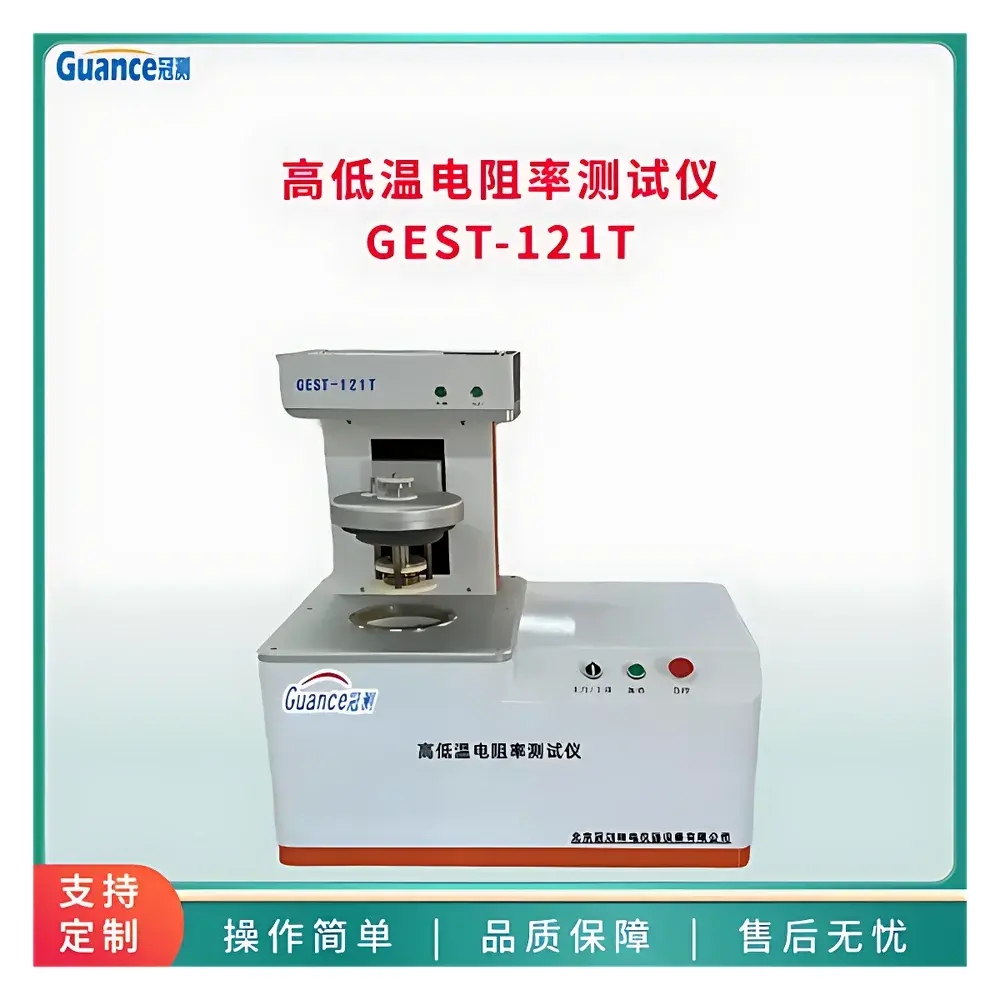
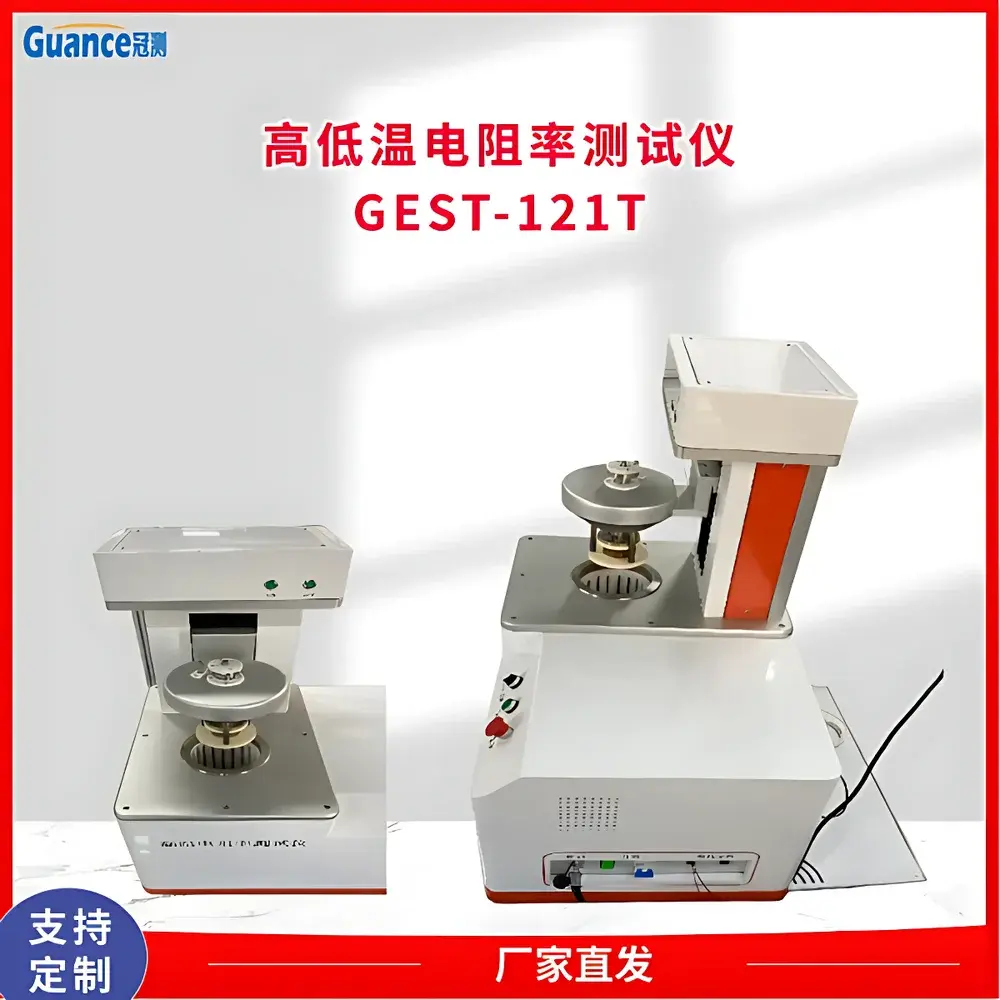
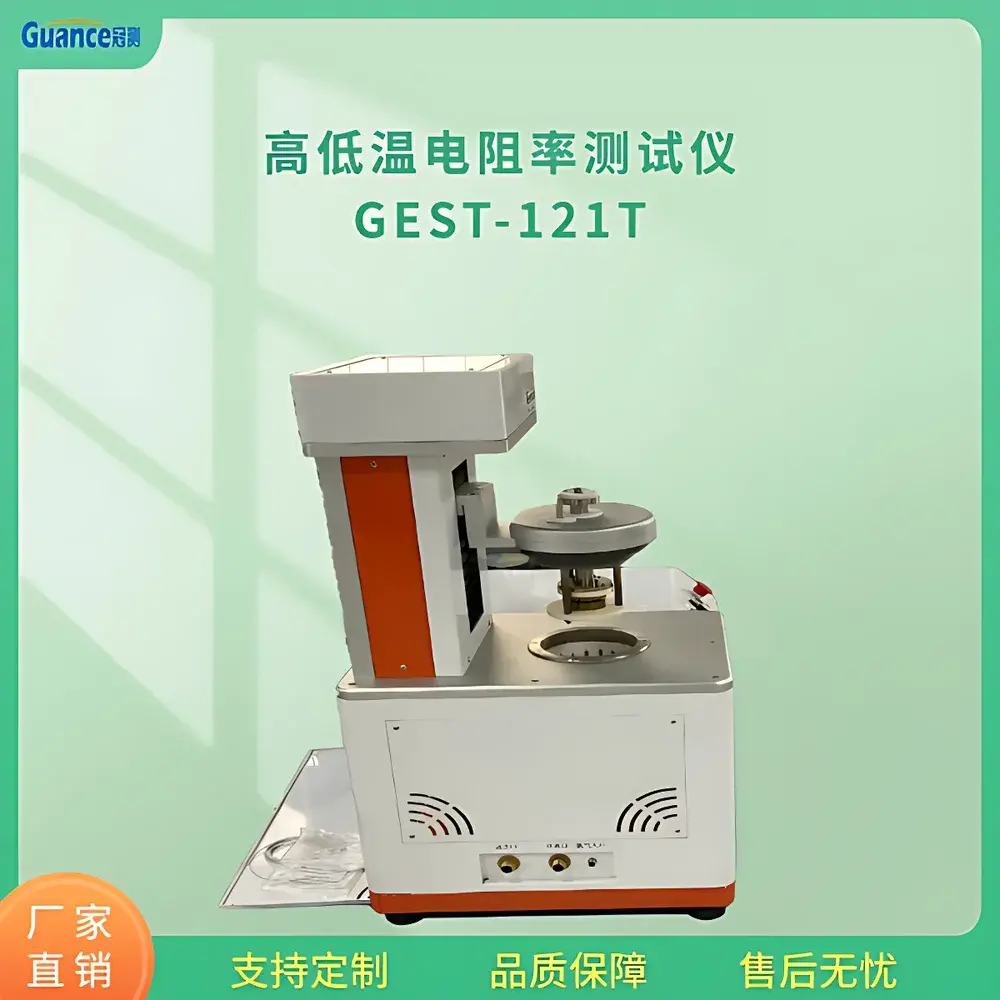
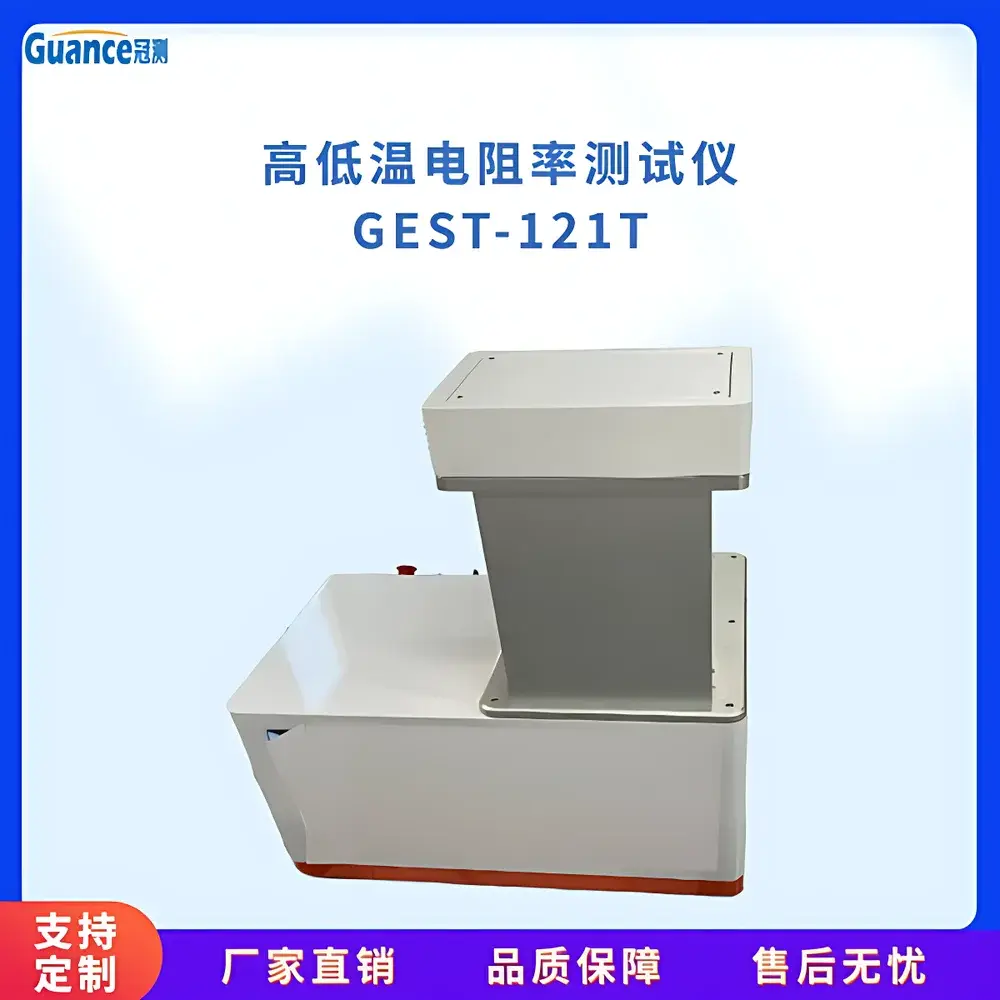
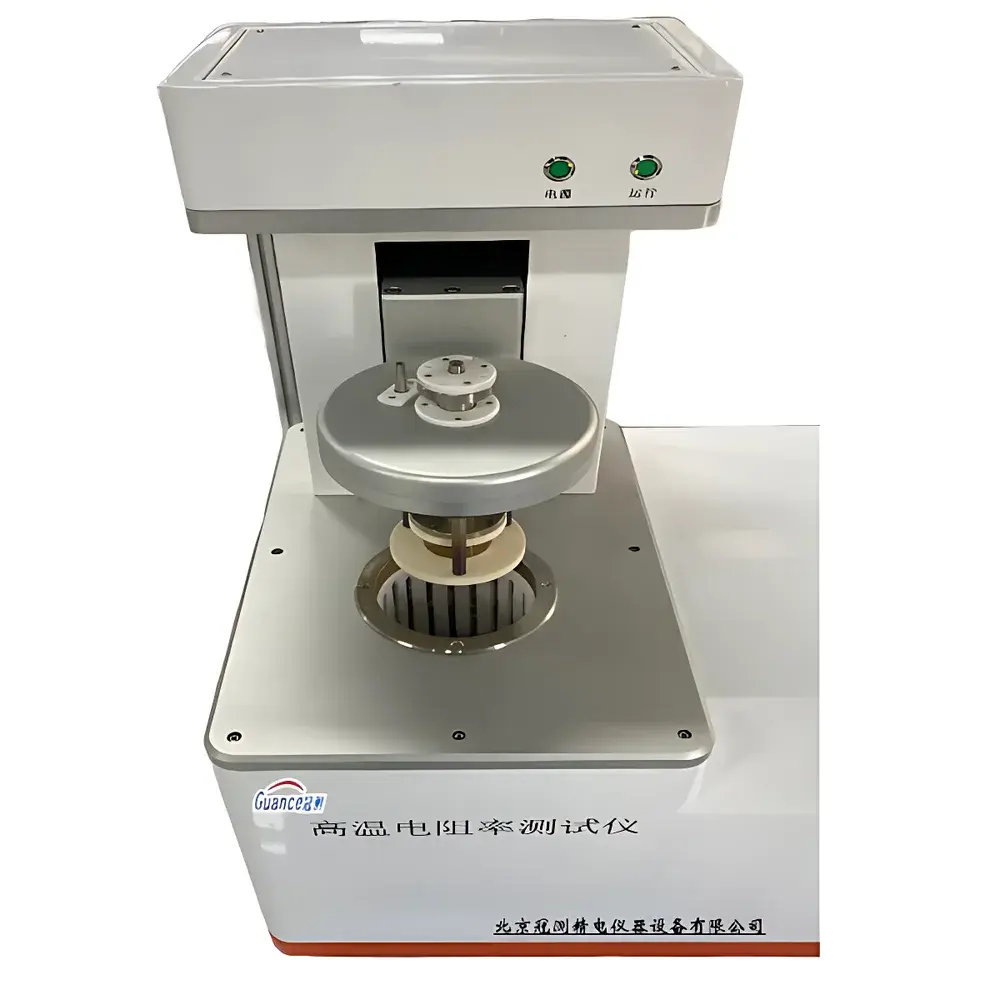
Guance Instruments GEST-121T High-Temperature Volume Resistivity Tester
| Brand | Guance Instruments |
|---|---|
| Model | GEST-121T |
| Temperature Capability | Up to 250 °C (integrated with GDW-250 environmental chamber) |
| Resistance Range | 1×10⁴ Ω to 1×10¹⁸ Ω |
| Voltage Sources | 10 V, 50 V, 100 V, 250 V, 500 V, 1000 V DC |
| Current Measurement Range | 2×10⁻⁴ A to 1×10⁻¹⁶ A |
| Accuracy | ±1% (for R ≤ 1×10¹⁰ Ω), ±5–10% (for R > 1×10¹⁰ Ω) |
| Dimensions | 300 mm × 300 mm × 150 mm |
| Power Supply | 220 V AC / 50 Hz |
| Power Consumption | 100 W |
| Weight | ~30 kg |
| Compliance | Designed for ASTM D257, IEC 60093, GB/T 1410, ISO 3915 environments |
Overview
The Guance Instruments GEST-121T High-Temperature Volume Resistivity Tester is an engineered solution for precise, traceable measurement of volume and surface resistivity in insulating materials under controlled thermal conditions. It integrates a programmable high-temperature environmental chamber (GDW-250, up to 250 °C) with a fully automated resistivity measurement system (GEST-121A), enabling stable, reproducible DC resistance characterization across temperature gradients. The instrument operates on the principle of constant-voltage DC excitation and high-impedance current sensing—compliant with the fundamental methodology defined in ASTM D257 and IEC 60093 for insulation resistance testing. Unlike basic benchtop ohmmeters, the GEST-121T incorporates guarded electrode configurations, low-noise electrometer-grade circuitry, and active temperature compensation to minimize thermoelectric offset and leakage path errors—critical for reliable measurements in the 10¹⁴–10¹⁸ Ω range.
Key Features
- Integrated high-temperature test platform (GDW-250) with PID-controlled heating, uniformity ±1.5 °C over 50–250 °C operating range
- Wide dynamic resistance measurement range: 1×10⁴ Ω to 1×10¹⁸ Ω, supporting ultra-high-resistivity polymers, ceramics, and composites
- Multiple selectable DC test voltages (10 V to 1000 V) with programmable dwell time and auto-ranging current measurement (2×10⁻⁴ A to 1×10⁻¹⁶ A)
- Touchscreen HMI with embedded calibration management, real-time graphing, and pass/fail threshold alerts
- Modular electrode support: accommodates standard concentric ring (IEC 60093), parallel plate, and custom fixtures for films, powders, liquids, and bulk solids
- Guarded measurement architecture minimizing surface leakage and stray capacitance effects—essential for accurate volume resistivity derivation
- Robust mechanical design: aluminum alloy chassis, EMI-shielded enclosure, and thermally isolated sensor stage for long-term stability
Sample Compatibility & Compliance
The GEST-121T supports diverse sample geometries—including thin films (≥25 µm), molded plaques (up to 100 mm × 100 mm), cylindrical rods (Ø6–25 mm), granular powders (with compression cell), and viscous pastes—when used with appropriate electrode kits. All test configurations adhere to standardized specimen preparation protocols outlined in ASTM D1711 (terminology), ASTM D257 (DC resistance), and GB/T 1410 (Chinese national standard equivalent to IEC 60093). The system is compatible with inert atmosphere purging (N₂ or dry air) and optional vacuum integration (≤10 mbar) for moisture-sensitive or outgassing-prone materials. While not inherently 21 CFR Part 11 compliant, audit-ready data logging (with user ID, timestamp, parameter set, and raw current/voltage traces) can be configured per GLP/GMP laboratory requirements via optional software modules.
Software & Data Management
The embedded control firmware enables full test sequencing—including pre-conditioning hold, voltage ramping, stabilization delay, measurement acquisition, and automatic calculation of resistivity (ρ = R × A / t) and surface resistivity (ρₛ = R × P / L)—all computed in real time using user-input geometric parameters. Data export is supported in CSV and XLSX formats, with metadata tags for test condition, operator ID, and calibration certificate reference. Optional PC-based software (GEST-Control Suite v3.x) adds advanced features: multi-curve overlay, Arrhenius plot generation, statistical batch reporting (mean, SD, CV%), and PDF report templating aligned with ISO/IEC 17025 documentation standards. Firmware updates are delivered remotely; all versions are archived with SHA-256 checksums for integrity verification.
Applications
- Quality assurance of high-performance polymer films (e.g., polyimide, PEEK, ETFE) used in aerospace wiring and flexible electronics
- R&D evaluation of ceramic matrix composites (CMCs) and alumina substrates for high-voltage insulation systems
- Temperature-dependent resistivity profiling of battery separator membranes under thermal abuse simulation
- Validation of anti-static additives in injection-molded housings per IEC 61340-2-1 ESD control standards
- Third-party certification testing for UL 746C, IPC-4101, and MIL-STD-202G Method 302 compliance
- Calibration transfer between metrology labs and production-floor testers via NIST-traceable reference resistors
FAQ
What is the maximum operating temperature for resistivity measurement?
The integrated GDW-250 chamber supports continuous operation up to 250 °C; resistivity readings remain valid within this range when using high-temp electrodes and properly rated cabling.
Can the system measure both volume and surface resistivity simultaneously?
No—measurements are sequential and require physical reconfiguration of electrode geometry per ASTM D257 Annex A2 (volume) and Annex A3 (surface); however, the same test sequence can be scripted and repeated automatically.
Is external calibration required before first use?
Yes—initial calibration against certified reference resistors (10⁶ Ω to 10¹⁴ Ω) is mandatory; calibration certificates are provided with each shipment, and annual recalibration is recommended per ISO/IEC 17025 guidelines.
Does the instrument support automated humidity control?
Not natively—the GDW-250 chamber is temperature-only; optional external humidity chambers (e.g., ESPEC SH-241) may be interfaced via RS-485 for combined temp/humidity profiling.
How is electrical safety ensured during 1000 V testing?
The system includes interlocked chamber doors, LED status indicators, redundant hardware overvoltage cutoff (<1.2× setpoint), and CE-compliant double-insulated HV cabling rated to 1.5 kV DC.