
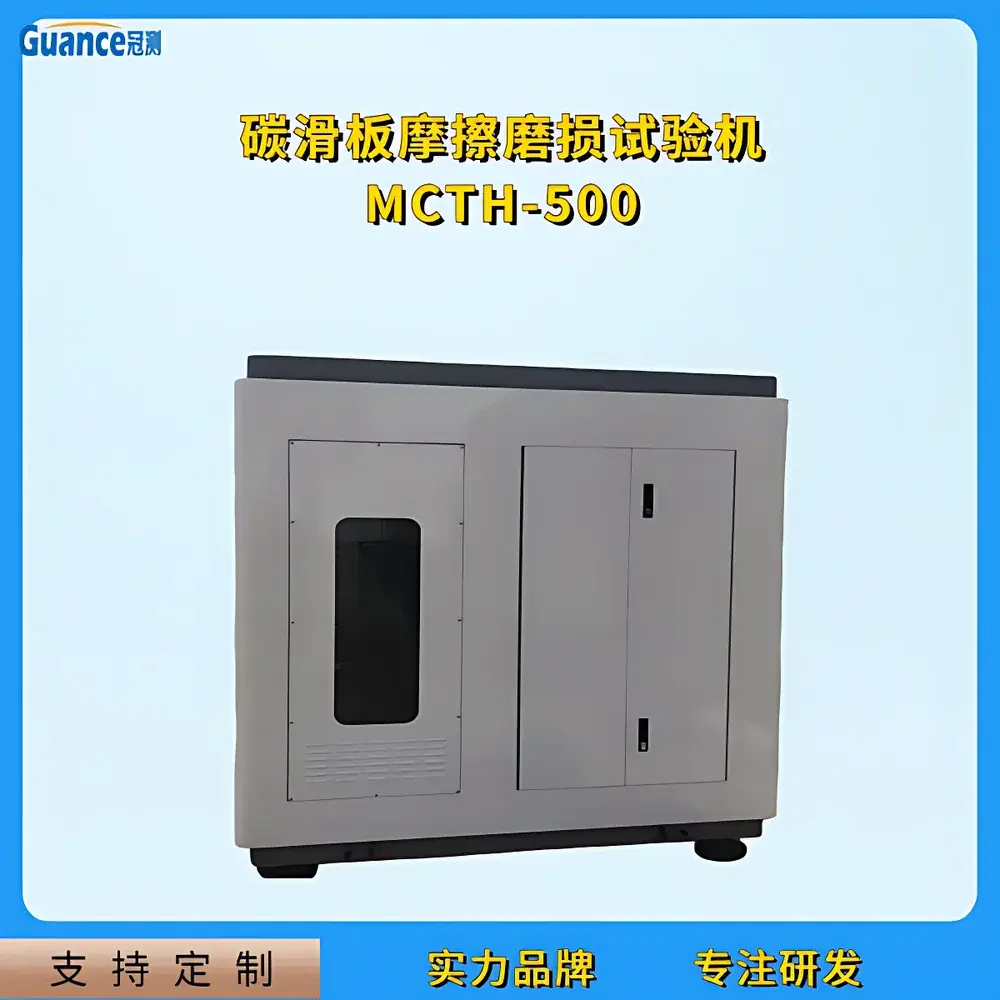
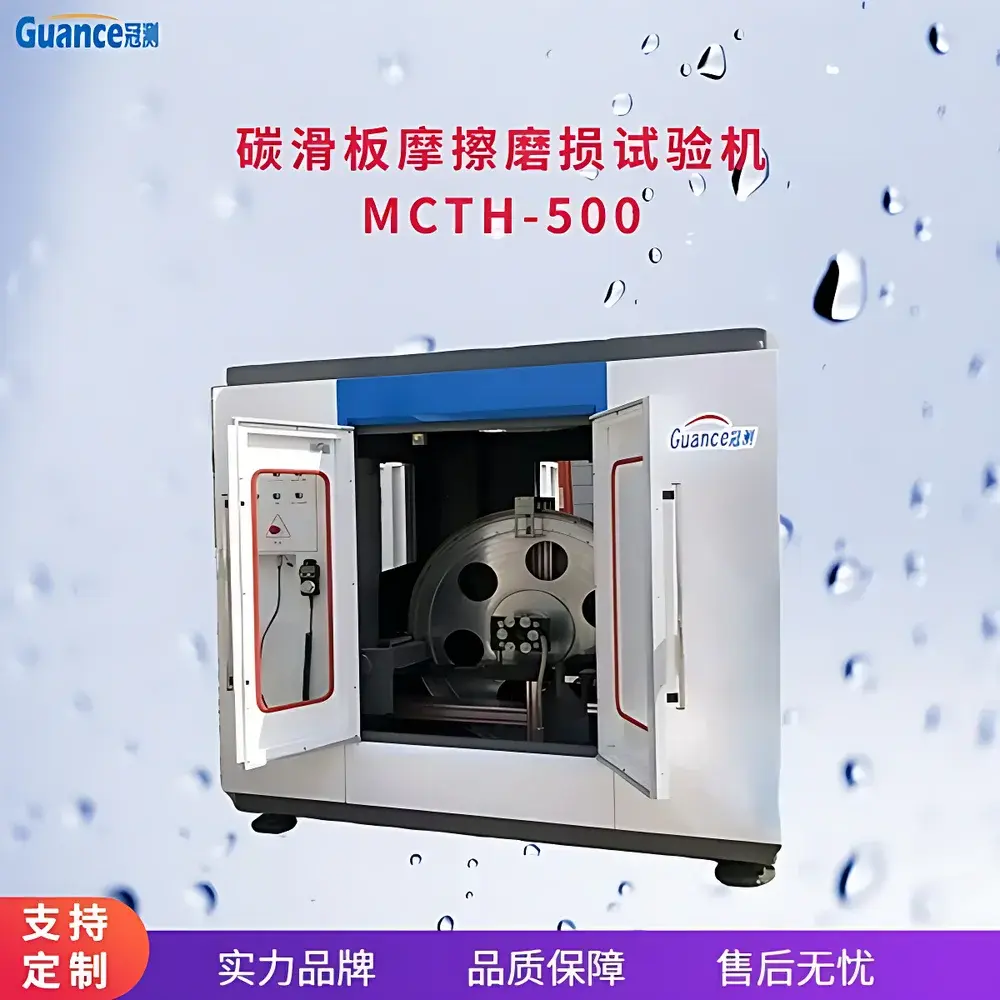
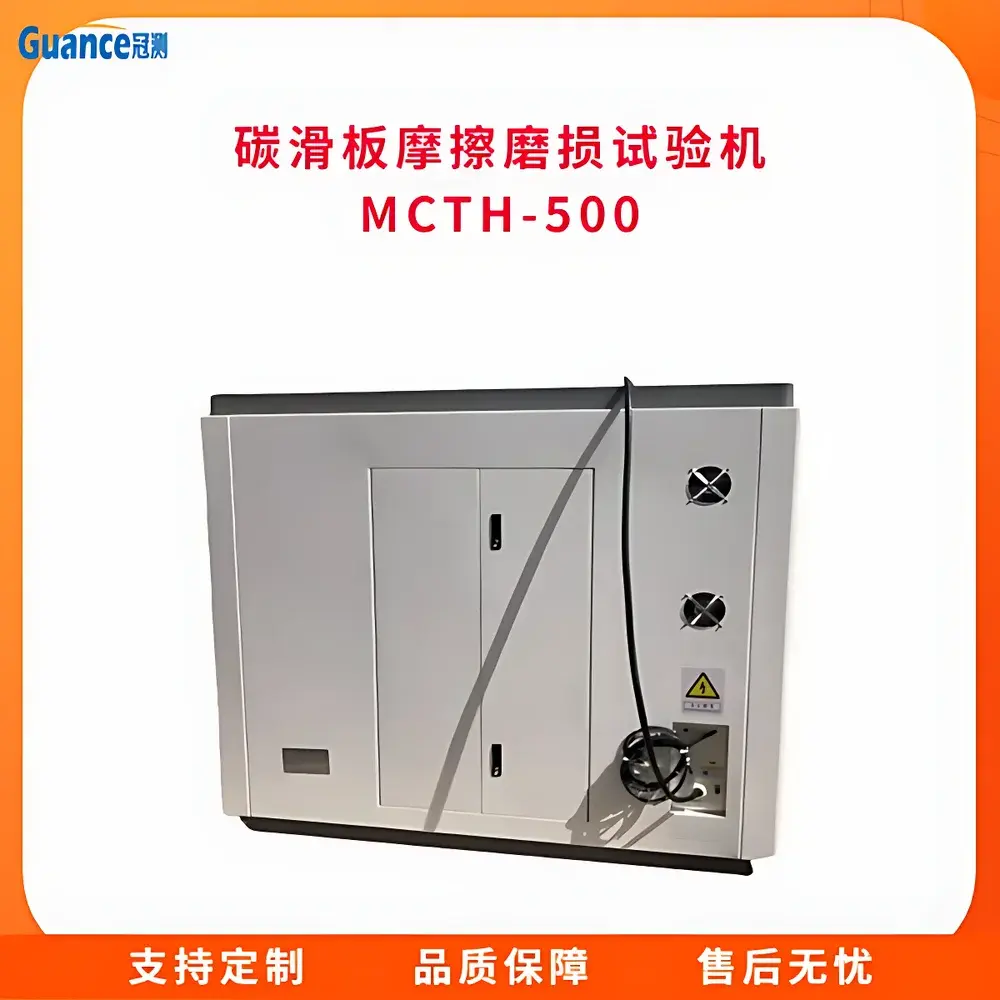
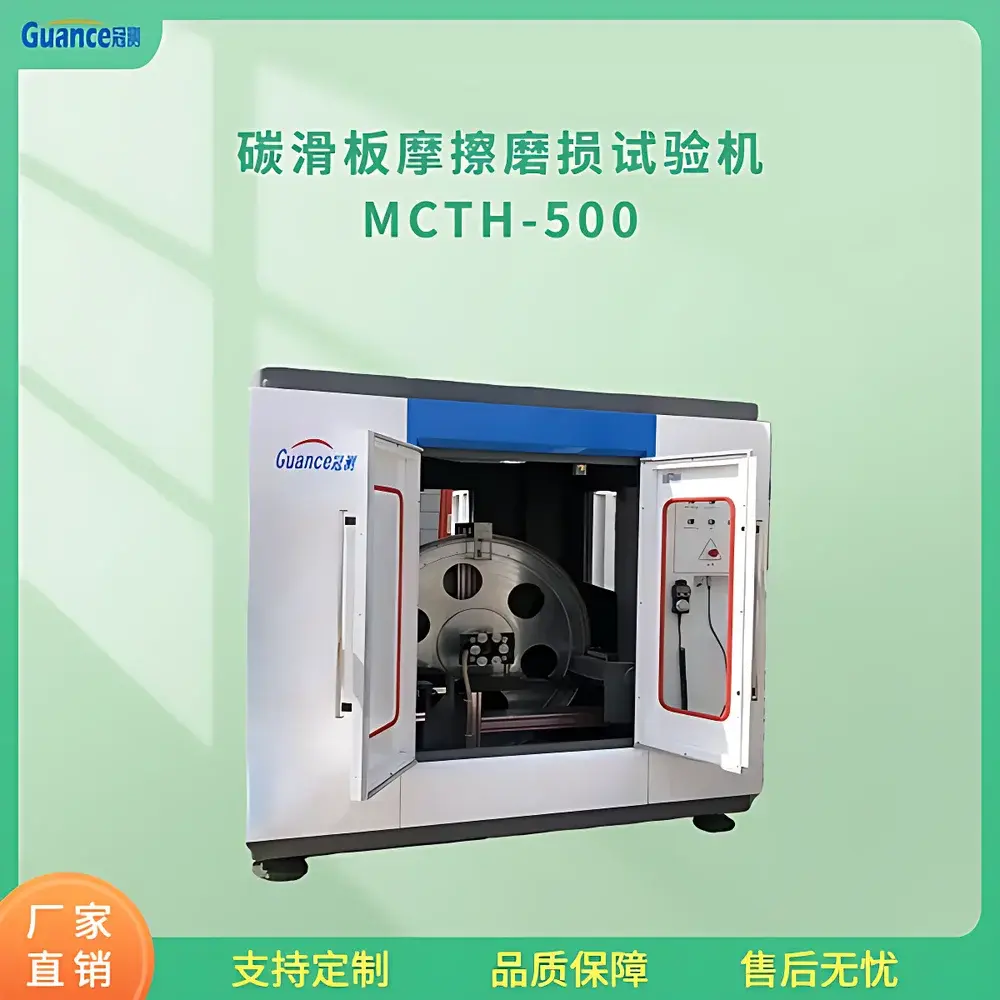
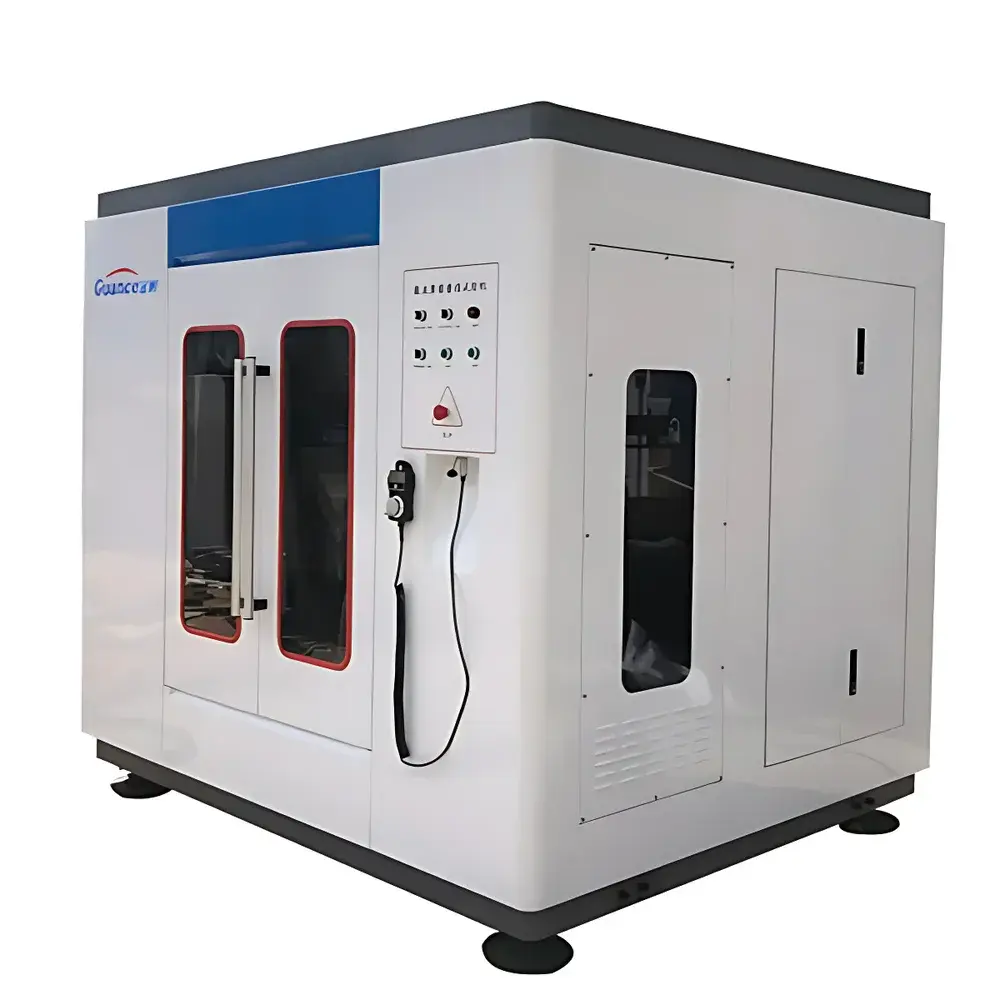
Guance Instruments MCTH-500.4 Carbon Pantograph Slider Tribological Tester
| Brand | Guance Instruments |
|---|---|
| Model | MCTH-500.4 |
| Origin | Beijing, China |
| Instrument Type | Multi-Functional Tribological Tester |
| Maximum Friction Force Range | 30–150 N (via calibrated deadweight loading) |
| Operating Ambient Temperature | −30 to +40 °C |
| Relative Humidity | ≤85 % RH |
| Atmospheric Pressure | 80–120 kPa |
| Supply Voltage | 220 ±10 % VAC, 50 ±0.5 Hz |
| Total Power Consumption | 20 kW |
| Rotating Disc Diameter | 420 mm |
| Disc Rotational Speed | up to 2600 rpm |
| Slider Vertical Stroke | 100 mm |
| Slider Reciprocating Frequency | up to 90 cycles/min |
| Test Current Output | 0–500 A AC (5 V output) |
| Radial Runout Measurement | Integrated dial indicator (0–360° scale, micrometer resolution) |
| Data Acquisition | Real-time voltage, current, and rotational speed logging with Excel export |
| Dust Extraction System | 3 kW industrial vacuum unit |
| Dimensions (L×W×H) | 1500 × 1000 × 1700 mm |
| Weight | 600 kg |
Overview
The Guance Instruments MCTH-500.4 Carbon Pantograph Slider Tribological Tester is a purpose-built, electromechanically controlled test system engineered for standardized evaluation of wear behavior and frictional performance of carbon-based pantograph sliders under simulated railway catenary contact conditions. It operates on the principle of controlled relative motion between a stationary carbon slider and a rotating copper or copper-alloy contact wire—replicating the dynamic sliding interface found in electric traction systems. The system integrates high-current electrical loading (up to 500 A AC), precise normal force application (30–150 N via calibrated deadweights), and synchronized mechanical actuation to replicate real-world service parameters including velocity-equivalent reciprocating motion (up to 90 cycles/min), defined contact geometry, and thermal-electrical-mechanical coupling. Designed for compliance with international railway component qualification frameworks—including UIC 803-2, EN 50317, and GB/T 21563—the MCTH-500.4 supports both R&D validation and routine quality assurance of carbon slider materials used in high-speed and metro rail applications.
Key Features
- Electro-tribological simulation: Simultaneous application of high-current load (0–500 A, 5 V AC) and controlled normal force (30–150 N) during dynamic sliding contact.
- Rotating disc subsystem: 420 mm diameter precision-machined disc driven by a 10 kW servo motor, capable of stable operation at 2600 rpm with <±0.5% speed regulation.
- Vertical slider actuation: Servo-driven linear mechanism enables programmable reciprocating motion (stroke: 100 mm; frequency: up to 90 cpm) with repeatable positioning accuracy.
- Real-time parameter monitoring: Integrated sensors continuously acquire voltage, current, rotational speed, and radial runout (via dial indicator mounted on rotating assembly), with timestamped logging.
- Surface conditioning module: Pneumatically actuated abrasive cleaning head with replaceable sandpaper fixtures enables in-situ wire surface renewal between test cycles—ensuring consistent initial roughness per ASTM D4060.
- Radial runout verification: Dedicated 360° angular scale and high-resolution dial indicator (0.001 mm resolution) allow quantitative assessment of disc/wire concentricity prior to and during testing.
- Dust management system: 3 kW industrial vacuum unit with sealed collection chamber minimizes airborne particulate accumulation and ensures operator safety per OSHA 1910.94 standards.
Sample Compatibility & Compliance
The MCTH-500.4 accommodates standard carbon slider specimens (typically 100 × 60 × 20 mm) mounted on an anodized aluminum fixture with adjustable clamping torque. Contact wires up to Ø16 mm are compatible with the 420 mm rotating disc mount. The system satisfies mechanical and environmental operating constraints specified in IEC 60068-2 series (climatic testing), ISO 20816-1 (vibration severity), and GB/T 13309 (Chinese national standard for pantograph slider testing). Electrical safety complies with GB 4793.1 (equivalent to IEC 61010-1), while grounding resistance (<1 Ω) meets IEEE Std 80 requirements for equipment earthing. All control logic adheres to IEC 61131-3 PLC programming standards, supporting audit-ready operation logs required under GLP and Tier-2 GMP environments.
Software & Data Management
Control and data acquisition are managed via a Windows-based HMI interface linked to the embedded PLC controller. The software provides real-time visualization of voltage, current, and rotational speed waveforms, with configurable sampling intervals (10 ms to 1 s). Post-test analysis includes automatic calculation of cumulative sliding distance, mean friction coefficient (derived from force transducer output), and energy dissipation metrics. All raw time-series data are exportable in native Excel (.xlsx) format with column headers compliant with ASTM E2917 metadata conventions. Audit trails—including user login timestamps, parameter change logs, and calibration event records—are retained locally and support 21 CFR Part 11-compliant electronic signatures when deployed with validated third-party authentication modules.
Applications
- Qualification testing of carbon composite pantograph sliders for high-speed rail (CRH, Fuxing) and urban transit systems.
- Comparative wear rate analysis across carbon formulations (e.g., resin-bonded, metal-impregnated, nano-enhanced grades).
- Correlation studies between electrical resistivity, surface temperature rise (via optional IR thermography integration), and mass loss under variable current loads.
- Development and validation of anti-arcing surface treatments and lubricant coatings for contact wire interfaces.
- Supporting failure mode analysis (FMA) of in-service slider degradation mechanisms—e.g., grooving, cracking, or transfer film formation.
FAQ
What standards does the MCTH-500.4 comply with for railway component testing?
It supports test protocols aligned with EN 50317 (pantograph–catenary interaction), UIC 803-2 (carbon slider type approval), and GB/T 21563 (Chinese rolling stock vibration testing), with mechanical and electrical safety conforming to IEC 61010-1 and GB 4793.1.
Can the system accommodate non-standard wire diameters or slider geometries?
Yes—custom mounting adapters and disc inserts are available upon request; dimensional constraints require prior engineering review to ensure mechanical stability and thermal dissipation integrity.
Is radial runout measurement traceable to national metrology institutes?
The integrated dial indicator is supplied with factory calibration certificate (NIST-traceable reference standards); users may perform periodic verification using certified gauge blocks per ISO/IEC 17025 guidelines.
Does the software support automated pass/fail evaluation against predefined wear thresholds?
Basic threshold alerts are configurable within the HMI; full statistical process control (SPC) and Weibull-based life prediction require integration with external analytics platforms such as MATLAB or JMP.
What maintenance intervals are recommended for the dust extraction system?
Filter inspection is advised every 50 operational hours; HEPA filter replacement and vacuum pump oil change are scheduled at 500-hour intervals, documented in the included maintenance logbook.
Related Products



