
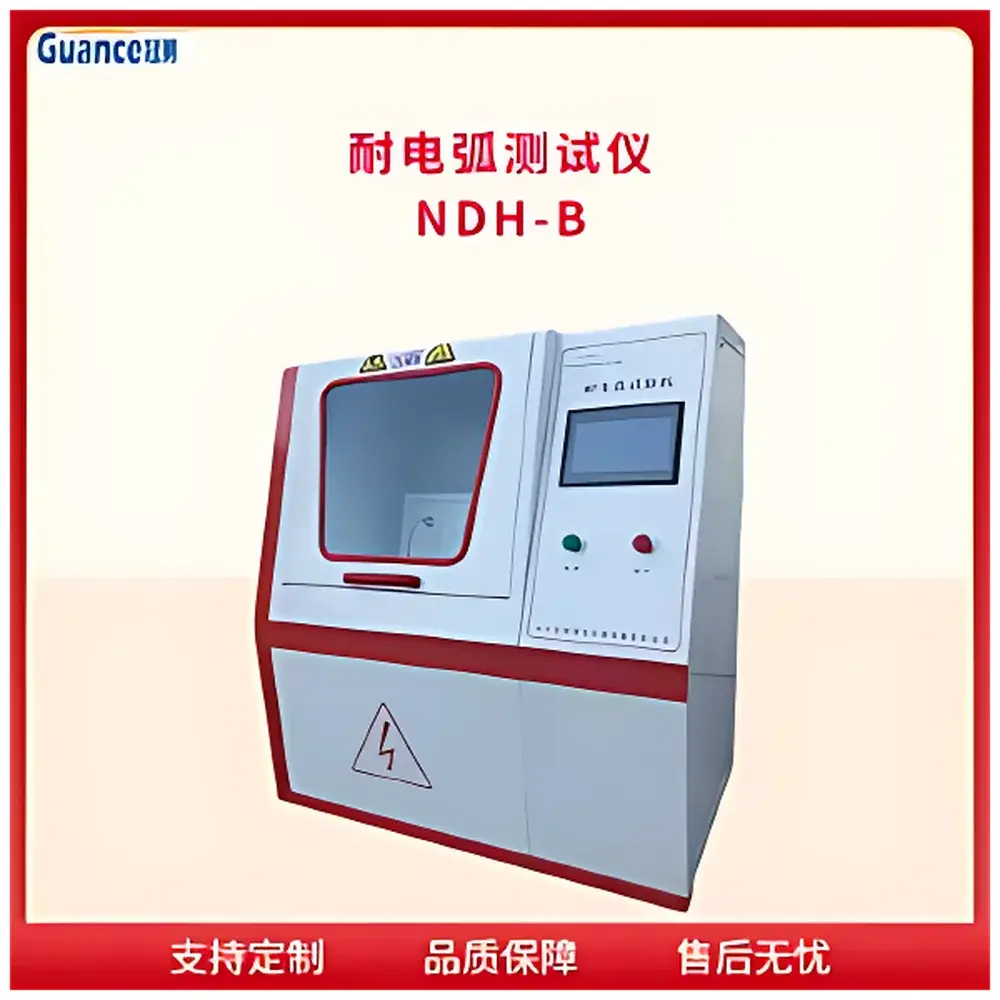
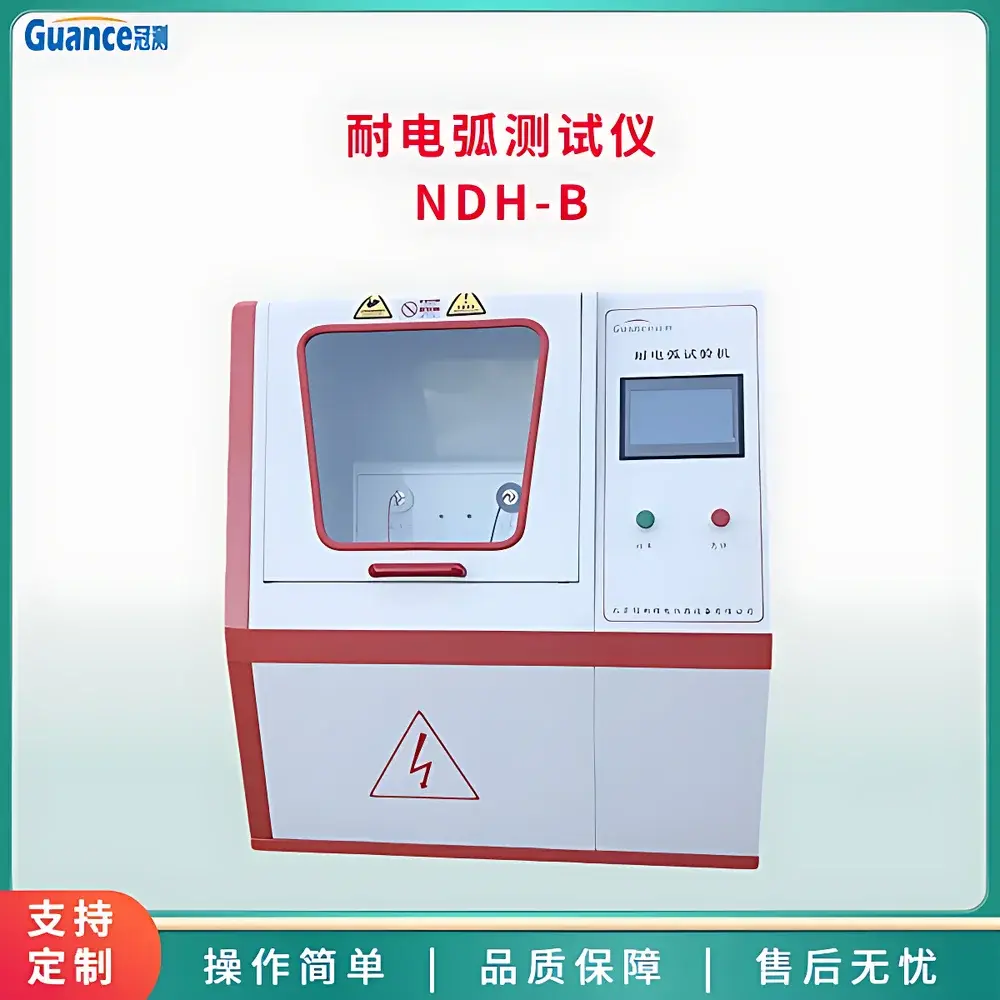
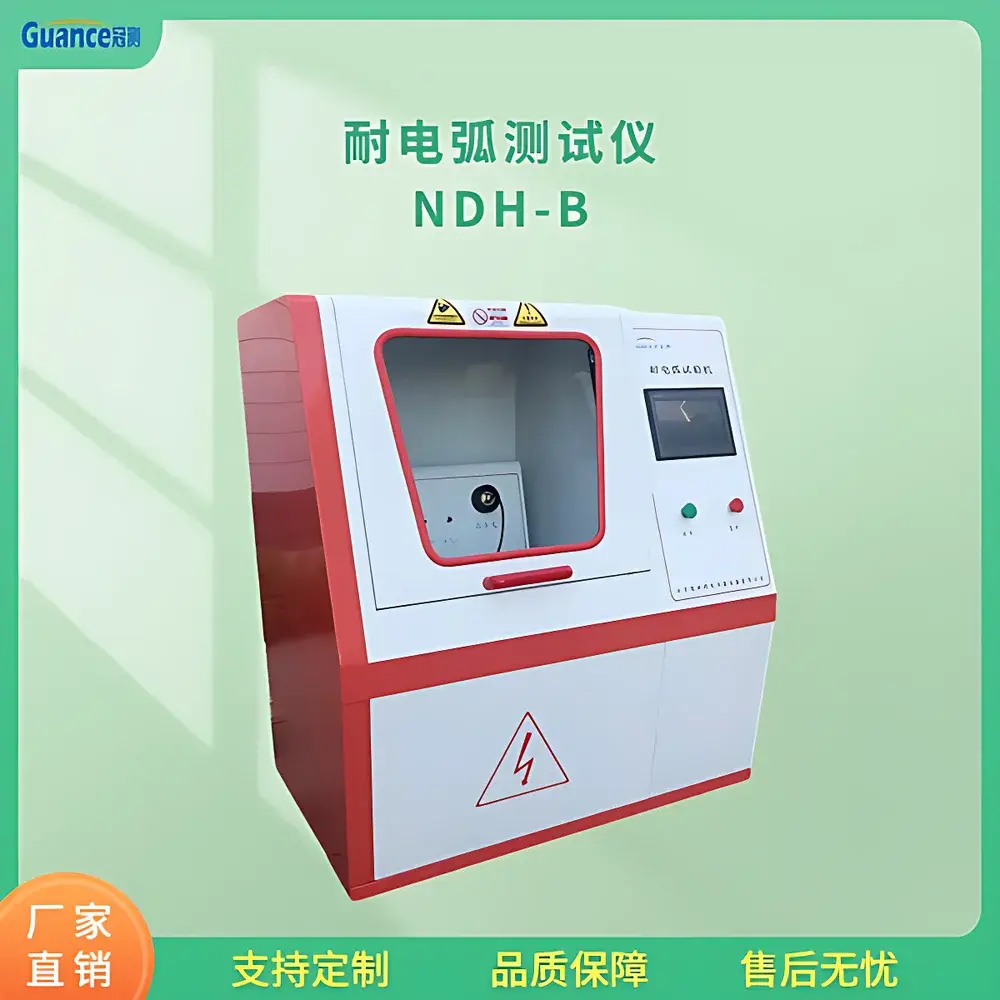
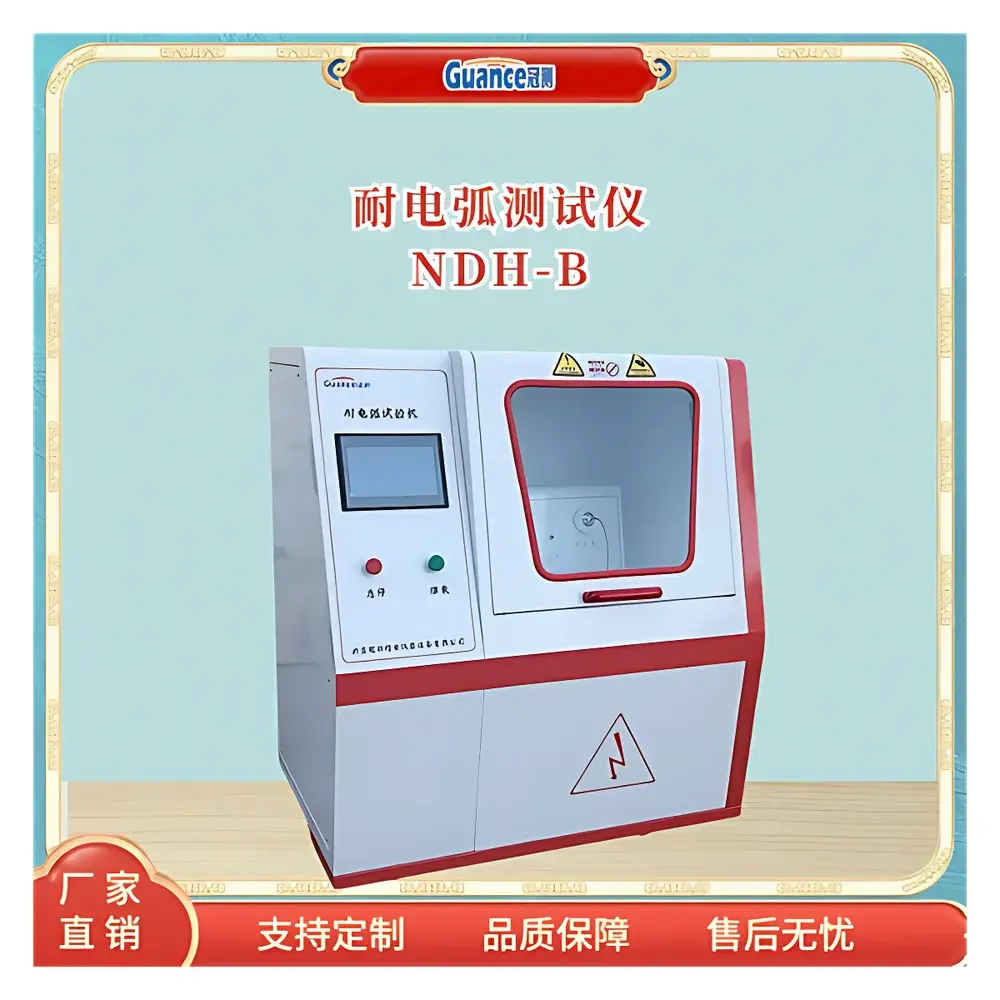
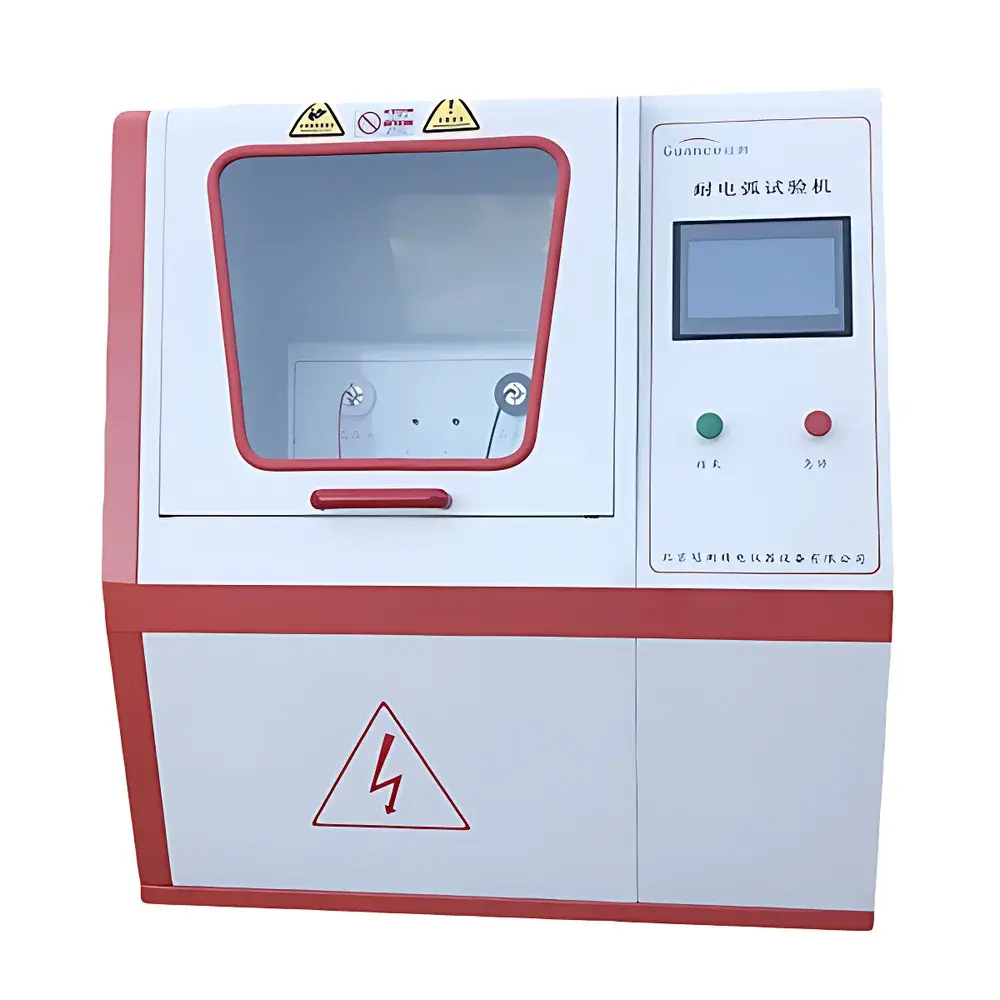
Guance Instruments NDH-B2 High-Voltage Arc Resistance Universal Tester
| Brand | Guance Instruments |
|---|---|
| Origin | Beijing, China |
| Manufacturer Type | Authorized Distributor |
| Product Category | Domestic |
| Model | NDH-B2 |
| Instrument Type | Electronic Universal Testing Machine |
| Arc On/Off Time Accuracy | < ±1 ms |
| Voltage Regulation Capacity | 3 kVA |
| High-Voltage Transformer Capacity | 3 kVA, 0–20 kV Output |
| Rated Test Voltage | 12.5 kV |
| Voltage Accuracy | ±1% |
| Current Control Accuracy | ±3% |
| Current Measurement Accuracy | ±1.5% |
| Electrode Force on Specimen | (0.5 ± 0.05) N |
| Electrode Material | Tungsten Rod |
| Electrode Spacing | (6.35 ± 0.1) mm (IEC), (6.0 ± 0.1) mm (ASTM) |
| Ambient Temperature | (23 ± 2) °C |
| Ambient Humidity | (50 ± 5)% RH |
| Input Power | 220 V AC / 50 Hz |
| Output Voltage Range | 0–17.5 kV AC |
| Test Current Settings | 10, 20, 30, 40 mA |
Overview
The Guance Instruments NDH-B2 High-Voltage Arc Resistance Universal Tester is a precision-engineered instrument designed to evaluate the arc resistance of solid insulating materials under controlled high-voltage, low-current electric arc discharge conditions. It operates on the principle of controlled intermittent and continuous arc initiation between two tungsten electrodes spaced at standardized distances—6.0 mm per ASTM D495 or 6.35 mm per IEC 61621—while applying a nominal test voltage of 12.5 kV and adjustable current levels from 10 mA to 40 mA. The time elapsed from arc initiation until specimen failure (carbonization, tracking, or puncture) is recorded as the arc resistance value in seconds—a critical parameter for material qualification in electrical insulation applications. The system complies with GB/T 1411–2002 (identical to IEC 61621:1997), ASTM D495, IEC 60149, and UL 746A, and was developed under technical supervision of the National Standardization Technical Committee on Insulating Materials (SAC/TC 51). Its architecture integrates high-voltage generation, real-time current regulation, and fail-safe interlocks to ensure repeatability, operator safety, and metrological traceability.
Key Features
- Bilateral modular design: left-side test chamber (with tempered glass viewing door, internal electrode assembly, HV output terminals, and analog current meter) and right-side control cabinet housing Siemens PLC, industrial-grade HMI touchscreen, and power electronics.
- Programmable test execution: preloaded IEC and ASTM test protocols enable fully automated voltage ramping, arc timing sequence control, and automatic return-to-zero post-test.
- Robust high-voltage subsystem: 3 kVA autotransformer (T5) coupled with a 3 kVA high-voltage test transformer (T4) delivers stable 0–17.5 kV AC output; voltage setpoint accuracy maintained within ±1% of full scale.
- Dual-current monitoring: simultaneous analog ammeter readout and digital software display ensure cross-verified current measurement with ±1.5% uncertainty.
- Active safety infrastructure: rotating warning beacon during HV operation, integrated protective resistors in low-voltage wiring, and electromagnetic interference (EMI)-hardened control circuitry.
- Inert gas port: optional nitrogen or argon purging capability enables oxidation-sensitive testing environments per specialized protocol requirements.
- Self-calibration support: built-in voltage and current verification routines simplify periodic metrological validation and regulatory audit preparation.
Sample Compatibility & Compliance
The NDH-B2 accommodates rigid flat specimens measuring ≥3.0 mm ± 0.4 mm in thickness, with smooth, burr-free surfaces prepared per ISO 293 or ASTM D1898. Compatible materials include thermosetting resins (e.g., phenolic, epoxy, silicone), laminates (G10/FR4, paper- and glass-based), insulating varnishes, elastomeric compounds, and filled polymer composites used in motor windings, switchgear housings, PCB substrates, and appliance enclosures. All mechanical and electrical performance criteria align with GLP-compliant laboratory practice. The instrument supports documentation workflows compliant with FDA 21 CFR Part 11 when paired with validated data acquisition software (optional add-on), and its test reports meet evidentiary requirements for ISO/IEC 17025-accredited laboratories conducting conformity assessments against IEC 60243-1, UL 746A Section 20, and GB/T 1411 Annex A.
Software & Data Management
The embedded Siemens S7-1200 PLC communicates bidirectionally with a 7-inch industrial capacitive touchscreen HMI, enabling intuitive test setup, real-time waveform visualization (voltage/current vs. time), and immediate pass/fail evaluation per user-defined acceptance thresholds. Test logs—including timestamp, voltage setpoint, current step sequence, arc duration per cycle, total arcing time, and operator ID—are stored locally in non-volatile memory with CSV export capability via USB interface. Audit trail functionality records all parameter modifications, emergency stops, and calibration events with immutable timestamps—supporting traceability under GMP/GLP frameworks. Optional PC-based software (sold separately) extends functionality with statistical process control (SPC) charts, multi-specimen batch reporting, and PDF report generation conforming to ISO 10012 requirements.
Applications
The NDH-B2 serves as a primary qualification tool in R&D, quality assurance, and third-party certification labs across multiple sectors:
- Electrical manufacturing: validation of arc resistance for busbar coatings, relay bases, and terminal blocks.
- Automotive electronics: screening of high-voltage battery enclosure materials and EV power module substrates.
- Aerospace component suppliers: assessment of polyimide films and cyanate ester laminates per SAE AS4449.
- Wire & cable producers: verification of jacketing compound performance under partial discharge stress.
- Academic research: fundamental studies on carbon track formation kinetics, surface degradation mechanisms, and filler dispersion effects in nanocomposite dielectrics.
FAQ
What standards does the NDH-B2 fully support?
It is configured to execute tests per GB/T 1411–2002, IEC 61621:1997, ASTM D495–18, UL 746A Section 20, and IEC 60149, with hardware-level compliance verified by national standardization authorities.
Is inert gas purging mandatory for standard testing?
No—gas introduction is optional and reserved for non-ambient atmospheric conditions specified in research protocols or material-specific annexes (e.g., ASTM D495 Annex A1).
How is electrode alignment and force calibrated?
Electrode spacing is mechanically preset using precision-ground spacers traceable to NIST standards; contact force is applied via calibrated spring loading mechanism with ±0.05 N tolerance.
Can test data be exported for LIMS integration?
Yes—CSV-formatted raw and summary data files are exportable via USB; API-enabled versions support OPC UA or Modbus TCP for direct LIMS/SCADA connectivity.
What maintenance intervals are recommended?
Annual verification of HV transformer insulation resistance, biannual cleaning of electrode tips with isopropyl alcohol, and quarterly functional checks of safety interlocks and arc timing fidelity per manufacturer’s service manual.
Related Products



