
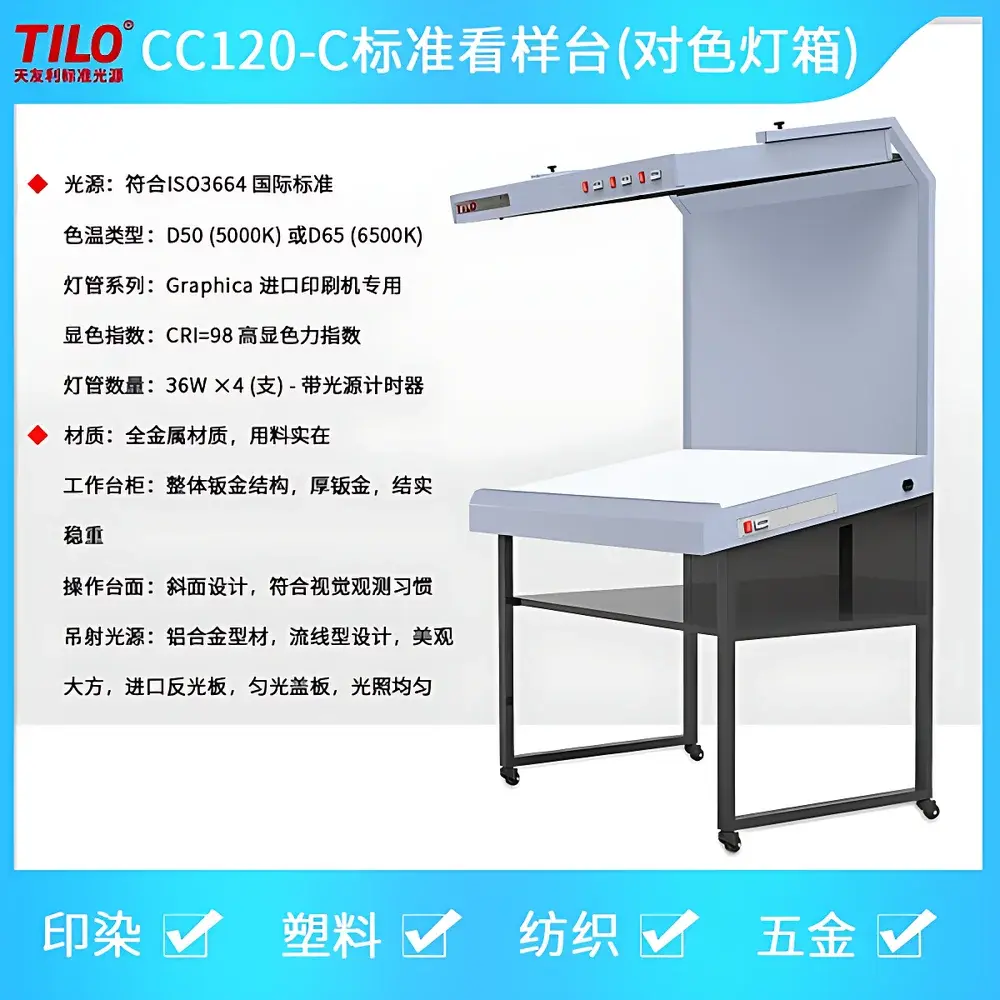
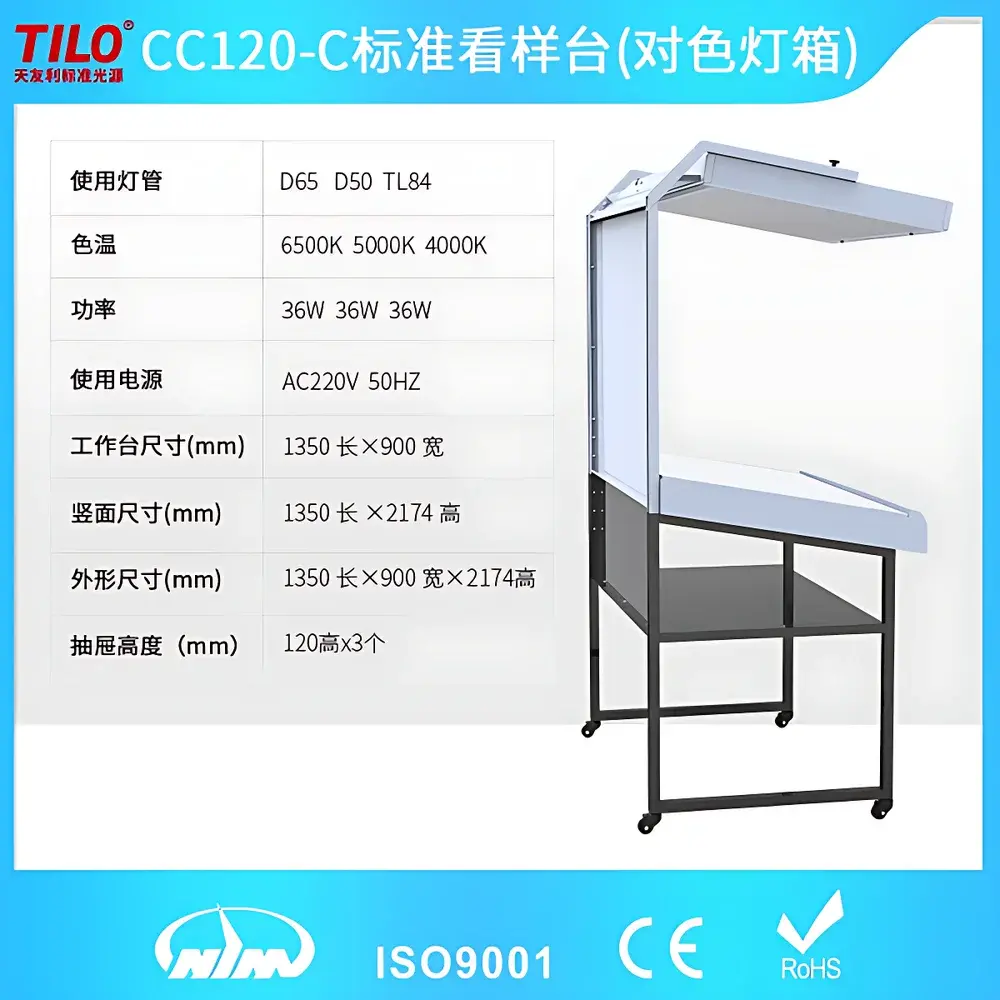
TILO CC120-C Dual-Mode Transmission/Reflection Standard Light Booth
| Brand | TILO |
|---|---|
| Origin | Guangdong, China |
| Model | CC120-C |
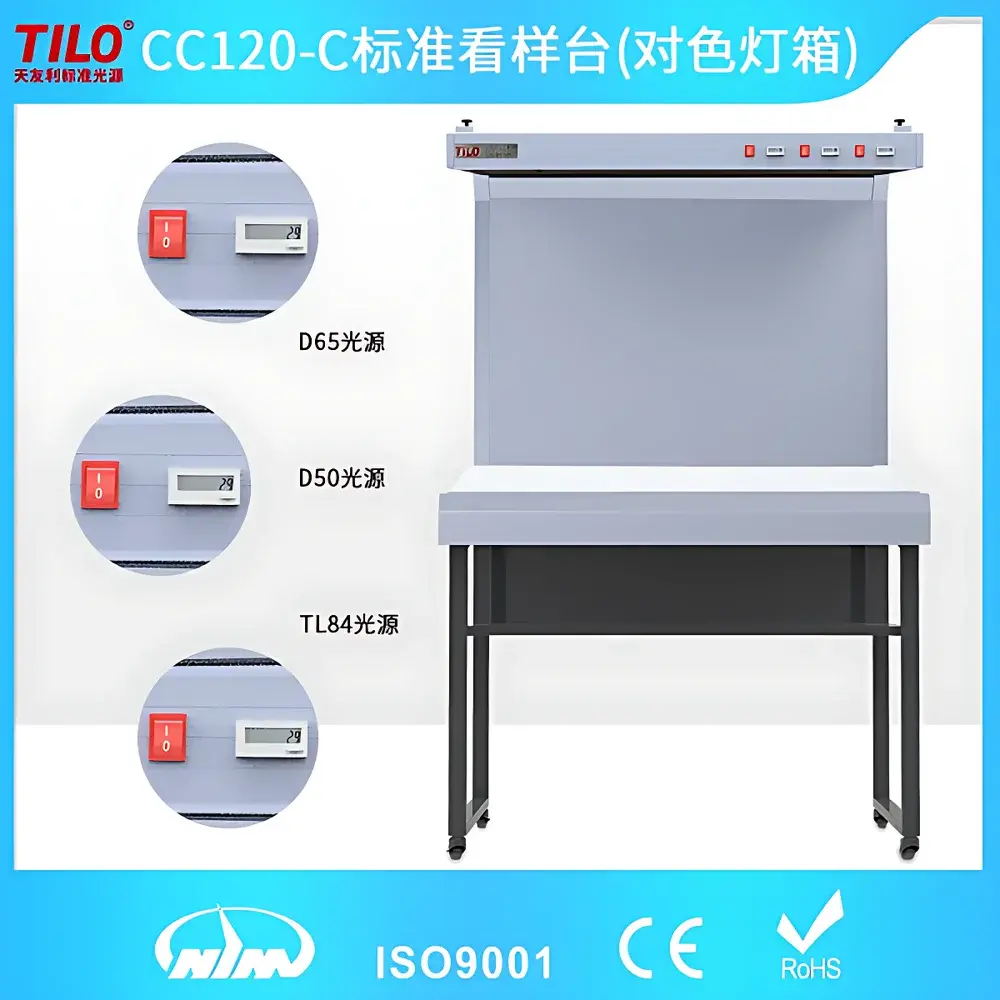
| Light Sources | Single / Dual / Triple Configurable |
| CRI (Ra) | ≥98 |
| Compliance | ISO 3664:2009 |
| Construction | Full-metal sheet metal chassis with reinforced frame |
| Viewing Surface | Angled ergonomic work surface |
| Illumination System | Precision-machined aluminum extrusion housing with imported specular reflector and diffuser plate |
| Light Timer | Integrated lamp-hour counter |
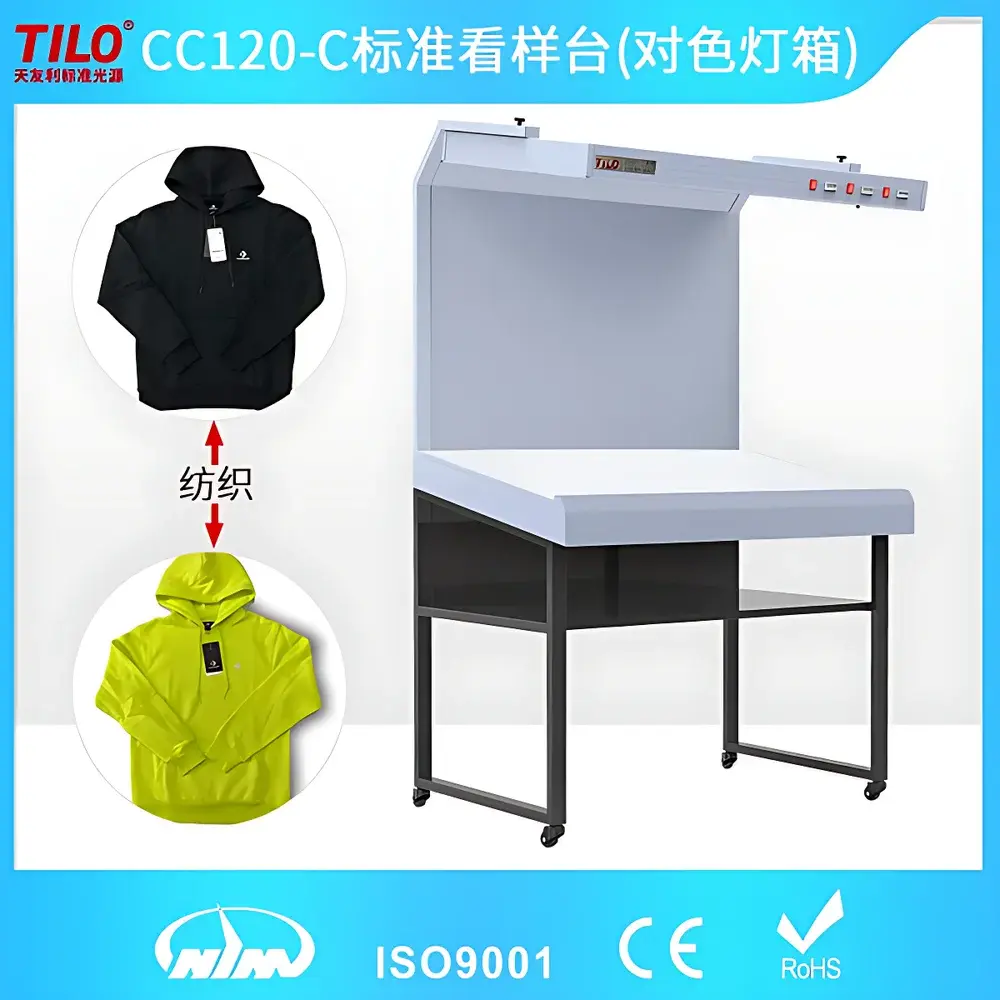
| Application Scope | Print proofing, textile dyeing, plastic color matching, coating QC, automotive trim evaluation |
Overview
The TILO CC120-C Dual-Mode Transmission/Reflection Standard Light Booth is an engineered solution for color-critical visual assessment in industrial quality control environments. Designed in strict accordance with ISO 3664:2009 — the internationally recognized standard for graphic technology and photography lighting conditions — this booth delivers photometrically stable, spectrally accurate illumination across configurable light source combinations. Its dual-mode optical architecture supports both reflective sample evaluation (e.g., printed sheets, coated panels, textiles) and transmissive inspection (e.g., photographic films, backlit signage, transparent packaging), enabling consistent cross-media color judgment without equipment reconfiguration. The system employs high-CRI Graphica-series fluorescent lamps (CRI ≥98), selected for spectral continuity in the 400–700 nm visible range and minimal metamerism risk during comparative color matching. All optical components — including the precision-ground aluminum reflector, opal diffuser plate, and sealed lamp housing — are calibrated to maintain uniform illuminance (±5% across viewing area) and minimize glare or hotspot formation under standardized observer geometry (D65, TL84, UV, etc.).
Key Features
- Full-metal structural chassis fabricated from cold-rolled steel sheet (≥1.5 mm thickness), ensuring long-term dimensional stability and vibration resistance in production-floor environments
- Ergonomically angled viewing surface (25° forward tilt) aligned with CIE-recommended observation posture to reduce operator fatigue during extended evaluation sessions
- Modular light engine supporting single-source (D65 only), dual-source (D65 + TL84), or triple-source (D65 + TL84 + UV) configurations via front-panel toggle switches
- Integrated lamp-hour meter with non-volatile memory logging total operational time per lamp bank — essential for scheduled lamp replacement per ISO 3664 maintenance guidelines
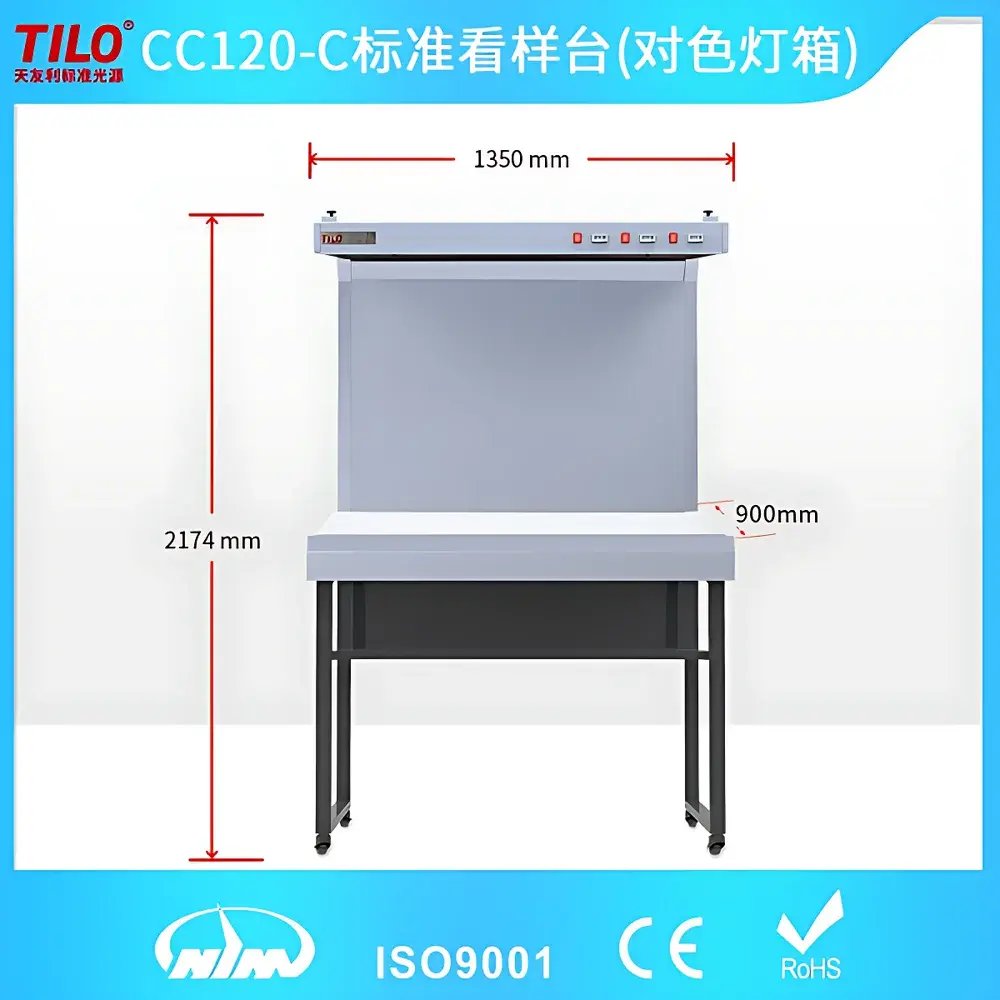
- Optimized optical path: Imported specular aluminum reflector + matte-finish polycarbonate diffuser plate achieves <5% spatial illuminance variation across 1200 × 600 mm viewing aperture
- EMC-compliant power supply with thermal cutoff protection; meets IEC 61000-6-3 for industrial electromagnetic compatibility
Sample Compatibility & Compliance
The CC120-C accommodates rigid and flexible substrates up to 10 mm thickness and 1200 mm width. Its open-front design permits direct placement of press sheets, fabric swatches, injection-molded parts, or laminated composites without mechanical constraints. For transmission mode, translucent samples are mounted on the internal rear carrier grid (supplied), ensuring repeatable positioning relative to the UV-enhanced backlight array. The booth satisfies ISO 3664:2009 requirements for illuminant spectral power distribution (SPD), correlated color temperature (CCT = 6500 K ± 200 K for D65), and illuminance uniformity (≥500 lux at viewing plane). It is routinely deployed in GLP-compliant print labs, textile dye houses certified to ISO 17025, and automotive Tier-1 suppliers operating under IATF 16949 color management protocols.
Software & Data Management
While the CC120-C operates as a standalone optical reference device, its lamp-hour counter outputs TTL-level signals compatible with external SCADA or MES systems via optional RS-485 interface module (TILO Part #CC120-IO-485). Lamp usage logs support predictive maintenance scheduling aligned with ISO 3664’s 2000-hour lamp service life recommendation. Audit trails generated by integrated timer data comply with FDA 21 CFR Part 11 electronic record requirements when paired with validated data acquisition software. No proprietary firmware or cloud connectivity is implemented — all control logic resides in hardened industrial-grade microcontrollers to ensure deterministic response and immunity to network-based security vulnerabilities.
Applications
- Print & Packaging: Press proof verification against digital proofs under D65 and FWA-compensated TL84; spot-color matching for Pantone®-certified workflows
- Textiles & Apparel: Dye lot comparison across multiple illuminants to detect metameric failure in reactive-dyed cotton or polyester blends
- Plastics & Polymers: Evaluation of pigment dispersion homogeneity and batch-to-batch hue consistency in ABS, PP, and PC injection-molded components
- Automotive Interiors: Trim panel color validation under D65 (daylight) and A (incandescent) sources per SAE J1740 specifications
- Paint & Coatings: Visual assessment of metallic flake orientation and flop effect under directional D65 illumination
FAQ
What is the recommended lamp replacement interval?
Per ISO 3664:2009 Annex B, fluorescent lamps must be replaced after 2000 hours of cumulative operation or every 12 months — whichever occurs first — to maintain spectral fidelity and CCT stability.
Can the CC120-C be used for evaluating fluorescent or phosphorescent materials?
Yes. The integrated UV-A (365 nm) lamp bank enables detection of optical brightening agents (OBAs) and verification of fluorescence response in security inks, medical device packaging, and archival papers.
Is calibration documentation provided with shipment?
Each unit ships with a factory-issued Certificate of Conformance referencing ISO 3664:2009 test parameters, including measured CCT, CRI (Ra), and illuminance uniformity map — traceable to NIM (China National Institute of Metrology) standards.
Does the booth meet electrical safety requirements for EU export?
Yes. Certified to IEC 61000-6-2 (immunity) and IEC 61000-6-4 (emissions), with CE marking affixed and full technical file available upon request.
How is viewing angle controlled during assessment?
The fixed 25° viewing surface slope and 45°/0° illumination geometry conform to ISO 3664’s specified observer position, eliminating variability from manual adjustment while maintaining compliance with ASTM D1729 and ISO 13655 measurement geometries.





