
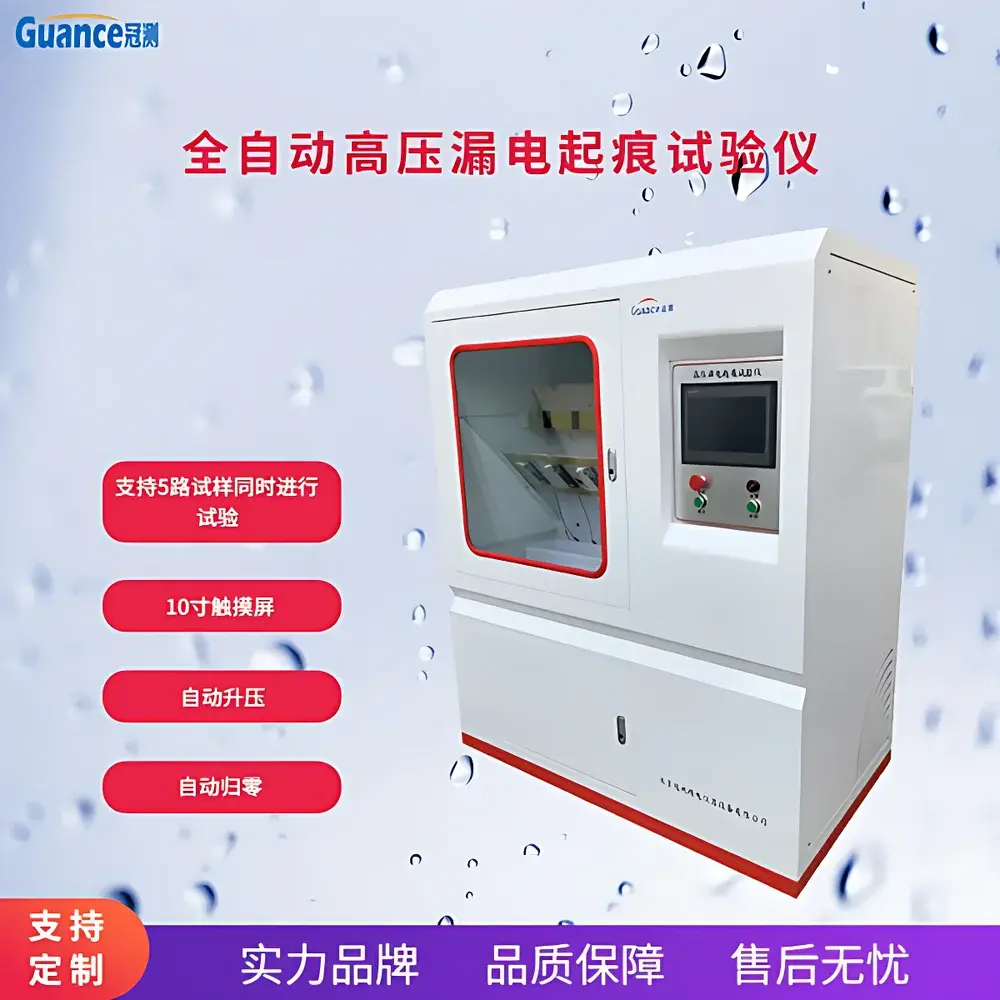
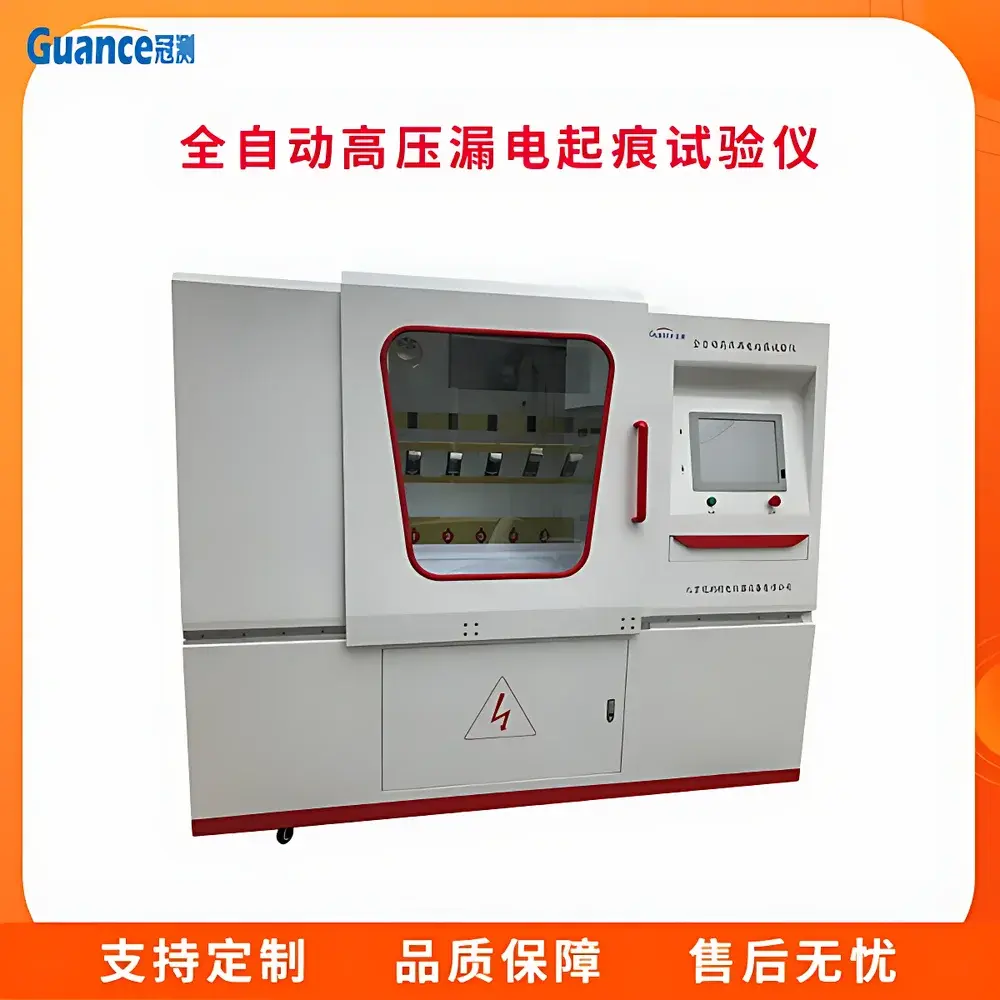
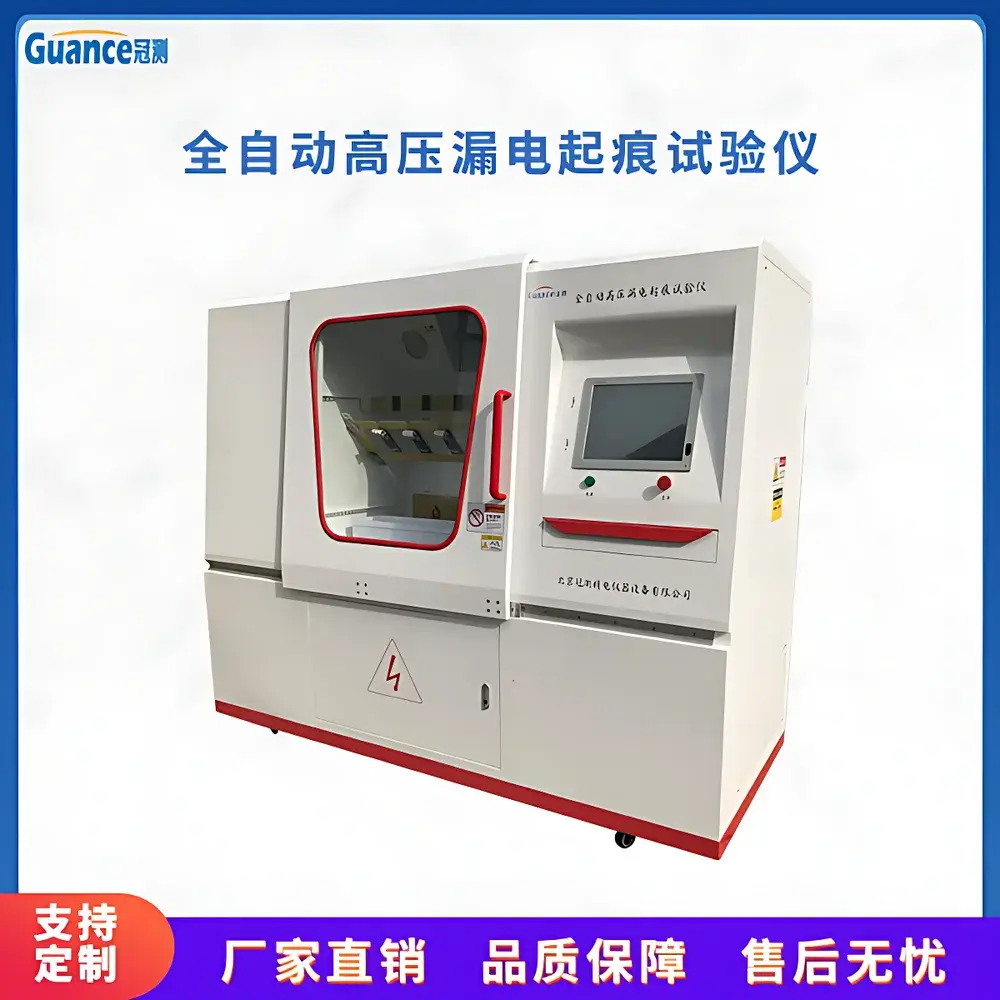
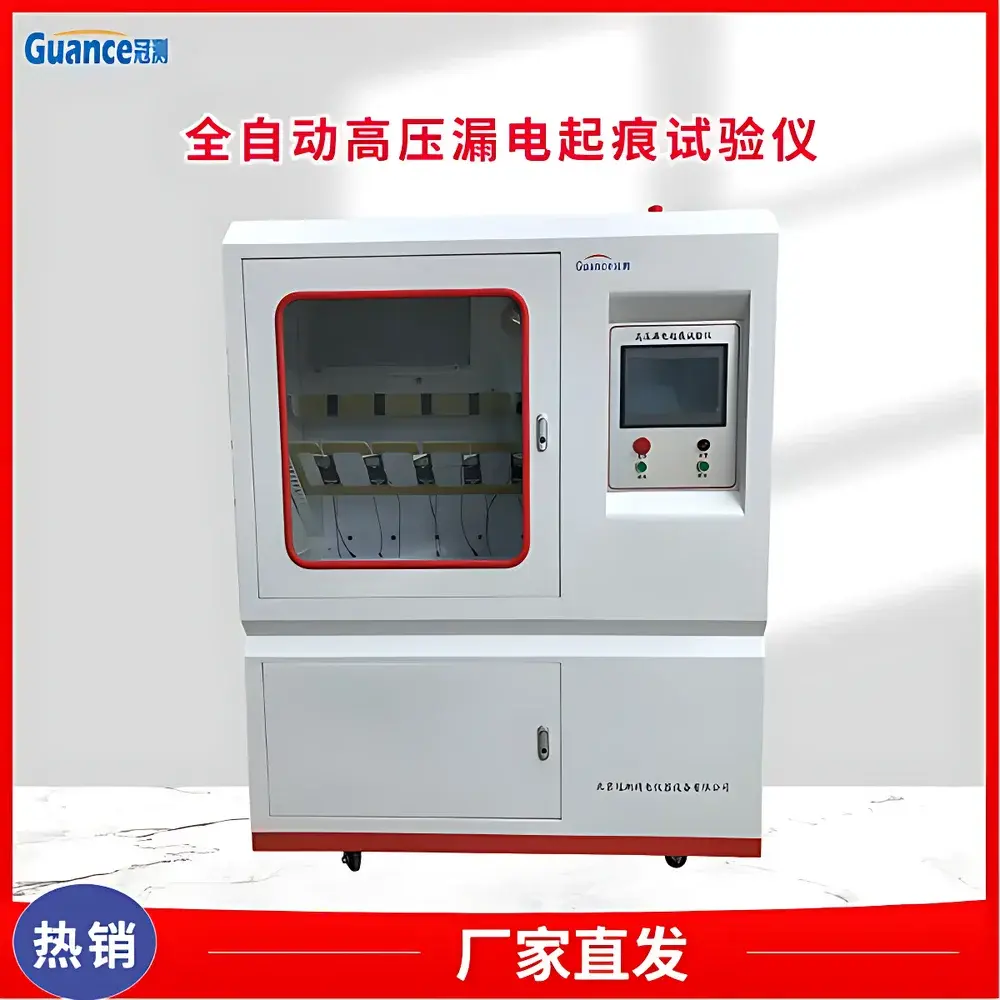
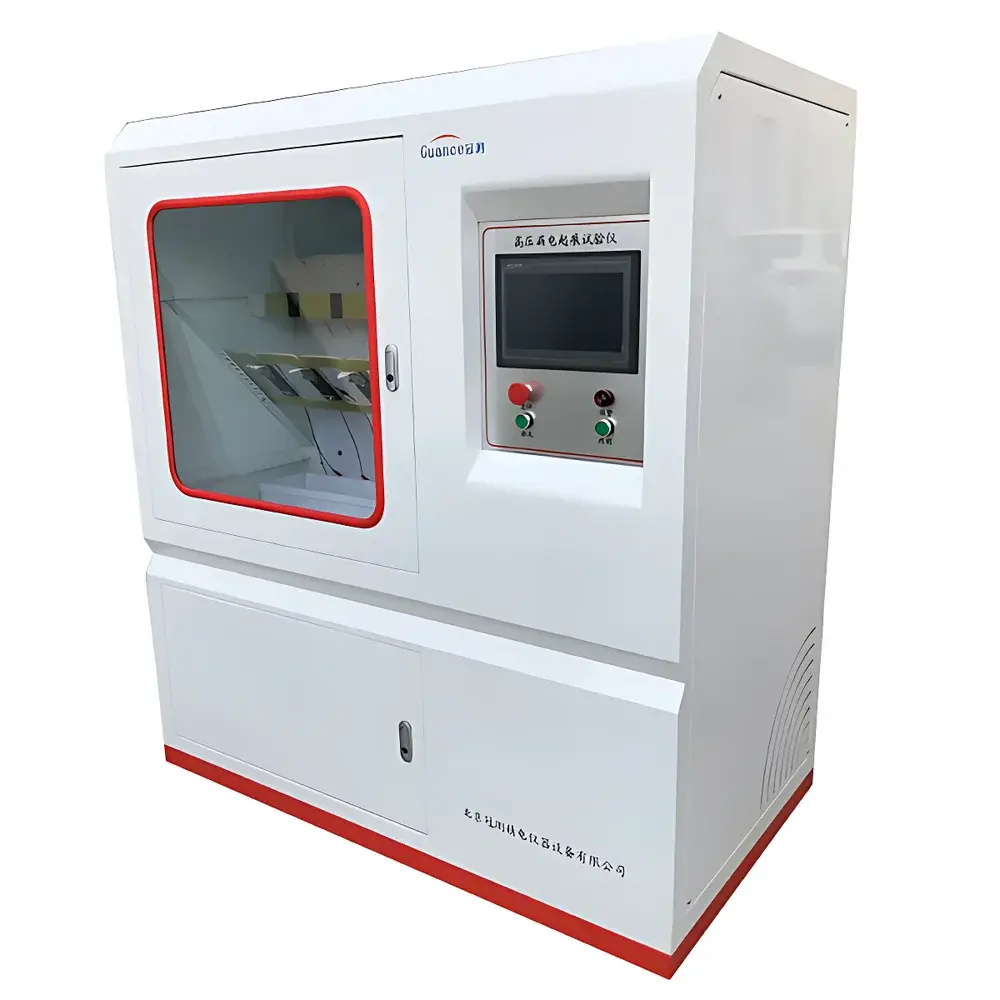
Guance Instruments NLD-AI4 Automated Tracking Resistance Universal Tester
| Brand | Guance Instruments |
|---|---|
| Origin | Beijing, China |
| Manufacturer Type | Authorized Distributor |
| Country of Origin | China |
| Model | NLD-AI4 |
| Instrument Type | Electronic Universal Testing Machine |
| Compliance | GB/T 6553–2003, IEC 60587:1984 |
| Output Voltage | AC 100–8000 V / DC 100–8400 V |
| Electrical Capacity | 7 kVA |
| Input Voltage | AC 220 V, 50 Hz |
| Voltage Drop | ≤5% at rated load |
| Electrode Spacing | (50 ± 0.5) mm |
| Electrode Material | 304 stainless steel |
| Electrode Mounting | Separated upper/lower electrode fixture with high-insulation, high-strength composite support |
| Sample Capacity | 5 specimens simultaneously |
| Droplet Control | Programmable peristaltic pump with real-time flow display |
| Leakage Current Alarm Range | 0–100 mA (user-configurable per channel) |
| Test Duration | User-defined (minutes) |
| Safety Interlock | Automatic HV cutoff upon door opening |
| Voltage Regulation | Autotransformer + oil-immersed step-up transformer |
| Calibration | Onboard voltage and current calibration function |
| Test Methods | Constant-voltage method, stepwise-voltage method |
| Ventilation System | Dedicated exhaust ducting for hazardous fume removal |
| Illumination | Integrated LED lighting for internal observation |
Overview
The Guance Instruments NLD-AI4 Automated Tracking Resistance Universal Tester is an engineered solution for evaluating the comparative tracking index (CTI) and erosion resistance of solid electrical insulating materials under severe environmental stress. Designed in strict accordance with GB/T 6553–2003 and IEC 60587:1984, this system applies controlled high-voltage stress across inclined test specimens while introducing standardized contaminant solutions—typically ammonium chloride (NH₄Cl) or sodium chloride (NaCl)—to simulate conductive pollution accumulation on insulator surfaces in humid, contaminated service environments. The instrument operates using either constant-voltage or stepwise-voltage protocols, enabling precise determination of the voltage threshold at which electrical tracking initiates and propagates along the material surface. Its dual-mode high-voltage output (AC: 100–8000 V; DC: 100–8400 V), combined with a stable 7 kVA power capacity and ≤5% voltage drop under full load, ensures reproducible test conditions essential for comparative qualification and material certification.
Key Features
- Parallel multi-channel testing: Supports simultaneous evaluation of up to five specimens, each with independent high-voltage supply, leakage current monitoring, and programmable alarm thresholds (0–100 mA).
- Industrial-grade control architecture: Core logic implemented via Siemens PLC with opto-isolated voltage/current acquisition, minimizing electromagnetic interference and ensuring long-term signal integrity in high-noise laboratory environments.
- Intuitive human-machine interface: 10-inch capacitive touchscreen display provides real-time visualization of per-channel parameters—including instantaneous and peak leakage current, applied voltage, elapsed test time, and droplet flow rate.
- Precision fluid delivery: Peristaltic pump enables accurate, user-adjustable contaminant dosing (0.01–1.00 mL/min range); flow rate is continuously displayed and logged alongside electrical data.
- Fail-safe interlocks: Door-open detection triggers immediate HV disconnection across all channels; individual channel over-current events isolate only the affected circuit without interrupting concurrent tests.
- Stable high-voltage generation: Two-stage regulation—autotransformer pre-regulation followed by fixed-ratio oil-immersed transformer—ensures minimal voltage sag and thermal drift during extended tests.
- Maintainable metrology: Onboard calibration routines allow periodic verification and correction of voltage and current measurement circuits, supporting traceable compliance with ISO/IEC 17025 quality requirements.
Sample Compatibility & Compliance
The NLD-AI4 accommodates standard test specimens measuring 100 mm × 100 mm × 3–6 mm, including ceramic insulators, silicone rubber housings, epoxy encapsulants, polymeric bushings, and other dielectric components used in medium- and high-voltage equipment. Electrodes are precision-machined from corrosion-resistant 304 stainless steel and mounted on high-dielectric-strength composite fixtures to eliminate parasitic leakage paths. The system supports both horizontal and inclined (45°) specimen mounting configurations per IEC 60587. All mechanical and electrical subsystems conform to IEC 61000-4 electromagnetic compatibility standards. For regulatory submissions, test reports generated by the NLD-AI4 meet documentation requirements for ASTM D3638 (CTI determination), UL 746A (polymeric materials), and EN 60695-2-10/11/12 (fire hazard testing). Optional audit trail logging and electronic signature modules support 21 CFR Part 11 compliance for pharmaceutical and medical device applications.
Software & Data Management
Data acquisition and test sequencing are managed through embedded firmware with timestamped, channel-specific logging at 100 ms resolution. Each test session exports structured CSV files containing voltage, current, time, droplet count, and alarm status metadata. Optional PC-based software (sold separately) adds advanced features: automated CTI calculation per IEC 60112 methodology, statistical trend analysis across material batches, customizable report templates compliant with GLP/GMP documentation frameworks, and secure user role management (administrator/operator/viewer). Raw data files are stored in non-proprietary formats to ensure long-term archival accessibility and third-party validation readiness.
Applications
- Qualification of polymer formulations for outdoor insulators and cable terminations operating in coastal or industrial atmospheres.
- Comparative assessment of silicone rubber vs. ethylene propylene diene monomer (EPDM) housing materials under accelerated contamination cycles.
- Development screening of nano-filled composites intended for high-CTI printed circuit board substrates.
- Third-party certification testing per UL, CSA, and VDE standards for electrical enclosures and switchgear components.
- Root-cause analysis of field failures attributed to surface tracking in photovoltaic junction boxes and EV charging connectors.
FAQ
What standards does the NLD-AI4 fully comply with?
GB/T 6553–2003, IEC 60587:1984, IEC 60112 (for CTI), and ASTM D3638. Optional configuration supports UL 746A and EN 60695 series requirements.
Can the system perform both AC and DC tracking tests?
Yes—the NLD-AI4 delivers independently regulated AC (100–8000 V) and DC (100–8400 V) outputs, allowing direct comparison of material behavior under both waveform types.
Is remote monitoring or network connectivity supported?
Standard Ethernet port enables local network access for file export and firmware updates; optional OPC UA or Modbus TCP integration is available for factory automation environments.
How is test repeatability ensured across multiple operators?
Through hardware interlocks (e.g., door safety cutoff), automatic voltage ramping/zeroing, calibrated current sensing, and deterministic droplet timing—minimizing operator-dependent variables per ISO 5725 guidelines.
Does the system include validation documentation for laboratory accreditation?
Yes—factory calibration certificates (traceable to CNAS-accredited labs), IQ/OQ documentation templates, and maintenance logs are provided with each unit to support ISO/IEC 17025 implementation.



