
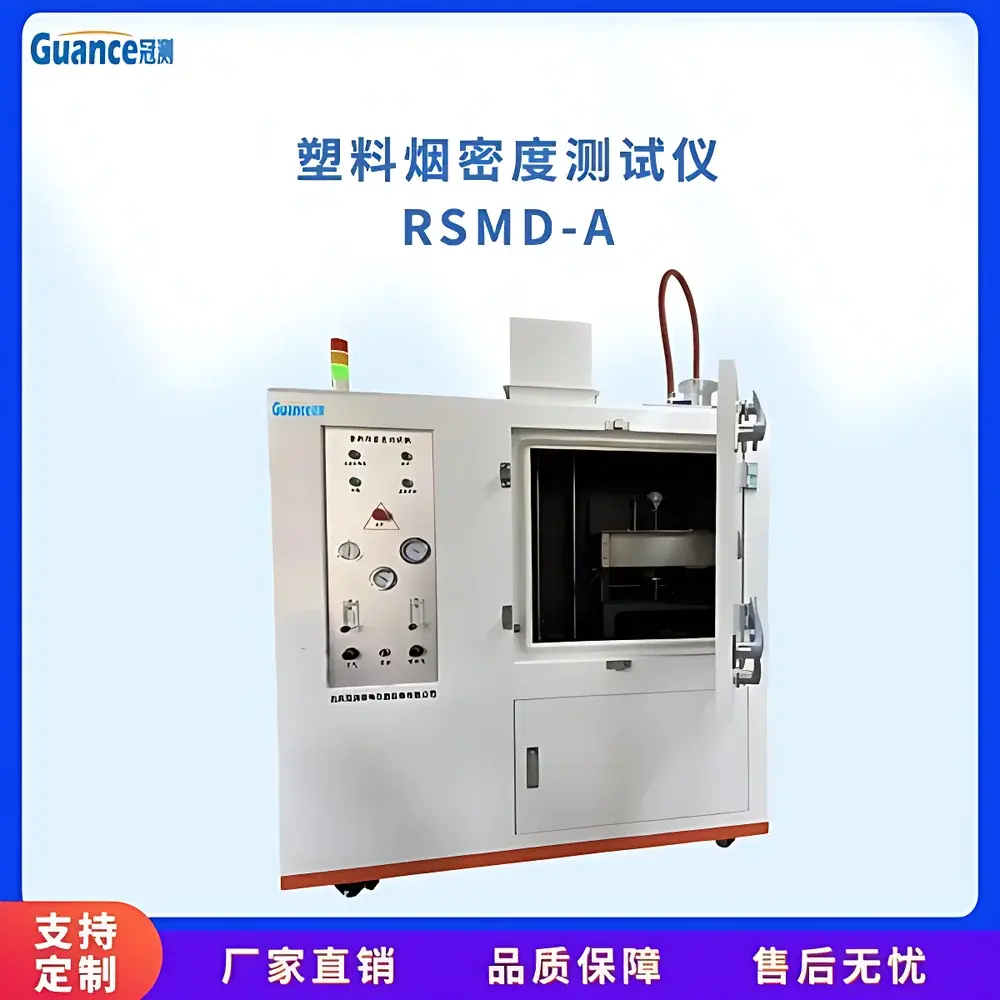
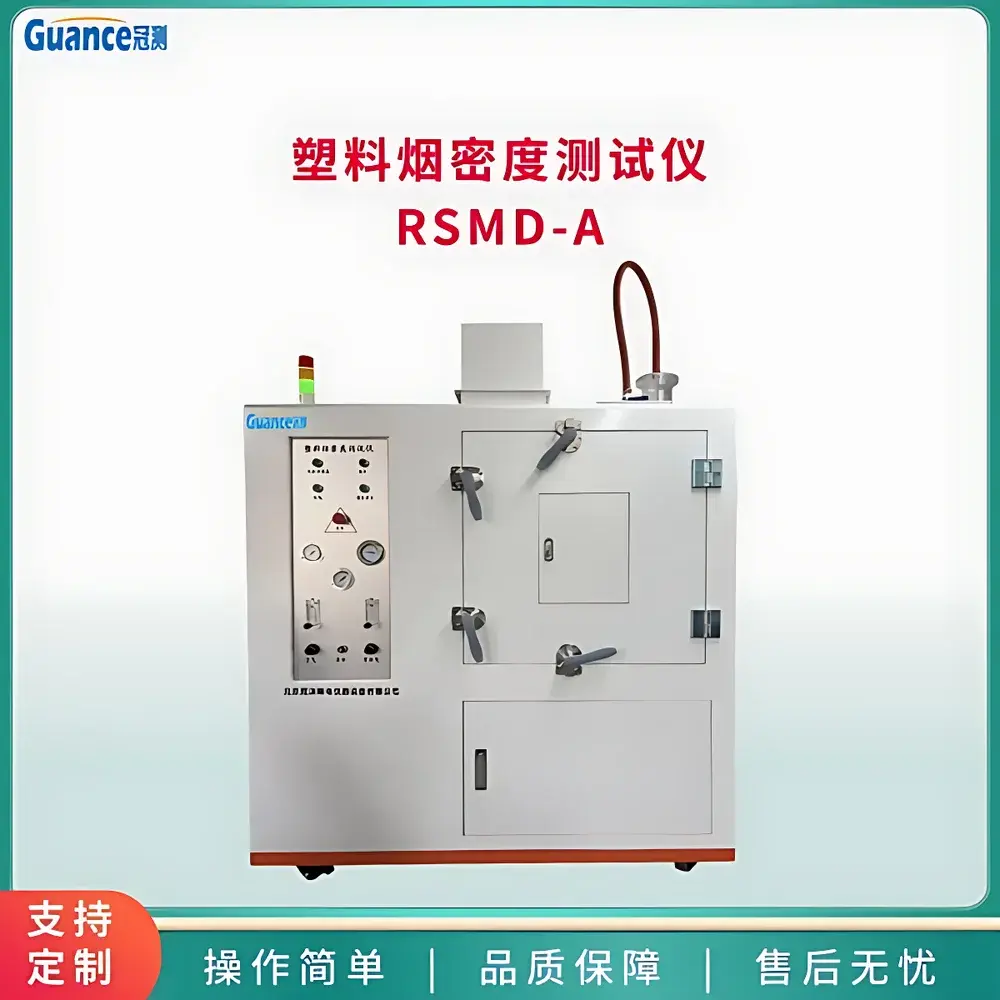
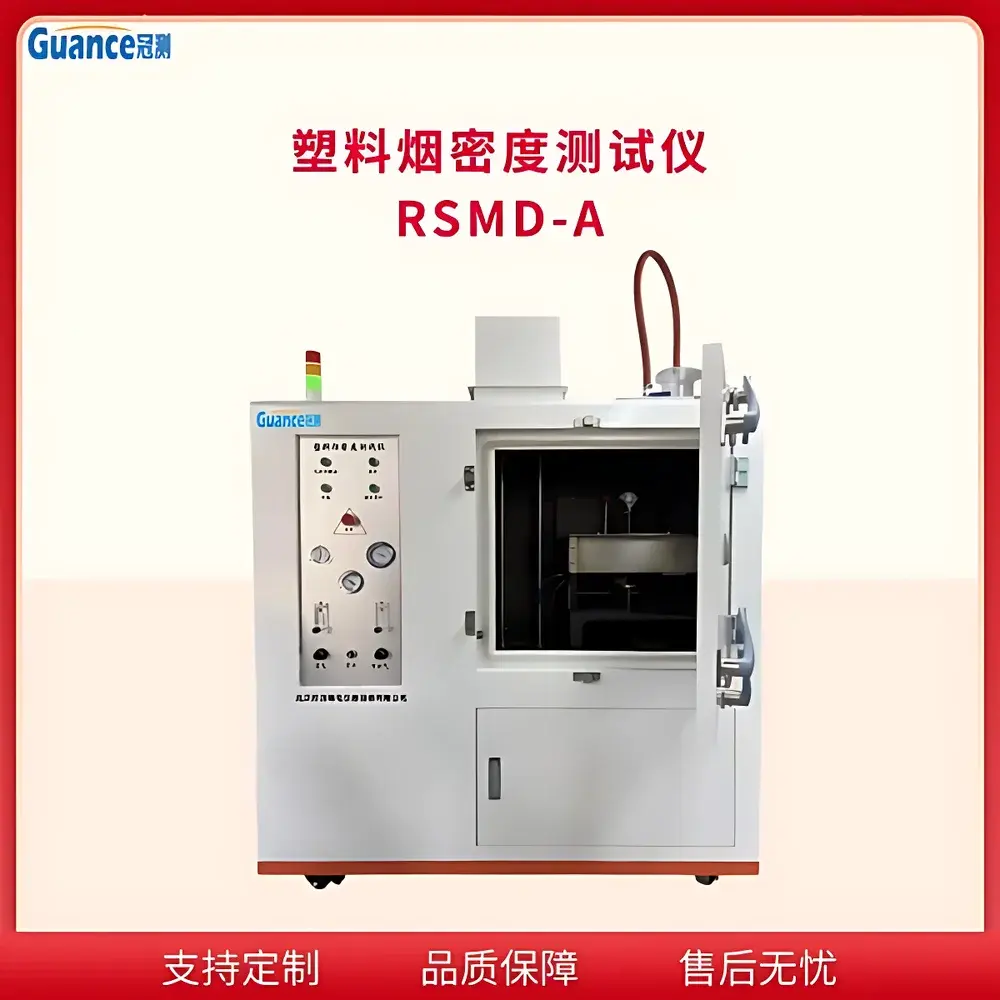
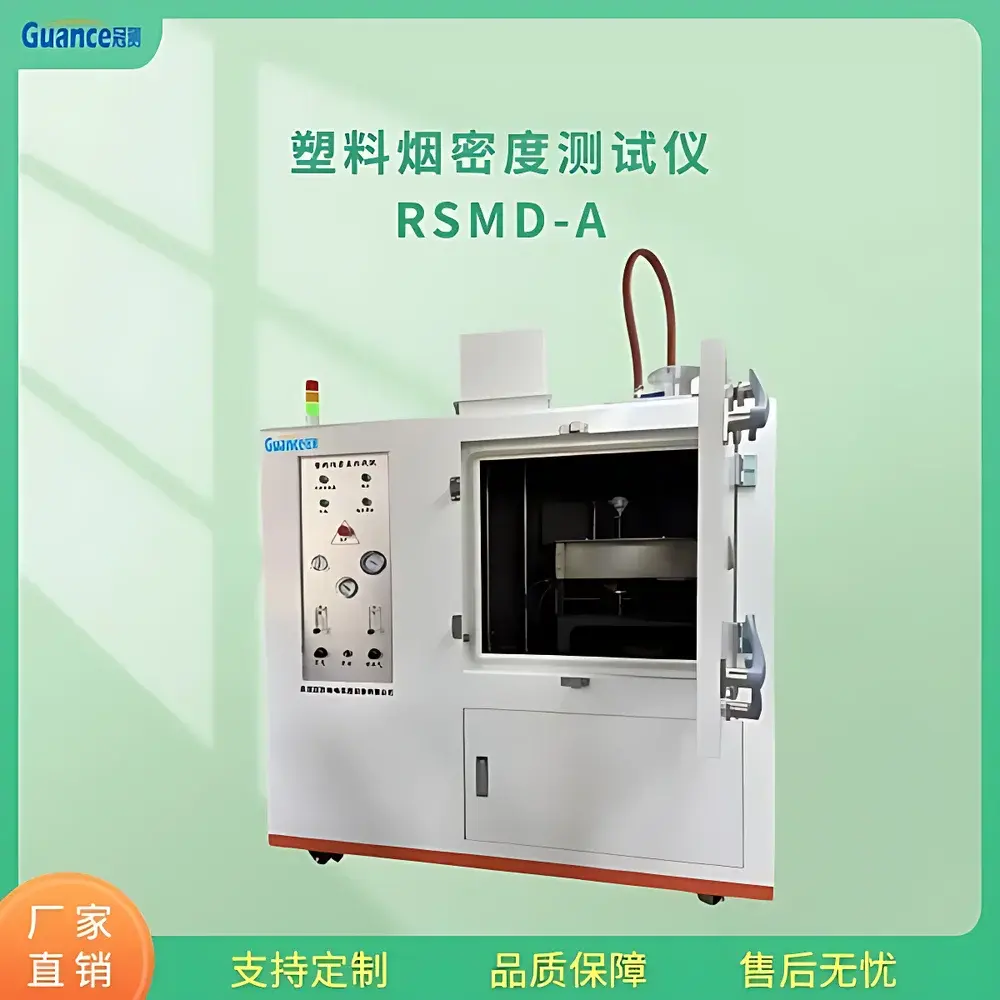
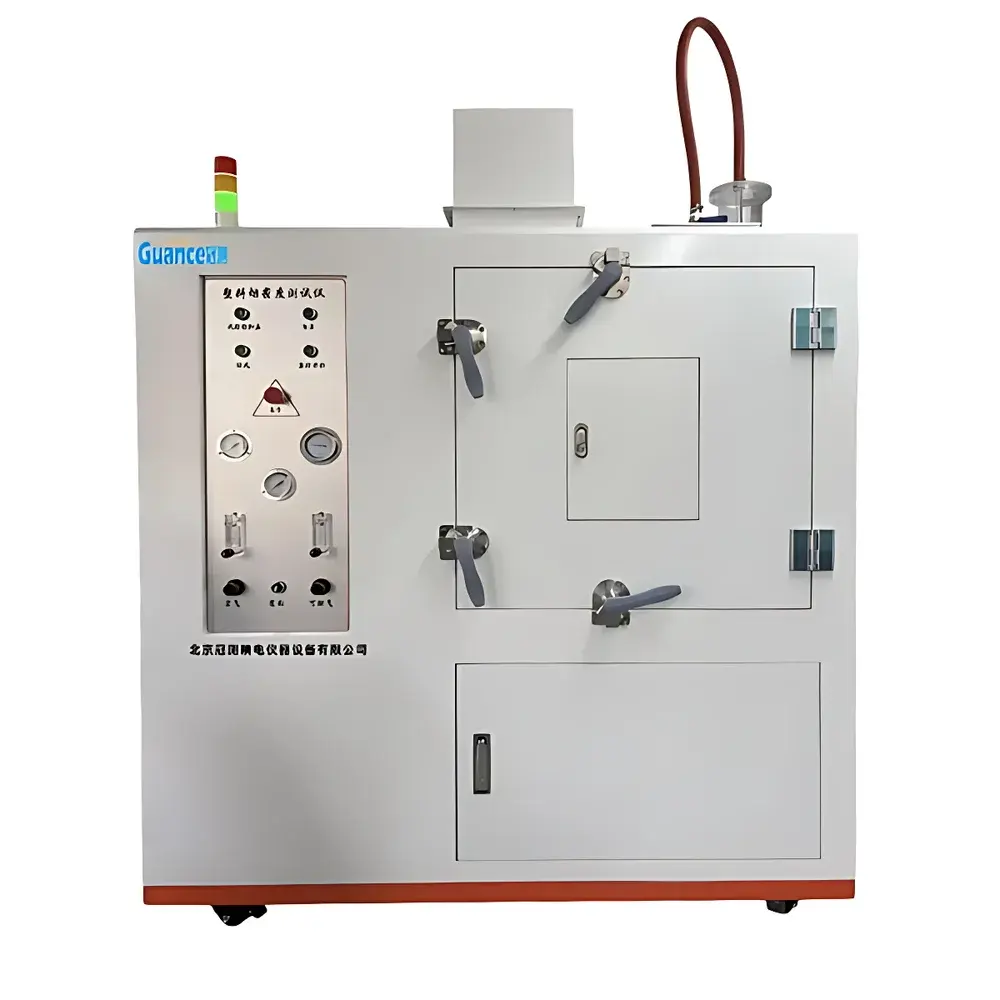
Guance Instruments RSMD-A Smoke Density Chamber for Plastic Combustion Testing
| Brand | Guance Instruments |
|---|---|
| Origin | Beijing, China |
| Manufacturer Type | Authorized Distributor |
| Country of Origin | China |
| Model | RSMD-A |
| Price | USD 1,580 (FOB Beijing) |
Overview
The Guance Instruments RSMD-A Smoke Density Chamber is a precision-engineered test apparatus designed to quantify the specific optical density of smoke generated during the controlled combustion of polymeric materials under standardized single-chamber conditions. It operates on the principle of measuring the attenuation of a collimated light beam (6.5 V tungsten-filament lamp, A-illuminant spectral distribution, color temperature 2854 K) as it traverses a defined smoke-filled volume. The instrument calculates specific optical density (Ds) in real time according to Beer–Lambert law-based photometric analysis, with Ds = –log10(T), where T is transmittance. The maximum specific optical density (Ds,max) recorded over the test duration serves as the primary performance metric for smoke generation propensity. This method is fundamental to fire safety evaluation in material development, regulatory compliance, and product qualification across plastics, elastomers, coated textiles, wood composites, and interior finishing materials.
Key Features
- Robust 914 mm × 914 mm × 610 mm test chamber fabricated from 2 mm thick 304 stainless steel with high-temperature powder coating—engineered to maintain structural integrity and long-term gas-tight sealing under transient pressure events up to ±5 kPa.
- Integrated pressure-sensing and active ventilation control: A calibrated pressure transducer continuously monitors internal chamber pressure; upon exceeding user-defined thresholds, a PLC-triggered pneumatic actuator opens a Φ50 mm exhaust port—eliminating reliance on sacrificial rupture membranes and enabling repeatable, maintenance-free overpressure mitigation.
- Dual 75 mm optical windows with independent PID-controlled heating (50–55 °C ± 0.5 °C) using 9 W ring heaters and dedicated temperature modules—preventing condensation and soot deposition while ensuring stable photometric baseline per ISO 5659-2 and GB/T 8323.2 requirements.
- High-stability radiant heat source: 2600 W Incoloy 840 alloy radiant cone delivering adjustable incident flux between 10 kW/m² and 50 kW/m² at specimen center, with uniformity verified at ±15% across ±25 mm radius; thermally stabilized via isolated 3000 W transformer and Siemens PLC-based closed-loop temperature control (±2 °C).
- Reference-grade photodetection system: Hamamatsu photomultiplier tube (PMT) operating at –1000 V DC, coupled with ND-0.5 (31.7% T) and ND-2.0 (0.95% T) neutral density filters, precision convex lenses (Ø51 mm), and calibrated optical dark boxes—achieving dark current < 0.001 µA and spectral response matched to human photopic vision (550–650 nm).
Sample Compatibility & Compliance
The RSMD-A accommodates flat, rigid specimens up to 75 mm × 75 mm × 10 mm (thickness), including thermoplastics, thermosets, fiber-reinforced composites, rubber compounds, laminated textiles, painted substrates, and engineered wood panels. It fully conforms to the operational and metrological requirements of ISO 5659-2:2006 “Plastics — Smoke generation — Part 2: Determination of optical density by a single-chamber test” and GB/T 8323.2–2008 “Plastics — Smoke generation — Part 2: Single-chamber test method for determination of smoke density”. All critical subsystems—including radiant flux calibration, photometric linearity verification, window temperature uniformity, and pressure-response timing—are traceable to national standards and support GLP-compliant documentation workflows.
Software & Data Management
The embedded control and acquisition software provides synchronized real-time logging of transmittance (%T), specific optical density (Ds), chamber pressure (kPa), radiant cone surface temperature (°C), and gas flow rates (cm³/min). Raw data are stored in CSV format with timestamped metadata, supporting post-test analysis in third-party tools (e.g., MATLAB, Excel). The system supports audit-trail functionality—recording operator ID, parameter changes, calibration events, and test start/stop triggers—aligning with basic FDA 21 CFR Part 11 principles for electronic records in non-GMP research environments. Calibration certificates for PMT gain, neutral density filters, and thermal sensors are retained digitally within the software archive.
Applications
This instrument is routinely deployed in polymer formulation labs to screen flame-retardant additives (e.g., aluminum trihydrate, phosphinate salts, intumescent systems) for smoke suppression efficacy; in automotive OEM component validation to meet FMVSS 302 and ISO 3795 interior material requirements; in construction product certification for EN 13501-1 classification; and in academic fire science research investigating smoke particle morphology and pyrolysis kinetics. Its reproducible Ds,max output enables comparative ranking of material classes, supports FRA (Fire Risk Assessment) modeling inputs, and satisfies mandatory reporting criteria for CE-marked building products.
FAQ
What standards does the RSMD-A directly support?
ISO 5659-2:2006 and GB/T 8323.2–2008 are fully implemented in hardware design, optical path geometry, thermal control logic, and software calculation algorithms.
Can the RSMD-A test non-plastic materials?
Yes—provided specimens meet dimensional constraints and produce measurable smoke under radiant exposure, it is validated for rubber, coated fabrics, wood-based panels, and surface-treated metals.
Is the photomultiplier tube calibrated traceably?
Each unit ships with a factory calibration report referencing NIST-traceable neutral density filters and spectral irradiance standards; users may perform routine verification using certified optical density reference filters (OD 3.0, 550–650 nm).
How is gas flow controlled during testing?
Propane (95% purity) and compressed air are metered via dual precision rotameters (1–100 cm³/min and 5–500 cm³/min), regulated by proportional solenoid valves and monitored in real time via the PLC interface.
What safety interlocks are integrated?
Hardware-enforced interlocks include door-open inhibition, overtemperature shutdown (>850 °C at cone surface), overpressure vent activation, and flame-out detection via thermocouple feedback—meeting IEC 61000-6-2 EMC immunity and Class I electrical safety requirements.



