
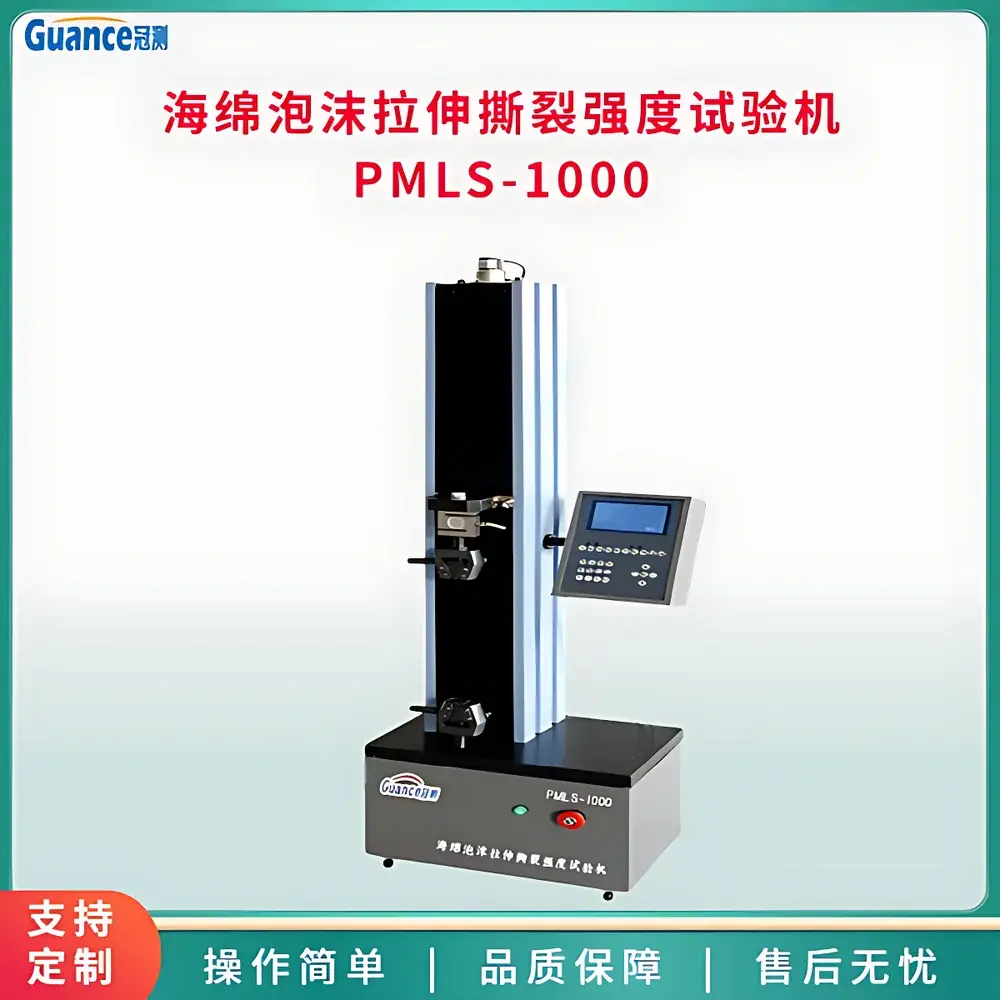
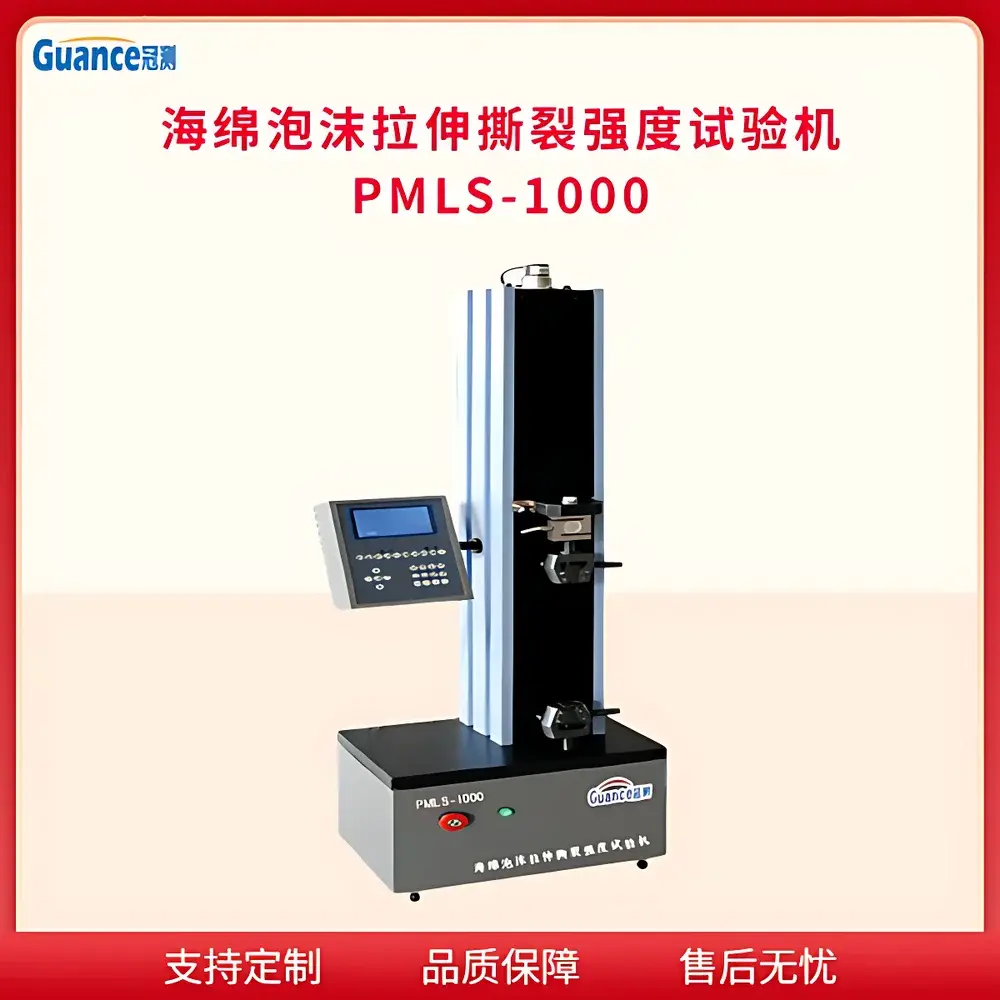
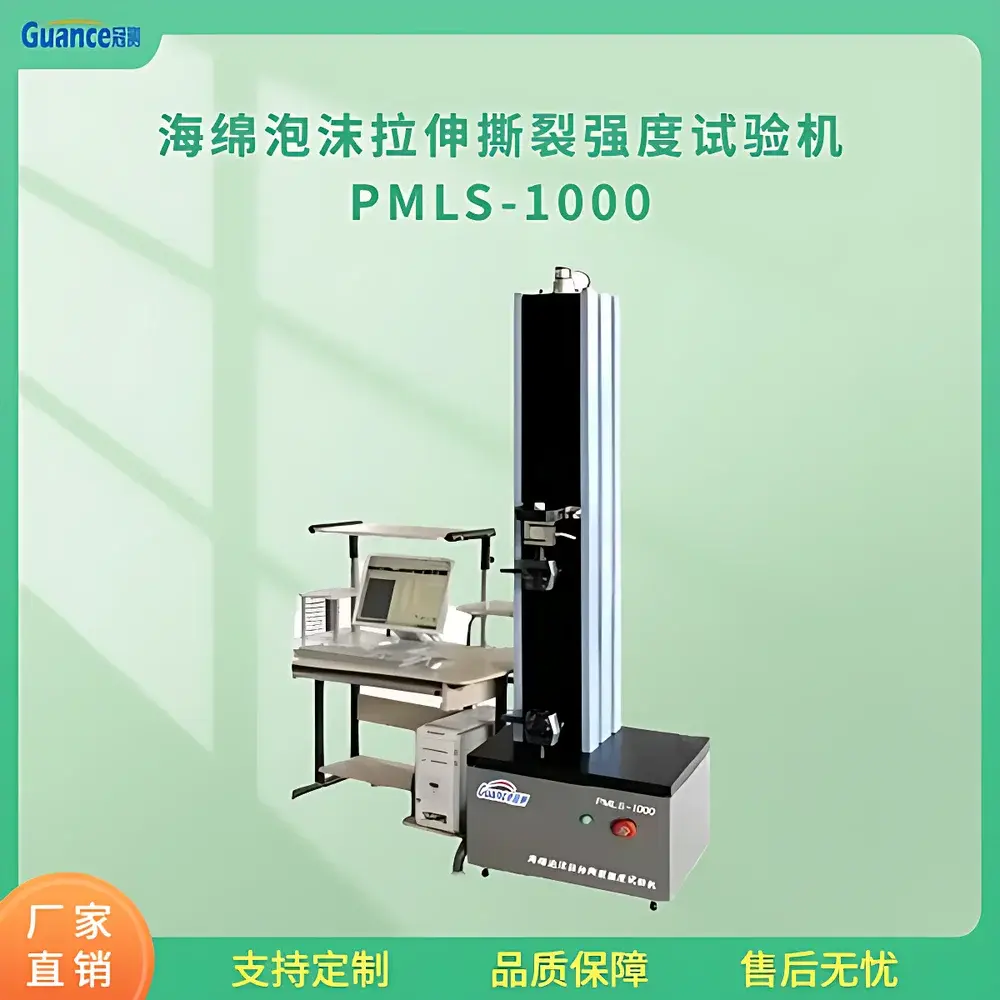
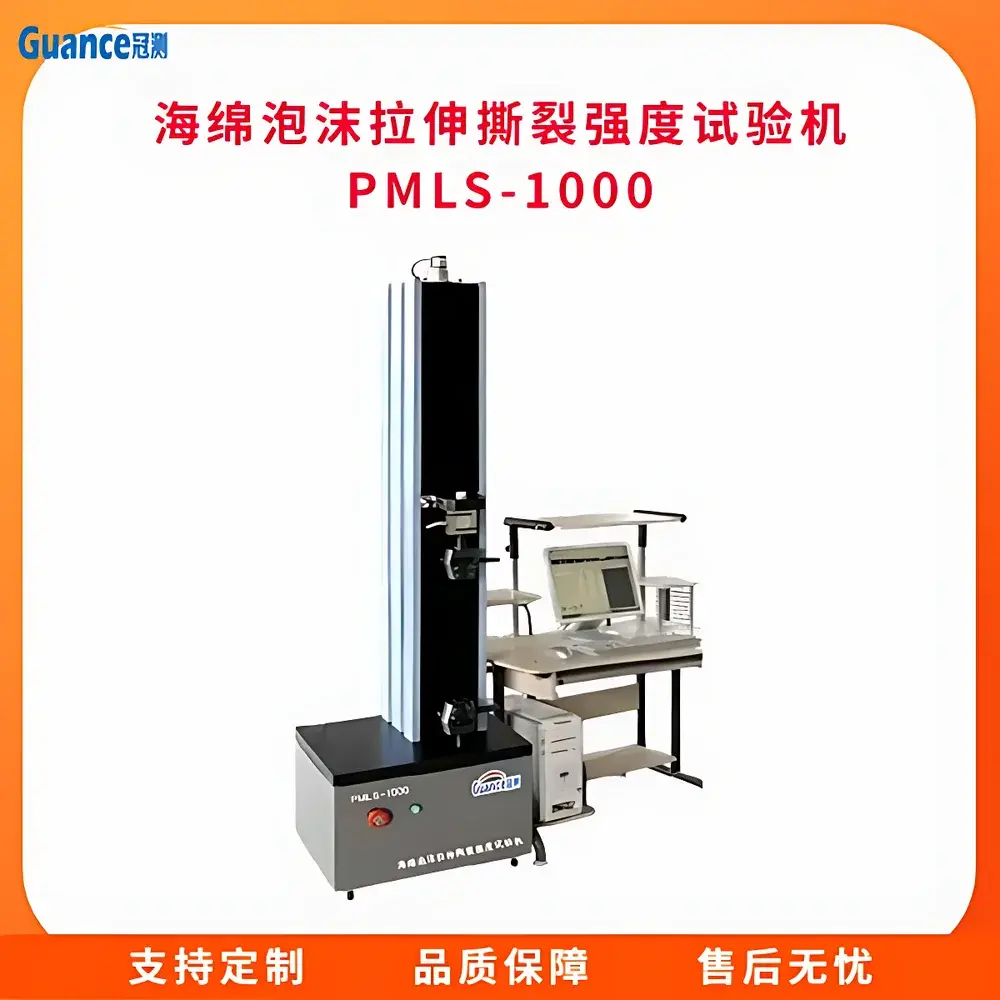
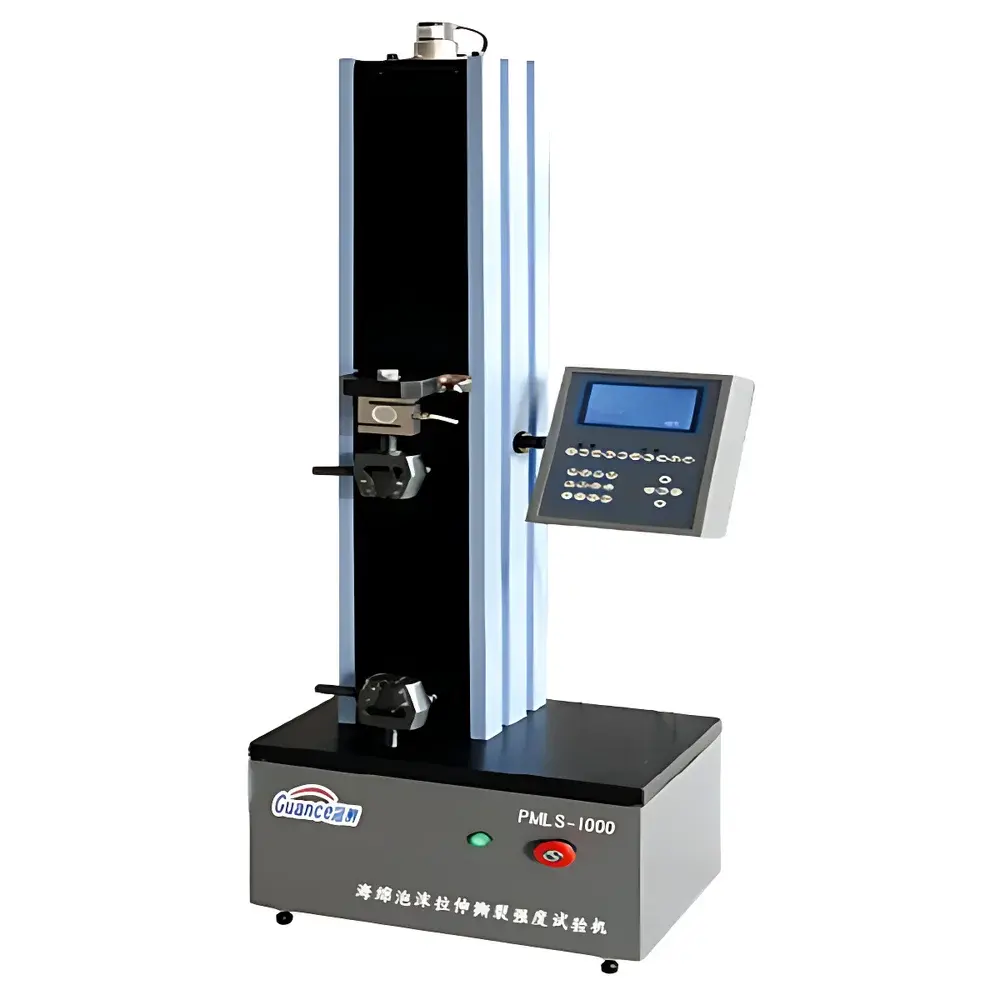
GuanCe PMLS-1000 Tensile & Tear Strength Tester for Flexible Foam and Sponge Materials
| Brand | GuanCe Instruments |
|---|---|
| Origin | Beijing, China |
| Model | PMLS-1000 |
| Max Test Force | 0–1000 N (Single-Column Configuration) |
| Force Measurement Range | 0–1000 N |
| Force Accuracy | Better than ±1% of indicated value |
| Crosshead Speed Range | 0.05–300 mm/min |
| Displacement Resolution | 0.01 mm |
| Displacement Accuracy | Better than ±1% of indicated value |
| Stroke | 0–800 mm (excluding fixtures) |
| Compliance | GB/T 6344–2008, GB/T 10808–2006, ISO 1798–1997 |
Overview
The GuanCe PMLS-1000 Tensile & Tear Strength Tester is a dedicated mechanical testing system engineered for the precise quantification of tensile strength, elongation at break, and tear resistance in flexible polymeric foam materials—including open-cell and closed-cell polyurethane, polyester, latex, and viscoelastic foams. Operating on the principle of controlled uniaxial force application via a servo-controlled electromechanical drive, the instrument conforms to internationally recognized test standards including ISO 1798:1997 (Flexible cellular polymeric materials — Determination of tensile strength and elongation at break), GB/T 6344–2008 (Soft cellular polymeric materials — Determination of tensile strength and elongation at break), and GB/T 10808–2006 (High-polymer porous elastic materials — Determination of tear strength). Its single-column, rigid frame architecture ensures high structural stiffness and minimal deflection under load—critical for maintaining measurement fidelity across low-force regimes typical of soft foam specimens.
Key Features
- Electromechanical actuation system featuring a fully digital speed-controlled AC servo motor coupled with a precision ground ball screw and arc-synchronous belt reduction for smooth, low-noise crosshead motion.
- Real-time dynamic display of test parameters—including load (N), displacement (mm), crosshead speed (mm/min), peak load, and real-time stress–strain curve—on a high-contrast 7-inch LCD touchscreen interface with Chinese/English bilingual support.
- Three-step programmable speed switching during test execution, enabling rapid positioning, controlled loading ramping, and post-failure retraction without interrupting data acquisition.
- Dual-stage safety protection: hardware-based mechanical limit switches complement software-defined programmable travel limits to prevent over-travel or fixture collision.
- Overload protection triggered at 103–105% of full-scale capacity (1000 N), automatically halting motion and preserving sensor integrity.
- Auto-return function returns the crosshead to the pre-test home position following test completion; auto-stop functionality engages immediately upon specimen rupture detection.
- Integrated thermal-printer module supports on-demand hardcopy output of test reports—including date/time stamp, sample ID, test parameters, and key metrics (e.g., tensile strength in kPa, elongation %, tear force in N).
Sample Compatibility & Compliance
The PMLS-1000 is optimized for standardized dumbbell- or rectangular-strip specimens cut from flexible foam sheets per ISO 1798 and GB/T 6344 protocols. Compatible specimen thickness ranges from 10 mm to 50 mm (with optional compression platens or pneumatic grips available for non-standard geometries). All force and displacement measurements are traceable to national metrological standards, and the system’s ±1% force accuracy and 0.01 mm displacement resolution meet minimum requirements for GLP-compliant physical property documentation in R&D and QC laboratories. While not inherently 21 CFR Part 11 compliant, audit trails and electronic records can be generated externally via exported CSV files for integration into validated LIMS or QMS platforms.
Software & Data Management
The embedded firmware supports local storage of up to 200 test records with timestamped metadata. Raw force–displacement data is exportable via USB port in comma-separated values (CSV) format, compatible with Excel, OriginLab, MATLAB, and statistical process control (SPC) software. No proprietary software installation is required for basic operation; however, optional PC-based analysis modules enable advanced curve fitting (e.g., Young’s modulus calculation from linear region), batch report generation, and comparative trend analysis across material lots or processing conditions.
Applications
- Quality assurance of automotive seat cushioning, mattress cores, and packaging foam inserts.
- R&D evaluation of formulation changes—e.g., catalyst concentration, blowing agent ratio, or filler addition—in polyurethane foam synthesis.
- Validation of aging effects (thermal, UV, or humidity exposure) on mechanical integrity of elastomeric foams.
- Comparative assessment of biodegradable foam alternatives (e.g., soy-based or starch-blended foams) against petroleum-derived benchmarks.
- Supplier qualification testing per OEM specifications requiring conformance to ASTM D3574 (Flexible Cellular Materials — Slab, Bonded, and Molded Urethane Foams).
FAQ
What types of foam materials are supported by the PMLS-1000?
It is validated for flexible open- and closed-cell polymeric foams—including polyurethane, polyethylene, latex, and thermoplastic elastomer (TPE) foams—with densities ranging from 15–120 kg/m³.
Does the system support ASTM D3574 test methods?
Yes—while optimized for ISO 1798 and GB/T standards, its force range, speed control, and grip geometry are fully compatible with ASTM D3574 Sections A (Tensile Strength), B (Tear Strength), and C (Tensile Set) when configured with appropriate fixtures.
Can test data be integrated into a laboratory information management system (LIMS)?
Direct LIMS integration is not built-in, but CSV exports contain all raw and calculated parameters required for manual or scripted ingestion into validated enterprise systems.
Is calibration certification included with delivery?
A factory calibration certificate (traceable to CNAS-accredited reference standards) is provided; users are advised to perform periodic verification using certified load cells and displacement gauges per ISO/IEC 17025 guidelines.
What maintenance is required for long-term reliability?
Routine maintenance includes periodic lubrication of the ball screw assembly, inspection of synchronous belt tension, and verification of encoder alignment—typically every 6 months under continuous operation.



