
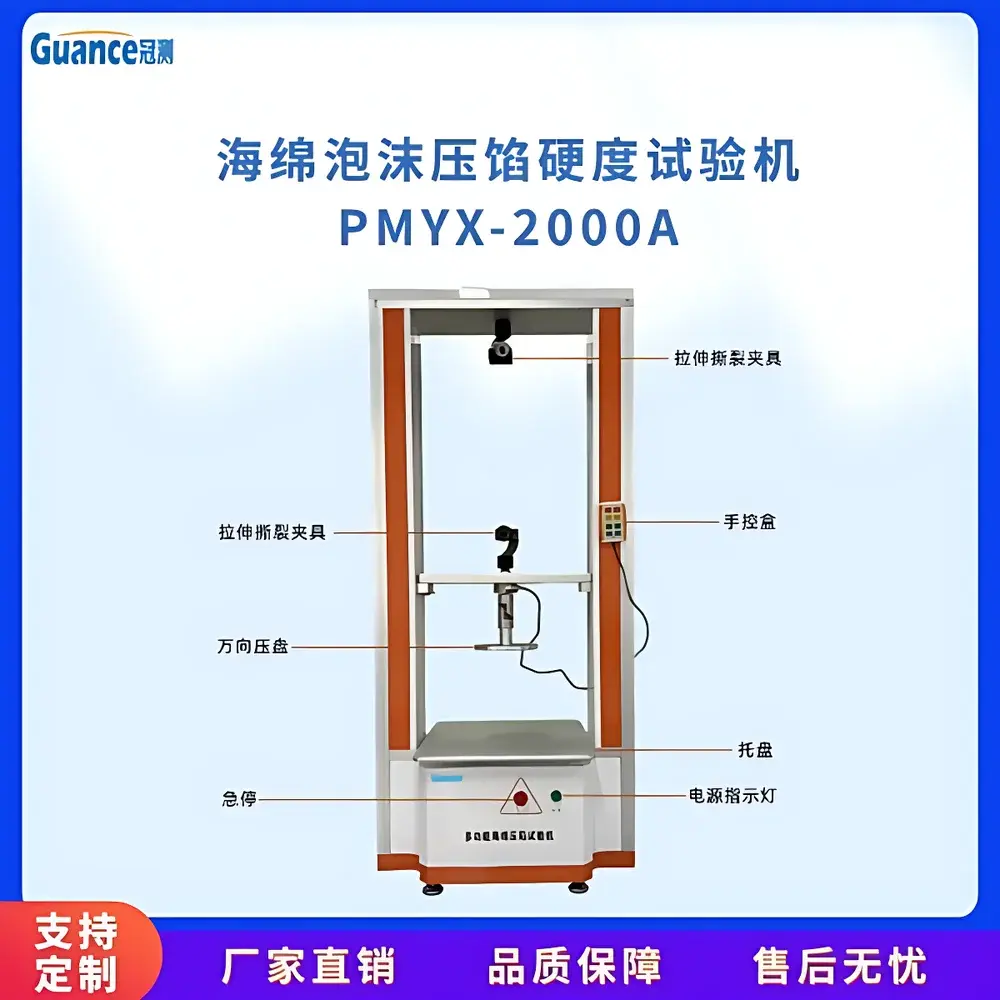
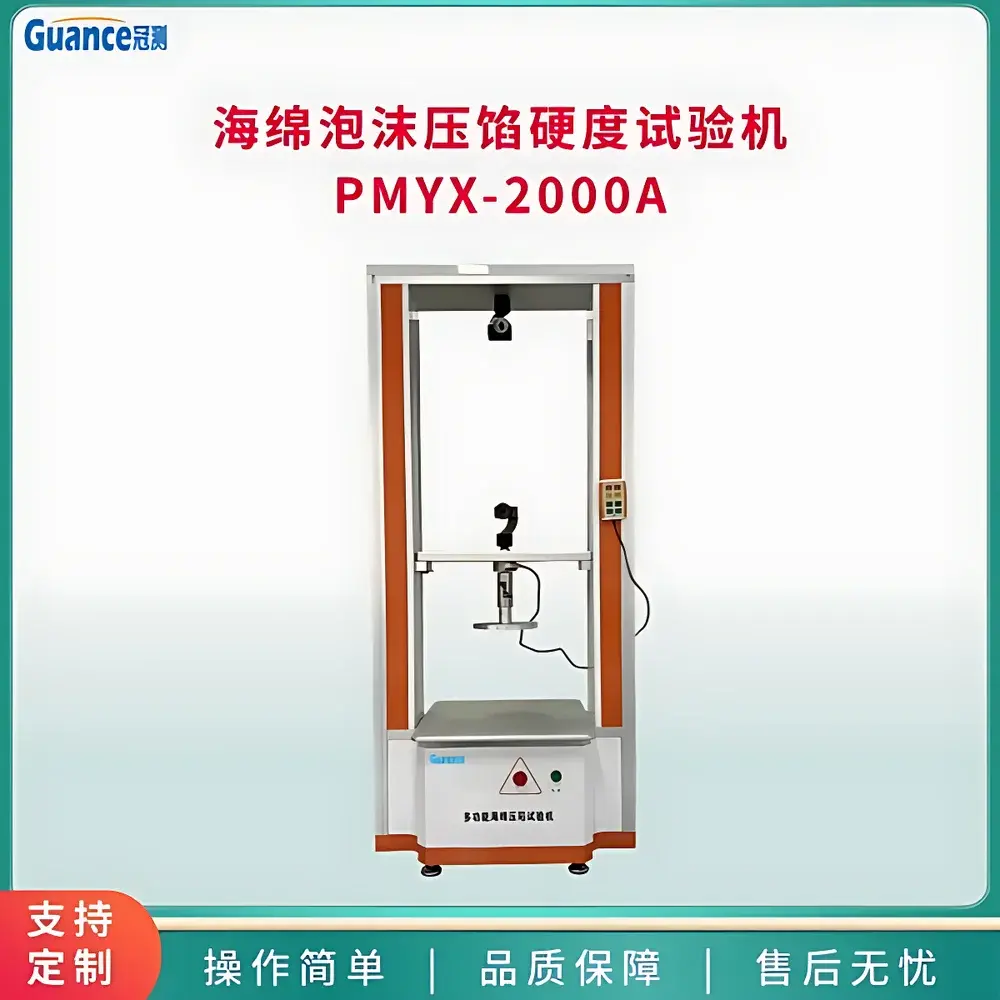
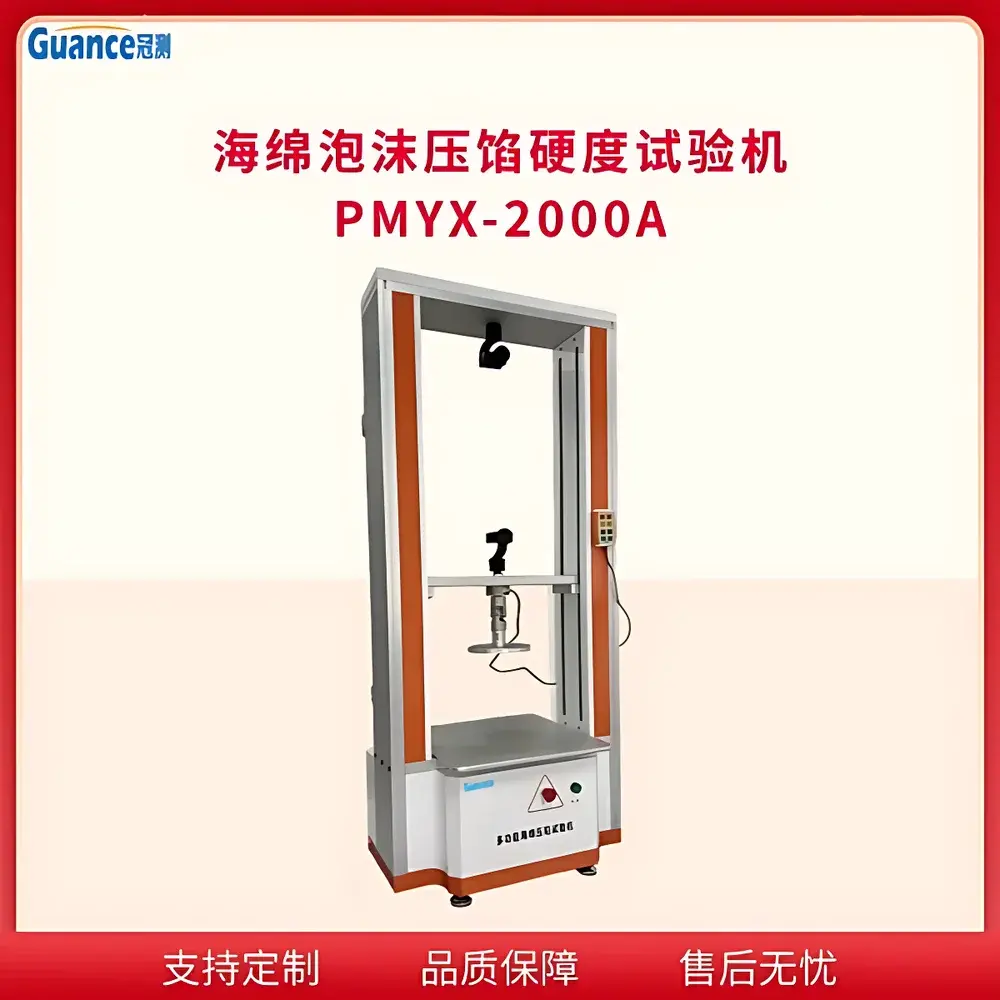
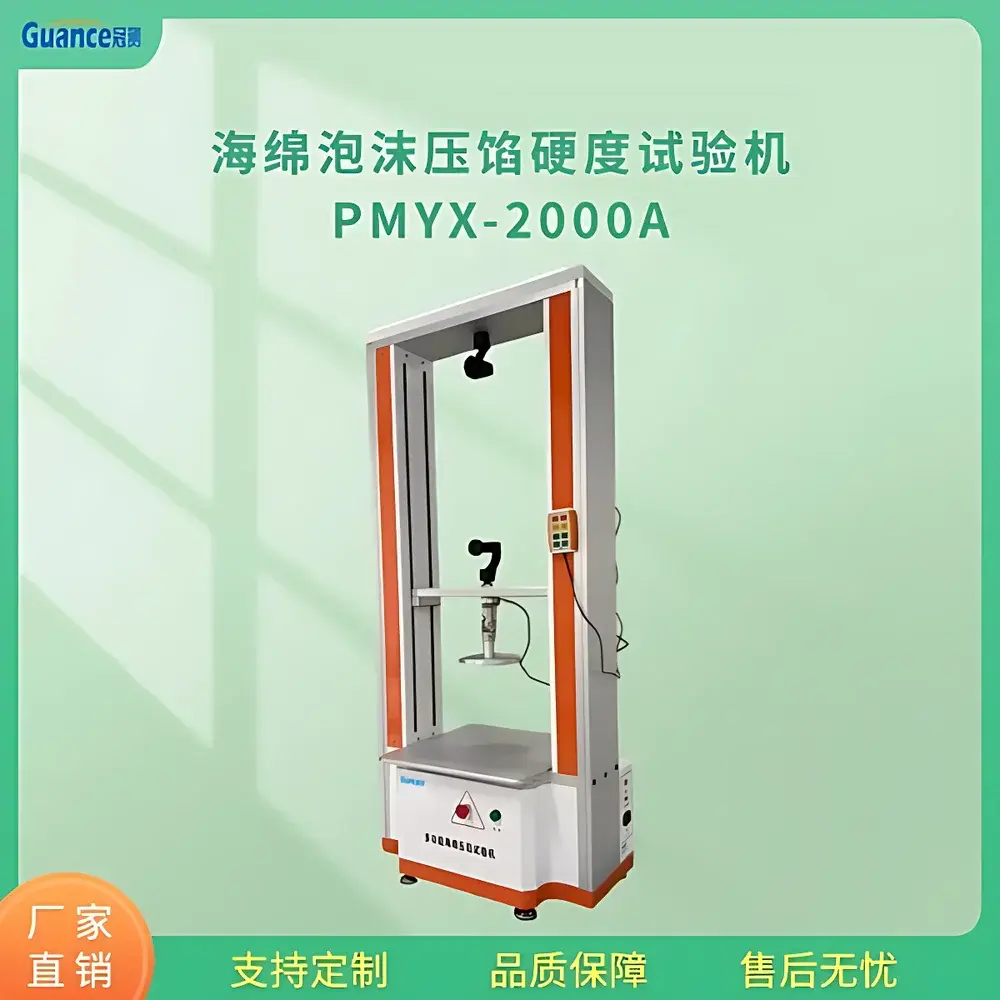
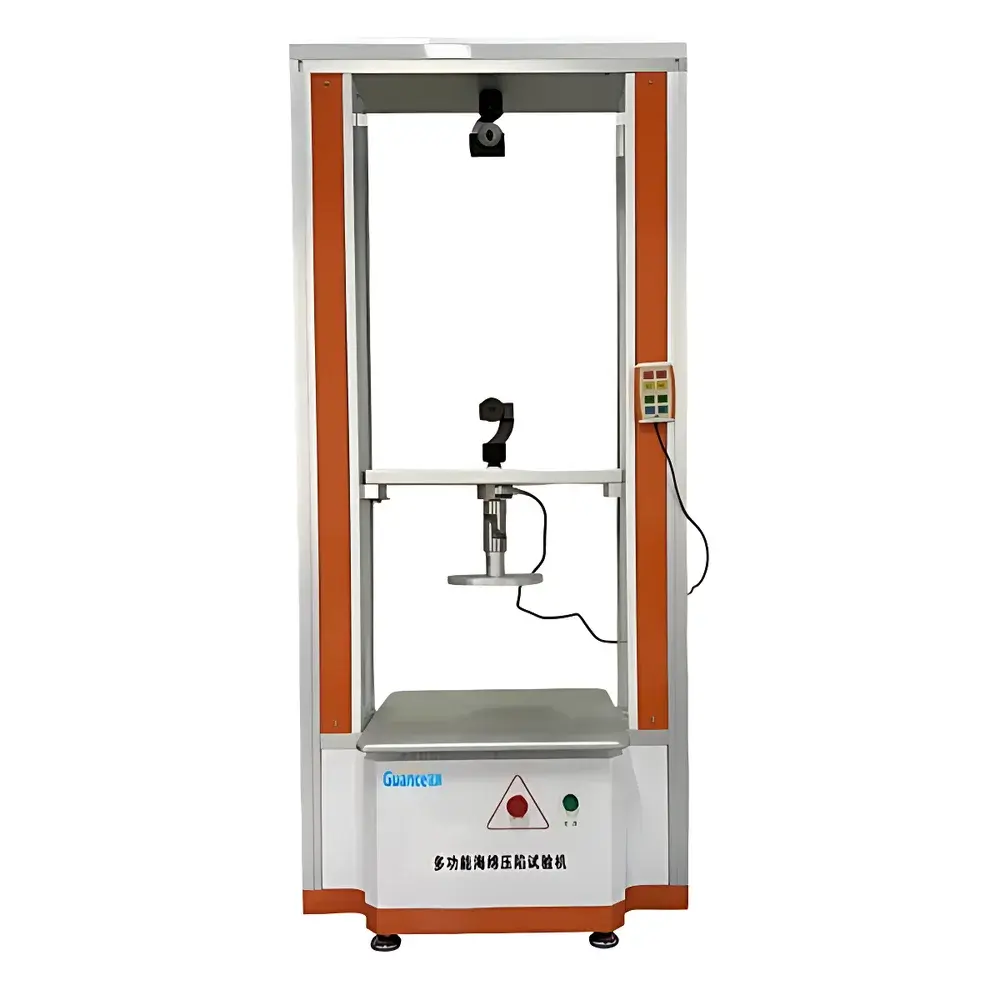
GuanCe PMYX-2000AH Foam Indentation Hardness Tester
| Brand | GuanCe |
|---|---|
| Origin | Beijing, China |
| Model | PMYX-2000AH |
| Compliance | GB/T 10807-2006, GB/T 12825-2003, GB/T 18942.1-2003, ASTM D3574, GB/T 26392-2011 |
| Test Speed Range | 1–300 mm/min (adjustable) |
| Load Cell Accuracy | ±0.5% FS |
| Maximum Load Capacity | 2000 N |
| Indentation Depth Resolution | 0.01 mm |
| Sample Thickness Measurement | Automatic, via integrated displacement sensor |
| Control Interface | PC-based software with real-time curve plotting and audit-trail-capable data logging |
Overview
The GuanCe PMYX-2000AH Foam Indentation Hardness Tester is an electromechanical compression testing system engineered for precise, repeatable characterization of soft cellular polymeric materials—primarily flexible polyurethane foams, viscoelastic (slow-recovery) foams, and other porous elastomeric substrates. It operates on the principle of controlled quasi-static indentation under defined displacement rates and dwell conditions, measuring the compressive force required to achieve standardized indentation depths (e.g., 25%, 40%, or 65% of initial sample thickness). This methodology aligns with internationally recognized indentation hardness protocols—including the “Indentation Force Deflection” (IFD) method—used to quantify load-bearing behavior, resilience, and support characteristics critical in mattress, automotive seating, packaging, and medical cushioning applications. The instrument integrates a high-rigidity frame, precision-ground ball-screw actuation, and a calibrated load cell to ensure mechanical stability and measurement fidelity across repeated cycles.
Key Features
- Full compliance with multiple national and international standards: GB/T 10807-2006 (A/B/C methods), GB/T 12825-2003, GB/T 18942.1-2003, ASTM D3574 (Methods A–H), and GB/T 26392-2011 for slow-recovery foam recovery time assessment.
- Programmable test sequences supporting pre-conditioning cycles (up to 3 pre-indentations), multi-step indentation profiles, variable dwell times (configurable from 1 s to 300 s), and user-defined speed ramping (1–300 mm/min).
- Real-time synchronized acquisition and display of force (N), displacement (mm), and time (s), with on-screen cursor interrogation for instantaneous parameter readout at any point along the test curve.
- Automated thickness measurement prior to each test cycle using an integrated linear displacement transducer—eliminating manual caliper dependency and reducing operator-induced variability.
- Robust mechanical architecture featuring low-backlash ball-screw transmission, zero-backlash coupling, and vibration-damped base structure to minimize noise and improve repeatability.
- PC-hosted control software with password-protected method libraries, electronic signature support, and export-ready data formats (CSV, PDF, XLSX) compatible with LIMS integration.
Sample Compatibility & Compliance
The PMYX-2000AH accommodates standard rectangular foam specimens (typically 380 mm × 380 mm × 50 mm, per ASTM D3574 and GB/T 10807), though custom fixtures support alternative geometries up to 400 mm × 400 mm planar area. It supports both conditioned (23 ± 2 °C, 50 ± 5% RH) and ambient testing environments. All test procedures adhere to Good Laboratory Practice (GLP) principles, with full traceability of calibration records, operator ID, environmental metadata, and version-controlled test methods. Software logs meet FDA 21 CFR Part 11 requirements for electronic records and signatures when configured with audit trail and user access controls.
Software & Data Management
The proprietary Windows-based application provides ISO/IEC 17025-aligned test execution workflows. Each test generates a timestamped dataset including raw force-displacement-time arrays, calculated indices (e.g., IFD25, IFD40, IFD65, ratio coefficients), and derived metrics such as compression set (if paired with optional environmental chamber). Data files are stored in encrypted local directories with automatic backup options. Reporting templates comply with internal QA documentation standards and external certification submissions (e.g., UL, OEKO-TEX, CertiPUR-US). Export functions include graphical overlays for comparative analysis across batches or formulations.
Applications
- Quality control of flexible PU foam production lines—verifying batch-to-batch consistency in indentation hardness and load-deflection linearity.
- R&D evaluation of new foam chemistries (e.g., bio-based polyols, flame-retardant additives) by quantifying changes in support factor (IFD65/IFD25) and hysteresis loss.
- Regulatory validation for furniture safety standards (e.g., CAL TB 117-2013, EN 1334) requiring minimum IFD thresholds.
- Performance benchmarking of memory foam vs. conventional HR foam in healthcare seating and pressure-relief mattress systems.
- Material aging studies—tracking hardness drift after thermal cycling, humidity exposure, or compression fatigue (when used with optional cyclic testing module).
FAQ
What standards does the PMYX-2000AH directly support out-of-the-box?
It includes preloaded test templates for GB/T 10807-2006 Methods A–C, ASTM D3574 Methods A, B, C, E, and F, GB/T 12825-2003, and GB/T 26392-2011—with all parameters (speed, dwell, pre-cycle count) editable per test sequence.
Can the system perform dynamic or cyclic compression testing?
Yes—the software allows multi-cycle indentation protocols with programmable pause intervals, return speeds, and variable compression depths, enabling basic fatigue and recovery behavior analysis.
Is third-party calibration certification available?
Yes; optional NIST-traceable calibration services are provided with documented uncertainty budgets and ISO/IEC 17025-compliant certificates.
Does the software support audit trails for regulated environments?
When deployed with role-based user accounts and enabled audit logging, it satisfies FDA 21 CFR Part 11 and EU Annex 11 requirements for electronic records integrity and change control.
What maintenance is required for long-term accuracy?
Annual verification of load cell linearity, displacement encoder resolution, and crosshead alignment is recommended; routine cleaning of the ball-screw assembly and periodic lubrication per manufacturer guidelines ensures mechanical longevity.



