
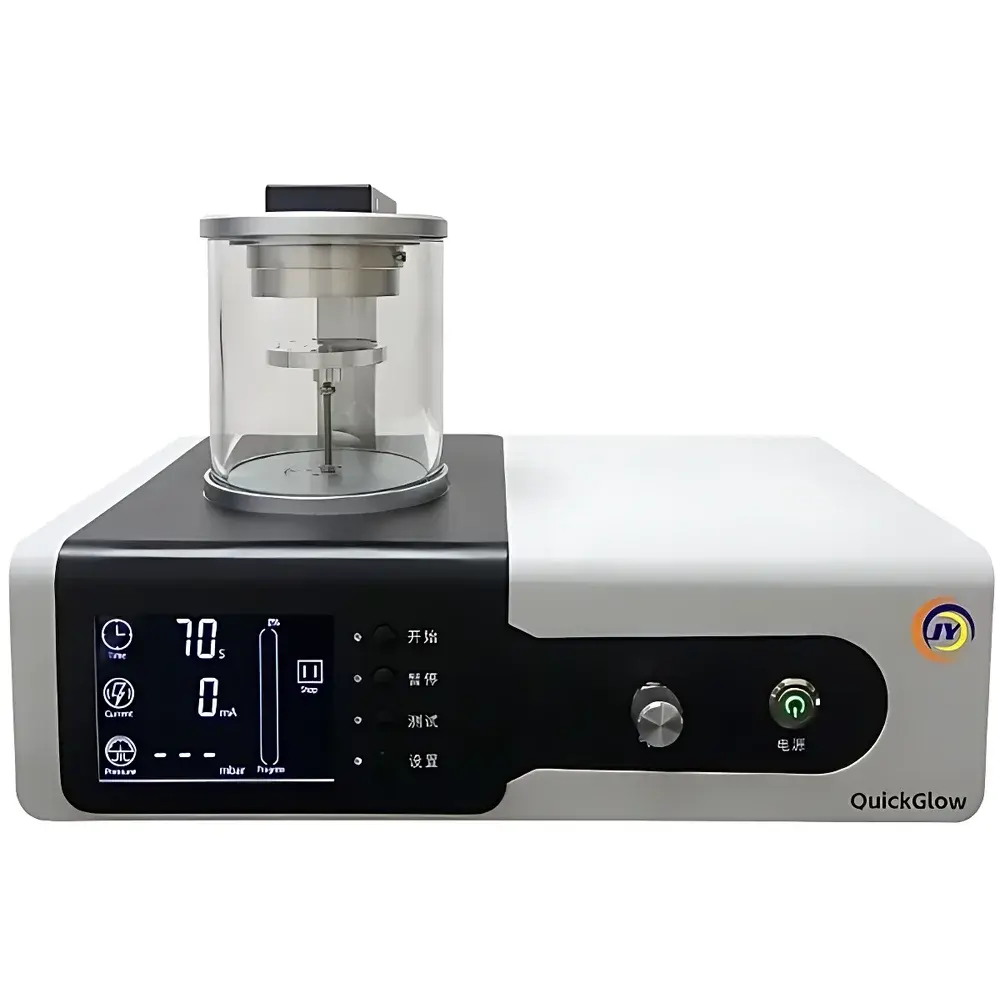
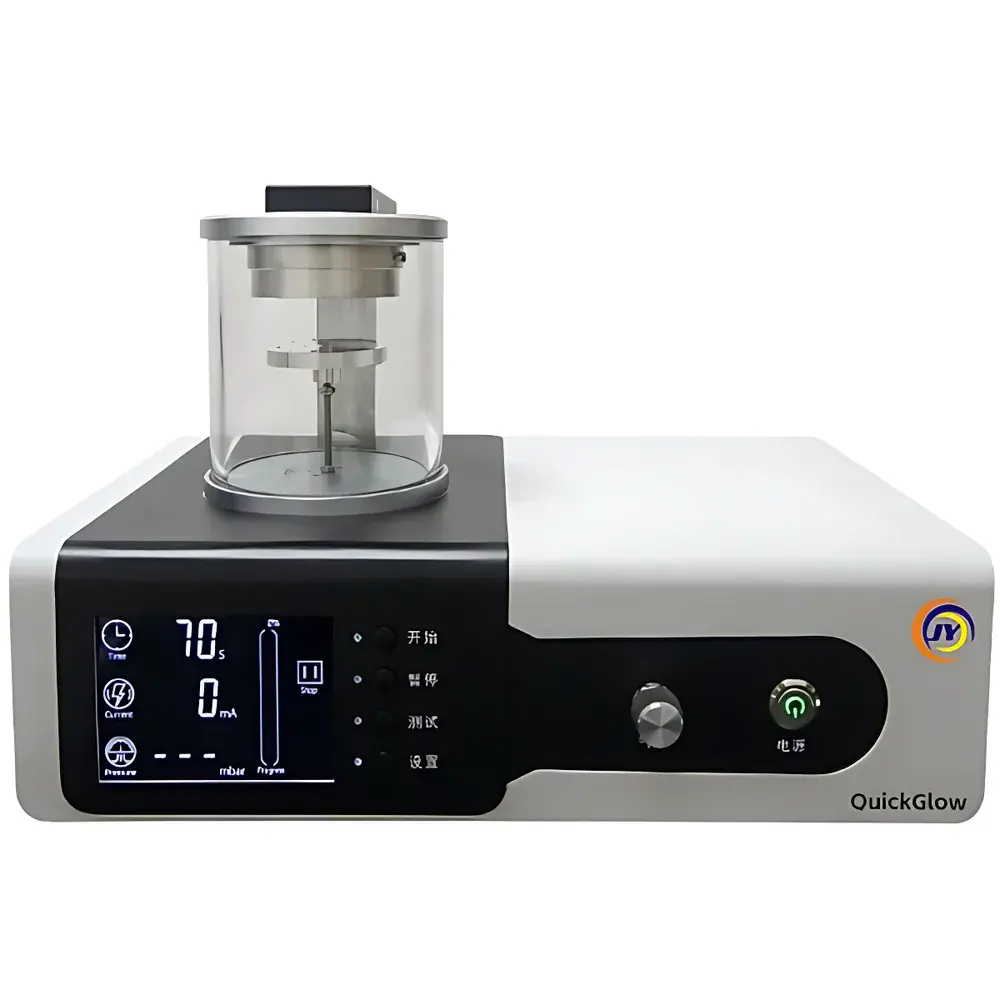
Guangzhou Jingying QuickGlow Glow Discharge System
| Brand | Guangzhou Jingying |
|---|---|
| Origin | Guangdong, China |
| Manufacturer | Yes |
| Type | Domestic |
| Model | QuickGlow |
| Price | Upon Request |
| Plasma Current | 3–30 mA |
| High-Voltage Power Supply | 50 W |
| Electrode Polarity | Negative |
| Sample Stage Diameter | Ø63 mm (customizable) |
| Sample Stage Height Adjustment | 30–80 mm |
| Treatment Time Range | 0–999 s |
| Chamber Dimensions | Ø120 mm × 120 mm (H) |
| Operating Vacuum Range | 0.20–1.0 mbar |
| HV/Vacuum Interlock | Software-Enabled Safety Lockout |
| Display | 102 mm × 68 mm LCD |
| Unit Dimensions | 417 mm (L) × 305 mm (W) × 280 mm (H) |
| Weight | 9.6 kg |
| Power Supply | 220 V, 50 Hz |
Overview
The Guangzhou Jingying QuickGlow Glow Discharge System is a compact, benchtop plasma treatment instrument engineered for reproducible surface functionalization of electron microscopy substrates. It operates on the principle of low-pressure DC glow discharge in inert or reactive gas environments (e.g., air, argon, or oxygen), generating energetic electrons and ionized species that modify surface chemistry through oxidation, bond cleavage, and introduction of polar functional groups (e.g., –OH, C=O). This process converts hydrophobic carbon-coated TEM grids or silicon wafers into uniformly hydrophilic surfaces—critical for achieving monolayer dispersion of biological macromolecules, uniform ice vitrification in cryo-EM, and enhanced contrast in negative staining protocols. Unlike RF or microwave plasma systems, the QuickGlow employs a stable negative-polarity DC configuration optimized for gentle, non-destructive treatment of delicate samples—including protein complexes, lipid bilayers, and 2D materials—without inducing thermal damage or carbon contamination.
Key Features
- Stable DC glow discharge with adjustable plasma current (3–30 mA) and precise vacuum control (0.20–1.0 mbar), ensuring consistent surface activation across batches;
- Integrated software-enforced high-voltage/vacuum interlock system compliant with IEC 61010-1 safety standards, preventing accidental arcing during chamber access;
- Motorized height-adjustable sample stage (30–80 mm range) accommodating standard TEM grids (200–400 mesh), SEM stubs, and custom substrates up to Ø63 mm;
- Programmable treatment duration (0–999 s) with real-time LCD feedback (102 mm × 68 mm display), enabling method reproducibility per GLP/GMP documentation requirements;
- Modular 25-position grid holder included as standard—supporting high-throughput processing without manual repositioning;
- Benchtop footprint (417 × 305 × 280 mm) and lightweight design (9.6 kg) facilitate integration into shared EM core facilities or cleanroom environments.
Sample Compatibility & Compliance
The QuickGlow supports a broad spectrum of electron microscopy substrates and specimen types: carbon-coated copper/nickel TEM grids, silicon nitride membranes, gold-coated SEM stubs, and polymer-based cryo-EM support films (e.g., Quantifoil, UltrAuFoil). It is routinely applied to biological specimens including purified proteins, nucleic acid assemblies, virus particles, and membrane proteins; nanomaterials such as graphene oxide, quantum dots, and metal–organic frameworks; and inorganic thin films and ceramic nanoparticles. All operational parameters adhere to ISO 14644-1 Class 5 cleanroom compatibility when used with appropriate gas filtration. The system meets electromagnetic compatibility (EMC) requirements per EN 61326-1 and electrical safety standards per EN 61010-1. While not FDA-cleared, its treatment protocols align with common practices described in USP , ASTM E2937-21 (for particle dispersion analysis), and cryo-EM workflow guidelines published by the Electron Microscopy Society of America (EMSA).
Software & Data Management
The QuickGlow features embedded firmware with non-volatile memory for storing up to 10 user-defined methods, each retaining vacuum setpoint, current limit, treatment time, and electrode polarity settings. All parameter changes are timestamped and logged locally on the LCD interface—providing traceability for internal quality audits. Though no external PC connectivity is built-in, the system’s deterministic behavior and repeatable endpoint conditions support integration into laboratory information management systems (LIMS) via documented SOPs. For regulated environments, users may implement manual audit trails in accordance with FDA 21 CFR Part 11 requirements by maintaining signed logbooks correlating batch IDs, operator initials, date/time stamps, and post-treatment QC checks (e.g., water contact angle measurements or TEM grid wettability scoring).
Applications
- TEM Grid Hydrophilization: Enables rapid, uniform wetting of carbon films—reducing aggregation during sample adsorption and improving stain distribution in uranyl acetate or phosphotungstic acid protocols;
- Cryo-EM Grid Preparation: Enhances ice layer homogeneity by promoting even water film formation on holey carbon films, directly contributing to higher-resolution reconstructions (as validated in benchmark studies using apoferritin and β-galactosidase);
- SEM Sample Mounting: Improves adhesion and dispersion of nanoparticle suspensions on conductive substrates, minimizing charging artifacts and edge accumulation;
- Surface Cleaning Prior to Coating: Removes organic contaminants from metal or silicon substrates before sputter coating or evaporation, increasing coating adhesion and reducing void formation;
- Functionalization for Correlative Microscopy: Prepares substrates for sequential light/electron microscopy workflows where surface chemistry must remain stable across multiple imaging modalities.
FAQ
What gases are compatible with the QuickGlow system?
Air is the default and most commonly used gas. Argon, oxygen, and nitrogen may also be employed depending on desired surface chemistry—oxygen enhances hydrophilicity, while argon provides gentler cleaning with minimal oxidation.
Can the QuickGlow be used for plasma cleaning of non-conductive samples?
Yes—provided the sample is placed on a conductive substrate (e.g., a metal stub or carbon tape) and grounded via the stage. Non-grounded insulators may accumulate charge; users should verify stability under test conditions.
How often does the glow discharge electrode require maintenance or replacement?
The tungsten cathode is designed for >5,000 treatment cycles under normal operating conditions. Visual inspection every 500 cycles is recommended; replacement kits are available from Guangzhou Jingying.
Is vacuum pump oil contamination a concern during extended use?
No—the system operates at relatively high pressures (0.2–1.0 mbar), well above typical diffusion pump thresholds. A standard two-stage rotary vane pump (not included) suffices; oil mist filters are optional but not mandatory.
Does the QuickGlow meet CE or RoHS certification requirements?
The unit complies with RoHS Directive 2011/65/EU and carries CE marking for electromagnetic compatibility and low-voltage directive conformity (2014/35/EU and 2014/30/EU), as verified by third-party testing reports available upon request.




