
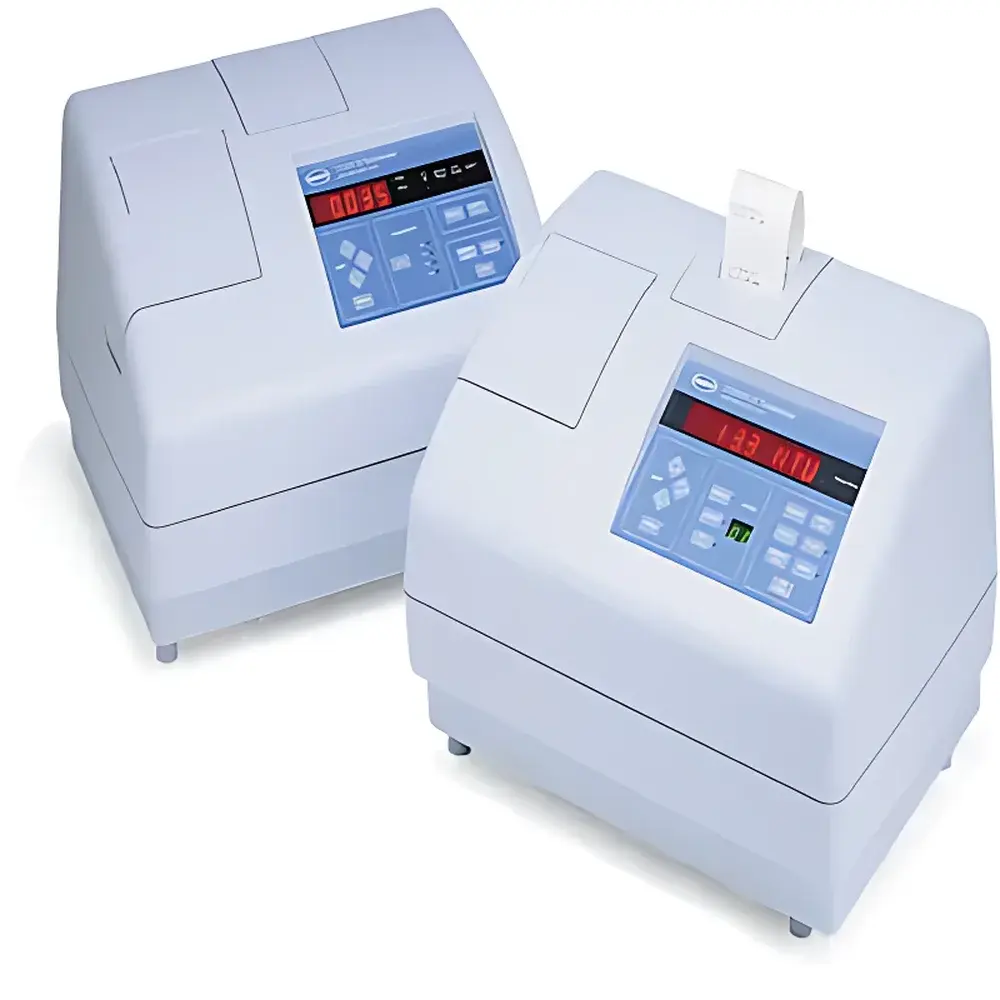
Hach 2100N Laboratory Turbidimeter
| Brand | Hach |
|---|---|
| Origin | USA |
| Manufacturer Type | Original Equipment Manufacturer (OEM) |
| Product Origin | Imported |
| Model | 2100N |
| Form Factor | Benchtop/Laboratory |
| Measurement Range | 0–4000 NTU |
| Resolution | 0.001 NTU |
| Operating Temperature | 10–40 °C |
| Accuracy | ±2% (0–1000 NTU) |
| Sample Volume | 20 mL minimum |
| Measurement Modes | NTU, NEP, EBC |
| Ratio Measurement | Yes |
| Power Supply | 230 V, 50/60 Hz |
| Relative Humidity | ≤90% RH (non-condensing at 25 °C) |
Overview
The Hach 2100N Laboratory Turbidimeter is a precision optical instrument engineered for reliable, traceable turbidity measurement in regulated and research-intensive environments. It operates on the principle of ratio nephelometry, utilizing dual-detector geometry to simultaneously measure forward-scattered (90°) and side-scattered (90° ±30°) light intensity from a collimated tungsten-halogen light source. This patented ratio measurement architecture compensates for color interference, particle settling, and lamp aging—ensuring long-term stability and compliance with ISO 7027 and EPA Method 180.1 requirements. Designed for use in drinking water laboratories, wastewater treatment facilities, environmental monitoring programs, pharmaceutical QC labs, and academic research, the 2100N delivers reproducible results across its full 0–4000 NTU range without manual range switching.
Key Features
- Patented Ratio Measurement Technology: Dual-detector optical system eliminates errors caused by sample coloration, absorbance, or non-uniform particle distribution—critical for colored effluents, humic-rich surface waters, and process streams with variable chromaticity.
- Programmable Signal Averaging: Configurable averaging intervals (1–100 readings) reduce stochastic noise in low-turbidity samples (e.g., filtered drinking water), enhancing repeatability below 1 NTU.
- Condensation-Resistant Sample Chamber: Integrated air purge port enables dry-air purging of the measurement cell prior to analysis—preventing condensation-induced scattering artifacts during cold-sample or high-humidity operation.
- Self-Diagnostic System: Real-time monitoring of lamp output, detector response, and optical path integrity; alerts users via on-screen codes for lamp degradation, cell contamination, or alignment drift.
- Multi-Unit Reporting: Direct readout in NTU (Nephelometric Turbidity Units), NEP (Nephelometric Efficiency Parameter), and EBC (European Brewery Convention) units—supporting method-specific reporting per ISO 7027-1:2016, DIN EN ISO 7027, and brewing industry standards.
Sample Compatibility & Compliance
The 2100N accommodates standard 20 mL glass vials (10 mm path length) and accepts samples within a temperature range of 10–40 °C. Its sealed optical chamber and air-purge capability enable robust performance with chilled groundwater, warm industrial cooling water, and thermally unstable biological suspensions. The instrument conforms to key regulatory frameworks including US EPA Method 180.1, ISO 7027-1:2016, and ASTM D6508. Data integrity is supported through GLP-compliant operation: all measurements include timestamped metadata (date/time, operator ID, calibration status), and instrument configuration logs are retained internally for audit readiness.
Software & Data Management
Data export and instrument control are managed via HachLink™ Software, a Windows-based application validated for FDA 21 CFR Part 11 compliance when deployed with appropriate IT controls (user authentication, electronic signatures, audit trail enablement). HachLink™ supports automated calibration verification, trend analysis across multiple instruments, and direct import into LIMS or Excel. All stored measurements (up to 500 records) retain full traceability—including raw detector voltages, ratio values, and calibration coefficients—facilitating root-cause analysis during method validation or regulatory inspection.
Applications
- Drinking water quality assurance per WHO Guidelines and national standards (e.g., US EPA Safe Drinking Water Act)
- Wastewater treatment plant effluent monitoring under NPDES permit requirements
- Surface and groundwater characterization in environmental impact assessments
- Pharmaceutical water system qualification (Purified Water, Water for Injection) per USP <730>
- Process control in food & beverage production (e.g., beer clarity per EBC 7.11, juice filtration validation)
- Academic research involving colloidal stability, coagulation-flocculation kinetics, and membrane fouling studies
FAQ
What calibration standards are required for the 2100N?
StablCal® primary standards (Formazin or AMCO Clear®) traceable to NIST SRM 2130a are recommended; secondary standards must be verified against primary references annually.
Does the 2100N support automatic calibration verification?
Yes—HachLink™ enables scheduled verification using pre-loaded standard values and generates pass/fail reports compliant with ISO/IEC 17025 internal quality control requirements.
Can the 2100N measure samples with high dissolved solids or viscosity?
It is optimized for aqueous suspensions; highly viscous or optically dense samples (>4000 NTU) require dilution per ISO 7027-1 Section 8.2 to maintain linearity and avoid multiple scattering artifacts.
Is firmware upgradable in the field?
Yes—firmware updates are distributed via Hach’s secure support portal and applied through USB or serial interface with version-locking to ensure method consistency across instrument fleets.
How is data integrity ensured during power interruption?
All active measurements and calibration events are written to non-volatile memory before display; unsaved data is retained until explicit user confirmation of discard or save.




