
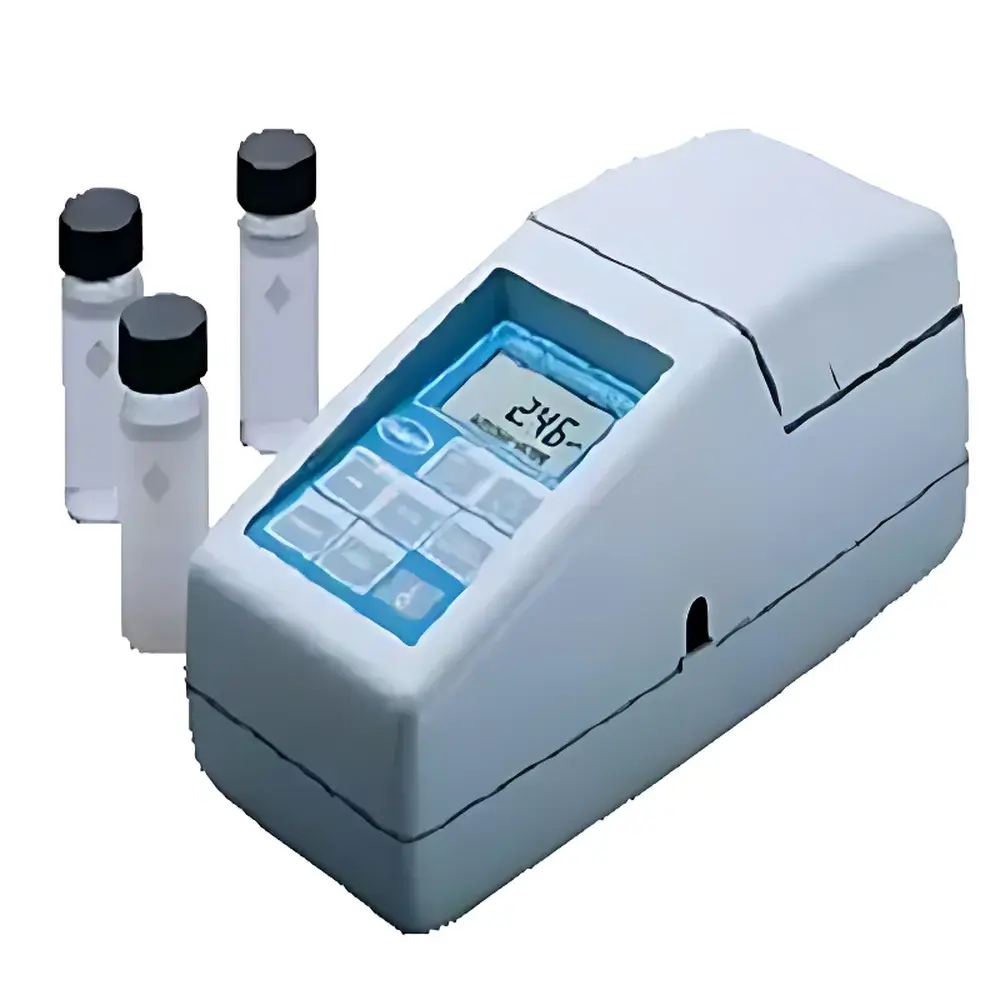
Hach 2100P Portable Turbidimeter
| Brand | Hach |
|---|---|
| Origin | Imported |
| Manufacturer Type | Manufacturer |
| Model | 2100P |
| Form Factor | Portable (Lab-Grade) |
| Measurement Range | 0–1000 NTU |
| Resolution | 0.01 NTU (at lowest range) |
| Accuracy | ±2% of reading |
| Operating Temperature | 0–50 °C |
| Power Supply | 4 × AA alkaline batteries or optional AC adapter |
| Weight | 520 g |
| Compliance | EPA Method 180.1 |
Overview
The Hach 2100P Portable Turbidimeter is a laboratory-grade optical instrument engineered for high-reliability turbidity measurement in both field and controlled laboratory environments. It operates on the principle of nephelometric detection—measuring the intensity of light scattered at 90° from a collimated incident beam—as defined by U.S. Environmental Protection Agency (EPA) Method 180.1. This standardized optical configuration ensures regulatory alignment for drinking water, wastewater, industrial process water, and environmental monitoring applications. Unlike basic portable meters, the 2100P integrates ratio-based dual-detector optics to actively compensate for color interference, stray light, source intensity drift, and sample heterogeneity—enabling stable, traceable measurements across the full 0–1000 NTU range without manual calibration adjustments between samples.
Key Features
- Ratio Optical System: Dual photodetectors (90° scatter + forward transmission) compute a normalized ratio signal, minimizing error from sample coloration, air bubbles, or suspended particle settling during measurement.
- Signal Averaging Algorithm: Real-time temporal averaging over 10 seconds mitigates transient fluctuations caused by particulate motion within the sample cell, enhancing repeatability in dynamic or low-turbidity conditions.
- EPA 180.1 Compliance: Fully validated against the U.S. EPA’s prescribed performance criteria—including calibration verification with formazin standards, linearity assessment, and limit-of-detection validation—supporting data defensibility in regulated reporting.
- Field-Ready Architecture: Ruggedized housing with IP67-rated sealing (when closed), shock-absorbing rubber overmold, and integrated battery compartment enable operation under variable ambient conditions (0–50 °C) without external power.
- Self-Diagnostic Firmware: Continuous internal verification of LED output stability, detector response linearity, and optical path integrity; alerts users via on-screen codes for immediate troubleshooting prior to data acquisition.
- One-Touch Measurement Protocol: Automatic zeroing and sample measurement initiated with single button press; results displayed in NTU within ≤60 seconds, including automatic unit scaling and range selection.
Sample Compatibility & Compliance
The 2100P accepts standard 25-mm round glass vials (10 mL volume) compatible with Hach StablCal® and AMCO-AE® primary standards. Its optical design accommodates colored, aerated, or mildly viscous aqueous matrices—common in wastewater effluent, filtered surface water, and pharmaceutical rinse water—without requiring filtration or dilution in most cases. The instrument meets requirements for routine monitoring under EPA-approved methods and supports documentation traceability per ISO/IEC 17025:2017 clause 7.7 (measurement uncertainty) when used with certified reference materials. While not inherently 21 CFR Part 11 compliant, audit-ready data logs (via optional Hach LabStation software export) support GLP/GMP-aligned record retention protocols.
Software & Data Management
Data generated by the 2100P is stored internally (up to 500 readings with timestamp, operator ID, and calibration status). Export is enabled via USB interface to Hach’s LabStation™ desktop application (Windows-compatible), which provides CSV/TXT export, statistical summary (mean, SD, CV%), calibration history tracking, and PDF report generation. All exported files retain embedded metadata—including instrument serial number, firmware version, and measurement mode—facilitating chain-of-custody documentation. Calibration events are logged with date/time stamps and standard lot numbers, satisfying internal QA/QC review cycles and third-party audit readiness.
Applications
- Drinking water treatment: raw intake screening, filter performance evaluation, and finished water compliance verification per NSF/ANSI 60 and 61.
- Wastewater operations: activated sludge monitoring, clarifier effluent testing, and disinfection process control.
- Environmental field studies: lake/stream turbidity profiling, stormwater runoff characterization, and sediment transport modeling input.
- Pharmaceutical manufacturing: purified water (PW) and water-for-injection (WFI) system validation per USP and EP 2.2.21.
- Industrial process control: cooling tower blowdown analysis, boiler feedwater clarity checks, and semiconductor rinse water qualification.
FAQ
Does the 2100P require annual factory recalibration?
No—field recalibration using NIST-traceable formazin standards (e.g., Hach 2100N Standard Set) is sufficient when performed per EPA 180.1 protocol; factory service is recommended only after physical impact or optical contamination.
Can it measure samples below 0.1 NTU with reliable precision?
Yes—the 0.01 NTU resolution at the lowest range, combined with ratio compensation, enables quantification down to 0.02 NTU with ±0.01 NTU repeatability under controlled lab conditions.
Is the instrument compatible with non-Hach sample vials?
Only Hach-certified 25-mm glass vials (Catalog No. 2465100) are validated for optical path consistency; use of alternative vials voids EPA 180.1 compliance and introduces systematic bias.
How is temperature variation managed during extended field use?
The internal thermistor continuously monitors sample cell temperature and applies empirically derived compensation coefficients to NTU values, maintaining accuracy across the full 0–50 °C operating envelope.
What battery life can be expected during continuous operation?
Approximately 2,000 measurements per set of fresh AA alkaline batteries (tested at 25 °C, 1 measurement/minute duty cycle), with low-battery warning activated at ≤10% remaining capacity.




