
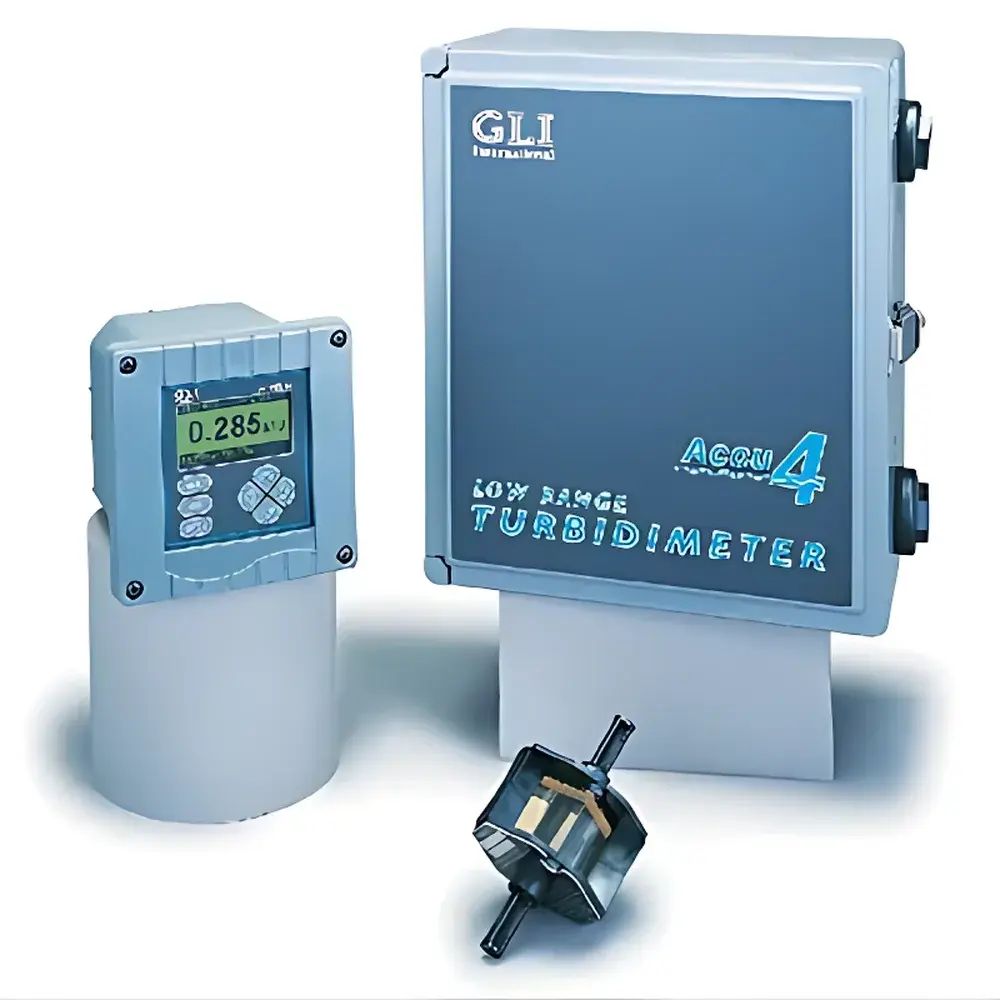
HACH Accu4/T53 Online Low-Turbidity Analyzer
| Brand | HACH |
|---|---|
| Origin | Imported |
| Manufacturer | HACH Company |
| Model | Accu4/T53 |
| Configuration | Online Turbidimeter |
| Measurement Range | 0.000–1.000, 0.00–10.00, 0.0–100.0 NTU |
| Resolution | 0.001 NTU |
| Accuracy | ±2% of reading |
| Repeatability | <0.1% of full scale |
| Operating Ambient Temperature | −20 to +60 °C |
| Sample Temperature Range | 0 to 60 °C |
| Sample Flow Rate | 0.19–26.5 L/min |
| Max Sample Pressure | 50 psig |
| Enclosure Rating | NEMA 4X (IP65) |
| Analog Outputs | Two isolated 4–20 mA outputs |
| Relay Outputs | Four SPDT relays |
| Power Supply | 100–240 VAC, 50/60 Hz |
| Light Source | Long-life LED |
| Compliance | EPA Method 180.2 (GLI Method 2) |
Overview
The HACH Accu4/T53 Online Low-Turbidity Analyzer is an industrial-grade turbidimeter engineered for continuous, high-stability monitoring of low-level turbidity in potable water and process streams. It operates on a patented four-beam optical architecture—distinct from conventional single- or dual-beam systems—utilizing two independent light sources and two photodetectors positioned at precise 90° intervals around the sample cell. In State 1, Detector 2 captures 90° scattered light while Detector 1 measures forward-scattered light; in State 2, the illumination geometry reverses. The embedded microprocessor computes turbidity by fusing all four independent optical signals, enabling real-time compensation for sensor drift, optical window fouling, and chromatic interference from colored dissolved organic matter (CDOM). This methodology delivers exceptional long-term stability and measurement integrity without manual recalibration, making it suitable for unattended operation in critical regulatory environments.
Key Features
- Patented four-beam optical design compliant with U.S. EPA Method 180.2 (GLI Method 2), ensuring regulatory acceptance for drinking water compliance reporting.
- Factory-certified, reusable CAL-CUBE reference standard included for traceable verification and field validation—eliminating reliance on liquid standards.
- Integrated air removal system prevents bubble-induced signal noise during low-turbidity measurement (especially critical below 0.1 NTU).
- Automatic color compensation algorithm mitigates absorbance-related bias in yellow-tinged or humic-rich waters, preserving accuracy across diverse source water types.
- High-reliability LED light source with >100,000-hour operational lifetime, eliminating lamp replacement cycles and associated calibration drift.
- NEMA 4X (IP65)-rated enclosure rated for outdoor or wet-location installation, with operating ambient temperature tolerance from −20 °C to +60 °C.
- Dual isolated 4–20 mA analog outputs configurable for primary turbidity and secondary diagnostic parameters (e.g., signal strength, temperature, or status flags).
Sample Compatibility & Compliance
The Accu4/T53 is validated for continuous flow-through analysis of clarified surface water, filtered distribution system water, and low-turbidity process effluents. It accommodates sample flow rates from 0.19 to 26.5 L/min and pressures up to 50 psig, supporting direct integration into pressurized municipal filtration galleries or inline industrial loops. Its optical path and signal processing meet the performance criteria defined in ASTM D6708 and ISO 7027-1 for nephelometric turbidity measurement. For regulated utilities, the instrument supports audit-ready data logging and meets foundational requirements for GLP/GMP-aligned operations—including secure user access control, time-stamped event logs, and configuration change tracking. While not inherently 21 CFR Part 11 compliant out-of-the-box, its firmware architecture allows integration with validated SCADA or LIMS platforms that provide electronic signature and audit trail capabilities.
Software & Data Management
The analyzer features an embedded web server accessible via Ethernet, enabling remote configuration, real-time trend visualization, and alarm management through standard browsers—no proprietary software required. All measurement data, calibration events, relay activations, and diagnostic alerts are timestamped and stored internally for ≥30 days. Data export is supported via Modbus TCP or ASCII serial protocols (RS-485), facilitating seamless ingestion into plant-wide historians (e.g., OSIsoft PI, Inductive Automation Ignition). Firmware updates are performed securely over HTTPS with SHA-256 signature verification. Configuration backups and restore functions support rapid recovery during maintenance or system migration.
Applications
- Real-time turbidity monitoring at key points in drinking water treatment: pre-filtration, post-filtration, final clarifier effluent, and finished water storage tank outlets.
- Early-warning detection of filter breakthrough or coagulation upsets in municipal and regional water authorities.
- Compliance-driven reporting for regulatory agencies requiring continuous turbidity records per SDWA §141.72 and state primacy programs.
- Process optimization in beverage, pharmaceutical, and semiconductor ultrapure water (UPW) recirculation loops where sub-0.05 NTU stability is essential.
- Remote telemetry deployment in distributed infrastructure—e.g., booster stations or reservoirs—leveraging built-in relay alarms for pump interlock or SCADA dispatch triggers.
FAQ
Is the Accu4/T53 certified for drinking water compliance under U.S. EPA regulations?
Yes—the instrument implements EPA Method 180.2 (GLI Method 2) and is listed in the EPA’s Certified Equipment List for turbidity analyzers used in public water systems.
Can the CAL-CUBE be reused indefinitely?
Yes—each CAL-CUBE is factory calibrated and mechanically robust; it requires no periodic re-certification and maintains traceability to NIST standards across repeated use.
Does the analyzer require periodic cleaning of the optical windows?
While the four-beam design compensates for gradual window fouling, HACH recommends scheduled visual inspection and cleaning per site-specific water quality; automated wiper options are available as accessories.
What is the minimum detectable turbidity level with guaranteed accuracy?
The instrument achieves ±2% accuracy down to 0.001 NTU within the 0.000–1.000 NTU range, validated using Formazin and AMCO AEPA standards per ISO 7027-1 Annex A.
How does the four-beam method improve long-term stability compared to traditional turbidimeters?
By decoupling signal drift from individual components (e.g., LED aging or detector sensitivity loss) through mathematical normalization of four orthogonal measurements, the system maintains baseline fidelity over extended deployment periods without manual intervention.




