
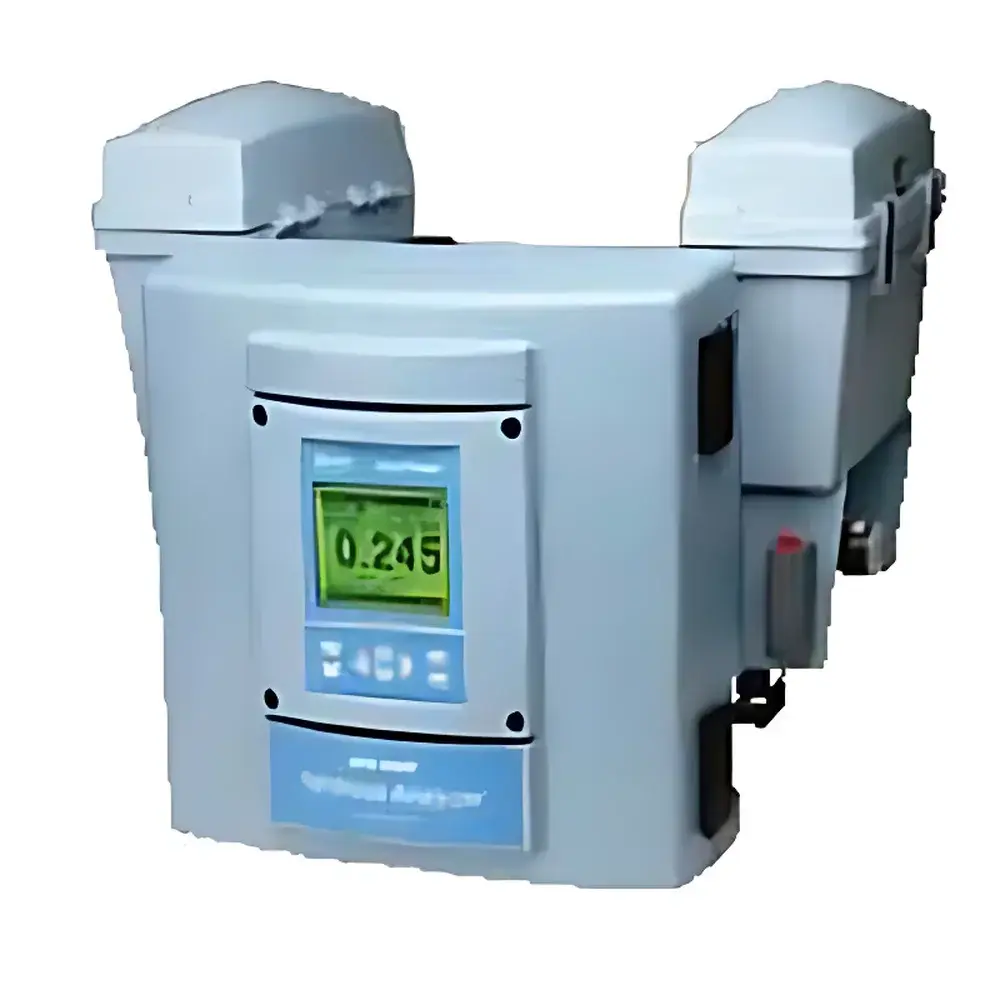
HACH APA6000 Copper Ion Online Analyzer
| Brand | HACH |
|---|---|
| Model | APA6000 |
| Measurement Principle | Automated titration pump coupled with colorimetric detection |
| Range (Low) | 0.05–2.0 mg/L Cu²⁺ |
| Range (High) | 1.0–10.0 mg/L Cu²⁺ |
| Accuracy (Low) | ±3% or ±0.03 mg/L (whichever is greater) |
| Accuracy (High) | ±5% or ±0.05 mg/L (whichever is greater) |
| Resolution | 0.001 ppm |
| Repeatability | ±3% of reading or <±0.03 mg/L (whichever is greater) |
| Cycle Time | ~4 minutes per analysis |
| Display | Digital and graphical output calibrated to Cu²⁺ concentration |
| Sample Flow Rate | 20–1000 mL/min |
| Operating Temperature | 5–50 °C |
| Relative Humidity | ≤95% RH, non-condensing |
| Inlet Pressure | 0.17–6.9 bar |
| Calibration Frequency | Configurable from twice daily to once weekly (calibration duration: ~35 min) |
| Analog Outputs | Two isolated 4–20 mA outputs |
| Alarm Outputs | Two SPDT relays |
| Power Supply | 95–240 VAC, 50/60 Hz |
| Enclosure Rating | NEMA 4X (IP65) |
| Mounting Options | Panel-mount, benchtop, or wall-mount (hardware included) |
| Data Storage | 30-day onboard history with trend and graphical analysis capability |
| Maintenance Interval | Up to 30 days unattended operation |
Overview
The HACH APA6000 Copper Ion Online Analyzer is an industrial-grade, fully automated water quality monitoring system engineered for continuous, real-time quantification of dissolved copper ions (Cu²⁺) in challenging process and effluent streams. It employs a hybrid analytical methodology—integrating precise reagent-driven colorimetric detection with programmable automated titration pumping—to deliver laboratory-grade accuracy under field-deployed conditions. Unlike discrete grab-sample analyzers, the APA6000 operates on a true online, flow-through principle: raw sample is continuously drawn, conditioned, chemically reacted, optically measured, and waste-processed without manual intervention. Its thermally stabilized reaction chamber—featuring proprietary air-gap insulation—maintains consistent thermal equilibrium during chromogenic complex formation, minimizing temperature-induced drift and ensuring metrological traceability to reference methods. Designed for integration into SCADA and DCS environments, the APA6000 meets the operational rigor demanded by municipal wastewater treatment plants, electroplating facilities, mining discharge monitoring stations, and semiconductor fab cooling water loops.
Key Features
- Fully autonomous operation: integrated auto-calibration, auto-cleaning, and auto-reagent dispensing eliminate routine operator involvement.
- Extended unattended runtime: validated for up to 30 consecutive days of continuous measurement without maintenance or consumable replacement.
- Dual-sample capability: configurable to alternate between two independent sample streams using internal valving—ideal for comparative monitoring or redundancy verification.
- Thermal stability architecture: air-insulated reaction manifold maintains constant incubation temperature across ambient fluctuations (5–50 °C), directly contributing to measurement reproducibility and alignment with ASTM D1688 and ISO 8694 protocols.
- Low reagent and sample consumption: optimized fluidics reduce chemical usage by >40% versus legacy photometric analyzers, lowering operating cost and minimizing waste generation.
- NEMA 4X (IP65)-rated enclosure: corrosion-resistant housing suitable for outdoor installation, washdown environments, and high-humidity industrial zones.
Sample Compatibility & Compliance
The APA6000 is validated for use with clarified, low-turbidity aqueous matrices including treated industrial process water, cooling tower blowdown, metal finishing rinse water, and municipal secondary effluent. It tolerates suspended solids up to 50 mg/L and chloride concentrations ≤1000 mg/L without interference—provided samples undergo optional pre-filtration (100 µm recommended). The analyzer complies with key regulatory frameworks governing environmental compliance reporting: its data integrity controls align with EPA Method 200.7 requirements for metals analysis; its audit-trail-enabled calibration logging satisfies GLP and ISO/IEC 17025 documentation expectations; and its analog output stability meets IEC 61000-4-2 EMC immunity standards. While not certified under FDA 21 CFR Part 11, its time-stamped, non-erasable event logs support GMP-aligned validation protocols when deployed in pharmaceutical water systems.
Software & Data Management
Onboard firmware provides embedded data handling without external PC dependency. All measurements are timestamped and stored in non-volatile memory with 30-day rolling buffer capacity (~43,200 data points). Users access historical trends via built-in graphical display (line plots, bar charts, deviation overlays) or export CSV files through RS-232 serial interface. Configuration, alarm thresholds, calibration schedules, and diagnostic logs are managed via intuitive menu-driven interface with multilingual support (English, Spanish, German, Chinese). For enterprise integration, Modbus RTU and optional Ethernet/IP communication modules enable seamless connectivity to plant historians (e.g., OSIsoft PI, Inductive Automation Ignition) and LIMS platforms. Calibration events automatically generate digital records including reagent lot numbers, zero/span values, drift correction factors, and operator ID—supporting ISO 17025 Clause 7.7 traceability requirements.
Applications
- Real-time compliance monitoring of copper discharges against NPDES permits and local wastewater ordinances.
- Process control in printed circuit board (PCB) manufacturing, where Cu²⁺ concentration in etchant baths directly impacts line resolution and yield.
- Early leak detection in copper-cooled power plant condensers by trending baseline Cu²⁺ in closed-loop cooling water.
- Performance verification of ion exchange or chelating resin beds used in metal recovery circuits.
- QA/QC of ultrapure water (UPW) distribution systems in semiconductor fabrication, where sub-ppb Cu contamination risks device failure.
FAQ
What sample pretreatment is required prior to analysis?
Minimal pretreatment is needed for most applications; however, filtration to ≤100 µm is recommended for samples containing particulates >50 mg/L or oil emulsions.
Can the APA6000 be configured for remote diagnostics and firmware updates?
Yes—via optional HACH Link™ cellular or Ethernet gateway, enabling secure remote access for configuration, log retrieval, and over-the-air firmware upgrades compliant with IEC 62443-3-3.
Does the analyzer support multi-point calibration curves?
No—it uses fixed two-point (zero and span) calibration per range; however, slope/intercept drift compensation is applied dynamically during each cycle based on internal reference checks.
How does the system handle air bubbles or flow interruptions?
Integrated flow sensors and pressure transducers trigger automatic fault detection, suspend analysis, initiate purge cycles, and activate relay alarms until hydraulic continuity is restored.
Is validation documentation available for regulatory submissions?
HACH provides Factory Acceptance Test (FAT) reports, instrument qualification templates (IQ/OQ), and method verification data packages upon request—aligned with ASTM D5847 and USP analytical instrument qualification guidelines.
Related Products







