
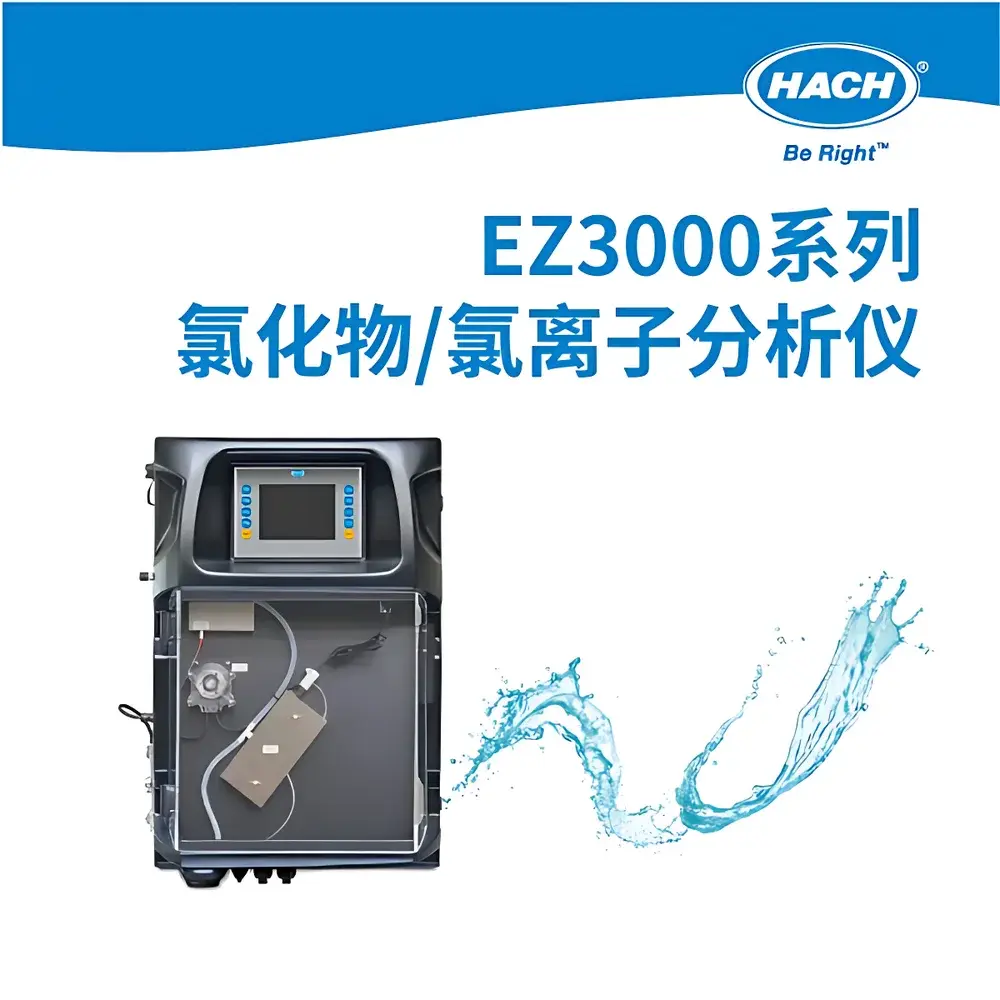
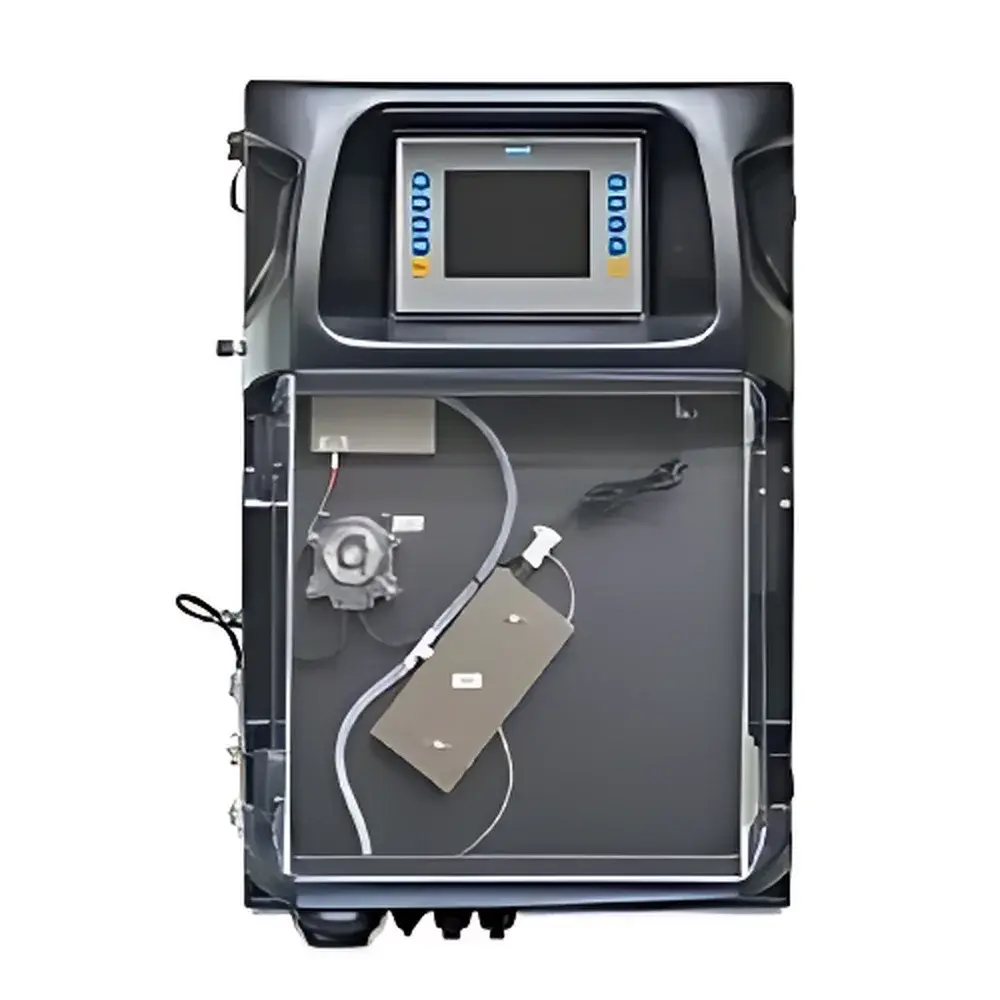
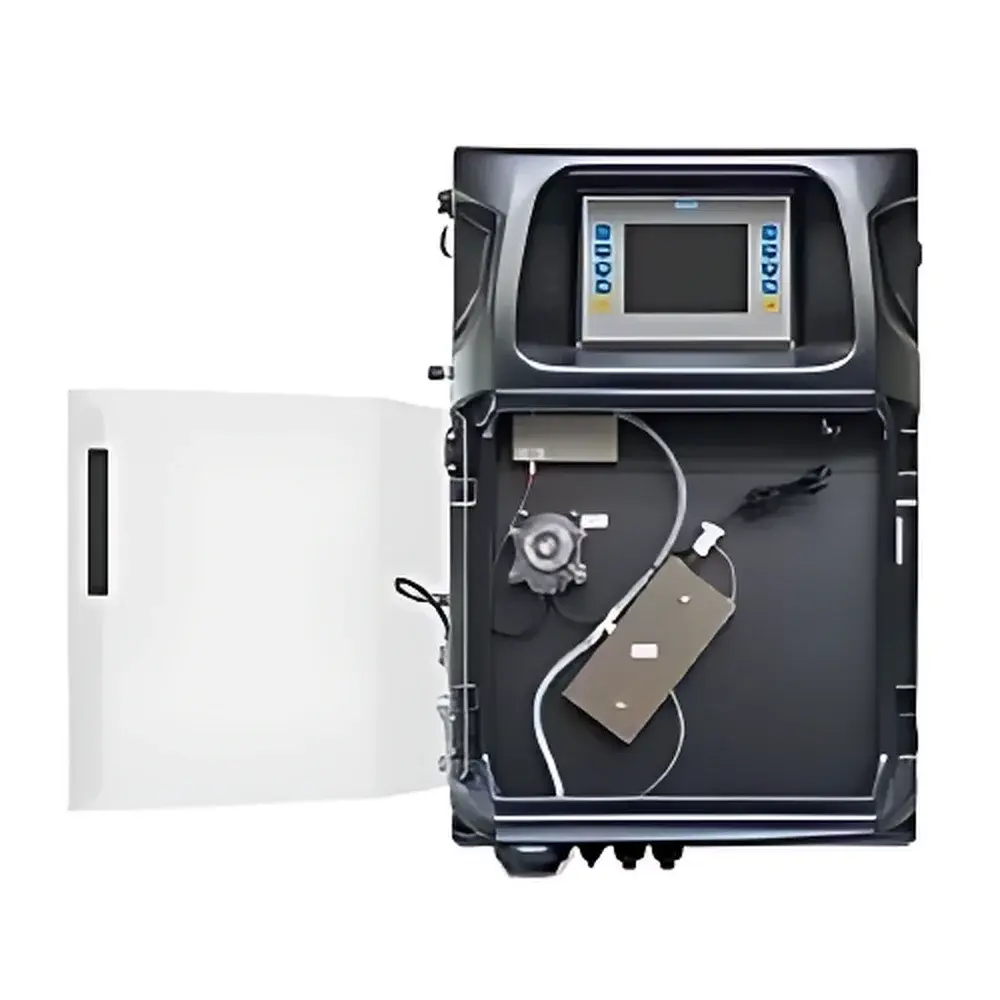
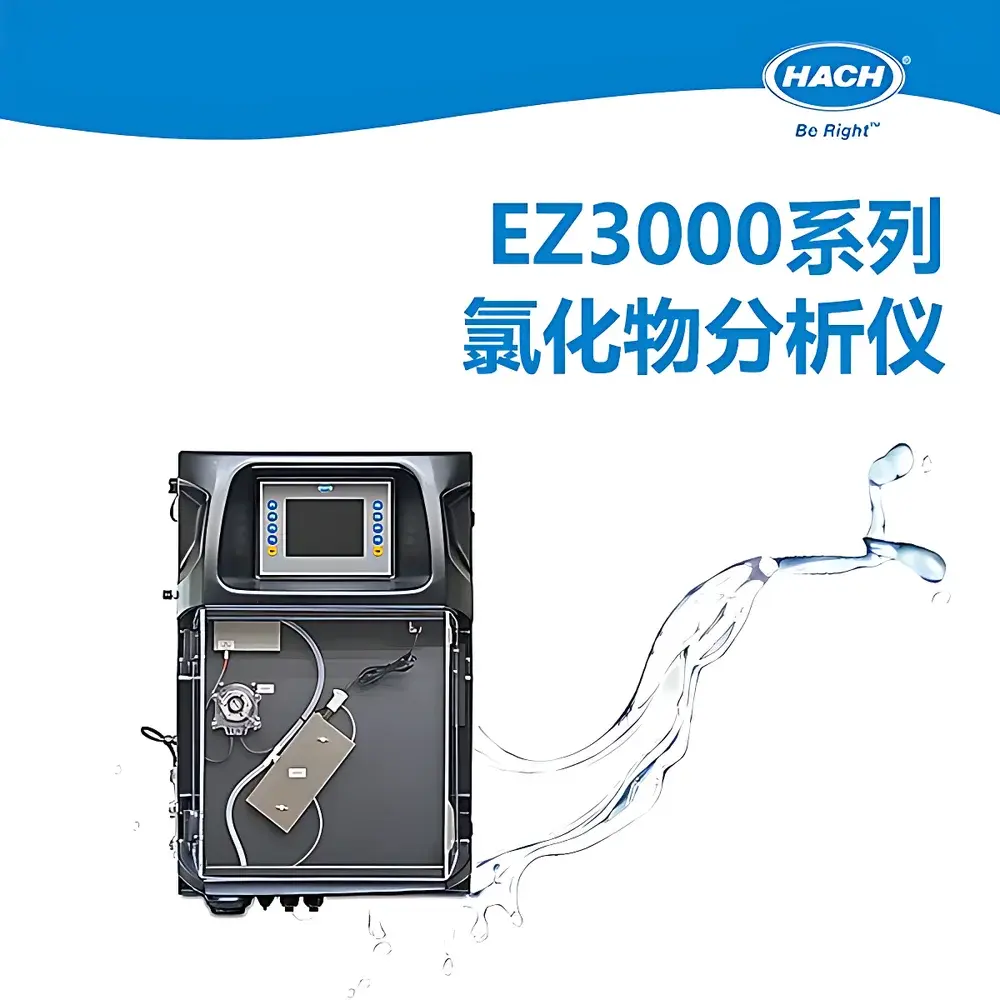
HACH EZ3000 Series Chloride Analyzer
| Brand | HACH |
|---|---|
| Origin | Imported |
| Manufacturer Type | Manufacturer |
| Model | EZ3003.99001102, EZ3004.99001102, EZ3005.99001102 |
| Measurement Range | EZ3003: 1–10 mg/L Cl⁻ |
| EZ3004 | 10–100 mg/L Cl⁻ |
| EZ3005 | 100–1,000 mg/L Cl⁻ |
| Detection Limit | ≤1 mg/L Cl⁻ |
| Response Time | 5 min |
| Accuracy | ≤2% F.S. (using certified standard solutions) |
| Operating Temperature | 10–30 °C |
| Sample Temperature Range | 10–30 °C |
| Sample Flow Rate | 100–300 mL/min |
| Power Supply | 110–240 VAC, 4 A, 50/60 Hz, max. 150 VA |
| Analog Output | 4–20 mA (1 channel standard, up to 8 optional) |
| Digital Output | RS232, Modbus TCP/IP or RS485 (optional) |
| Enclosure Rating | IP55 (analyzer), IP65 (panel PC) |
| Dimensions | 690 × 465 × 330 mm |
| Weight | 30 kg |
Overview
The HACH EZ3000 Series Chloride Analyzer is an industrial-grade, online ion-selective electrode (ISE)-based analyzer engineered for continuous, reliable quantification of chloride ions (Cl⁻) in potable water and surface water applications. It employs a batch-mode direct ISE measurement principle—fully compliant with EPA Method 9212 and ASTM D512-12—ensuring regulatory traceability and methodological rigor. Unlike continuous-flow amperometric or colorimetric systems, the EZ3000 utilizes a precisely metered sample aliquot introduced into a sealed, temperature-stabilized measurement cell where a solid-state chloride-selective electrode and reference electrode generate a stable Nernstian potential. This voltage is converted to concentration via a two-point calibration curve, minimizing drift and interferences from ionic strength variations. Designed for unattended operation in municipal water treatment plants, reservoir monitoring stations, and watershed surveillance networks, the system delivers high reproducibility under variable inlet conditions while maintaining compliance with GLP-aligned data integrity requirements.
Key Features
- Batch-mode direct ISE measurement architecture—eliminates membrane fouling and reduces electrode polarization effects common in continuous-flow ISE systems
- Low-maintenance design with minimal reagent consumption (no chemical reagents required beyond calibration standards)
- Three scalable measurement ranges (EZ3003, EZ3004, EZ3005) enabling optimal resolution across low-, mid-, and high-concentration chloride environments
- Integrated industrial panel PC with intuitive HMI interface for local configuration, real-time diagnostics, and alarm management
- Configurable measurement interval (default 5 minutes) with automated validation and scheduled self-check routines
- Flexible I/O architecture: standard 4–20 mA analog output (1 channel), expandable to 8 channels; optional Modbus TCP/IP, Modbus RTU (RS485), or RS232 digital protocols for SCADA integration
- Ruggedized enclosure rated IP55 (main unit) and IP65 (panel PC), suitable for indoor and protected outdoor deployment
Sample Compatibility & Compliance
The EZ3000 accepts raw or filtered water samples meeting defined physical specifications: suspended solids ≤0.1 g/L, particle size ≤100 µm, and turbidity <50 NTU. Samples must be maintained within 10–30 °C during analysis; ambient operating temperature range is 5–35 °C ±5 °C (non-condensing, sheltered from direct sunlight and precipitation). The analyzer complies with CE and UL safety standards and supports audit-ready operation per 21 CFR Part 11 when paired with HACH’s validated software suite. Its adherence to EPA 9212 and ASTM D512-12 enables direct use in regulatory reporting workflows for drinking water utilities subject to U.S. Safe Drinking Water Act (SDWA) monitoring requirements.
Software & Data Management
The embedded panel PC runs a deterministic real-time OS with HACH’s proprietary EZ3000 Control Software, supporting full parameter configuration, calibration history logging, event-driven alarms (e.g., out-of-range, low flow, calibration failure), and time-stamped measurement records with operator ID tagging. All calibration and validation events are stored with metadata—including date/time, standard lot numbers, and deviation values—for GLP/GMP traceability. Data export options include CSV via USB and network-based retrieval via Modbus or HTTP API. Optional cloud connectivity enables remote health monitoring and predictive maintenance alerts based on electrode impedance trends and response stability metrics.
Applications
- Continuous monitoring of chloride breakthrough in granular activated carbon (GAC) or ion exchange beds at drinking water treatment facilities
- Early-warning detection of saline intrusion in coastal groundwater abstraction points and river intakes
- Compliance verification for chloride limits (e.g., WHO guideline value: 250 mg/L; U.S. EPA secondary standard: 250 mg/L) in distribution system sampling stations
- Process control feedback for de-icing salt runoff mitigation in stormwater retention basins
- Long-term trend analysis in watershed-scale environmental monitoring programs requiring high temporal resolution
FAQ
What measurement principle does the EZ3000 employ?
It uses batch-mode direct potentiometric measurement with a chloride-selective electrode, conforming to EPA 9212 and ASTM D512-12.
Can the EZ3000 operate without reagents?
Yes—no consumable reagents are required for measurement; only certified calibration standards are needed for periodic two-point calibration.
Is multi-channel capability available?
Yes—up to eight independent measurement channels can be configured using a shared panel PC and modular analyzer modules.
How is data integrity ensured for regulatory reporting?
All measurements, calibrations, and system events are timestamped, user-logged, and stored with cryptographic checksums; optional 21 CFR Part 11-compliant software packages provide electronic signature and audit trail functionality.
What are the environmental installation requirements?
The analyzer requires sheltered mounting with ambient temperature control (5–35 °C), avoidance of condensation, and protection from UV exposure and rain; sample line temperature must remain between 10–30 °C.
Related Products







