
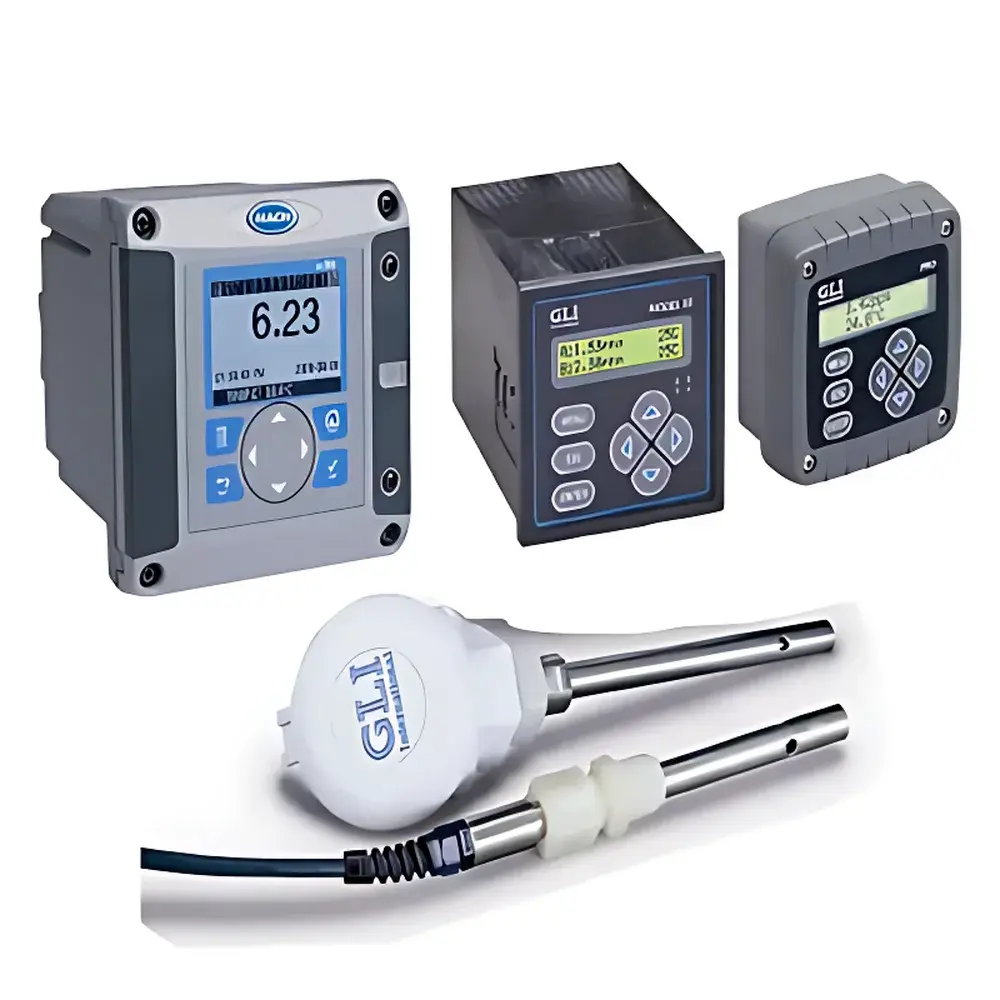
HACH GLI Conductivity Analyzer Series (C53, C33, PRO-C3)
| Brand | HACH |
|---|---|
| Origin | USA |
| Manufacturer | HACH Company |
| Product Line | GLI |
| Controller Models | C53, C33, PRO-C3 |
| Measurement Parameters | Conductivity (0.0–2,000,000 µS/cm), Resistivity (0–19.99 MΩ·cm), TDS (0–9,999 ppm) |
| Temperature Range | −20.0 to +200.0 °C |
| Accuracy | Up to ±0.05% of full scale (PRO-C3), ±0.2% per 24 h (C53/C33) |
| Repeatability | Up to ±0.05% FS (PRO-C3), ±0.1% FS (C53/C33) |
| Sensor Inputs | 2 (C53, C33), 1 (PRO-C3) |
| Outputs | Dual 4–20 mA (C53, C33), Single 4–20 mA (PRO-C3) |
| Relays | 4 (C53), 2 (C33), N/A (PRO-C3) |
| Enclosure Rating | NEMA 4X / IP65 (all models) |
| Hazardous Area Certification | Class I, Division II, Groups A, B, C, D, T5 (PRO-C3 only) |
| Calibration Method | Dry-Cal™ (electrode constant & temperature coefficient pre-labeled on probe) |
| Compliance | CE, RoHS, FCC, UL 61010-1, ATEX/IECEx optional for PRO-C3 |
| Software Interface | Local menu-driven operation with password protection, diagnostic logging, and audit-ready configuration history |
Overview
The HACH GLI Conductivity Analyzer Series—including the C53, C33, and intrinsically safe PRO-C3 models—is a field-proven family of industrial-grade conductivity, resistivity, and total dissolved solids (TDS) analyzers engineered for continuous, high-stability monitoring in demanding water quality applications. Based on two-electrode or four-electrode conductometric measurement principles, these analyzers deliver trace-level resolution down to 0.057 µS/cm and ultra-high resistivity detection up to 18.2 MΩ·cm—making them suitable for ultrapure water systems in pharmaceutical manufacturing, power plant condensate loops, semiconductor rinse processes, and municipal drinking water treatment. Each model integrates temperature-compensated conductivity calculation using either linear, non-linear (NaCl curve), or user-defined algorithms, ensuring metrological rigor across wide dynamic ranges. The system architecture supports both analog and digital sensor integration, with all controllers designed for long-term drift stability under variable thermal and chemical load conditions.
Key Features
- Dry-Cal™ calibration methodology eliminates reliance on standard solutions: electrode cell constant (K = 0.01–10.0 cm⁻¹) and temperature coefficient (β) are laser-etched on each GLI probe (e.g., Model 3422 for ultrapure water); values are entered directly into the analyzer for traceable, repeatable calibration.
- Multi-parameter capability: simultaneous real-time computation and display of conductivity, resistivity, and TDS—each fully configurable with independent scaling, units, and alarm thresholds.
- Robust hardware design: NEMA 4X/IP65-rated enclosures for outdoor or washdown environments; C53 and C33 support panel, wall, or pipe mounting; PRO-C3 certified for Class I, Division II hazardous locations per UL 913 and IEC 60079-0/11.
- Comprehensive diagnostics: built-in sensor health monitoring (including cable resistance, electrode fouling detection, and temperature sensor validation), automatic error logging with timestamped event records, and self-test routines compliant with GLP/GMP data integrity requirements.
- Secure operational interface: password-protected configuration menus, role-based access control (operator/engineer/administrator), and firmware-upgradable logic—enabling audit-ready deployment in regulated industries.
Sample Compatibility & Compliance
The GLI analyzer series accommodates a broad range of aqueous matrices—from raw surface water and wastewater effluent to high-purity boiler feedwater and pharmaceutical process water. When paired with the GLI 3422 low-conductivity cell (K = 0.01 cm⁻¹), the system meets ASTM D1125 and ISO 7888 requirements for ultrapure water resistivity verification. All models comply with electromagnetic compatibility standards (EN 61326-1, FCC Part 15), safety regulations (UL 61010-1, CSA C22.2 No. 61010-1), and environmental directives (RoHS, REACH). The PRO-C3 variant is optionally certified to ATEX Directive 2014/34/EU and IECEx Scheme for use in explosive atmospheres. Data handling conforms to FDA 21 CFR Part 11 principles where electronic records and signatures are implemented via optional HACH DataStream software.
Software & Data Management
While the C53 and C33 feature an intuitive local LCD interface with multilevel navigation and English/Spanish language support, full system integration is achieved through HACH’s DataStream™ platform—a secure, web-enabled SCADA interface supporting Modbus RTU/TCP, EtherNet/IP, and OPC UA protocols. DataStream enables centralized configuration management, remote firmware updates, historical trend visualization, and automated report generation (PDF/CSV) aligned with ISO/IEC 17025 documentation practices. Audit trails capture every parameter change, calibration event, and user login with immutable timestamps—supporting regulatory inspections under EPA, EU Water Framework Directive, and pharmaceutical cGMP frameworks.
Applications
- Power generation: condensate polishing loop monitoring, demineralizer effluent verification, and turbine steam purity assurance.
- Pharmaceutical & biotechnology: USP purified water and water-for-injection (WFI) conductivity compliance testing.
- Municipal utilities: source water characterization, coagulation control feedback, and distribution system integrity assessment.
- Industrial pretreatment: RO feed monitoring, cooling tower blowdown optimization, and electroplating bath concentration control.
- Environmental compliance: NPDES discharge reporting, landfill leachate tracking, and watershed health surveillance.
FAQ
What is Dry-Cal™ calibration, and how does it differ from traditional wet calibration?
Dry-Cal™ uses factory-determined, probe-specific constants (cell constant K and temperature coefficient β) permanently marked on the sensor housing. This eliminates calibration solution variability and operator technique dependence—providing inherently higher reproducibility than conventional KCl-based methods.
Can the C53 or C33 be used in hazardous areas?
No—only the PRO-C3 model carries Class I, Division II, Groups A–D, T5 certification. C53 and C33 are rated for general-purpose industrial use only.
Does the analyzer support automatic temperature compensation for non-NaCl solutions?
Yes—users may select from preloaded curves (e.g., KCl, CaCO₃), define custom polynomial coefficients, or disable compensation entirely for research-grade manual interpretation.
How is data integrity ensured during power interruption or communication loss?
All models retain configuration and last-measured values in non-volatile memory. With DataStream™, buffered data is stored locally and synchronized upon network recovery—meeting ALCOA+ (Attributable, Legible, Contemporaneous, Original, Accurate, Complete, Consistent, Enduring, Available) principles.
Is third-party sensor compatibility supported?
GLI analyzers are optimized for HACH GLI-branded electrodes (e.g., 3422, 3415, 3400 series). While generic two-wire sensors may function, full diagnostic capability and Dry-Cal™ validation require native GLI probes with embedded calibration metadata.
Related Products







