
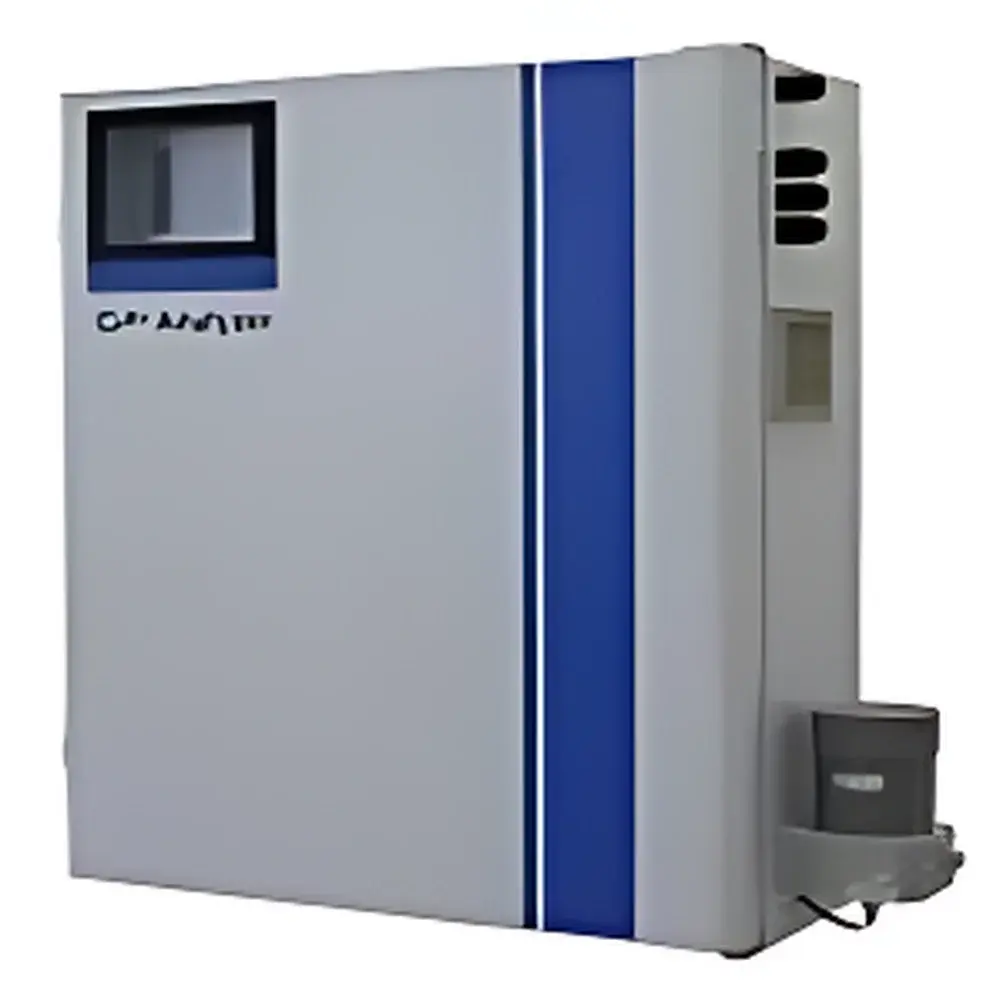
Hach HMA Series Heavy Metals Online Analyzers
| Brand | Hach |
|---|---|
| Origin | Imported |
| Manufacturer Type | Manufacturer |
| Instrument Type | Online Analyzer |
| Detection Principle | Photometric Colorimetry |
| Measurable Metals | Cr(VI), Total Cr, Total Cu, Total Ni, Total Mn (Multi-Parameter Configurable) |
| Analysis Time | 25 min (Cr(VI)) |
| Accuracy/Precision | ±3% F.S. |
| Resolution | 0.001 mg/L |
Overview
The Hach HMA Series Heavy Metals Online Analyzers are fully automated, laboratory-grade photometric instruments engineered for continuous, unattended monitoring of regulated heavy metal species in municipal wastewater, industrial effluent, drinking water treatment plants, and environmental compliance applications. Each analyzer operates on standardized colorimetric reaction chemistry—fully compliant with EPA Method 7196A (Cr(VI)), ISO 11084 (Total Cr), ISO 8288 (Total Ni), and ASTM D1688 (Cu)—and integrates precise reagent dosing, high-temperature digestion (for total metal forms), optical detection at optimized wavelengths (470 nm or 540 nm), and real-time signal processing. The system employs a robust peristaltic fluidic architecture with integrated sample filtration, automatic backflushing, and dual-range adaptive dilution to maintain analytical integrity across wide concentration spans—from trace-level regulatory thresholds (e.g., 0.01 mg/L Cr(VI)) to industrial discharge limits (e.g., 20 mg/L Mn). Designed as a modular platform, the HMA series supports field-swappable analyte modules without hardware replacement, enabling flexible deployment across multi-parameter monitoring stations.
Key Features
- Automated high-temperature digestion module (except Cr(VI)) operating up to 120°C, ensuring complete oxidation of organically bound and particulate metal fractions into detectable ionic forms
- Integrated sample filtration with air-driven automatic backflush after every analysis cycle—reducing maintenance frequency and preventing clogging from suspended solids
- Intelligent dual-range operation: automatic sample dilution and range switching between low- and high-concentration modes based on real-time absorbance feedback
- Low consumables footprint: monthly reagent consumption ranges from 1 L (Cr(VI)) to 5 L (Ni); waste generation is minimized to 1.1–1.9 L/month per parameter
- Self-calibrating architecture with programmable calibration intervals (1–7 days), drift compensation, and full-system diagnostic logging
- 5.7-inch color TFT touchscreen interface with multilingual support (English, Chinese), intuitive menu navigation, and embedded troubleshooting guides
- Industrial-grade enclosure rated for indoor installation (IP20), operational at 10–40°C ambient, with vibration-resistant mounting and wall-mountable form factor (900 × 255 × 600 mm)
Sample Compatibility & Compliance
The HMA analyzers accept raw or pre-filtered aqueous samples with flow rates of 1–3 L/min, inlet pressure of 20–50 kPa, and temperature stability between 10–40°C. Sample intake uses Rc1/2 threaded connections; waste discharge via Rc3/4. All wetted components—including tubing, digestion coils, and cuvettes—are chemically resistant to strong acids (HNO₃, H₂SO₄), oxidants (persulfate), and complexing agents used in standard methods. The platform meets ISO/IEC 17025 traceability requirements for routine calibration and supports audit-ready data handling under GLP and GMP frameworks. Optional pretreatment systems—including pH adjustment, coarse filtration, and dechlorination modules—are available to extend instrument uptime in challenging matrices (e.g., high-TSS or chlorinated influents).
Software & Data Management
Firmware includes embedded MODBUS-RTU (RS-485) and RS-232C serial protocols for seamless integration into SCADA, DCS, or PLC-based control networks. Two isolated 4–20 mA analog outputs provide real-time concentration signals with configurable damping and scaling. Relay outputs (2×, 24 VDC / 220 VAC rated) support alarm-triggered actions such as pump shutdown or bypass valve actuation. Internal memory stores ≥30 days of timestamped measurement records, calibration logs, error codes, and maintenance events—with automatic overwrite policy. Data export is supported via USB flash drive in CSV format. The system complies with FDA 21 CFR Part 11 requirements for electronic records when paired with Hach’s optional secure authentication and audit trail extension.
Applications
- Regulatory compliance monitoring for Cr(VI) in surface water discharges per EU Water Framework Directive and US Clean Water Act
- Effluent tracking at electroplating, metal finishing, and battery manufacturing facilities
- Process control in chemical precipitation and ion exchange units treating metal-laden wastewaters
- Early-warning detection of metal leaching in landfill leachate collection systems
- Drinking water safety verification at entry points following source contamination incidents
- Long-term trend analysis for environmental impact assessments (EIA) and permit renewal reporting
FAQ
What sample preparation is required prior to analysis?
No manual sample prep is needed—the HMA performs full on-board digestion (for total metals), filtration, reagent addition, reaction incubation, and photometric quantification autonomously.
Can multiple metals be measured simultaneously on one instrument?
No—the HMA is a single-analyte platform; however, multiple HMA modules (e.g., HMA-CR6 + HMA-TCU) can be rack-mounted and synchronized via shared I/O and power to form a multi-parameter station.
Is remote diagnostics supported?
Yes—via optional Ethernet gateway module (sold separately), enabling secure web-based access to live status, historical trends, and firmware updates.
How often must the optical cell be cleaned manually?
Under normal operation with regular backflushing, manual cleaning of the flow cell is recommended only every 6 months or after 5,000 measurement cycles.
Are reagent formulations proprietary or publicly disclosed?
Hach publishes full reagent recipes for all HMA methods, enabling qualified users to prepare in-house solutions—reducing long-term operational costs and supply chain dependency.







