
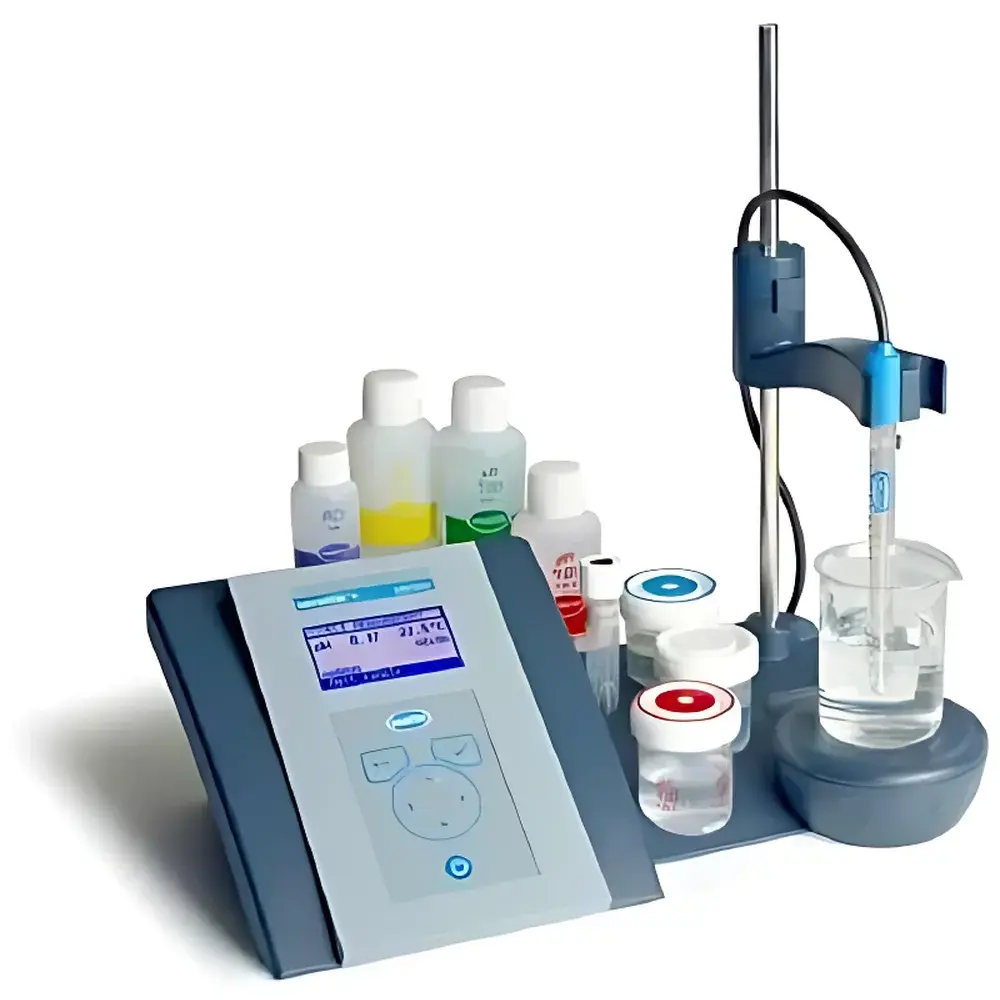
Hach MM374 Multi-Parameter Benchtop Analyzer for pH, Conductivity, and Ion-Selective Electrode Measurements
| Brand | Hach |
|---|---|
| Model | MM374 |
| Measurement Channels | Dual independent channels (Channel 1: pH + EC + °C |
| Channel 2 | pH / mV / ISE + °C) |
| Electrode Support | Dual-channel electrode configuration with dedicated reference electrodes, Pt1000 temperature probes, integrated conductivity cells with automatic temperature compensation (ATC), and built-in magnetic stirrers per channel |
| Compliance | Designed for laboratory-based water quality analysis in accordance with ASTM D1125, ISO 7888, ISO 10523, and USP <791>, <645> |
| Software Interface | RS232 and USB connectivity for data export |
Overview
The Hach MM374 is a dual-channel benchtop multi-parameter analyzer engineered for precise, simultaneous measurement of pH, electrical conductivity (EC), and ion-selective electrode (ISE) responses in laboratory water quality applications. Built upon Hach’s legacy of electrochemical instrumentation reliability, the MM374 employs potentiometric and conductimetric principles—utilizing high-impedance voltage measurement circuits for pH/mV/ISE and four-electrode AC conductivity sensing for enhanced accuracy across variable salinity ranges. Its architecture supports concurrent operation of two independent analytical channels, enabling comparative analysis (e.g., parallel calibration verification, matrix-matched sample vs. standard testing) or sequential multi-analyte profiling without hardware reconfiguration. The system is purpose-built for regulated environments including municipal drinking water labs, environmental compliance facilities, and academic research laboratories conducting method validation under GLP or ISO/IEC 17025 frameworks.
Key Features
- Dual independent measurement channels—each with isolated circuitry, dedicated temperature compensation (Pt1000), and individual magnetic stirring control to eliminate cross-channel interference and ensure reproducible hydrodynamic conditions.
- Channel 1 optimized for combined pH/conductivity analysis: accepts combination pH electrodes, separate reference electrodes, and integrated conductivity cells with automatic temperature compensation (ATC) compliant with ISO 7888 Annex B.
- Channel 2 configured for flexible potentiometric modes: selectable between pH, direct mV, or ISE measurement (e.g., nitrate, fluoride, ammonium) with user-definable slope calibration and Nernstian response validation.
- Built-in magnetic stirrers on both channels provide consistent, adjustable agitation—critical for minimizing diffusion layer effects during ISE measurements and improving endpoint stability in low-conductivity samples.
- Rugged benchtop enclosure with chemical-resistant housing, front-panel keypad navigation, and large backlit LCD display supporting real-time parameter overlay (e.g., pH + mV + °C simultaneously).
- Calibration management with up to five-point pH calibration, linear/nonlinear EC cell constant verification, and ISE standard addition support—all logged with timestamp, operator ID, and calibration deviation metrics.
Sample Compatibility & Compliance
The MM374 accommodates aqueous samples across a broad range of matrices: raw surface water, treated drinking water, wastewater effluents, leachates, and process streams with total dissolved solids (TDS) up to 200 g/L. It supports standard 12-mm diameter glass pH electrodes, double-junction reference electrodes with KCl or polymer gel electrolytes, and industry-standard conductivity cells (e.g., 1.0 cm⁻¹ or 0.1 cm⁻¹ cells). For ISE applications, it interfaces with solid-state and liquid-membrane sensors meeting ASTM D6694 specifications. All measurement protocols align with EPA Method 150.1 (pH), ASTM D1125 (conductivity), and ISO 10304-1 (ion chromatography–correlated ISE validation). Data integrity complies with FDA 21 CFR Part 11 when used with Hach Lab Software, providing electronic signatures, audit trails, and role-based access control.
Software & Data Management
The MM374 communicates via RS232 and USB virtual COM port protocols, enabling seamless integration into LIMS and ELN platforms. Hach Lab Software (v3.2+) provides secure, encrypted data import with full metadata capture—including instrument ID, sensor serial numbers, calibration history, environmental ambient logs, and user-defined sample IDs. Each measurement record includes raw mV/µS/cm values, temperature-corrected results, confidence indicators (e.g., electrode impedance check status), and pass/fail flags against configurable acceptance criteria. Audit trails are immutable, time-stamped, and exportable as PDF or CSV for regulatory submission. Instrument firmware supports over-the-air updates verified via SHA-256 checksums.
Applications
- Drinking water compliance monitoring: simultaneous verification of pH stability and conductivity per WHO Guidelines and EU Directive 98/83/EC Annex I.
- Wastewater treatment optimization: tracking ammonium and nitrate trends via ISE during nitrification/denitrification cycles.
- Environmental field lab support: rapid screening of acid mine drainage (pH + sulfate ISE + EC) with traceable calibration chains.
- Pharmaceutical water systems: USP conductivity mapping and pH verification in purified water and water-for-injection (WFI) loops.
- Educational laboratories: teaching fundamental electrochemistry concepts—including junction potentials, activity coefficients, and Debye-Hückel corrections—using dual-channel comparative experiments.
FAQ
Can the MM374 measure pH and conductivity simultaneously on the same sample?
Yes—Channel 1 supports concurrent pH and EC measurement using a combination electrode and integrated conductivity cell, with synchronized temperature compensation from a single Pt1000 probe.
Does the instrument support automatic calibration recognition for Hach IntelliCAL electrodes?
No—the MM374 requires manual entry of electrode identification and calibration parameters; it does not feature RFID or digital electrode handshake capability.
Is GLP-compliant data export possible without additional software?
Raw data export via USB/RS232 is timestamped but lacks audit trail functionality; full GLP compliance requires Hach Lab Software with enabled electronic signature and change control modules.
What is the maximum allowable sample temperature for continuous operation?
The instrument operates continuously within 5–40 °C ambient; electrode and conductivity cell specifications govern sample temperature limits—typically 0–105 °C depending on sensor model.
How is electrode drift monitored during extended ISE measurements?
The MM374 calculates and displays real-time electrode potential stability (mV/min) and prompts users to confirm measurement validity before result acceptance, per ISO 15197:2013 guidance for electrochemical sensor performance assessment.
Related Products







