
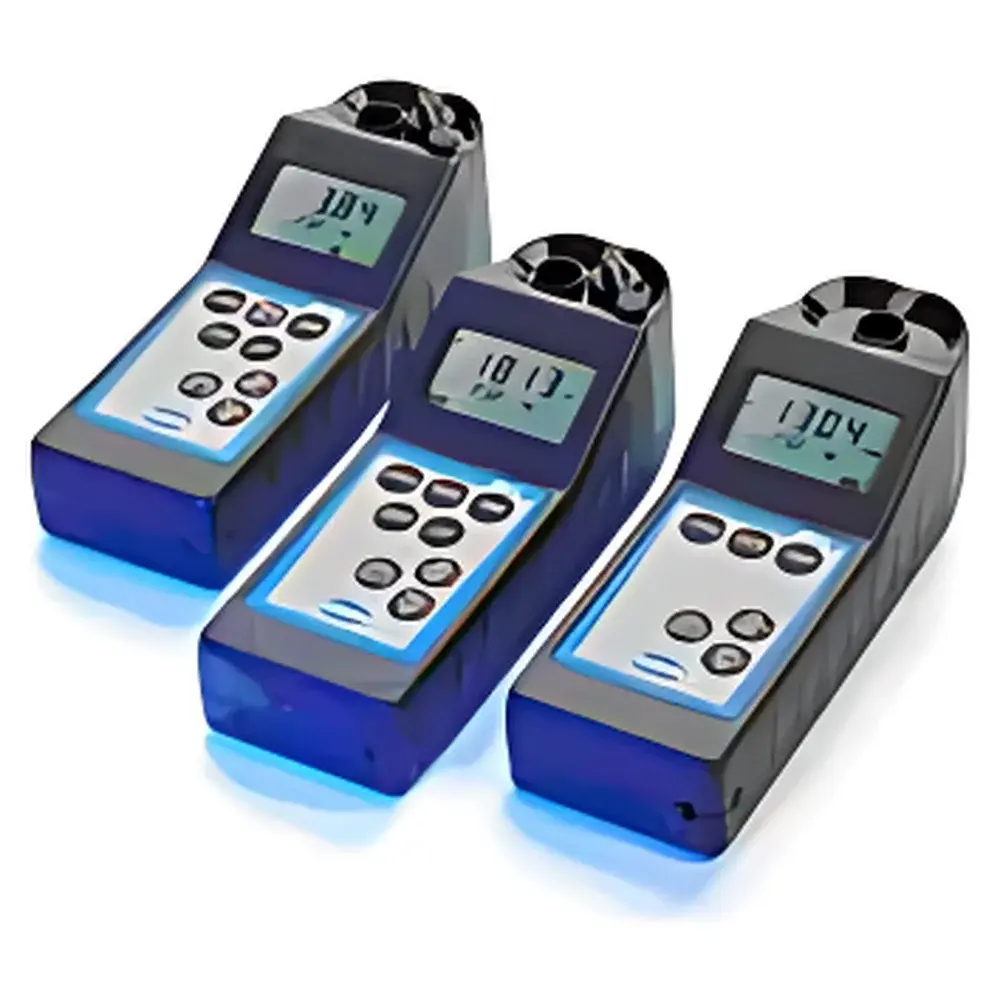
HACH MP Portable Multiparameter Meter – Probe-Free Design
| Brand | HACH |
|---|---|
| Model | MP Meter |
| Type | Portable Multiparameter Electrochemical Analyzer |
| Power | 9V Alkaline Battery (≥100 h / ~5,000 readings) |
| Display | 4-digit LCD |
| Ingress Protection | IP67 / NEMA 6 (submersible to 1 m) |
| Operating/Storage Temperature | 0–55 °C |
| Dimensions | 196 × 68 × 64 mm |
| Weight | 352 g |
| pH Range | 0–14 |
| pH Resolution | 0.01 |
| pH Accuracy | ±0.01 |
| ORP Range | ±999 mV |
| ORP Resolution | 1 mV |
| ORP Accuracy | ±1 mV |
| Conductivity Ranges | 0–9999 µS/cm, 10–200 mS/cm (5 auto-ranging scales) |
| Conductivity Accuracy | ±1% of reading |
| TDS Ranges | 0–9999 ppm, 10–200 ppt (5 auto-ranging scales) |
| TDS Accuracy | ±1% of reading |
| Resistivity Range | 10 kΩ–30 MΩ |
| Resistivity Accuracy | ±1% of reading |
| Temperature Range | 0–71 °C |
| Temp Resolution | 0.1 °C/°F |
| Temp Accuracy | ±0.1 °C |
| Auto Temperature Compensation | 0–71 °C |
| Adjustable TC Coefficient | 0.00–9.99 %/°C |
| Predefined TDS Conversion Factors | KCl, 442™, NaCl |
| Adjustable TDS Conversion Factor | 0.20–7.99 |
| Sample Volumes | pH/ORP: 1.2 mL |
| Conductivity/TDS/Resistivity | 5 mL |
| Cell Material | VALOX® thermoplastic |
Overview
The HACH MP Portable Multiparameter Meter is an integrated, probe-free electrochemical analyzer engineered for rapid, reliable field and laboratory measurement of pH, oxidation-reduction potential (ORP), conductivity, resistivity, total dissolved solids (TDS), salinity, and temperature. Unlike conventional meters requiring external electrodes or immersion probes, the MP employs a sealed, built-in sample chamber with integrated sensor elements—eliminating cable management, probe contamination risks, and calibration drift associated with exposed electrode surfaces. Its measurement architecture combines a solid-state pH/ORP sensing element with a four-electrode conductivity cell, enabling high reproducibility across diverse aqueous matrices—from potable water and wastewater effluents to industrial process streams and environmental surface waters. The device operates on fundamental potentiometric (pH, ORP) and conductimetric (conductivity, resistivity, TDS) principles, with all signal conditioning and temperature compensation performed by an embedded microprocessor calibrated against traceable NIST-traceable standards.
Key Features
- Probe-free design: All sensors are housed within the instrument body—no detachable probes, cables, or fragile glass membranes.
- Single-hand operation: Two-step workflow—fill the integrated sample chamber, then press the parameter key for immediate readout.
- IP67/NEMA 6-rated enclosure: Fully submersible to 1 meter; buoyant housing enables safe use in open channels, tanks, or flooded environments.
- Extended battery life: 9V alkaline power supports ≥100 hours of continuous operation (~5,000 measurements) with automatic power-down.
- Non-volatile memory: Calibration constants, measurement history, and configuration settings persist during battery replacement.
- Four-electrode conductivity cell: Minimizes polarization error and contact resistance effects—critical for high-accuracy measurements in low-conductivity or fouling-prone samples.
- Adjustable temperature compensation: User-selectable TC coefficient (0.00–9.99 %/°C) and optional disable function for non-standard media or compliance with ASTM D1125 or ISO 7888.
Sample Compatibility & Compliance
The MP Meter accommodates a broad range of aqueous samples without dilution or pretreatment: drinking water, groundwater, wastewater, cooling tower water, boiler feedwater, and hydroponic nutrient solutions. Its 1.2 mL pH/ORP chamber and 5 mL conductivity chamber minimize reagent consumption and cross-contamination risk. The instrument complies with standard method frameworks including EPA Method 150.1 (conductivity), ASTM D1293 (pH), and ISO 5667-22 (field sampling). While not certified for GLP or GMP production environments, its data integrity features—including timestamped readings, configurable units, and electronic calibration logs—support audit-ready documentation under ISO/IEC 17025-accredited laboratories. The preloaded KCl, 442™, and NaCl TDS conversion profiles align with USP , APHA Standard Methods 2510, and regulatory expectations for distribution system monitoring.
Software & Data Management
Optional MP DataLink software (v3.0+) and USB-powered MP Base Dock enable secure, error-resistant data transfer. The software automatically structures exported records in CSV format with columns for measurement ID, parameter type, numeric value, unit, solution profile, temperature, date, and time stamp—ensuring compatibility with LIMS, ELN, and statistical process control platforms. All data transfers comply with FDA 21 CFR Part 11 requirements when used with validated configurations, including electronic signatures, audit trails, and user access controls. No proprietary drivers are required; the MP Base Dock enumerates as a standard CDC-compliant USB serial device on Windows, macOS, and Linux systems.
Applications
- Drinking water quality verification at entry points, storage reservoirs, and distribution nodes.
- Rapid screening of wastewater influent/effluent for pH, ORP, and conductivity prior to biological treatment stages.
- Industrial cooling water monitoring for scaling potential (via conductivity/resistivity trends) and corrosion control (via ORP).
- Environmental field surveys where portability, ruggedness, and minimal consumables are critical—e.g., stream health assessments, wetland monitoring, and stormwater outfall checks.
- Educational labs requiring intuitive instrumentation for teaching fundamental electrochemical concepts without probe handling complexity.
FAQ
Does the MP Meter require routine electrode cleaning or storage solution?
No—its integrated solid-state pH/ORP sensor and sealed four-electrode conductivity cell eliminate traditional maintenance such as soaking, polishing, or refilling electrolyte.
Can the MP Meter be used for non-aqueous or high-viscosity samples?
It is validated exclusively for aqueous solutions. Non-aqueous solvents, oils, or slurries may damage internal seals or compromise sensor response and are outside the scope of performance specifications.
How often must the instrument be calibrated?
Typical calibration intervals range from biweekly to monthly depending on usage frequency and matrix variability; field validation against certified buffer and standard solutions is recommended before critical measurements.
Is the MP Meter compatible with third-party data loggers or SCADA systems?
Direct analog output is not supported; however, batch-exported CSV files from MP DataLink can be ingested into most industrial data historians via scripting or middleware integration.
What does the “442™” TDS conversion factor represent?
It reflects a proprietary mixture ratio (40% sodium sulfate, 40% sodium bicarbonate, 20% sodium chloride) developed by HACH to emulate natural freshwater mineral composition—widely adopted in municipal water testing per AWWA standards.




