
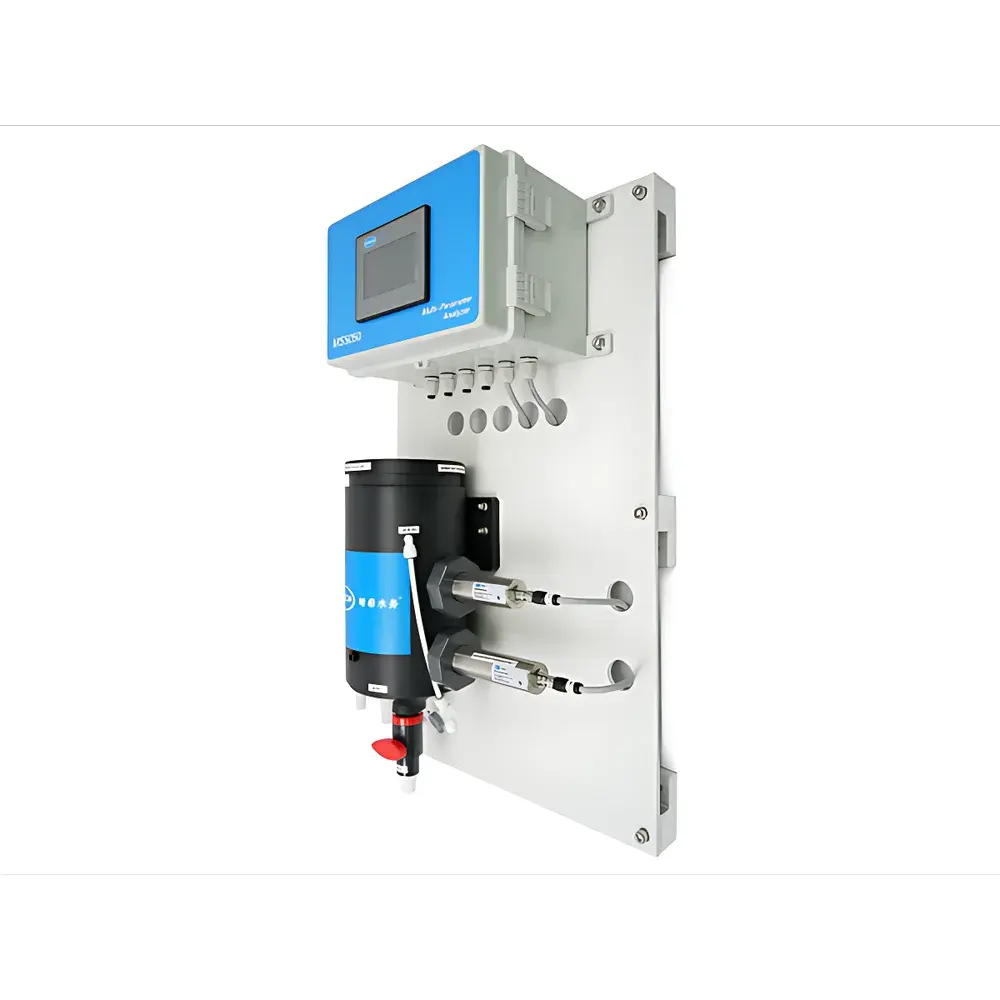
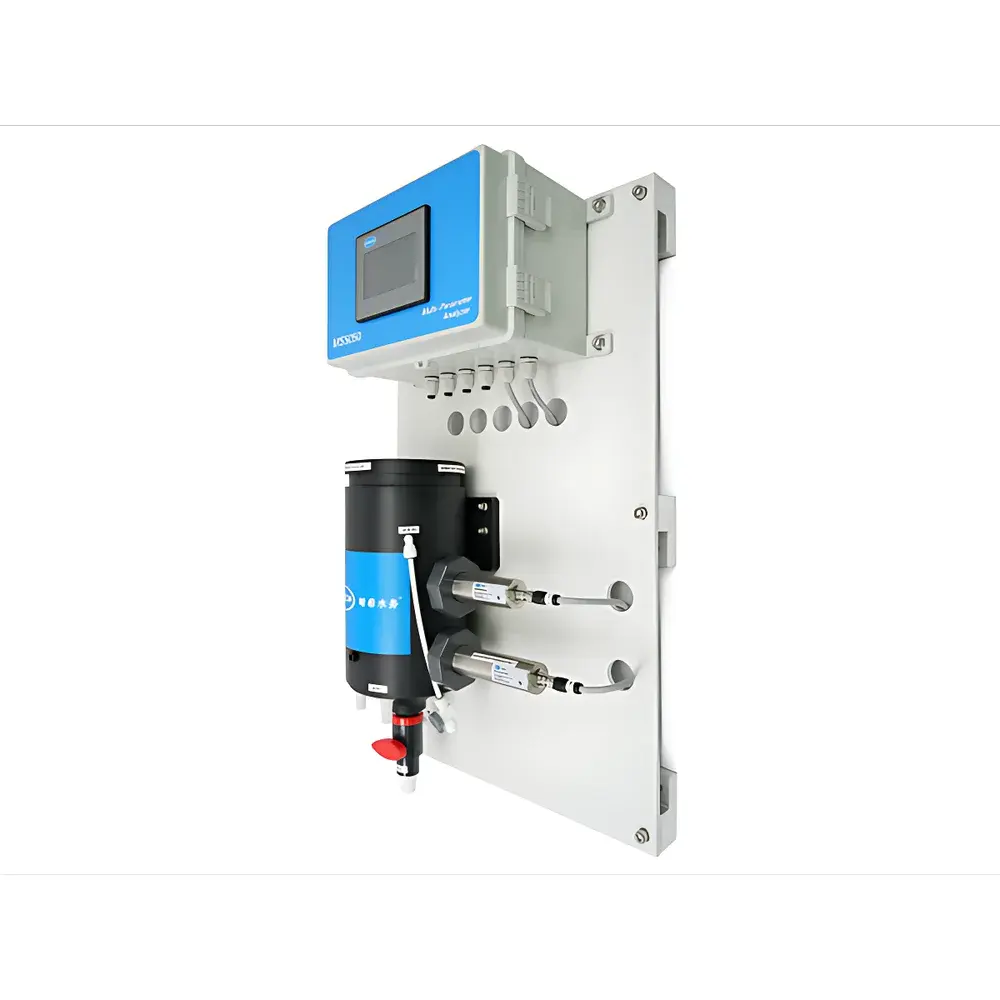
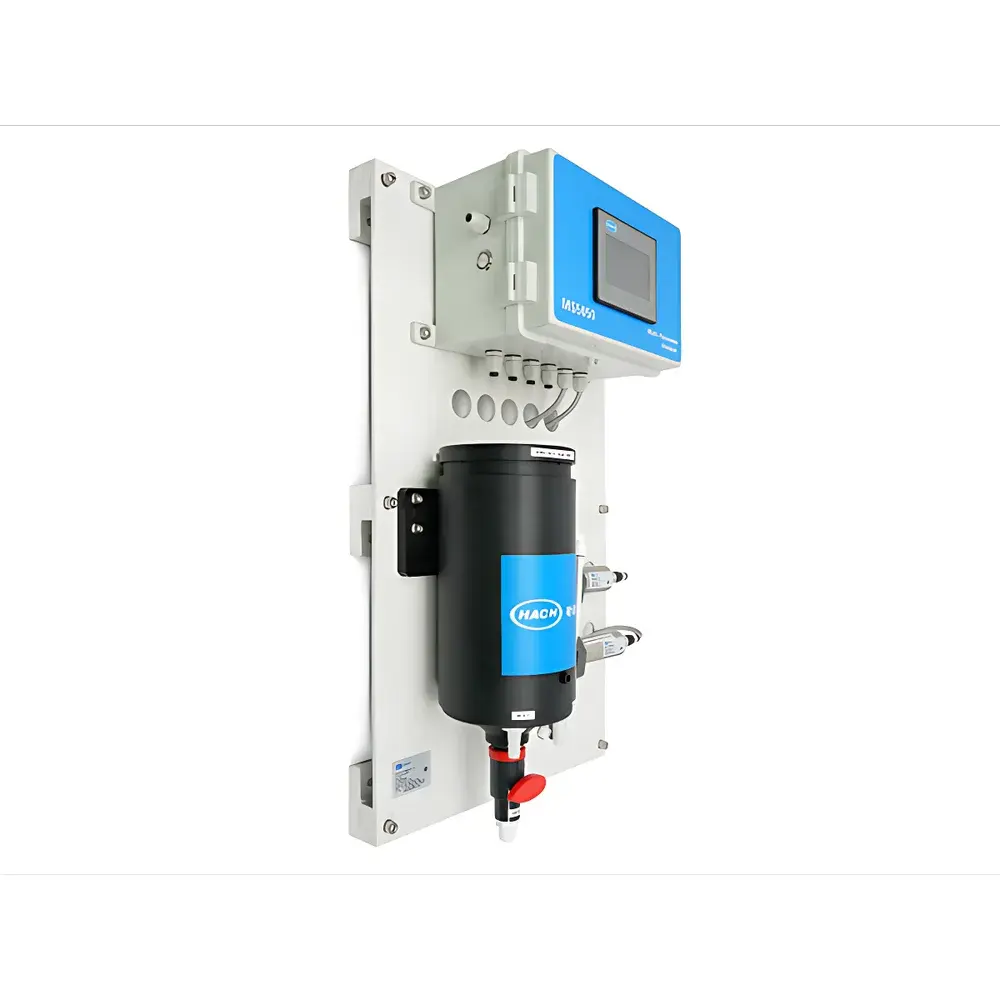
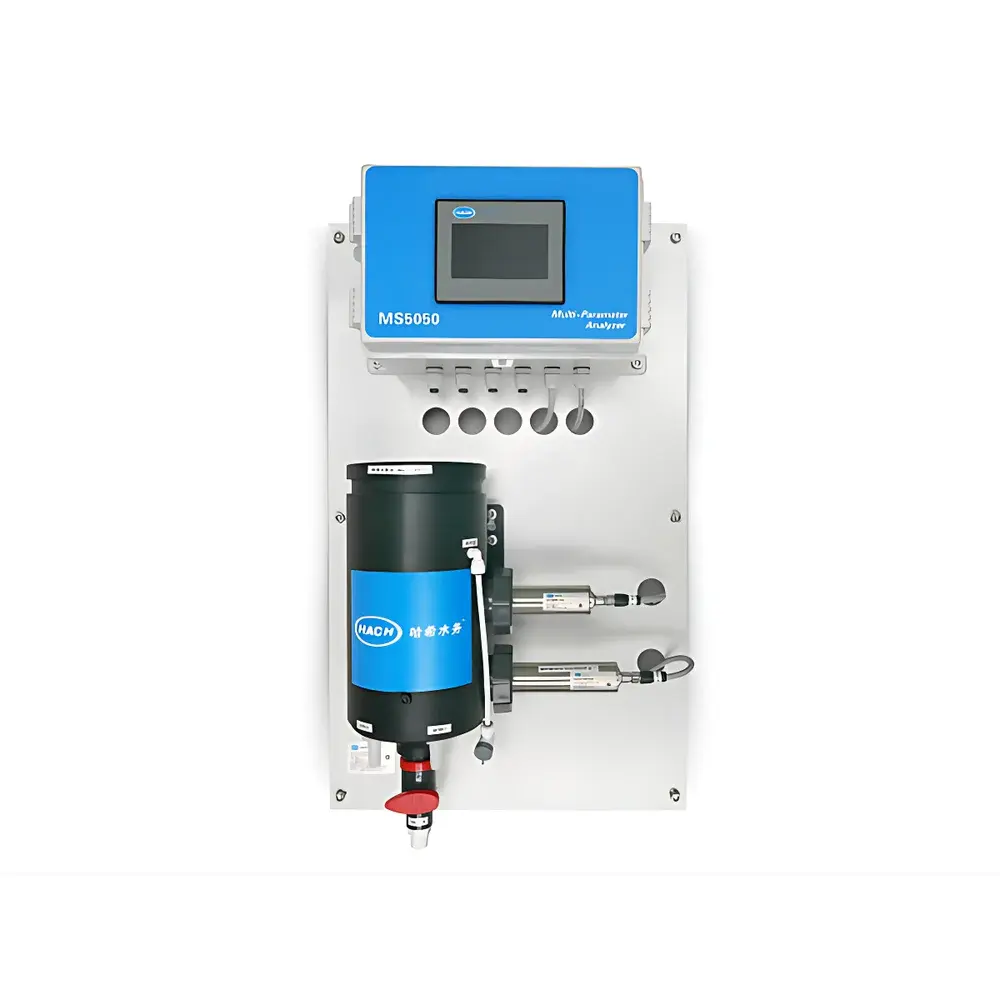
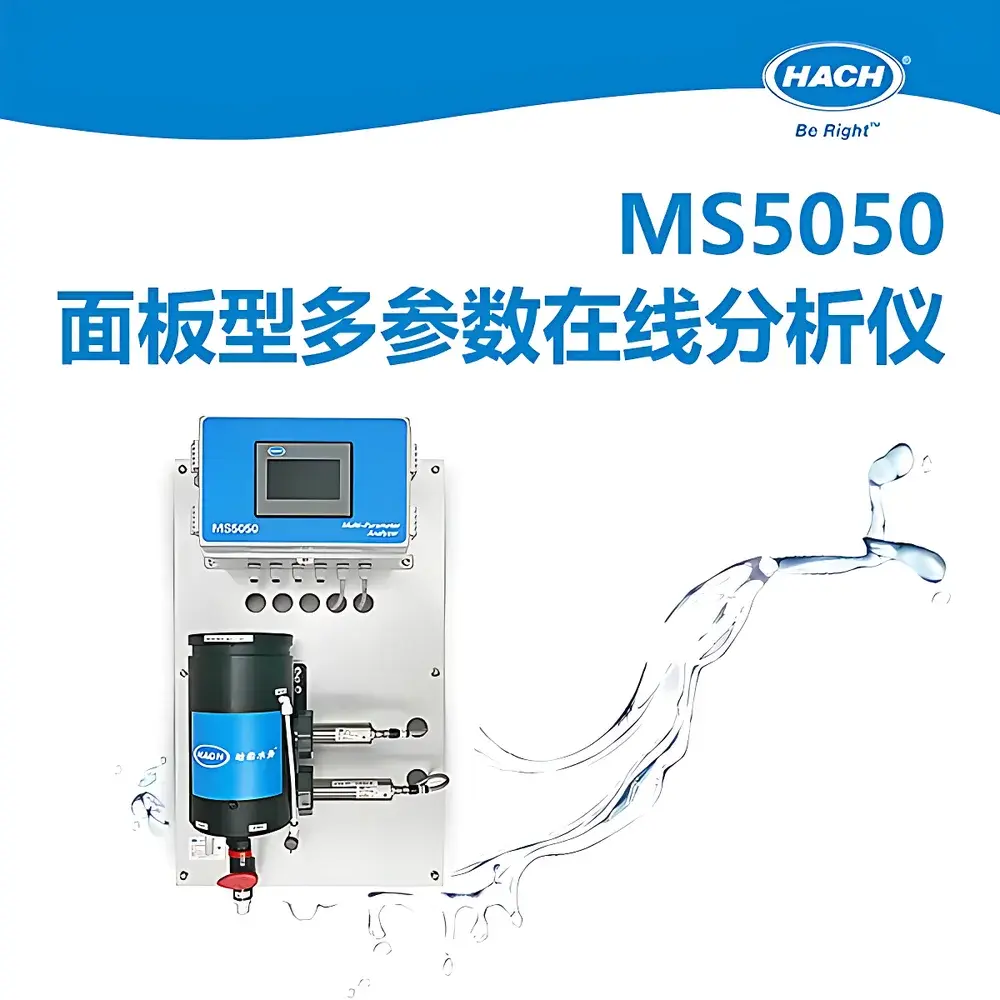
Hach MS5050 Panel-Mount Multi-Parameter Online Water Quality Analyzer
| Brand | Hach |
|---|---|
| Model | MS5050 |
| Measurement Principles | Amperometric (Cl₂/ClO₂, 3-electrode constant-voltage), pH glass electrode, PT100 temperature sensing, 90° nephelometric turbidity (EPA Method 180.1) |
| Measurement Range | Free Chlorine/Chlorine Dioxide: 0–5 mg/L as Cl₂ or ClO₂ |
| pH | 2–12 |
| Temp | −5–65 °C |
| Turbidity | 0–10 NTU / 10–40 NTU |
| Optional ORP | ±1500 mV |
| Optional Conductivity | 0–100,000 µS/cm |
| Detection Limits | Cl₂/ClO₂: 0.01 mg/L |
| pH | 0.01 |
| Turbidity | 0.001 NTU |
| Accuracy | Cl₂/ClO₂: ±0.01 ppm or ±2% of reading (whichever greater) |
| pH | ±0.02 @ 25 °C |
| Turbidity | ±0.01 NTU or ±2% of reading |
| ORP | ±20 mV or ±2% FS |
| Conductivity | ±10 µS/cm or ±1% of reading |
| Resolution | Cl₂/ClO₂: 0.01 mg/L |
| pH | 0.01 |
| Temp | 0.01 °C |
| Turbidity | 0.001 NTU |
| ORP | 1 mV |
| Conductivity | 1 µS/cm |
| Response Time (T90) | Cl₂/ClO₂ ≤120 s |
| Output | Dual-channel 4–20 mA and RS-485 (Modbus RTU) |
| Probe Materials | SS304 housing |
| Enclosure | 750 × 450 × 230.5 mm, full-plastic corrosion-resistant panel-mount chassis |
| weight | 15.2 kg |
| Display | 4.3″ TFT touchscreen (480 × 272) |
| Power | 100–240 VAC, 50/60 Hz |
| Power consumption | ~30 W |
| Operating Temp | 5–45 °C |
| Storage Temp | −20–55 °C |
| Humidity | 5–95% RH (non-condensing) |
| Max. altitude | 2000 m |
| Sample Requirements | Temp: 5–45 °C |
| Pressure | 0.05–0.25 MPa (pressure regulator required above 0.25 MPa) |
| Flow rate | ≥470 mL/min |
Overview
The Hach MS5050 Panel-Mount Multi-Parameter Online Water Quality Analyzer is an integrated, CE- and EPA-compliant platform engineered for continuous, real-time monitoring of critical disinfection and physical-chemical parameters in potable water distribution systems. It employs three distinct, co-located electrochemical and optical measurement principles within a single compact panel enclosure: amperometric detection of free chlorine or chlorine dioxide using a three-electrode constant-voltage cell (working, counter, and reference), potentiometric pH measurement via integrated glass electrode, and nephelometric turbidity quantification at 90° scatter geometry using a warm-white LED source (3200 K), fully compliant with U.S. EPA Method 180.1 and approved under 40 CFR 141.74(a)(1). Temperature compensation is performed in real time using a built-in PT100 sensor, and all primary measurements—chlorine/chlorine dioxide, pH, temperature, and turbidity—are acquired simultaneously without cross-interference. The analyzer’s architecture eliminates the need for membranes or electrolyte fill solutions in the chlorine sensor, significantly reducing drift, calibration frequency, and routine maintenance—particularly advantageous in secondary distribution networks and rural drinking water applications where operator availability and service infrastructure are constrained.
Key Features
- Triple-parameter composite sensor: Simultaneous output of free chlorine (or chlorine dioxide), pH, and temperature from a single, field-replaceable probe—enabling robust compensation for pH- and temperature-dependent chlorine speciation without external inputs.
- Membrane-free, fill-free amperometric chlorine sensor: Engineered for long-term stability in low-conductivity, variable-pH drinking water matrices; eliminates membrane clogging and electrolyte depletion failures common in conventional polarographic cells.
- EPA 180.1–compliant turbidity measurement: Warm-white LED (3200 K) ensures spectral consistency with regulatory reference methods; achieves 0.001 NTU resolution and <±0.01 NTU absolute accuracy across the 0–10 NTU range.
- Expandable modular design: Optional plug-and-play ORP and conductivity probes integrate seamlessly via standardized IP65 connectors and share the same dual-output (4–20 mA + RS-485 Modbus RTU) interface and power supply.
- Panel-integrated human-machine interface: 4.3″ high-contrast TFT touchscreen with intuitive navigation, on-device data logging, and U盘-based firmware updates and report exports—no PC dependency for commissioning or routine diagnostics.
- Industrial-grade environmental resilience: Full-plastic, corrosion-resistant chassis rated for indoor panel mounting; operating temperature range of 5–45 °C; ingress protection IP65 on all probe interfaces and front-panel electronics.
Sample Compatibility & Compliance
The MS5050 is validated for use in municipal drinking water, secondary distribution systems, and decentralized rural supply schemes where compliance with national and international drinking water standards is mandatory. Its measurement methodology aligns directly with U.S. EPA requirements for residual disinfectant monitoring (40 CFR 141.74), turbidity verification (EPA Method 180.1), and pH control per WHO Guidelines for Drinking-water Quality. The system supports GLP/GMP-aligned operational practices through audit-trail-capable event logging (power cycles, calibrations, alarms), configurable alarm thresholds with relay outputs, and timestamped raw data export. All sensors meet NEMA-4X equivalent mechanical robustness and are compatible with standard 1/2″ NPT or ISO 228 threaded process connections. Sample pressure and flow specifications (0.05–0.25 MPa; ≥470 mL/min) ensure laminar, bubble-free flow through the integrated flow cell—critical for reproducible amperometric and optical measurements.
Software & Data Management
Data acquisition and configuration are managed entirely via the embedded Linux-based firmware and native touchscreen UI. No external software installation is required. The system logs all primary parameters at user-defined intervals (default: 1-second sampling, 1-minute averaging), stores up to 30 days of compressed historical data onboard, and allows export to CSV via USB flash drive. RS-485 Modbus RTU enables integration into SCADA, DCS, or cloud-based telemetry platforms (e.g., Ignition, Siemens Desigo, or AWS IoT Core) without protocol gateways. All analog outputs (four independent 4–20 mA channels) are individually scalable, linearized, and assignable to any measured parameter—including calculated values such as saturation index or compensated chlorine residuals. Firmware updates preserve configuration files and calibration coefficients, ensuring continuity during maintenance cycles. Audit logs record every calibration event, parameter change, and alarm activation with UTC timestamps—supporting FDA 21 CFR Part 11–aligned record integrity when paired with secure network authentication.
Applications
- Real-time monitoring of chlorine residual decay in booster pump stations and storage tank outlets to verify CT compliance per EPA Guidance Manual for Disinfection By-Products.
- Performance validation of point-of-use (POU) and point-of-entry (POE) chlorination systems in rural water associations lacking centralized lab support.
- Turbidity excursions detection at filtration effluent points—triggering automatic backwash or alarm escalation per AWWA B100-2022 guidelines.
- pH-driven corrosion control in aging cast-iron and lead service line infrastructure, supporting Lead and Copper Rule (LCR) monitoring programs.
- Multi-parameter trending for early anomaly detection in small-system compliance reporting (e.g., SDWA Tier 3 reporting), including automated PDF report generation for state primacy agencies.
- Integration into smart water grid architectures where low-bandwidth, high-reliability edge instrumentation reduces dependency on continuous cloud connectivity.
FAQ
Does the MS5050 require daily calibration?
No. The chlorine sensor is factory-calibrated and designed for stable operation over 3–6 months between verifications, depending on water matrix. pH and turbidity sensors include one-point verification routines accessible via touchscreen; full two-point pH calibration is recommended quarterly.
Can the MS5050 operate in high-turbidity surface water intakes?
It is optimized for finished drinking water (typically 40 NTU, Hach recommends the TU5 series turbidimeter or inline sample dilution—MS5050’s turbidity channel is validated only up to 40 NTU per EPA 180.1 scope.
Is Modbus TCP supported?
No. Communication is RS-485 Modbus RTU only. TCP/IP bridging requires an external industrial protocol converter.
What is the warranty coverage for the composite chlorine/pH/temperature probe?
Hach provides a 12-month limited warranty covering materials and workmanship; extended service plans include predictive replacement scheduling based on cumulative exposure hours and diagnostic health metrics.
How does the system handle air bubbles in the flow cell?
The flow cell geometry and minimum 470 mL/min requirement promote turbulent flow that minimizes bubble adhesion. An optional ultrasonic degassing module (sold separately) may be installed upstream for high-air-content groundwater sources.







