
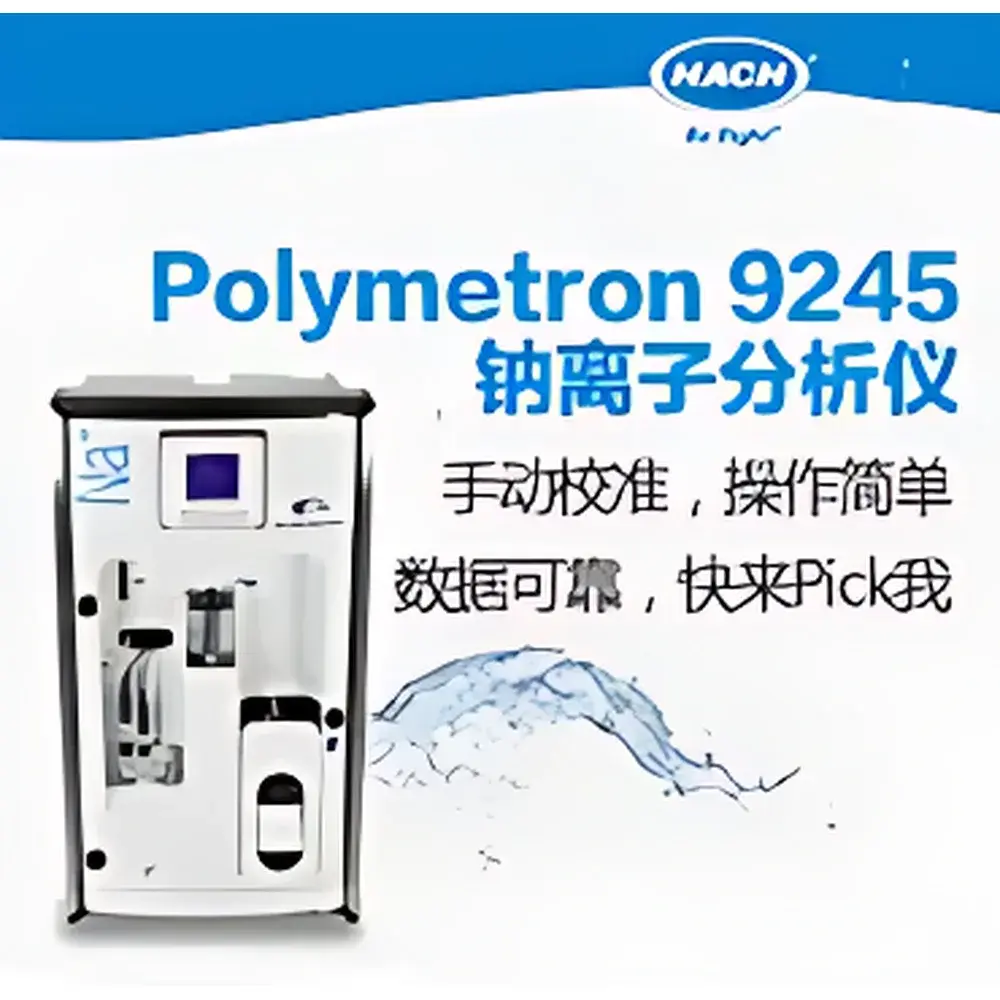
HACH Polymetron 9245 Online Sodium Analyzer
| Brand | HACH |
|---|---|
| Origin | USA |
| Manufacturer | HACH Company |
| Instrument Type | Online Sodium Analyzer |
| Measurement Range | 0–10,000 ppb (programmable up to 0–200 ppm) |
| Detection Limit | 0.01 ppb |
| Response Time (T90) | 180 s |
| Accuracy | ±6 mg/L at 100 mg/L |
| Temperature Operating Range | 5–50 °C |
| Enclosure Rating | IP65 |
| Power Supply | 90–240 VAC, ±10%, 50/60 Hz, 80 VA |
| Calibration | Manual 1-point or 2-point |
| Communication Protocols | Modbus RTU (JBUS), Profibus DP |
Overview
The HACH Polymetron 9245 Online Sodium Analyzer is a high-precision, industrial-grade ion-selective electrode (ISE)-based analyzer engineered for continuous, real-time monitoring of trace sodium concentrations in ultra-pure water streams. It operates on the principle of potentiometric measurement using a highly selective sodium-specific glass electrode paired with a stable reference electrode. The system is purpose-built for critical water quality control applications where sub-ppb sodium detection is essential—particularly in high-pressure boiler feedwater, steam condensate, demineralized water loops, and nuclear power plant secondary coolant circuits. Its design adheres to fundamental electrochemical measurement standards, ensuring thermodynamic stability and Nernstian response behavior across its operational range. Unlike laboratory-based methods, the Polymetron 9245 integrates sample conditioning, flow control, temperature compensation, and automatic electrode maintenance into a single ruggedized platform, enabling unattended operation under demanding plant environments.
Key Features
- Ultra-low detection limit of 0.01 ppb—validated per ASTM D4582 and ISO 15377 for trace sodium quantification in high-purity water.
- Programmable dual-range capability: standard 0–10,000 ppb mode and extended 0–200 ppm mode via K-tool configuration, supporting both regulatory compliance and troubleshooting scenarios.
- Automated electrode activation sequence ensures consistent membrane hydration and optimal surface potential recovery—critical for reproducible T90 response within 180 seconds.
- True online-to-lab transition: manual validation mode accepts 250 mL sample without process interruption; instrument auto-resumes continuous monitoring post-analysis.
- IP65-rated wall-mount enclosure with stainless steel frame and ABS polymer housing—designed for chemical resistance and mechanical durability in utility corridors and turbine halls.
- Integrated temperature compensation (5–50 °C operating range) using Pt100 sensor input, minimizing drift from thermal gradients in piping systems.
- Configurable communication interfaces: native Modbus RTU (JBUS) and optional Profibus DP v1 support seamless integration into DCS, SCADA, and PLC architectures compliant with IEC 61158 and ISA-88 standards.
Sample Compatibility & Compliance
The Polymetron 9245 is validated for use with low-conductivity (< 1 µS/cm), low-pH (6.5–8.5), and low-silica (< 10 ppb) water matrices typical of once-through or recirculating steam-water cycles. It rejects interference from common cations—including lithium, potassium, calcium, and ammonium—via optimized electrode membrane formulation and built-in ionic strength adjustment algorithms. The analyzer meets requirements for GMP-relevant water systems under USP and EP 2.2.42, and supports audit-ready data integrity when configured with HACH’s optional GLP-compliant firmware package (including electronic signatures, user access levels, and 21 CFR Part 11–compliant event logging). All wetted parts comply with FDA 21 CFR 177.2420 for food-contact polymers and ASME BPE-2021 surface finish specifications (Ra ≤ 0.8 µm).
Software & Data Management
The embedded firmware provides configurable alarm thresholds (high/low, rate-of-change), trend logging at user-defined intervals (1 sec to 1 hr), and buffered storage of ≥30 days of high-resolution data. Local HMI includes password-protected setup menus, calibration history review, and diagnostic status indicators for electrode impedance, junction potential, and flow cell pressure. Remote access is supported via Ethernet/IP or serial-to-Ethernet gateways, enabling secure read-only monitoring through HACH’s PlantWeb® Digital Ecosystem or third-party historian platforms (e.g., OSIsoft PI, AVEVA System Platform). Calibration records include timestamped operator ID, standard concentration values, slope (%Nernst), and offset (mV)—all exportable as CSV or PDF for internal QA audits.
Applications
- Monitoring sodium breakthrough in mixed-bed ion exchange polishing units prior to high-pressure boiler injection.
- Early leak detection in steam generators by tracking sodium rise in condensate return lines (ASTM D1089).
- Verification of cation conductivity correlation in ultrapure water systems serving semiconductor fab UPW loops.
- Regulatory reporting for fossil and nuclear power plants subject to EPRI TR-102323 and NEI 03-03 guidelines.
- Process optimization in pharmaceutical WFI (Water for Injection) distribution systems per EU Annex 1 and FDA guidance.
FAQ
What is the minimum recommended sample conductivity for reliable sodium measurement?
The analyzer performs optimally at conductivities below 1 µS/cm; higher conductivity may require inline dilution or conductivity compensation enabled in firmware.
Does the Polymetron 9245 support automatic temperature compensation?
Yes—integrated Pt100 sensor input enables real-time Nernst equation correction across the full 5–50 °C operating range.
Can the system meet 21 CFR Part 11 requirements for electronic records?
When deployed with HACH’s optional GLP firmware module and external authentication server, it supports electronic signatures, audit trails, and role-based access control.
Is field calibration possible without interrupting the process stream?
Yes—manual validation uses an isolated 250 mL sample port; the analyzer automatically re-establishes online flow path integrity after analysis.
What maintenance intervals are recommended for the sodium electrode?
Electrode replacement is typically required every 12–18 months under continuous operation; quarterly verification against NIST-traceable standards is advised.
Related Products







