
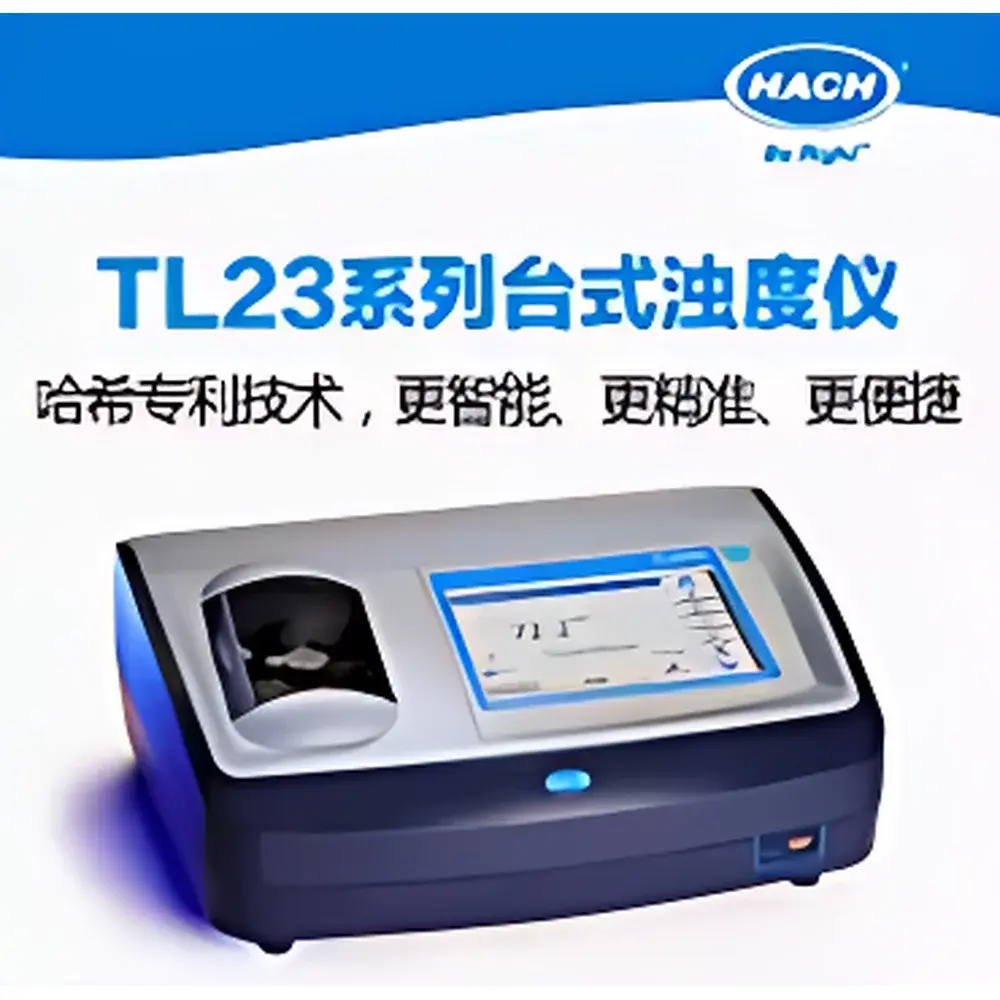
Hach TL23 Series Benchtop Turbidimeter
| Brand | Hach |
|---|---|
| Origin | USA |
| Manufacturer Type | Original Equipment Manufacturer (OEM) |
| Product Category | Imported |
| Model | TL23 Series |
| Measurement Range | 0–20000 NTU |
| Resolution | 0.001 NTU |
| Operating Temperature | 0–40 °C |
| Accuracy | ±2% (0–1000 NTU), ±5% (1000–4000 NTU), ±10% (4000–10000 NTU) |
| Compliance | EPA Method 180.1, ISO 7027, DIN EN 27027, DIN 38404, NFT 90-33 |
| Display | 7-inch color touchscreen |
| Light Source | Tungsten lamp or LED (860 ± 30 nm) |
| Units | NTU, FNU, FAU, EBC, Abs, %T, mg/L |
| Sample Cell | 95 × 25 mm borosilicate glass vial with rubber-sealed cap |
| Data Storage | 2000 records (measurements, calibrations, verifications) |
| Interface | Dual USB-A ports |
| Power | 100–240 V AC, 50/60 Hz, 3.4 A |
| Certifications | CE, RoHS, CMC |
| Warranty | 1 year |
Overview
The Hach TL23 Series Benchtop Turbidimeter is a precision optical instrument engineered for high-reliability turbidity measurement in laboratory and quality control environments. Based on the nephelometric principle—measuring scattered light intensity at 90° relative to the incident beam—the TL23 Series delivers traceable, repeatable results across an extended dynamic range of 0–20,000 NTU. Its dual-light-source architecture (tungsten lamp for broad-spectrum compliance with EPA Method 180.1 and 860 nm LED for ISO 7027 alignment) ensures metrological flexibility across regulatory frameworks. Designed for long-term stability and operator confidence, the instrument integrates intelligent signal stabilization algorithms that assess real-time photometric drift and only report readings once optical equilibrium is confirmed—eliminating subjective judgment and minimizing inter-operator variability.
Key Features
- 7-inch high-resolution color touchscreen interface with intuitive navigation, consistent with Hach’s spectrophotometer UI architecture for seamless cross-platform operation
- Automated reading validation: internal kinetic model evaluates signal convergence before finalizing display—reducing misinterpretation of settling or flocculation artifacts
- Dual USB-A ports enabling direct connection to USB flash drives (for CSV export), thermal printers (for GLP-compliant hardcopy reports), keyboards, and barcode scanners for sample ID tracking
- Configurable sample identification fields support full traceability—each stored record includes timestamp, operator ID (if entered), calibration history, and verification status
- Multi-mode acquisition: single-shot, continuous monitoring, Rapid Settling Time (RST) mode for unstable suspensions, signal averaging (10-point mean), and ratio mode for background correction
- Borosilicate glass sample cell (95 × 25 mm) with rubber-sealed lid ensures optical clarity, thermal stability, and resistance to chemical degradation; optional adapters accommodate smaller vials (≤25 mm diameter)
Sample Compatibility & Compliance
The TL23 Series supports aqueous samples within temperature limits of 0–70 °C and minimum volume requirements of 20 mL for standard 25 mm cells. It meets critical international regulatory standards including U.S. EPA Method 180.1 (tungsten-based turbidimetry), ISO 7027 (infrared LED-based nephelometry), DIN EN 27027, DIN 38404-2, and French standard NFT 90-33. Its multi-unit reporting capability (NTU, FNU, FAU, EBC, Abs, %T, mg/L) enables direct comparability across drinking water, wastewater, pharmaceutical, and beverage applications. CE, RoHS, and CMC certifications confirm conformance with electromagnetic compatibility, hazardous substance restrictions, and metrological traceability requirements for regulated markets.
Software & Data Management
Data integrity and audit readiness are embedded into system design. All 2000 stored records include raw analog-to-digital converter (ADC) values, calibration coefficients, date/time stamps, and user-defined metadata. Exported files follow ISO/IEC 17025-aligned formatting: CSV with header rows specifying instrument ID, serial number, firmware version, and measurement conditions. The USB-driven workflow eliminates manual transcription errors and supports integration into LIMS or ELN platforms. While native software does not enforce 21 CFR Part 11 electronic signature controls, the device’s immutable log structure—including timestamps for every calibration event and zero-point verification—facilitates retrospective GxP audits under GLP and GMP frameworks.
Applications
- Drinking water treatment: verification of coagulation/flocculation efficiency and final filter effluent clarity per WHO and EPA guidelines
- Wastewater discharge monitoring: compliance with NPDES permit limits for suspended solids surrogate quantification
- Pharmaceutical manufacturing: USP particulate matter testing in parenteral solutions using turbidity correlation protocols
- Food & beverage QC: consistency assessment of juices, beers, and dairy emulsions where haze correlates with colloidal stability
- Environmental research: long-term turbidity trend analysis in surface water bodies using standardized ISO 7027 methodology
- Academic laboratories: teaching nephelometric principles with real-time visualization of scattering dynamics and calibration traceability
FAQ
What regulatory standards does the TL23 Series comply with?
It conforms to EPA Method 180.1 (tungsten lamp configuration), ISO 7027 (860 nm LED configuration), DIN EN 27027, DIN 38404-2, and NFT 90-33. Dual-source capability allows method-specific validation without hardware modification.
How does the instrument ensure measurement stability for settling samples?
The Rapid Settling Time (RST) mode continuously monitors scattering signal decay kinetics and applies adaptive averaging—reporting only after confirming <1% variation over three consecutive 2-second intervals.
Can the TL23 Series be used for low-turbidity applications such as ultrapure water?
Yes. With 0.001 NTU resolution in the lowest range and sub-0.01 NTU repeatability, it meets ASTM D6508 requirements for high-purity water monitoring when paired with certified Formazin or AMCO AEPA standards.
Is data export compatible with common laboratory informatics systems?
CSV exports contain ISO/IEC 17025–recommended metadata fields (instrument ID, calibration date, uncertainty estimates) and are natively ingestible by LabWare LIMS, Thermo Fisher SampleManager, and custom Python/R analytics pipelines.
What maintenance is required to sustain metrological accuracy?
Annual verification using NIST-traceable turbidity standards (e.g., Hach StablCal kits) and quarterly optical path inspection with supplied cleaning swabs and isopropyl alcohol. No routine lamp replacement is needed for LED-configured units (rated >50,000 hours).





