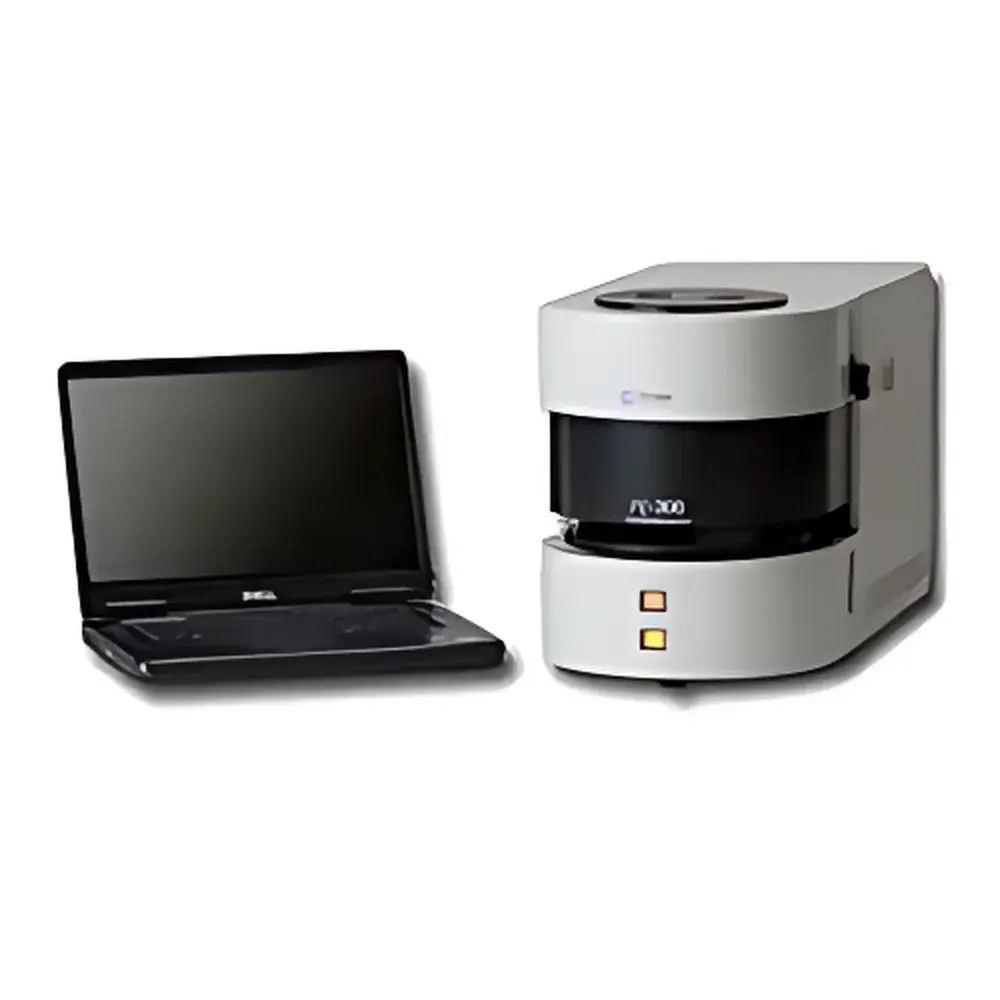
HalfMoon FE-300 Series UV-VIS-NIR Spectroscopic Ellipsometry & Reflectometry Film Thickness Measurement System
| Brand | HalfMoon |
|---|---|
| Origin | Japan |
| Model Series | FE-300V / FE-300UV / FE-300NIR / FE-300NIR+ |
| Optical Principle | Normal-Incidence Spectroscopic Reflectometry (Spectroscopic Reflectance Analysis) with Nonlinear Least-Squares Fitting of Optical Constants (n, k) |
| Wavelength Ranges | 450–780 nm (FE-300V), 300–800 nm (FE-300UV), 900–1600 nm (FE-300NIR), 1470–1600 nm (FE-300NIR+) |
| Thickness Range | 10 nm – 1.5 mm (model-dependent) |
| Thickness Accuracy | ≤ ±0.2 nm (for thin films < 1 µm) |
| Repeatability (2σ) | ≤ 0.1 nm |
| Spot Size | ~Φ3 mm |
| Max Sample | 8-inch wafer (≤5 mm thick) |
| Measurement Time | 0.1–10 s per point |
| Light Sources | Tungsten-halogen lamp (V/NIR), Deuterium lamp (UV) |
| Interface | USB 2.0 |
| Dimensions | 280 × 570 × 350 mm (W×D×H) |
| Weight | ~24 kg |
| Software | Standard reflectance peak/valley analysis, FFT, optimization-based fitting, nonlinear least-squares inversion |
| Optional Modules | Multi-layer optical model builder, reference standard calibration suite, dispersion-corrected material database |
Overview
The HalfMoon FE-300 Series is a benchtop spectroscopic reflectometry system engineered for non-contact, non-destructive thickness and optical constant characterization of single- and multi-layer thin films on semiconductor wafers and optical substrates. Operating on the principle of normal-incidence spectral reflectance analysis, the system measures intensity-based reflectance spectra across user-selectable wavelength bands—spanning deep UV to near-infrared—and inverts the data using robust nonlinear least-squares algorithms to extract film thickness (d), refractive index (n), and extinction coefficient (k). Unlike ellipsometers requiring precise angular alignment and polarization control, this reflectometer delivers high-precision metrology with simplified optical geometry, reduced sensitivity to surface roughness or ambient vibration, and rapid single-point acquisition (<1 s). Its architecture inherits core analytical rigor from the flagship FE-3000 platform—including advanced dispersion modeling, multi-wavelength constraint handling, and iterative dielectric function reconstruction—while optimizing cost-of-ownership for high-throughput QC labs and process development environments.
Key Features
- Four dedicated optical configurations: FE-300V (visible), FE-300UV (deep UV–visible), FE-300NIR (short-wave NIR), and FE-300NIR+ (extended NIR) — enabling seamless coverage from 300 nm to 1600 nm
- Sub-nanometer thickness repeatability (≤0.1 nm, 2σ) and accuracy (≤±0.2 nm for films <1 µm) validated against NIST-traceable SiO₂/Si reference standards
- Integrated dual-source illumination: deuterium lamp for UV stability and tungsten-halogen for VIS/NIR radiometric consistency
- Automated spectral acquisition with real-time signal-to-noise optimization; no manual gain or integration time adjustment required
- Preloaded optical models for common semiconductor and optical materials (SiO₂, Si₃N₄, photoresist, ITO, DLC, AR/OC coatings) with adjustable dispersion relations (Cauchy, Sellmeier, Tauc-Lorentz)
- Fully automated measurement sequence scripting for unattended wafer mapping (radial or grid patterns) via USB-controlled stage interface
Sample Compatibility & Compliance
The FE-300 Series accommodates flat, rigid substrates up to 200 mm (8-inch) diameter and 5 mm thickness, including silicon, fused silica, sapphire, and polymer films (e.g., PET, PI). It supports both bare and patterned wafers—provided feature pitch exceeds the ~3 mm measurement spot size—and tolerates moderate surface roughness (Ra < 5 nm). All models comply with IEC 61000-4 electromagnetic immunity standards and meet CE marking requirements for laboratory instrumentation. Data integrity protocols align with GLP/GMP documentation practices: software enforces audit trails for all parameter changes, includes electronic signature capability, and exports timestamped, metadata-embedded reports in CSV and PDF formats compatible with LIMS integration. While not FDA 21 CFR Part 11 certified out-of-the-box, the system supports optional validation packages for regulated environments requiring full traceability.
Software & Data Management
The native HalfMoon Analyze™ software provides a unified interface for instrument control, spectral acquisition, optical modeling, and report generation. Core algorithms implement Levenberg-Marquardt nonlinear minimization with automatic initial parameter estimation, convergence monitoring, and residual error mapping. Users may define custom multilayer stacks with interfacial roughness, grading, or substrate absorption constraints. All analyses are fully reproducible: raw spectra, fitted models, covariance matrices, and confidence intervals are saved in HDF5 format. The software supports batch processing of map files, statistical process control (SPC) charting (X-bar/R), and export to MATLAB, Python (via h5py), or Excel. Optional modules include Reference Standard Calibration (RSC) for drift compensation and ThinFilmDB™—a curated library of >120 experimentally verified n/k datasets spanning oxides, nitrides, metals, and organic semiconductors.
Applications
- Semiconductor front-end process control: photoresist thickness uniformity on 300 mm wafers, SOI handle layer verification, gate oxide (SiO₂, HfO₂) metrology, and hard mask (SiNₓ, TaN) deposition monitoring
- Back-end-of-line (BEOL) characterization: low-k dielectric (SiCOH, porous SiO₂) thickness and porosity estimation via effective medium approximation
- Optical coating QC: anti-reflective (MgF₂/TiO₂ stacks), transparent conductive oxides (ITO, IZO), and wear-resistant DLC on PET or glass substrates
- R&D applications: optical constant extraction of novel 2D materials (MoS₂, WS₂), perovskite absorbers, and thermochromic VO₂ films
- Failure analysis: delamination detection through interfacial reflectance anomaly mapping and thickness gradient profiling
FAQ
Does the FE-300 require vacuum or inert atmosphere operation?
No. All models operate under ambient laboratory conditions; no environmental chamber or purge gas is needed.
Can it measure transparent films on transparent substrates (e.g., SiO₂ on fused silica)?
Yes—provided sufficient refractive index contrast exists and the substrate thickness is known or independently characterized.
Is calibration traceable to national standards?
Yes. Factory calibration uses NIST-traceable Si/SiO₂ reference wafers; users may perform in-house recalibration using supplied standards.
What level of technical support is available outside Japan?
HalfMoon maintains authorized service partners in North America, Europe, and ASEAN regions, offering remote diagnostics, on-site maintenance contracts, and application engineering consultation.
How does it compare to ellipsometry for ultra-thin films (<5 nm)?
For sub-5 nm native oxides or ALD layers, spectroscopic ellipsometry generally offers higher sensitivity; however, the FE-300 provides superior throughput and ease-of-use for routine QC where ±0.2 nm absolute accuracy is sufficient.