
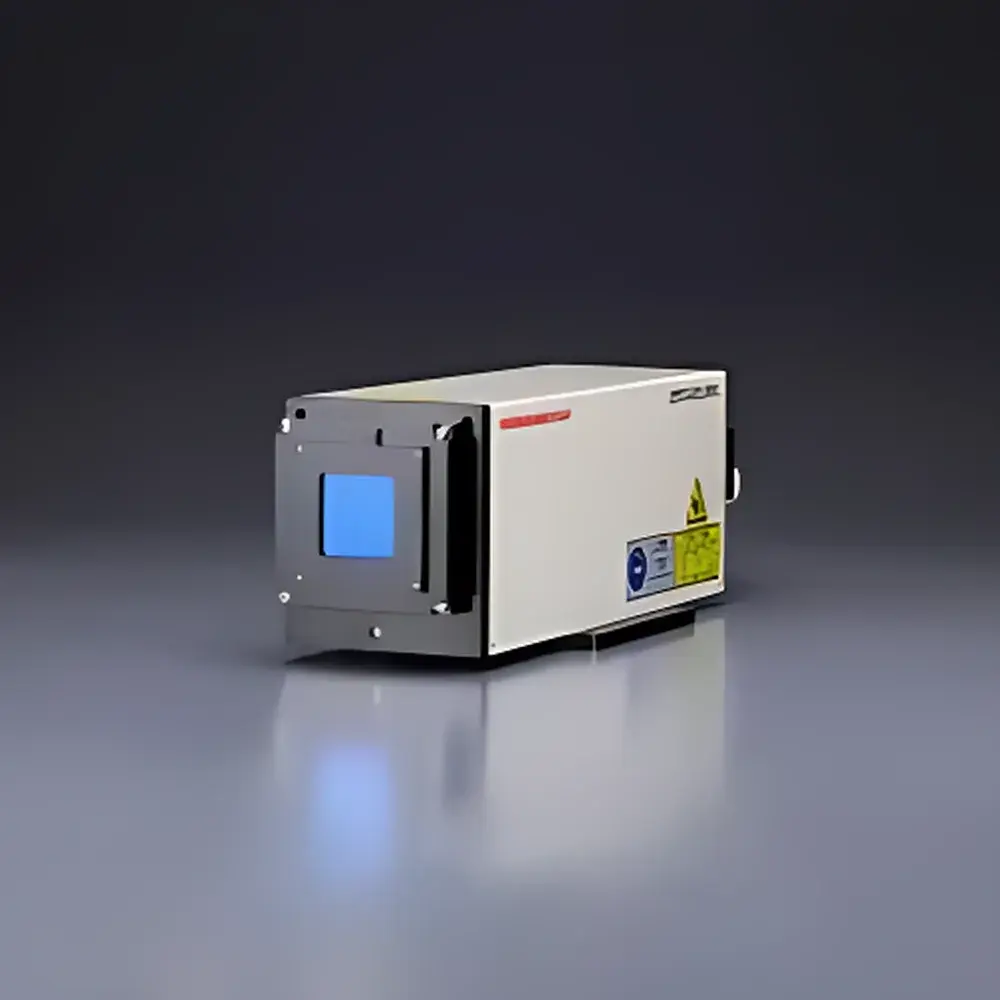
Hamamatsu DDL Series Direct-Diodes Laser Source
| Brand | Hamamatsu |
|---|---|
| Origin | Japan |
| Manufacturer Type | Original Equipment Manufacturer (OEM) |
| Product Category | Imported |
| Model | DDL |
| Light Source Type | High-Power Direct-Diode Laser (DDL) |
| Illumination Method | External Irradiation |
| Optical Output | Collimated or Focused Beam (Configurable per OEM Integration) |
Overview
The Hamamatsu DDL Series is a high-intensity, direct-diode laser source engineered for industrial material processing and precision optical integration. Unlike conventional solid-state or CO₂ lasers that rely on optical pumping and complex resonator cavities, the DDL architecture delivers laser radiation directly from high-brightness semiconductor laser diode arrays—eliminating intermediate conversion stages such as crystal lasing or gas discharge. This results in inherently higher electro-optical (E-O) efficiency (>40% typical), minimal thermal load, and compact form factor suitable for embedded integration into automated workstations, robotic arms, or inline manufacturing cells. The system operates in continuous-wave (CW) mode with wavelength options typically in the 808 nm, 915 nm, or 976 nm bands—optimized for absorption by metals, polymers, and selective coatings. Its beam geometry is designed for external irradiation, supporting both collimated delivery and fiber-coupled or lens-focused configurations depending on end-user optical train requirements.
Key Features
- Direct-diode architecture with no flashlamp, rod, or gas medium—enabling rapid turn-on/turn-off response and stable output without warm-up delay
- High electro-optical efficiency (>40%) and low standby power consumption—reducing total cost of ownership and cooling infrastructure demands
- Linear current-to-optical-power response over full operating range—facilitating precise closed-loop power control in feedback-regulated systems
- Compact, lightweight mechanical design (typical footprint < 150 × 100 × 60 mm)—designed for space-constrained integration in OEM machinery
- Robust hermetic packaging compliant with IEC 60825-1 Class 4 laser safety standards; includes interlock interface and TTL-compatible modulation input
- No consumables or periodic alignment required—ensuring long-term operational stability under industrial environmental conditions (IEC 60068-2 compliant)
Sample Compatibility & Compliance
The DDL series is compatible with a broad range of target materials including ferrous and non-ferrous metals (e.g., stainless steel, aluminum, copper), thermoplastics (e.g., PA6, PBT, PC), and coated substrates used in automotive, electronics, and medical device assembly. Its near-infrared output enables strong coupling with absorptive layers—particularly when combined with laser-absorbing additives in polymer joining applications. All units comply with international regulatory frameworks including CE marking (EN 60825-1:2014, EN 50581:2012), RoHS 2015/863/EU, and REACH SVHC declarations. For GMP-aligned production environments, optional firmware logging supports audit-ready timestamped power calibration records traceable to NIST-traceable reference detectors.
Software & Data Management
While the DDL operates as a hardware-level light engine, it interfaces seamlessly with third-party motion controllers (e.g., Beckhoff, Galil) and PLC-based automation platforms via analog voltage (0–5 V / 0–10 V) and digital TTL signals. Optional OEM software development kits (SDKs) provide API access to real-time monitoring of junction temperature, drive current, and photodiode feedback—enabling synchronized process data acquisition aligned with machine vision triggers or encoder position stamps. When deployed in validated manufacturing systems, configuration parameters—including maximum rated current, thermal derating thresholds, and interlock enable states—are stored in non-volatile memory with write-protection logic compliant with FDA 21 CFR Part 11 requirements for electronic records and signatures.
Applications
- Laser conduction welding of thin-sheet metal components in battery tab joining and sensor housing assembly
- Plastic welding via transmission laser welding (TLW), particularly for hermetic sealing of fluidic microchannels and medical cartridges
- Selective surface hardening (laser quenching) of gear teeth and bearing races using localized heat input control
- Brazing of dissimilar metals (e.g., Cu–Al joints in heat exchangers) with reduced intermetallic formation due to shorter dwell time
- Thermal annealing of thin-film transistor (TFT) backplanes and flexible OLED substrates requiring uniform irradiance profiles
- Pre-processing step in additive manufacturing—e.g., powder bed preheating or substrate conditioning prior to L-PBF deposition
FAQ
Is the DDL suitable for use in cleanroom environments?
Yes—its solid-state construction, absence of outgassing materials, and sealed optical path meet ISO Class 5 (Class 100) particulate limits when installed with appropriate air filtration and grounding protocols.
Can the output beam be fiber-coupled?
Yes—Hamamatsu offers OEM-compatible fiber launch optics for multimode fibers (e.g., 200–600 µm core, NA 0.22), with coupling efficiency >85% depending on model variant and spectral band.
What is the expected lifetime under continuous operation?
Rated L50 lifetime exceeds 20,000 hours at 25°C case temperature and nominal drive current, per TM-21 accelerated life testing per JEDEC JESD22-B108.
Does Hamamatsu provide calibration certificates?
Yes—NIST-traceable optical power calibration certificates are available upon request, including uncertainty budgets per ISO/IEC 17025:2017 accredited methodology.
Are safety interlocks and emergency stop interfaces included?
All DDL models feature dual-channel hardware interlock inputs (IEC 61800-5-2 compliant) and integrated photodiode-based output verification for fail-safe shutdown during beam path interruption.






