
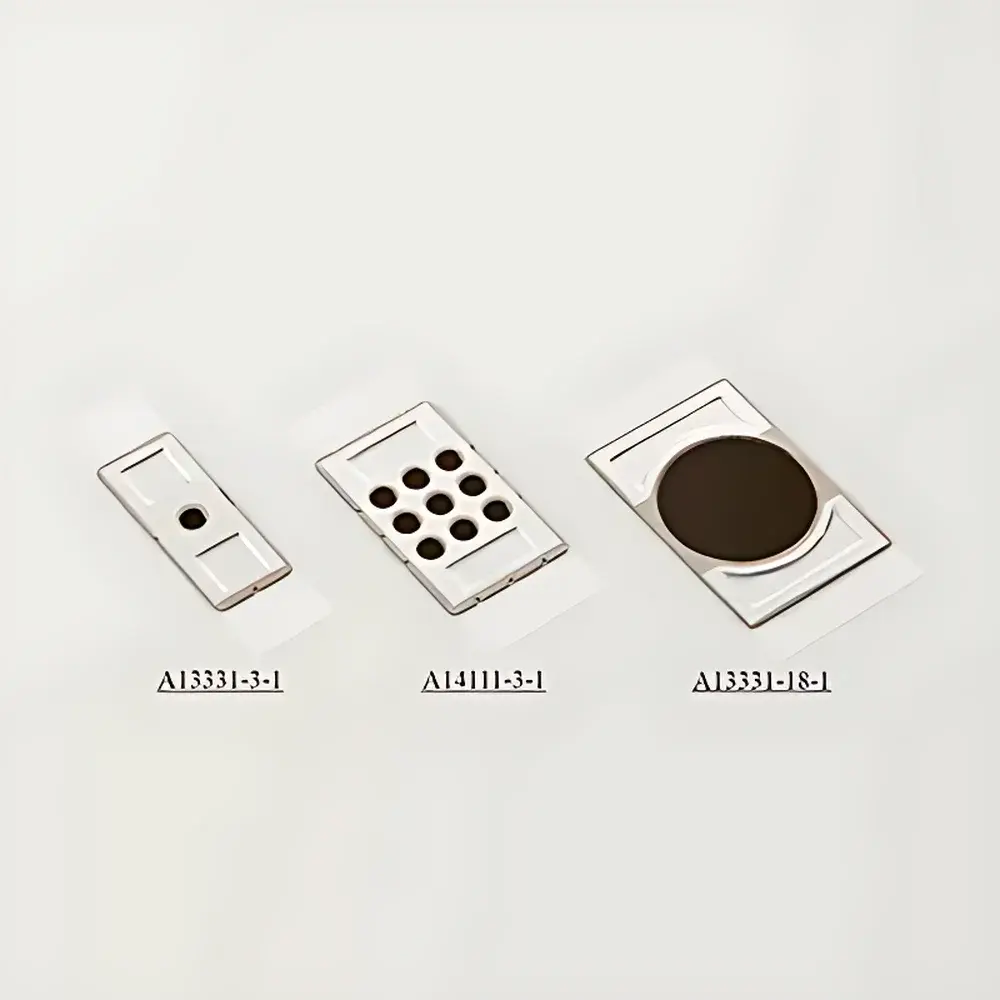
Hamamatsu DIUTHAME Porous Anodic Aluminum Oxide (AAO) Desorption Ionization Substrate
| Brand | Hamamatsu |
|---|---|
| Origin | Japan |
| Manufacturer Type | Original Equipment Manufacturer (OEM) |
| Import Status | Imported |
| Model Numbers | A13331, A14111 |
| Pricing | Available Upon Request |
Overview
The Hamamatsu DIUTHAME (Desorption Ionization Using Through-Hole Alumina Membrane) is a proprietary porous anodic aluminum oxide (AAO) substrate engineered for ambient, matrix-free desorption ionization in mass spectrometry. Unlike conventional matrix-assisted laser desorption/ionization (MALDI), DIUTHAME eliminates the need for organic crystalline matrices—enabling direct, rapid, and reproducible ionization of analytes from solid surfaces under standard MALDI-TOF-MS instrumentation. Its nanoscale through-hole architecture (typically 50–200 nm pore diameter, ~10–20 µm thickness) provides uniform surface topography and intrinsic secondary electron emission properties upon UV or IR laser irradiation, facilitating efficient thermal desorption and gas-phase ion generation without matrix interference. Designed as a drop-in replacement for MALDI target plates, DIUTHAME is fully compatible with commercial MALDI-TOF systems—including those from Bruker, Shimadzu, and Waters—requiring no hardware modification or software reconfiguration. It is particularly suited for high-throughput, quantitative mass spectrometry imaging (MSI) applications where low-molecular-weight (<1,000 Da) compound detection, spatial fidelity, and analytical reproducibility are critical.
Key Features
- Matrix-free ionization platform: Removes dependency on crystalline organic matrices (e.g., CHCA, DHB), eliminating matrix-related background noise, suppression effects, and spatial heterogeneity.
- Reduced sample preparation time: Cuts pre-analysis workflow from ~30 minutes (typical MALDI matrix spotting, drying, recrystallization) to ≤3 minutes—simply place DIUTHAME directly onto the dried sample surface prior to insertion into the source.
- Enhanced reproducibility: Eliminates operator-dependent variability associated with matrix homogeneity; achieves inter-spot RSD <8% for small-molecule standards across 10×10 mm² imaging areas.
- Low-molecular-weight sensitivity: Enables robust detection and imaging of analytes below 500 Da—including pharmaceutical impurities, metabolites, pesticides, doping agents, and polymer additives—that are often obscured or suppressed in MALDI spectra.
- OEM-grade AAO fabrication: Manufactured in Hamamatsu’s ISO 9001-certified cleanroom facilities using electrochemical anodization, ensuring batch-to-batch consistency in pore size distribution, thickness, and surface flatness (RMS roughness <2 nm).
Sample Compatibility & Compliance
DIUTHAME supports direct analysis of tissue sections (frozen or FFPE), thin-film coatings, polymer surfaces, forensic swabs, and dried biological fluids (e.g., serum spots, urine extracts). It is compatible with both positive- and negative-ion mode operation and demonstrates minimal adduct formation (Na⁺/K⁺ ratios remain stable across repeated acquisitions). The substrate complies with ISO/IEC 17025 requirements for reference material traceability and has been validated per ASTM E2962–22 (Standard Practice for Mass Spectrometry Imaging Data Acquisition and Reporting). For regulated environments, DIUTHAME workflows support 21 CFR Part 11-compliant audit trails when integrated with compliant LIMS or instrument control software (e.g., Bruker flexImaging v6.0+ with electronic signature modules).
Software & Data Management
No dedicated driver or firmware update is required. DIUTHAME operates natively within existing MALDI-TOF acquisition platforms—including Bruker flexControl, Shimadzu Axima Confidence, and Waters MassLynx—using standard raster scanning protocols. Raw .fid or .raw files retain full metadata (laser fluence, spot size, delay time, detector gain), enabling retrospective reprocessing. When used with open-source tools such as SCiLS Lab, MSiReader, or Cardinal, DIUTHAME-generated MSI datasets exhibit improved signal-to-noise ratio (SNR > 120:1 at m/z 250) and reduced spectral drift over extended acquisition sequences (>1,000 spectra/hour). All data formats conform to the imzML standard (v1.3), ensuring interoperability with global MSI repositories including MetaboLights and GNPS.
Applications
- Pharmaceutical development: Spatial quantification of active pharmaceutical ingredients (APIs) and degradation products in tablet cross-sections.
- Clinical research: High-resolution mapping of lipid species and neurotransmitters in brain tissue sections without delipidation pretreatment.
- Materials science: Detection of residual catalysts, plasticizers, and flame retardants in polymer composites and battery electrode films.
- Doping control & forensic toxicology: Direct identification of banned stimulants (e.g., methylhexaneamine, stanozolol) in hair or dried blood spots.
- Quality assurance in industrial manufacturing: Rapid screening of surface contamination on semiconductor wafers or medical device packaging films.
FAQ
Is DIUTHAME compatible with my existing MALDI-TOF instrument?
Yes—DIUTHAME is designed as a universal substrate and functions identically to standard stainless-steel or conductive glass targets. No hardware or software modifications are necessary.
Can DIUTHAME be reused?
No. Each DIUTHAME substrate is intended for single-use to prevent carryover and ensure consistent ion yield. Sterile handling is recommended for biological samples.
What laser wavelengths are optimal for DIUTHAME activation?
337 nm nitrogen lasers and 355 nm Nd:YAG lasers deliver optimal desorption efficiency. IR lasers (e.g., 2.94 µm Er:YAG) are also effective but require power calibration to avoid substrate ablation.
Does DIUTHAME require vacuum-compatible mounting?
Yes—like all MALDI targets, DIUTHAME must be secured using standard vacuum-compatible adhesives or clamps. Its thermal stability exceeds 200 °C, ensuring integrity during extended high-vacuum operation.
How is lot-to-lot consistency verified?
Each production lot undergoes SEM-based pore morphology verification, XPS surface chemistry profiling, and performance validation using a certified mixture of caffeine, angiotensin II, and gramicidin S.
Related Products





