
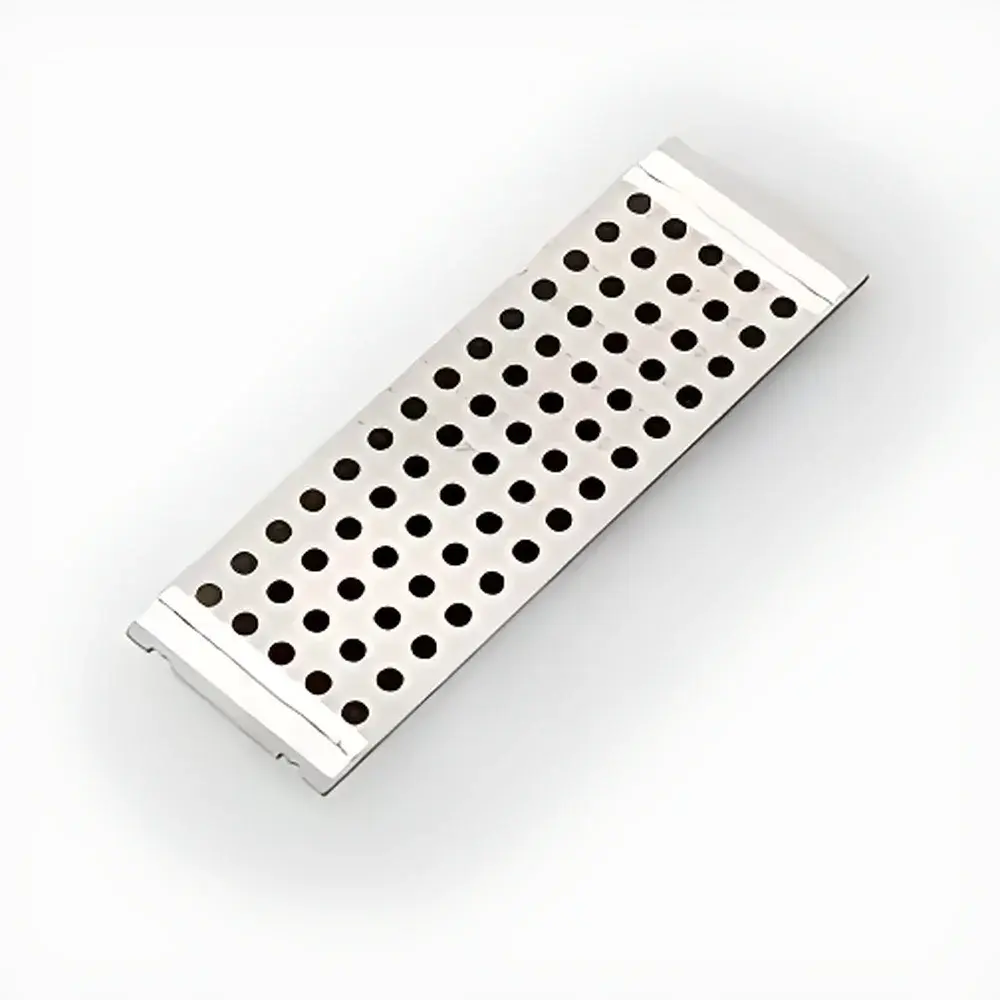
Hamamatsu DIUTHAME Porous Anodic Aluminum Oxide (AAO) Substrate for Matrix-Free Laser Desorption/Ionization – Model A14111-3-3
| Brand | Hamamatsu |
|---|---|
| Origin | Japan |
| Manufacturer | Hamamatsu Photonics K.K. |
| Product Type | Imported Mass Spectrometry Component |
| Model | A14111-3-3 |
| Pricing | Available Upon Request |
Overview
The Hamamatsu DIUTHAME (Desorption Ionization Using Through-Hole Alumina Membrane) substrate A14111-3-3 is a high-precision, matrix-free ionization platform engineered for compatibility with commercial MALDI-TOF and MALDI-FT-ICR mass spectrometers. Fabricated from anodized aluminum oxide (AAO), this substrate features a highly ordered, vertically aligned nanoporous architecture with uniform pore diameters and depth-controlled geometry—optimized to support efficient laser energy coupling, analyte desorption, and gas-phase ion generation without chemical matrix application. Unlike conventional MALDI, which requires homogeneous co-crystallization of analytes with organic matrices—a process prone to spatial heterogeneity, crystallization artifacts, and low-mass interference—the DIUTHAME platform enables direct, solvent-free sample transfer onto the membrane surface followed by rapid laser irradiation. This physical ionization mechanism eliminates matrix-derived background noise below <500 Da, preserves labile molecular structures (e.g., lipids, metabolites, peptides), and supports quantitative reproducibility across repeated acquisitions. The A14111-3-3 variant is configured as a single-use, rigid 25 × 76 mm rectangular substrate with defined mechanical stability for precise stage positioning in imaging mode.
Key Features
- Matrix-free ionization: Removes dependency on organic matrices (e.g., α-cyano-4-hydroxycinnamic acid), eliminating chemical background signals and enabling unambiguous detection of low-molecular-weight species.
- Reduced sample preparation time: Cuts pre-acquisition workflow from >30 minutes (standard MALDI spotting/drying/crystallization) to under 3 minutes—consisting solely of gentle blotting or vapor-phase extraction onto the membrane surface.
- High spatial fidelity: Nanopore geometry (pore diameter ~100 nm, thickness ~60 µm) ensures minimal lateral diffusion during desorption, supporting sub-100 µm resolution in mass spectrometry imaging (MSI) applications.
- Thermal and chemical stability: Anodized alumina withstands repeated UV laser pulses (337 nm, 3–5 ns pulse width) without structural degradation or signal drift over ≥500 shots per analysis zone.
- Standard form factor: Designed for drop-in compatibility with standard MALDI target plates (e.g., Bruker MTP 384, AB Sciex Opti-TOF 24 cm), requiring no hardware modification or recalibration.
Sample Compatibility & Compliance
The A14111-3-3 substrate demonstrates broad applicability across biological, pharmaceutical, and industrial specimens—including frozen tissue sections (mouse brain, chicken muscle), plant tissues (strawberry, black rice, flower petals), polymer films (PLGA, PEO), food matrices (chocolate), and synthetic materials (industrial coatings, skin biopsies). It supports both blotting-based transfer (for soluble analytes) and vapor-phase extraction (for volatile/semi-volatile compounds), making it suitable for ambient MSI workflows compliant with GLP and GMP-aligned laboratory practices. While not a regulated medical device, its use in analytical method development aligns with ASTM E2907-22 (Standard Guide for Mass Spectrometry Imaging Data Acquisition and Processing) and supports audit-ready data generation when paired with 21 CFR Part 11–compliant acquisition software (e.g., Bruker flexImaging, Waters MassLynx with secure user authentication).
Software & Data Management
No proprietary acquisition software is required. The DIUTHAME substrate functions transparently within existing MALDI-TOF/FT-ICR instrument control environments (e.g., Bruker flexControl, Shimadzu Axima Confidence, AB Sciex Analyst). Raw spectral data are stored in vendor-native formats (.fid, .raw, .wiff) and may be imported into open-source or commercial MSI processing platforms including SCiLS Lab, MSiReader, and Cardinal for multivariate analysis, ion density mapping, and spatial segmentation. Metadata annotation (sample ID, blotting duration, laser fluence, acquisition date) is preserved in instrument log files, facilitating traceability in regulated environments where electronic records must meet ALCOA+ principles (Attributable, Legible, Contemporaneous, Original, Accurate, Complete, Consistent, Enduring, Available).
Applications
- Label-free metabolic profiling of frozen tissue sections—enabling high-fidelity mapping of phospholipids, fatty acids, and neurotransmitters without matrix-induced suppression.
- Rapid quality control of polymer additives (plasticizers, antioxidants) via surface-assisted LDI-MS, minimizing solvent contamination risks in cleanroom manufacturing.
- Pharmaceutical formulation analysis: Direct imaging of active pharmaceutical ingredient (API) distribution in tablet cross-sections using vapor extraction protocols.
- Food science research: Spatial quantification of anthocyanins in black rice pericarp or flavonoids in strawberry mesocarp at cellular resolution.
- Environmental material characterization: Detection of surfactants and oligomeric contaminants on industrial film surfaces without extraction solvents.
FAQ
Is the A14111-3-3 substrate reusable?
No—each unit is designed for single-use to ensure consistent ion yield and prevent cross-contamination between samples.
What laser wavelengths are compatible with DIUTHAME substrates?
Optimized for nitrogen lasers (337 nm); also validated with frequency-tripled Nd:YAG (355 nm) and OPO-tuned UV sources (320–360 nm).
Can DIUTHAME be used with high-resolution mass analyzers beyond TOF?
Yes—peer-reviewed studies confirm successful integration with FT-ICR and Orbitrap platforms for high-mass-accuracy imaging (<1 ppm error) and tandem MS/MS fragmentation.
Does DIUTHAME require vacuum-compatible mounting hardware?
It is supplied pre-mounted on a stainless-steel MALDI plate compatible with standard vacuum load locks; no additional fixtures are needed.
How does DIUTHAME compare to other matrix-free substrates such as graphene or silicon nanowires?
Unlike carbon-based or semiconductor substrates, DIUTHAME offers superior batch-to-batch reproducibility due to electrochemical fabrication control, negligible Raman background, and resistance to oxidation under repeated laser exposure.
Related Products





