
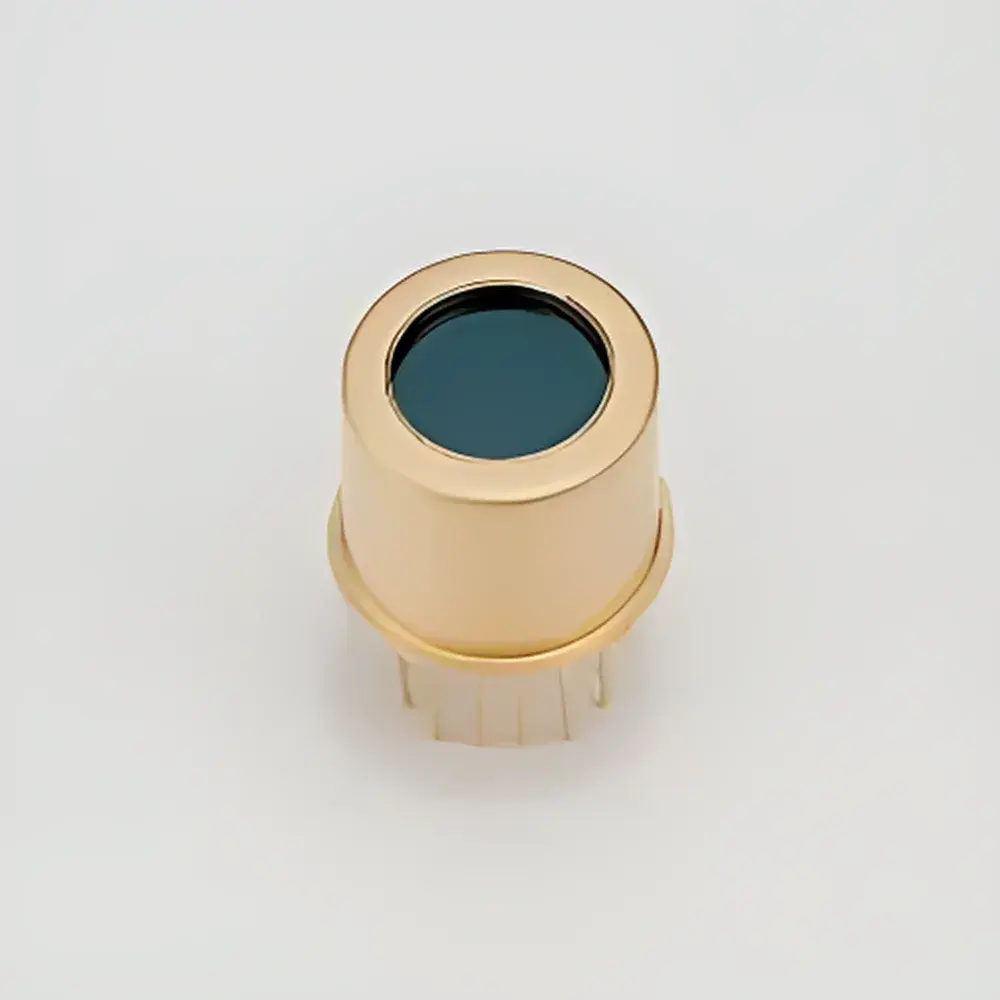
Hamamatsu L12016-1630T-C DFB Pulsed Quantum Cascade Laser
| Brand | Hamamatsu |
|---|---|
| Origin | Japan |
| Manufacturer Type | Original Equipment Manufacturer (OEM) |
| Product Category | Imported Instrument |
| Model | L12016-1630T-C |
| Core Component | Semiconductor Laser Device |
| Laser Type | Distributed Feedback (DFB), Pulsed Operation |
| Peak Emission Wavelength (Typ.) | 6.13 µm |
| Operating Temperature Range (QCL) | 10–50 °C |
| Spectral Linewidth (Max.) | 0.2 cm⁻¹ |
| Wavelength Tuning Range (Min.) | ±1.0 cm⁻¹ |
| Pulsed Optical Output Power (Min.) | 50 mW |
| Threshold Current (Max.) | 1.5 A |
| Side Mode Suppression Ratio (Min.) | 25 dB |
| Package | TO-8 Metal Can |
| Dimensions | Standard TO-8 Footprint (13.0 mm diameter, 4.5 mm height) |
Overview
The Hamamatsu L12016-1630T-C is a distributed feedback (DFB) quantum cascade laser (QCL) engineered for high-resolution, mid-infrared (MIR) spectroscopic applications. Unlike conventional interband diode lasers, QCLs operate on intersubband transitions within the conduction band of engineered semiconductor heterostructures—enabling precise, narrow-linewidth emission in the 4–10 µm spectral region. This device emits at a nominal wavelength of 6.13 µm, a region critical for fundamental vibrational absorption bands of numerous trace gases including CO, NO₂, CH₄, N₂O, and volatile organic compounds (VOCs). Its pulsed operation mode supports time-resolved detection schemes such as quartz-enhanced photoacoustic spectroscopy (QEPAS) and tunable diode laser absorption spectroscopy (TDLAS) with phase-sensitive lock-in detection. Designed for integration into compact, field-deployable or laboratory-grade gas analyzers, the L12016-1630T-C delivers stable spectral output under controlled thermal conditions (10–50 °C), making it suitable for both benchtop calibration systems and embedded OEM instrumentation.
Key Features
- DFB architecture ensuring single-mode, continuous-tuning capability over ±1.0 cm⁻¹ without mode hops
- Narrow intrinsic linewidth ≤ 0.2 cm⁻¹ (FWHM), enabling sub-parts-per-trillion (ppt) detection limits in absorption-based sensing
- Pulsed output with minimum peak power of 50 mW—optimized for high signal-to-noise ratio in gated detection configurations
- Robust TO-8 metal-can package with hermetically sealed cavity, providing mechanical stability and long-term reliability under thermal cycling
- Low threshold current (≤1.5 A) minimizing driver complexity and heat load in thermoelectrically cooled modules
- High side-mode suppression ratio (≥25 dB) ensuring spectral purity essential for quantitative multi-component gas analysis
- Compliant with JEDEC MO-049 and MIL-STD-750D mechanical and environmental test standards for semiconductor optoelectronic devices
Sample Compatibility & Compliance
The L12016-1630T-C is intended for use in optical systems requiring MIR excitation sources compatible with standard ZnSe, BaF₂, or CaF₂ optics and multipass gas cells (e.g., Herriott or White cells). It interfaces directly with industry-standard laser drivers supporting TTL-triggered pulse modulation (pulse width: 100 ns–1 µs; repetition rate: 1–500 kHz). The device meets RoHS Directive 2011/65/EU requirements and conforms to IEC 60825-1:2014 Class 3B laser safety specifications when operated within its rated electrical and thermal envelope. For regulated analytical environments—including EPA Method TO-14A/TO-15-compliant air monitoring or ISO 14001-certified emissions testing—the laser’s spectral stability and traceable wavelength calibration support adherence to ASTM E1421–22 (Standard Practice for Calibration of Mid-Infrared Spectrometers) and GLP data integrity requirements.
Software & Data Management
While the L12016-1630T-C operates as a hardware-level component, its integration into host systems typically leverages vendor-agnostic control protocols (e.g., analog voltage tuning input, digital TTL trigger lines). When paired with Hamamatsu’s optional C13092-series laser controllers or third-party OEM drivers (e.g., Wavelength Electronics QCL Series), full instrument control—including temperature setpoint regulation, current ramp profiling, and pulse timing synchronization—is achievable via USB/RS-232 or Ethernet interfaces. Data acquisition software such as LabVIEW, MATLAB, or Python-based PyVISA frameworks can log real-time wavelength tuning curves, power vs. current (L-I) characteristics, and thermal drift profiles. All operational parameters are exportable in CSV or HDF5 format to support 21 CFR Part 11–compliant audit trails when deployed in FDA-regulated QC laboratories or pharmaceutical environmental monitoring networks.
Applications
- Trace gas detection in ambient air quality monitoring stations (e.g., urban NOₓ, industrial CH₄ leak detection)
- In-line process control for semiconductor fabrication cleanrooms (HF, SiH₄, NH₃ monitoring)
- Medical breath analysis research targeting biomarkers such as acetone (diabetes), ammonia (renal function), or ethane (oxidative stress)
- Isotope-ratio measurements (e.g., ¹³CH₄/¹²CH₄) using high-finesse cavity ring-down spectroscopy (CRDS)
- Standoff detection systems employing retroreflector-based open-path configurations for perimeter security or landfill emissions surveillance
- Calibration source for Fourier-transform infrared (FTIR) spectrometers operating in the 1600–1700 cm⁻¹ range
FAQ
What is the recommended drive current range for stable pulsed operation?
The device operates reliably within 1.0–1.4 A (pulsed), with optimal SNR achieved at 1.25 A ± 0.05 A under 200 ns pulses at 100 kHz repetition rate. Exceeding 1.5 A may accelerate degradation.
Does this QCL require active cooling during operation?
Yes. Thermoelectric cooler (TEC) stabilization is mandatory to maintain wavelength accuracy and prevent thermal rollover; Hamamatsu recommends a TEC controller with ±0.1 °C setpoint stability.
Can the L12016-1630T-C be wavelength-calibrated against NIST-traceable references?
Yes. Its DFB structure allows absolute wavelength verification using a calibrated wavemeter (e.g., Bristol 621A) or through reference gas cell absorption lines (e.g., N₂O at 1622.5 cm⁻¹).
Is the TO-8 package compatible with standard butterfly-style fiber-coupling mounts?
No. The TO-8 package is free-space optimized; fiber coupling requires custom collimation optics and alignment fixtures—not included with the bare device.
What documentation is supplied with the device for regulatory compliance?
Each unit ships with a Certificate of Conformance (CoC), spectral test report (including L-I-V curves and tuning data), and RoHS/REACH declaration—sufficient for CE marking and ISO 9001 traceability in manufacturing environments.



