
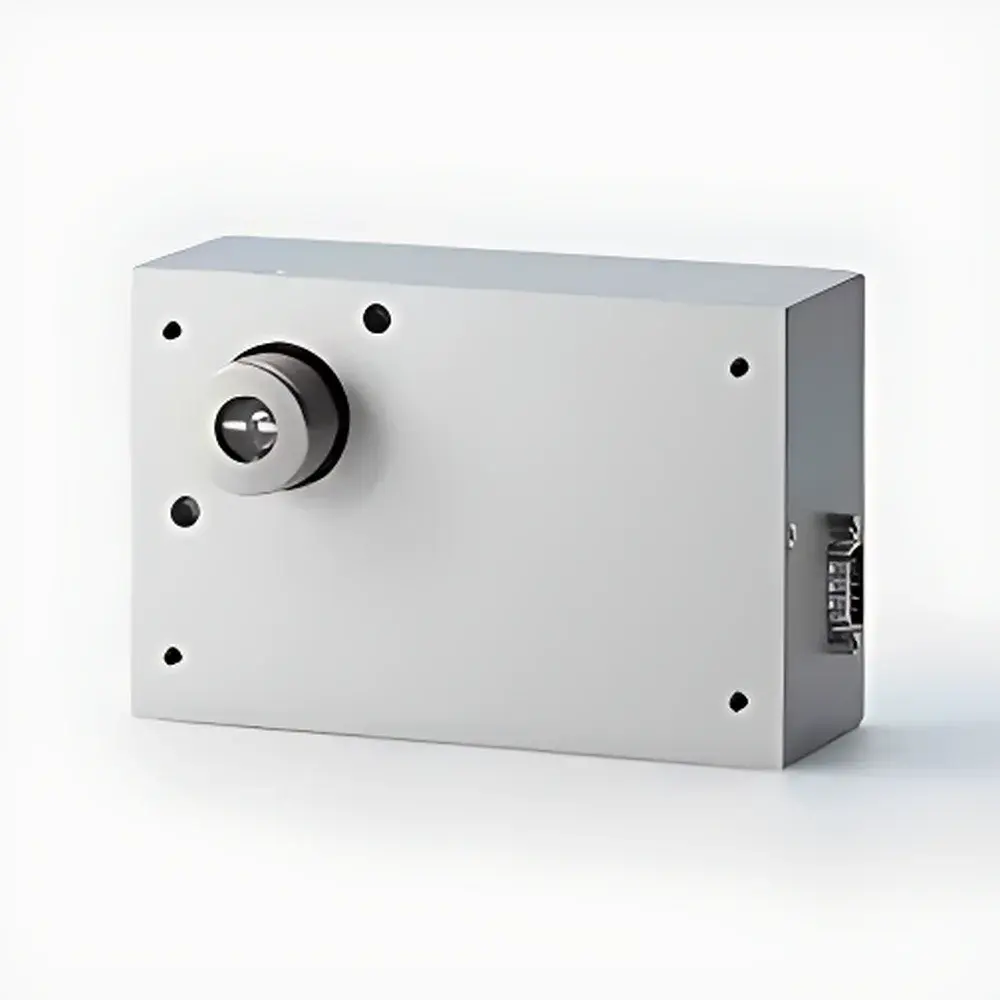
Hamamatsu L12745 20 W Pulsed Xenon Lamp Module
| Brand | Hamamatsu |
|---|---|
| Origin | Japan |
| Manufacturer | Hamamatsu Photonics K.K. |
| Product Type | Pulsed Xenon Light Source |
| Illumination Mode | Internal Illumination |
| Arc Size | 1.5 mm |
| Window Material | UV Glass (L12745-01/-02/-03) / MgF₂ (L12745-01-3/-02-3/-03-3) |
| Spectral Range | 185–2500 nm (UV-Glass) / 160–7500 nm (MgF₂) |
| Main Discharge Voltage Range | 400–1000 V (internal or external control) |
| Main Discharge Capacitance | 0.64 / 0.32 / 0.1 µF (model-dependent) |
| Max Flash Energy | up to 51.2 mJ per pulse |
| Max Repetition Rate | up to 1000 Hz |
| Max Average Power | 20 W |
| Optical Output Stability | ≤2.0% CV (typ. 0.9% CV), ≤6.0% p-p (typ. 4.5% p-p) |
| Rated Lifetime | 1.5 × 10⁸ – 1 × 10⁹ flashes |
| Input Voltage | 21.6–26.4 V DC |
| Trigger Signal | TTL-compatible rectangular pulse, ≥10 µs width, 5–10 V |
| Trigger Input Impedance | 330 Ω |
| Operating Temperature | 0–+40 °C |
| Storage Temperature | −40–+90 °C |
| Compliance | IEC/EN 61326-1 (EMC), IEC/EN 62471 (Risk Group 3), IEC/EN 61010-1 (Safety), IEC/EN 63000 (RoHS) |
Overview
The Hamamatsu L12745 is a high-performance, integrated 20 W pulsed xenon lamp module engineered for precision optical instrumentation requiring stable, broadband, and rapidly switchable illumination. Based on the principle of high-voltage capacitor discharge across a sealed xenon arc gap, the L12745 generates intense, sub-millisecond light pulses with spectral continuity from deep ultraviolet (160 nm with MgF₂ window) through near-infrared (up to 7500 nm). Its internal driver architecture eliminates the need for external high-voltage power supplies or separate trigger generators—reducing system complexity, electromagnetic interference, and alignment overhead. The pre-aligned arc geometry ensures consistent spatial coherence and eliminates post-installation optical axis adjustment, making it ideal for OEM integration into analytical platforms where mechanical stability and long-term repeatability are critical.
Key Features
- Integrated design: Combines xenon lamp, high-voltage discharge circuitry, trigger interface, and thermal management in a single compact module (dimensions: 60 × 40 × 35 mm).
- Broadband spectral output: Covers 160–7500 nm (MgF₂-window variants) or 185–2500 nm (UV-glass variants), enabling multi-wavelength detection without lamp swapping.
- Precise pulse control: Adjustable main discharge voltage (400–1000 V) and capacitance selection (0.1–0.64 µF) allow optimization of flash energy (8–51.2 mJ) and repetition rate (up to 1000 Hz) for application-specific signal-to-noise requirements.
- Exceptional photometric stability: Achieves ≤0.9% coefficient of variation (CV) and ≤4.5% peak-to-peak (p-p) intensity fluctuation under continuous operation at 1000 Hz—validated per ISO 9001 production test protocols.
- Long operational lifetime: Rated for 1.5 × 10⁸ to 1 × 10⁹ flashes under 20 W average load, defined as the point at which integrated irradiance (190–1100 nm) degrades to 50% of initial value or exceeds specified stability limits.
- No active cooling required: Designed for conduction-cooled operation up to +40 °C ambient; optional heatsinking recommended if housing surface temperature exceeds +45 °C during sustained high-duty-cycle use.
Sample Compatibility & Compliance
The L12745 is compatible with standard optical mounts (M3 threaded holes) and interfaces directly with industry-standard 9-pin D-sub connectors. Its low-noise trigger input (330 Ω impedance, 5–10 V TTL-level) supports synchronization with high-speed detectors, gated CCD/CMOS cameras, and time-resolved spectroscopy systems. Electrical safety and electromagnetic compatibility conform to IEC/EN 61010-1 (Measurement Category II, Pollution Degree 2), IEC/EN 62471 (Photobiological Safety, Risk Group 3), and IEC/EN 61326-1 (EMC emissions Class B, immunity per Table 1). RoHS-compliant construction (IEC/EN 63000) ensures suitability for regulated life science and clinical diagnostic environments. While not intrinsically certified for hazardous locations, its sealed quartz envelope and low external EMI signature support deployment in GLP/GMP-compliant laboratories when installed per manufacturer’s mechanical and thermal guidelines.
Software & Data Management
The L12745 operates as a hardware-level light source—no embedded firmware or proprietary software stack is required. Control is implemented via analog voltage (pin 3) for discharge voltage tuning and digital TTL triggering (pins 4–5), enabling seamless integration with LabVIEW, Python (via NI-DAQ or serial-to-TTL adapters), MATLAB, or custom FPGA-based timing controllers. For audit-trail compliance in regulated applications (e.g., FDA 21 CFR Part 11), users may log trigger timestamps, supply voltage, and ambient temperature alongside detector data using third-party DAQ systems. Hamamatsu provides full electrical schematics, pinout documentation, and thermal derating curves—supporting traceable calibration and validation per ISO/IEC 17025 requirements.
Applications
- UV-Vis-NIR spectrophotometry: High-intensity pulsed output improves SNR in fast-scanning monochromator systems and diode-array detectors.
- HPLC and UHPLC detectors: Synchronized flash timing enables zero-background absorbance measurement at millisecond resolution.
- Flow cytometry and imaging cytometers: Sub-10 µs pulse width supports high-throughput cell interrogation with minimal phototoxicity.
- Gas and water quality analyzers: Broad UV continuum facilitates simultaneous multi-analyte detection (e.g., NO₂, SO₂, TOC, nitrate) via differential absorption spectroscopy.
- Mineralogical and gemological identification: Stable spectral irradiance enables reproducible reflectance and fluorescence fingerprinting across visible and NIR bands.
- In vitro diagnostics: Used in automated urinalysis and hematology analyzers where precise flash-to-flash consistency ensures quantitative assay linearity per CLSI EP10-A3 guidelines.
FAQ
What is the difference between the “-01”, “-02”, and “-03” suffixes?
These denote main discharge capacitance values: 0.64 µF (-01), 0.32 µF (-02), and 0.1 µF (-03). Higher capacitance yields higher per-pulse energy but lower maximum repetition rate; selection depends on required flash energy vs. duty cycle.
Can the L12745 be triggered externally while maintaining internal voltage regulation?
Yes—external triggering (pin 5) operates independently of internal discharge voltage control (pin 3). The module supports simultaneous external sync and analog voltage tuning for dynamic pulse shaping.
Is the L12745 suitable for vacuum or inert-gas environments?
No—the module is rated for ambient air operation only. The quartz envelope and PCB layout are not hermetically sealed for vacuum compatibility or nitrogen purging.
How is optical output stability verified during manufacturing?
Each unit undergoes 24-hour burn-in and photometric testing using NIST-traceable silicon photodiodes (e.g., Hamamatsu S1336-8BQ) under standardized thermal and electrical conditions per internal QA-127 specification.
Does Hamamatsu provide spectral irradiance calibration data for the L12745?
Yes—optional NIST-traceable spectral radiance calibration certificates (covering 190–1100 nm) are available upon request, including uncertainty budgets aligned with ISO/IEC 17025 Clause 6.4.





