
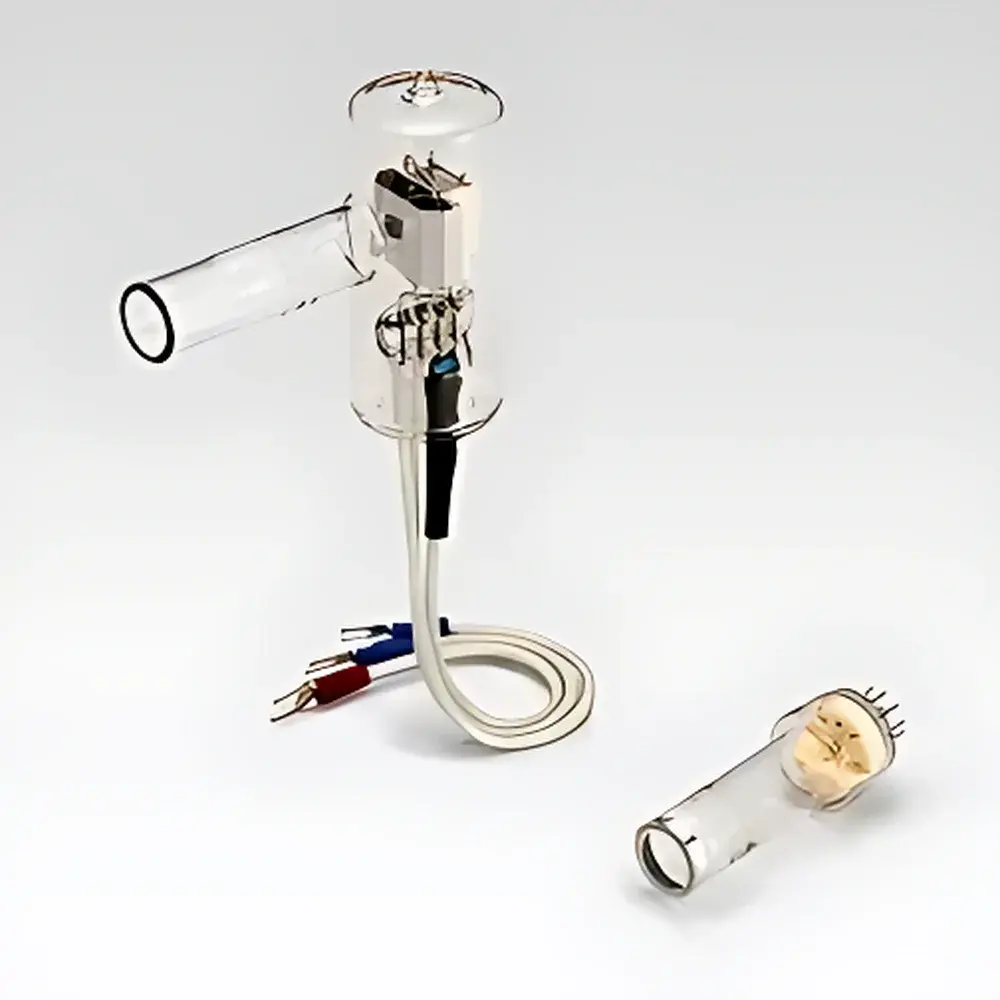
Hamamatsu L7293 / L13301 Photoionization Deuterium Lamp
| Brand | Hamamatsu |
|---|---|
| Origin | Japan |
| Manufacturer Type | Original Equipment Manufacturer (OEM) |
| Import Status | Imported |
| Model | L7293 / L13301 |
| Pricing | Available Upon Request |
Overview
The Hamamatsu L7293 and L13301 are high-performance, continuous-wave deuterium lamps engineered specifically for vacuum ultraviolet (VUV) photoionization in analytical mass spectrometry systems. Operating on the principle of molecular deuterium discharge, these lamps emit a stable, broadband VUV spectrum extending from approximately 115 nm to 400 nm, with a peak photon energy of 10.78 eV—sufficient to ionize a broad range of organic compounds (e.g., aromatic hydrocarbons, aldehydes, ketones, and halogenated species) while minimizing fragmentation. Unlike laser-based photoionization sources—which introduce complexity, thermal instability, and high maintenance costs—or conventional PID lamps with limited radiant flux and spectral cutoff above 10.6 eV, the L7293/L13301 provides a robust, cost-effective, and reproducible alternative for soft ionization. The lamps utilize a magnesium fluoride (MgF₂) window to transmit deep-UV radiation down to ~115 nm, enabling compatibility with time-of-flight (TOF), quadrupole, and ion trap mass analyzers requiring tunable, low-fragmentation ionization pathways.
Key Features
- High photon energy output: Nominal maximum photon energy of 10.78 eV, enabling efficient single-photon ionization of compounds with ionization energies ≤ 10.7 eV
- Stable VUV continuum emission: Broadband spectral output (115–400 nm) with smooth intensity distribution, optimized for quantitative ionization efficiency across compound classes
- MgF₂ optical window: Transmits deep-UV radiation down to 115 nm; hermetically sealed quartz envelope ensures long-term spectral stability and resistance to ozone degradation
- Compact OEM form factor: Designed for direct integration into vacuum-compatible ion sources; footprint optimized for modular mass spectrometer architectures
- Extended operational lifetime: Rated for ≥ 2,000 hours of continuous operation under recommended current and thermal management conditions
- Low thermal load & rapid warm-up: Achieves spectral stabilization within < 5 minutes after cold start, minimizing system downtime during method switching
Sample Compatibility & Compliance
These deuterium lamps are compatible with volatile and semi-volatile organic analytes introduced via gas chromatography (GC), direct probe, or ambient desorption interfaces (e.g., DART, REMPI-assisted inlets). Their soft ionization characteristics preserve molecular ion signals for accurate mass assignment and library matching—critical for untargeted screening and forensic toxicology workflows. From a regulatory perspective, lamp-driven photoionization supports GLP-compliant data acquisition when integrated with audit-trail-enabled acquisition software. While the lamp itself is not certified to a specific standard, its use aligns with ISO/IEC 17025 requirements for traceable ion source performance verification and supports method validation per USP and ASTM E2968-22 (Standard Guide for Photoionization Mass Spectrometry).
Software & Data Management
The L7293/L13301 operates as a hardware component within the instrument’s ion source control subsystem. It requires no embedded firmware or driver-level software but interfaces via standard analog voltage/current control inputs (typically 0–10 V or 4–20 mA) for intensity modulation and status monitoring. When integrated with commercial mass spectrometry platforms (e.g., TOFWERK, JEOL AccuTOF, or custom-built TOF-MS), lamp operation is synchronized through TTL triggers and monitored via real-time photodiode feedback (optional external sensor). All acquired spectra retain full metadata—including lamp operating hours, filament current, and window transmission history—enabling retrospective assessment of signal drift and supporting FDA 21 CFR Part 11 compliance when paired with validated acquisition software featuring electronic signatures and audit trails.
Applications
- Real-time environmental monitoring: Detection of BTEX, PAHs, and oxygenated VOCs in ambient air or stack emissions using portable TOF-MS
- Explosives and chemical threat detection: Standoff identification of nitroaromatics (e.g., TNT, DNT) and peroxide-based explosives with minimal in-source fragmentation
- Metabolomics and breath analysis: Soft ionization of low-molecular-weight metabolites (e.g., isoprene, acetone, ethanol) without derivatization
- Reaction monitoring in catalysis research: In situ tracking of short-lived intermediates in gas-phase heterogeneous reactions
- Reference standard calibration: Generation of known photoionization cross-sections for quantitative response factor determination
FAQ
What is the typical spectral irradiance output at 120 nm?
Measured irradiance depends on optical coupling and distance; under standard collimated configuration at 10 cm, nominal irradiance is ~1.2 × 10¹³ photons·s⁻¹·nm⁻¹·sr⁻¹ (integrated over 0.1 nm bandwidth).
Can the lamp be operated in ultra-high vacuum (UHV) environments?
Yes—the lamp housing is rated for bake-out up to 120 °C and compatible with base pressures ≤ 1 × 10⁻⁷ mbar when installed with appropriate UHV feedthroughs and differential pumping.
Is MgF₂ window replacement supported by Hamamatsu?
No—MgF₂ windows are permanently sealed during manufacturing; replacement requires factory service or lamp unit exchange per Hamamatsu’s OEM support policy.
How does lamp aging affect photoionization efficiency?
Output decay follows logarithmic trend; >90% initial irradiance is maintained for first 1,500 hours; periodic intensity calibration using reference compounds (e.g., benzene) is recommended for quantitative applications.
Are there RoHS or REACH compliance documents available?
Yes—Hamamatsu provides full substance declaration reports and EU Declaration of Conformity (DoC) upon request, confirming compliance with Directive 2011/65/EU and Regulation (EC) No. 1907/2006.






