
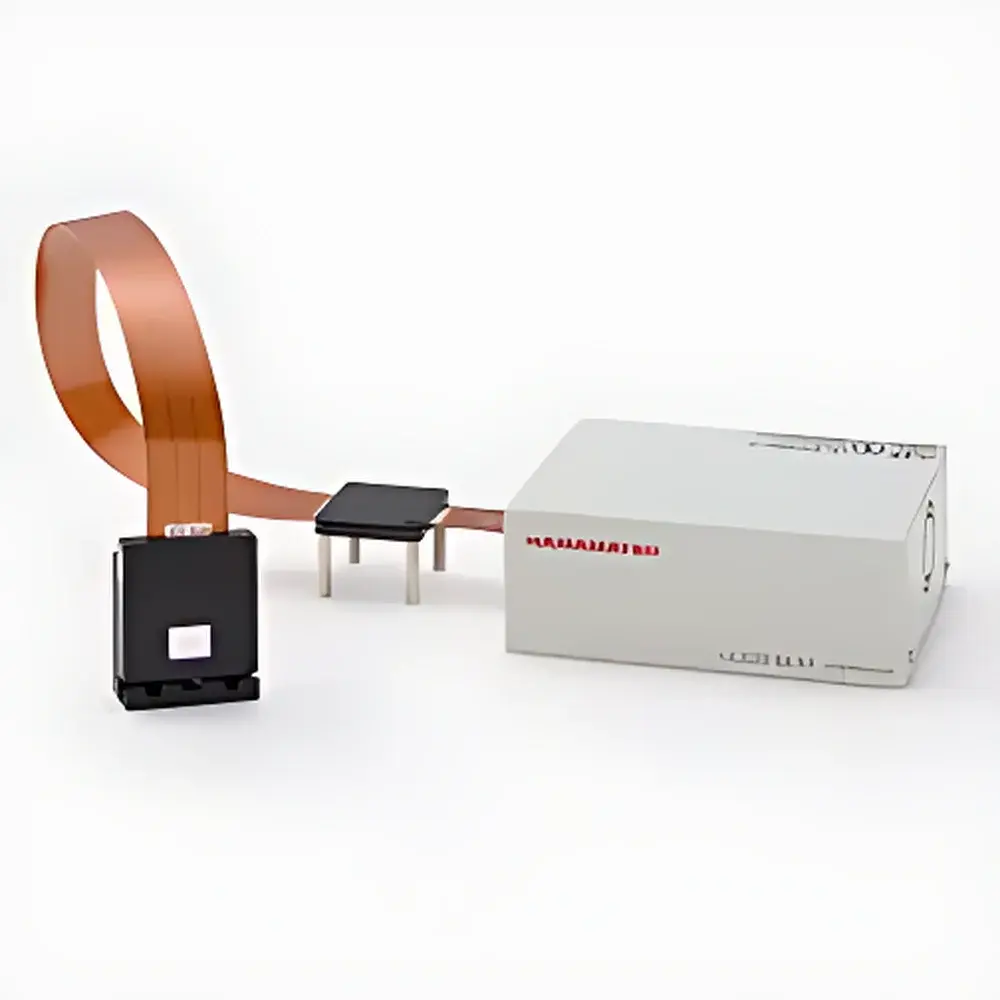
Hamamatsu LCOS-SLM X15213-16 Reflective Pure-Phase Spatial Light Modulator
| Brand | Hamamatsu |
|---|---|
| Origin | Japan |
| Manufacturer Type | Original Equipment Manufacturer (OEM) |
| Import Status | Imported |
| Model | X15213-16 |
| Pricing | Upon Request |
Overview
The Hamamatsu LCOS-SLM X15213-16 is a high-performance reflective pure-phase spatial light modulator engineered for precision wavefront control in advanced optical systems. Based on silicon-on-insulator liquid crystal on silicon (LCOS) technology, it enables voltage-driven, pixel-level modulation of the optical phase profile without introducing significant amplitude modulation—making it ideal for applications demanding high-fidelity phase-only manipulation, such as adaptive optics, holographic beam shaping, optical trapping, and ultrafast pulse shaping. The device operates within a narrow spectral band centered at 510 nm ± 50 nm (i.e., 460–560 nm), with peak optical efficiency measured at λ = 532 nm. Its reflective architecture minimizes thermal load and supports high-power handling, while the monolithic LCOS chip integrates a high-fill-factor (96%) pixel array with low intrinsic wavefront distortion—enabling diffraction-limited performance when coupled with appropriate calibration routines.
Key Features
- Pure-phase modulation mode with negligible amplitude coupling—ensures high-fidelity interference and hologram reconstruction
- High optical utilization efficiency (97% at 532 nm), achieved through optimized anti-reflection coatings and minimal inter-pixel gap design
- SXGA-resolution active area (1272 × 1024 pixels) with 12.5 µm pitch and 15.9 × 12.8 mm effective aperture
- DVI-D interface compatibility (60 Hz frame rate, 8-bit grayscale input) for seamless integration with standard laboratory PCs—no proprietary drivers or FPGA boards required
- Fast electro-optic response: 11 ms rise time and 34 ms fall time under typical operating conditions
- Robust phase linearity and repeatability, supported by factory-applied pixel-wise nonlinearity correction tables accessible via USB-B 2.0 (USB 2.0 High-Speed)
- Maximum spatial frequency resolution of 40 lp/mm, enabling precise control over sub-micron interference features in Fourier-plane applications
Sample Compatibility & Compliance
The X15213-16 is designed for use with collimated, linearly polarized illumination aligned to the device’s optimal incident angle (typically near-normal incidence). It is compatible with continuous-wave (CW) and pulsed laser sources operating within its specified wavelength range, including common solid-state lasers (e.g., frequency-doubled Nd:YAG at 532 nm) and tunable diode sources. While not certified to a specific regulatory standard as a standalone component, the module complies with IEC 61000-6-3 (EMC emission limits) and IEC 61000-6-2 (immunity requirements) when installed in properly shielded optical enclosures. Its optical performance metrics—including phase fidelity, diffraction efficiency, and temporal stability—are validated per Hamamatsu’s internal quality control protocols aligned with ISO/IEC 17025 traceability principles for metrological instrumentation.
Software & Data Management
Control is implemented via Hamamatsu’s proprietary SLM Control Software (v3.x or later), which runs on Windows OS and supports real-time phase pattern upload, gamma correction mapping, and dynamic phase sequence playback. The software includes built-in tools for measuring and compensating for static wavefront aberrations (e.g., piston, tilt, defocus) using Zernike polynomial fitting. All phase maps are stored in standardized binary formats (.bin or .tif) with embedded metadata (wavelength, pixel scale, timestamp), facilitating interoperability with MATLAB, Python (via NumPy/PIL), and commercial optical design platforms (e.g., Zemax OpticStudio, COMSOL Multiphysics). Audit trails—including user login, pattern upload history, and calibration timestamp—are retained locally and may be exported for GLP/GMP-compliant documentation workflows.
Applications
- Dynamic holography and computer-generated hologram (CGH) projection for optical tweezers and multi-point trapping
- Adaptive optics correction in microscopy (e.g., two-photon, STED) and astronomy systems
- Beam steering and focus shaping in laser material processing and biomedical imaging
- Ultrafast pulse compression and spectral phase modulation in chirped pulse amplification (CPA) systems
- Quantum optics experiments requiring programmable phase masks for spatial mode sorting (e.g., OAM multiplexing)
- Fourier-plane filtering and optical correlators in real-time pattern recognition setups
FAQ
What is the maximum average optical power this SLM can handle?
The X15213-16 is rated for continuous-wave operation up to 2 W/cm² at 532 nm, assuming uniform illumination across the active area and adequate thermal management (e.g., conductive mounting to a temperature-stabilized heatsink).
Is phase calibration data provided with the unit?
Yes—each unit ships with a factory-measured pixel-wise phase response lookup table (LUT), enabling linearized 8-bit-to-phase conversion with ≤0.05π RMS residual error after application.
Can the SLM be synchronized with external triggers (e.g., laser pulses)?
While the native DVI interface does not support hardware triggering, USB-B communication allows for software-synchronized pattern updates with microsecond-level latency via Hamamatsu’s SDK API.
Does the device support custom phase patterns generated in Python or MATLAB?
Yes—the control software accepts 1272 × 1024 grayscale bitmaps in standard formats; users may generate patterns programmatically and upload them directly using the included DLL-based API or Python wrapper.
Is there an option for extended wavelength operation beyond 460–560 nm?
No—optical coatings and LC birefringence properties are optimized specifically for this band. Operation outside this range results in degraded phase contrast, reduced efficiency, and potential long-term reliability risks.




