
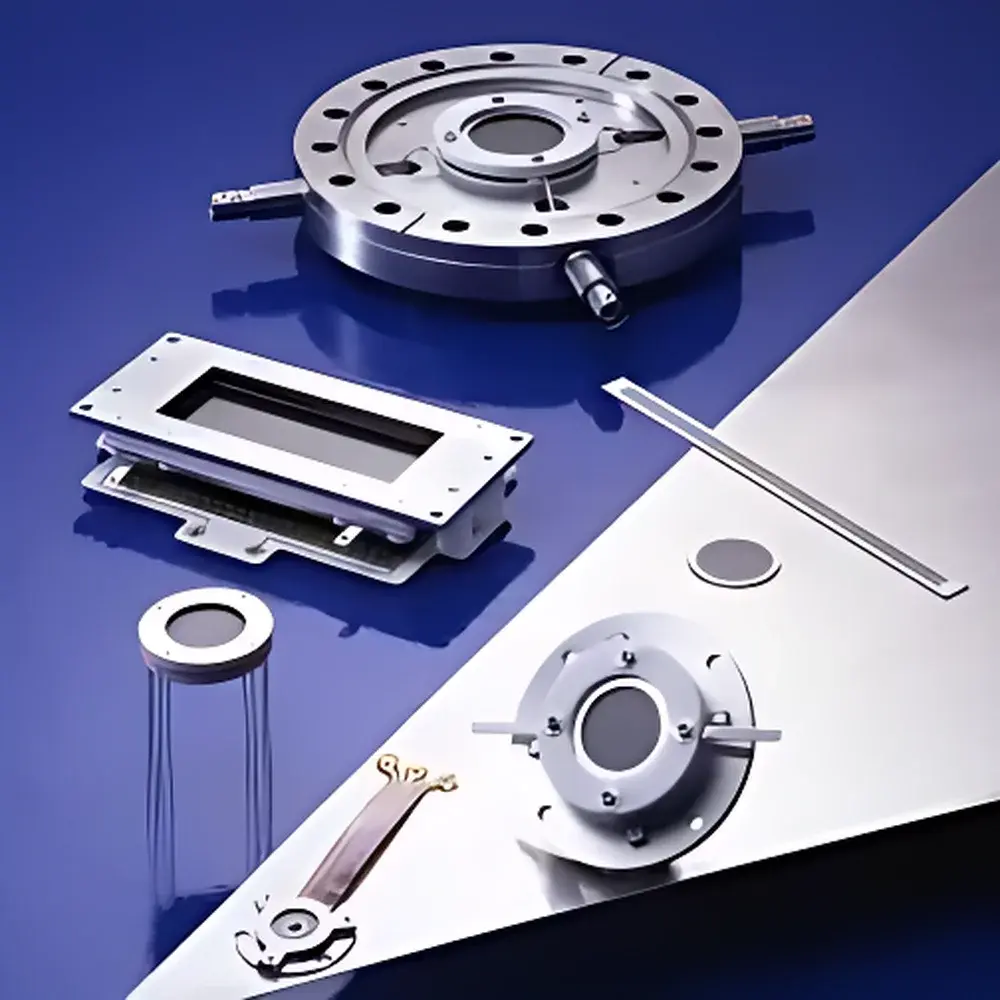
Hamamatsu Microchannel Plate (MCP)
| Brand | Hamamatsu |
|---|---|
| Origin | Japan |
| Manufacturer Type | Original Equipment Manufacturer (OEM) |
| Import Status | Imported |
| Component Category | Optical Component |
| Available Diameters | 14.5 mm, 20 mm, 27 mm, 28 mm, 32 mm, 40 mm, 42 mm, 77 mm |
| Available Rectangular Formats | 81 × 31 mm, 53 × 53 mm, 55 × 8 mm |
| Structural Options | Removable or Non-removable |
| Anode Configuration | Single, Multiple, or Selectable Single/Multiple |
Overview
The Hamamatsu Microchannel Plate (MCP) is a vacuum-compatible, two-dimensional electron multiplier engineered for high-gain, low-noise amplification of charged particles and short-wavelength photons. Based on the principle of secondary electron emission within millions of parallel, microscopic glass channels (typically 4–25 µm pore diameter, with aspect ratios >40:1), the MCP operates under bias voltages of 600–1200 V to achieve gain values ranging from 10³ to 10⁷—depending on configuration, voltage, and incident particle energy. Unlike discrete dynode electron multipliers, the MCP’s monolithic architecture enables sub-nanosecond temporal response, spatial resolution down to <10 µm, and intrinsic position sensitivity across its active area. It serves as the core detection element in image intensifiers, time-of-flight mass spectrometers, EUV lithography monitors, synchrotron beamline diagnostics, night vision systems, and ultrafast streak cameras. Since its commercial introduction by Hamamatsu Photonics in 1987, the MCP product line has evolved through rigorous process control, proprietary lead-glass composition optimization, and precision hydrogen firing protocols—ensuring exceptional gain uniformity, low ion feedback, and long-term operational stability under UHV (≤10⁻⁸ Pa) conditions.
Key Features
- High secondary emission yield (>3 electrons per incident particle at optimal bias)
- Sub-ns pulse response time and excellent timing jitter (<100 ps FWHM typical)
- Active area options spanning compact 14.5 mm diameter formats to large-format 81 × 31 mm rectangular plates
- Configurable channel geometry: standard pore sizes (6 µm, 10 µm, 12 µm, 25 µm), open-area ratios (50–75%), and bias-angle variants (e.g., 5°–13°)
- Robust hermetic sealing and bakeable construction compatible with UHV integration
- Low dark count rate (<0.1 events/cm²/s at 25°C, after proper aging)
- Available in single-, dual-, or triple-MCP stack configurations (chevron or Z-stack) for enhanced gain and ion feedback suppression
- Custom metallization options: NiCr, Inconel, or Au-coated input/output faces for optimized quantum efficiency and conductivity
Sample Compatibility & Compliance
Hamamatsu MCPs are sensitive to electrons (1–30 keV), positive and negative ions (H⁺, O⁺, Ar⁺, etc.), vacuum ultraviolet (VUV: 50–200 nm), soft X-rays (0.1–2 keV), and gamma-ray-induced photoelectrons. They are routinely integrated into detectors certified to ASTM E1316 (Standard Terminology for Nondestructive Examinations), ISO/IEC 17025-accredited calibration workflows, and systems requiring compliance with MIL-STD-883 (Method 1019 for radiation hardness). All MCPs undergo full electrical screening—including leakage current measurement (<1 nA at rated voltage), gain uniformity mapping (±15% max deviation over active area), and vacuum outgassing validation per NASA SP-R-0022A. Units intended for GLP/GMP environments support traceable lot documentation and material certifications (RoHS, REACH, conflict minerals).
Software & Data Management
While the MCP itself is a passive analog component, Hamamatsu provides comprehensive integration support for digital readout systems. Reference design kits include compatibility documentation for delay-line anodes (DLAs), cross-strip anodes, and CMOS-based Timepix/Timepix3 ASICs—enabling photon-counting imaging with timestamp resolution ≤100 ps. Hamamatsu’s MCP Integration Guide v4.2 details HV sequencing protocols, grounding schemes to minimize microphonic noise, and thermal management recommendations for sustained operation. For regulated environments, Hamamatsu supplies audit-ready manufacturing records and supports IQ/OQ documentation packages aligned with FDA 21 CFR Part 11 requirements when paired with validated data acquisition platforms (e.g., Keysight DAQ970A, National Instruments PXIe-6535B).
Applications
- Ultrafast electron microscopy: Stroboscopic imaging and pump-probe experiments requiring picosecond gating
- Space-based particle detectors: Radiation-hardened MCP stacks for solar wind analyzers and planetary ion mass spectrometers
- Plasma diagnostics: Spatially resolved Langmuir probe arrays and Thomson scattering detectors
- Quantum optics: Single-photon counting in visible-to-VUV regimes using MCP-coupled photocathodes (e.g., CsI, KBr)
- Industrial metrology: Real-time monitoring of EUV source stability in next-generation semiconductor lithography tools
- Biomedical imaging: High-resolution autoradiography and beta-imaging of radiolabeled tissue sections
FAQ
What vacuum level is required for optimal MCP operation?
Typical operation requires base pressure ≤5 × 10⁻⁷ Pa (5 × 10⁻⁹ mbar); extended lifetime and low noise performance are achieved at ≤1 × 10⁻⁸ Pa.
Can Hamamatsu MCPs be used in magnetic fields?
Yes—standard MCPs tolerate static fields up to ±50 Gauss without gain degradation; custom low-magnetic-permeability substrates are available for higher-field applications.
Is gain aging reversible?
Gradual gain reduction due to surface charge buildup is partially recoverable via controlled HV annealing (ramped bias at elevated temperature); irreversible aging results from ion feedback damage and is mitigated using curved-channel or atomic-layer-deposited (ALD) barrier coatings.
Do you offer custom electrode patterns?
Yes—Hamamatsu supports customer-defined anode layouts (e.g., wedge-and-strip, spiral, segmented ring) with lithographic alignment tolerances ≤±2 µm.
What is the typical service life under continuous operation?
At 50% of maximum rated gain and 10⁶ total extracted charge/cm², median operational lifetime exceeds 2 years; lifetime scales inversely with operating gain and total accumulated charge.






