
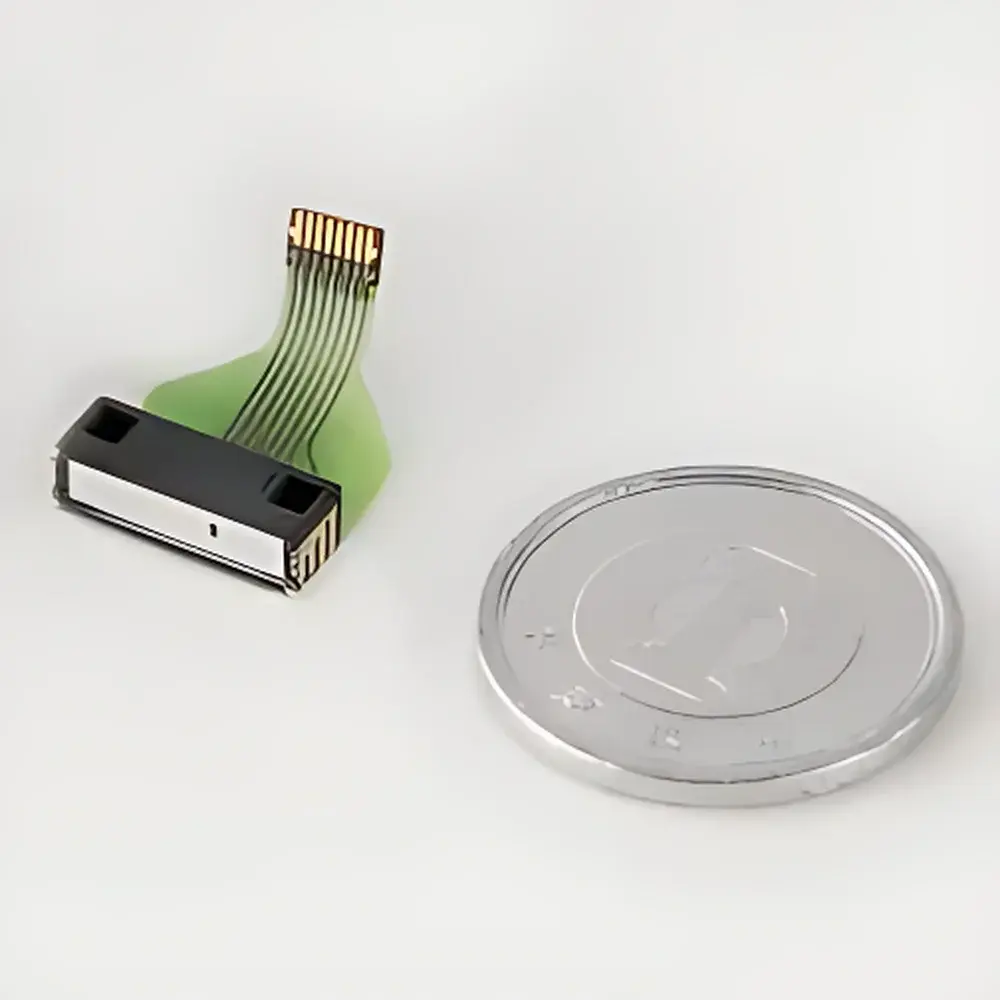
Hamamatsu Miniature Grating Spectrometer SMD Series C14384MA-01
| Brand | Hamamatsu |
|---|---|
| Origin | Japan |
| Manufacturer Type | Original Equipment Manufacturer (OEM) |
| Product Category | Imported Instrument |
| Model | C14384MA-01 |
| Application System | Universal |
| Grating Configuration | Integrated Grating Stage |
| Spectral Resolution (FWHM) | 17 nm typ. / 20 nm max. |
| Wavelength Range | 640–1050 nm |
| Wavelength Accuracy | 20 nm typ. / 25 nm max. (640–800 nm) |
| Stray Light | −23 dB |
| Detector | High-Sensitivity CMOS Linear Image Sensor with Integrated Slit |
| Pixel Count | 256 pixels (including optical black) |
| Operating Temperature | Typical at Ta = 25 °C |
| Cooling | Non-cooled |
| Dimensions (L×W×H, excluding flex cable) | 11.7 × 4.0 × 3.1 mm |
| Mass | 0.3 g |
Overview
The Hamamatsu Miniature Grating Spectrometer SMD Series C14384MA-01 is a monolithic, non-cooled, grating-based optical spectrometer engineered for integration into space-constrained, weight-sensitive platforms requiring real-time spectral acquisition in the near-infrared (NIR) range. Based on a fixed-grating optical architecture with an integrated entrance slit and high-quantum-efficiency CMOS linear image sensor, it operates on the principle of wavelength-dispersive spectroscopy: incident light is collimated, diffracted by a precision ruled or holographic grating, and focused onto a 256-pixel linear detector array. Each pixel corresponds to a discrete wavelength bin within the 640–1050 nm spectral window, enabling continuous spectral profile capture without mechanical scanning. Its design eliminates moving parts and thermoelectric coolers—reducing power consumption, thermal drift, and failure modes—while maintaining sufficient resolution and signal-to-noise performance for qualitative and semi-quantitative NIR analysis in field-deployable systems.
Key Features
- Ultra-compact footprint: 11.7 × 4.0 × 3.1 mm (excluding flex cable), compatible with embedded OEM integration in handheld analyzers, UAV-mounted payloads, wearables, and IoT edge sensors.
- Minimal mass: 0.3 g total device weight supports inertial stability and battery-life optimization in portable and aerial platforms.
- NIR-optimized sensitivity: Delivers up to 50× higher responsivity at 1000 nm compared to Hamamatsu’s legacy MS-series (e.g., C11708MA), achieved via back-thinned CMOS pixel architecture and optimized anti-reflection coatings.
- Integrated optical path: Monolithic optical bench includes entrance slit, collimating mirror, planar diffraction grating, and focusing optics—minimizing alignment sensitivity and environmental hysteresis.
- Non-cooled operation: Designed for ambient-temperature use (Ta = 25 °C typical), eliminating TEC power draw and thermal stabilization delays; dark current remains stable under standard laboratory and industrial conditions.
- Robust electrical interface: Flexible printed circuit (FPC) cable enables low-profile board-level mounting and simplifies signal routing in multi-sensor modules.
Sample Compatibility & Compliance
The C14384MA-01 is intended for use with diffuse reflectance, transmittance, or fluorescence measurements from solid, liquid, or particulate samples in the 640–1050 nm band—commonly applied to agricultural biomass assessment, polymer identification, pharmaceutical tablet coating uniformity screening, and silicon wafer inspection. While the device itself is not certified as a standalone analytical instrument, its optical and electronic specifications align with foundational requirements for instruments used in GLP-compliant environments when integrated into validated host systems. Its stray light level (−23 dB) meets minimum thresholds for routine NIR quantitation per ASTM E1655 (Standard Practices for Infrared Multivariate Quantitative Analysis) and supports method development compliant with USP Spectrophotometry and Light-Scattering. No intrinsic regulatory certification (e.g., CE, FDA 510(k)) applies to the bare module; final system-level compliance rests with the integrating manufacturer.
Software & Data Management
Hamamatsu provides baseline SDKs (C/C++, Python) for raw frame acquisition, pixel-to-wavelength calibration mapping, and dark reference subtraction. The 256-pixel output supports real-time streaming at frame rates up to 1 kHz (dependent on host interface bandwidth). Calibration files include polynomial coefficients for wavelength assignment (λ = a₀ + a₁·p + a₂·p²) and pixel-wise responsivity correction tables. Data export formats include CSV and binary RAW; spectral data may be imported into third-party chemometric platforms (e.g., Unscrambler®, MATLAB PLS Toolbox, Python scikit-learn) for multivariate modeling. Audit-trail functionality (e.g., timestamped acquisition logs, calibration version tracking) must be implemented at the host system level to satisfy 21 CFR Part 11 requirements for electronic records and signatures.
Applications
- Real-time NIR monitoring of moisture content and starch concentration in grain and feed during harvesting or conveyance.
- On-drone spectral mapping of vegetation health indices (e.g., NDVI variants) using compact multispectral sensor arrays.
- Embedded quality control in roll-to-roll manufacturing of thin-film photovoltaics and OLED displays.
- Miniaturized blood oximetry and tissue perfusion sensing in point-of-care wearable prototypes.
- Lab-on-chip absorbance detection for microfluidic immunoassays targeting NIR-absorbing dyes (e.g., IRDye® 800CW).
FAQ
Is the C14384MA-01 suitable for quantitative analysis?
Yes—when calibrated against traceable NIST SRM standards and integrated into a stable optical path with controlled illumination and sample presentation, it supports repeatable relative quantitation. Absolute quantitation requires system-level validation per ISO/IEC 17025.
Can it operate below 640 nm or above 1050 nm?
No—the spectral response is sharply attenuated outside the specified 640–1050 nm range due to detector quantum efficiency roll-off and grating blaze characteristics.
Does Hamamatsu provide factory calibration certificates?
Yes—each unit ships with a traceable wavelength calibration report and dark signal characterization at 25 °C; full spectral responsivity calibration is available as an optional service.
What is the recommended integration time range?
From 100 µs to 1 s, adjustable via host software; optimal exposure depends on light source intensity, optical throughput, and required SNR for the target application.
Is the flex cable customizable in length or pitch?
Standard pitch is 0.5 mm; custom FPC lengths and ZIF connector configurations are available under OEM agreement.
Related Products





