
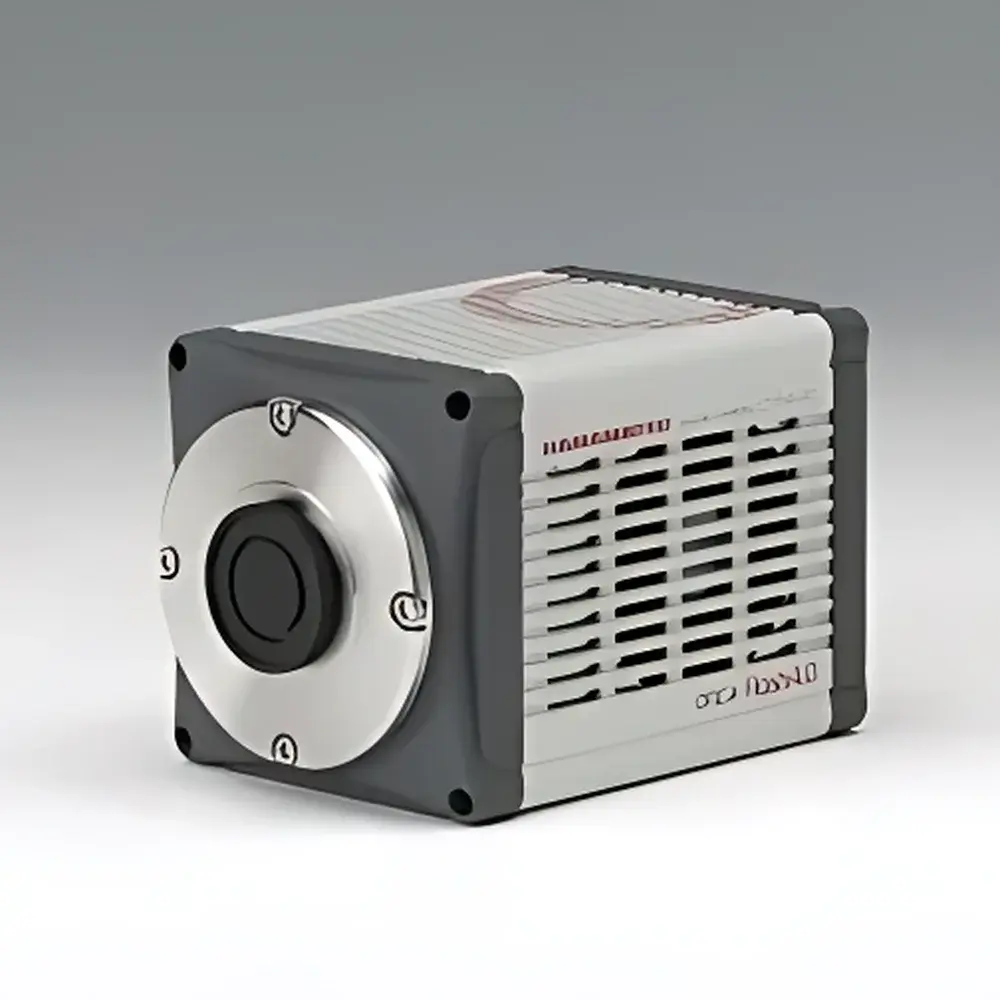
Hamamatsu ORCA-Flash4.0 V2 Scientific CMOS Camera
| Brand | Hamamatsu |
|---|---|
| Origin | Japan |
| Model | C11440-22CU |
| Image Resolution | 2048 (H) × 2048 (V) |
| Pixel Size | 6.5 µm × 6.5 µm |
| Sensor Architecture | 2×2 and 4×4 binning support |
| Onboard Memory | 512 MB |
| Readout Speed | 100 fps at full resolution via Camera Link |
| Dynamic Range | 37,000:1 (typ.) |
| Quantum Efficiency | 82% peak (at 600 nm) |
| Read Noise | 1.6 e⁻ RMS (standard scan, 100 fps), 1.4 e⁻ RMS (slow scan, 30 fps) |
| Full Well Capacity | 30,000 e⁻ (typ.) |
| Cooling | Peltier-cooled to −30 °C (with water at 15 °C) |
| Dark Current | 0.006 e⁻/pixel/s (−30 °C, typ.) |
| Exposure Range | 1 ms – 10 s (internal trigger, full frame) |
| Interface | Camera Link (base configuration) and USB 3.0 |
| ADC | True 16-bit (dual 11-bit seamless stitching) |
| Mount | C-mount |
Overview
The Hamamatsu ORCA-Flash4.0 V2 (Model C11440-22CU) is a second-generation scientific CMOS (sCMOS) camera engineered for quantitative widefield fluorescence microscopy, light-sheet imaging, and high-speed biological observation. Built upon a back-illuminated, globally reset sCMOS sensor, it delivers an optimal balance of quantum efficiency, read noise, dynamic range, and temporal resolution—without the multiplicative noise inherent in EM-CCD technology. Its measurement principle relies on photon-to-electron conversion within a thermoelectrically cooled silicon pixel array, followed by low-noise correlated double sampling (CDS) and true 16-bit digitization. Designed for rigorous optical metrology, the ORCA-Flash4.0 V2 supports both global shutter operation and flexible exposure timing—including fully programmable external triggering, global reset synchronization, and Lightsheet Readout Mode™ (patent-pending)—enabling precise spatiotemporal alignment with pulsed illumination or scanning systems.
Key Features
- Peak quantum efficiency of 82% at 600 nm—among the highest for commercially available sCMOS sensors—maximizing photon capture across key fluorophore emission bands (e.g., GFP, mCherry, Alexa Fluor dyes).
- Ultra-low read noise: 1.6 e⁻ RMS (100 fps, standard scan); 1.4 e⁻ RMS (30 fps, slow scan), validated across all 4.2 million active pixels without pixel masking or firmware-based correction.
- True 16-bit output achieved via dual 11-bit ADCs with seamless bit-stitching—ensuring linear response and no quantization artifacts in quantitative intensity analysis.
- Dual interface architecture: USB 3.0 (30 fps full-frame) and Camera Link (100 fps full-frame), both supporting identical low-noise performance and Lightsheet Readout Mode™.
- Peltier cooling to −30 °C (with 15 °C water coolant), reducing dark current to 0.006 e⁻/pixel/s—critical for long-exposure applications such as time-lapse confocal or super-resolution localization microscopy.
- Programmable trigger logic with three configurable TTL outputs, sub-millisecond trigger delay resolution (10 µs steps), and support for edge, level, and synchronous readout triggering.
- Factory-calibrated per-unit characterization data included: photon transfer curves, noise histograms, effective gain maps, and QE spectral response—traceable to NIST-traceable photometric standards.
Sample Compatibility & Compliance
The ORCA-Flash4.0 V2 is compatible with standard widefield, TIRF, spinning-disk confocal, light-sheet, and structured illumination platforms. Its C-mount interface ensures mechanical interoperability with most commercial and custom optical assemblies. The camera complies with CE, FCC Class A, and RoHS directives. For regulated environments, its deterministic timing behavior, non-volatile parameter logging, and hardware-level trigger synchronization support GLP/GMP-aligned experimental workflows. While not FDA 21 CFR Part 11–certified out-of-the-box, its DCAM-SDK API enables integration into validated acquisition software frameworks that implement audit trails, electronic signatures, and secure parameter archiving—meeting requirements for preclinical imaging validation under ISO 13485 or ICH-GCP guidelines.
Software & Data Management
The camera ships with Hamamatsu’s DCAM-SDK v4.x—a cross-platform (Windows/Linux), thread-safe, C/C++/Python-compatible SDK supporting asynchronous acquisition, region-of-interest (ROI) definition, real-time histogramming, and metadata embedding (EXIF-like tags). Third-party compatibility includes Micro-Manager 2.0+, MetaMorph, NIS-Elements, and MATLAB Image Acquisition Toolbox. All acquired frames include embedded timestamps, exposure settings, sensor temperature, and trigger status flags. Raw 16-bit TIFF or HDF5 export preserves bit-depth fidelity; optional lossless compression (ZIP64) maintains quantitative integrity while reducing storage footprint. Calibration files (gain, offset, flat-field) are stored in vendor-neutral JSON format and can be applied during acquisition or post-processing.
Applications
- Single-molecule localization microscopy (SMLM): High QE and sub-1.5 e⁻ RMS noise enable robust photon counting in PALM/STORM, improving localization precision and reducing required labeling density.
- Light-sheet fluorescence microscopy (LSFM): Lightsheet Readout Mode™ eliminates rolling-shutter artifacts during orthogonal illumination, enabling artifact-free volumetric acquisition at up to 100 Hz.
- Calcium imaging & electrophysiology correlation: Sustained 100 fps acquisition with <10 ms readout latency allows tight synchronization with patch-clamp or optogenetic stimulation protocols.
- Ratiometric and FRET imaging: Linear 16-bit response and uniform pixel response (<0.3% PRNU) ensure accurate intensity ratio calculation across dual-channel acquisitions.
- High-content screening (HCS): 4.2 MP resolution combined with fast ROI readout supports multi-well plate imaging with adaptive focus and illumination control.
FAQ
What distinguishes the ORCA-Flash4.0 V2 from first-generation sCMOS cameras?
It features improved quantum efficiency (82% vs. ~75% at 600 nm), lower read noise (1.4 e⁻ RMS in slow mode), enhanced cooling stability (−30 °C achievable), and proprietary Lightsheet Readout Mode™—all implemented without compromising full-frame speed or dynamic range.
Is the 16-bit output truly linear and calibrated?
Yes. Each unit undergoes factory photon transfer curve characterization. The dual 11-bit ADC architecture produces seamless 16-bit data with <0.01% integral nonlinearity (INL) across the full well range.
Can the camera operate in triggered global reset mode for synchronization with pulsed lasers?
Yes. It supports global reset edge/level triggering with programmable delay (0–10 s, 10 µs resolution) and hardware-synchronized exposure start—essential for pump-probe or time-resolved fluorescence experiments.
How is calibration data delivered and validated?
Each camera includes a unique digital calibration package (JSON + TIFF) containing measured QE spectra, noise histograms, gain maps, and dark current profiles—all traceable to Hamamatsu’s internal photometric reference standards and archived for audit purposes.
Does the camera support time-lapse acquisition with metadata-embedded timestamps?
Yes. Hardware-timestamped frames (µs resolution) are embedded in the image header; metadata includes exposure time, sensor temperature, trigger source, and ADC configuration—enabling reproducible reprocessing and regulatory compliance documentation.



