
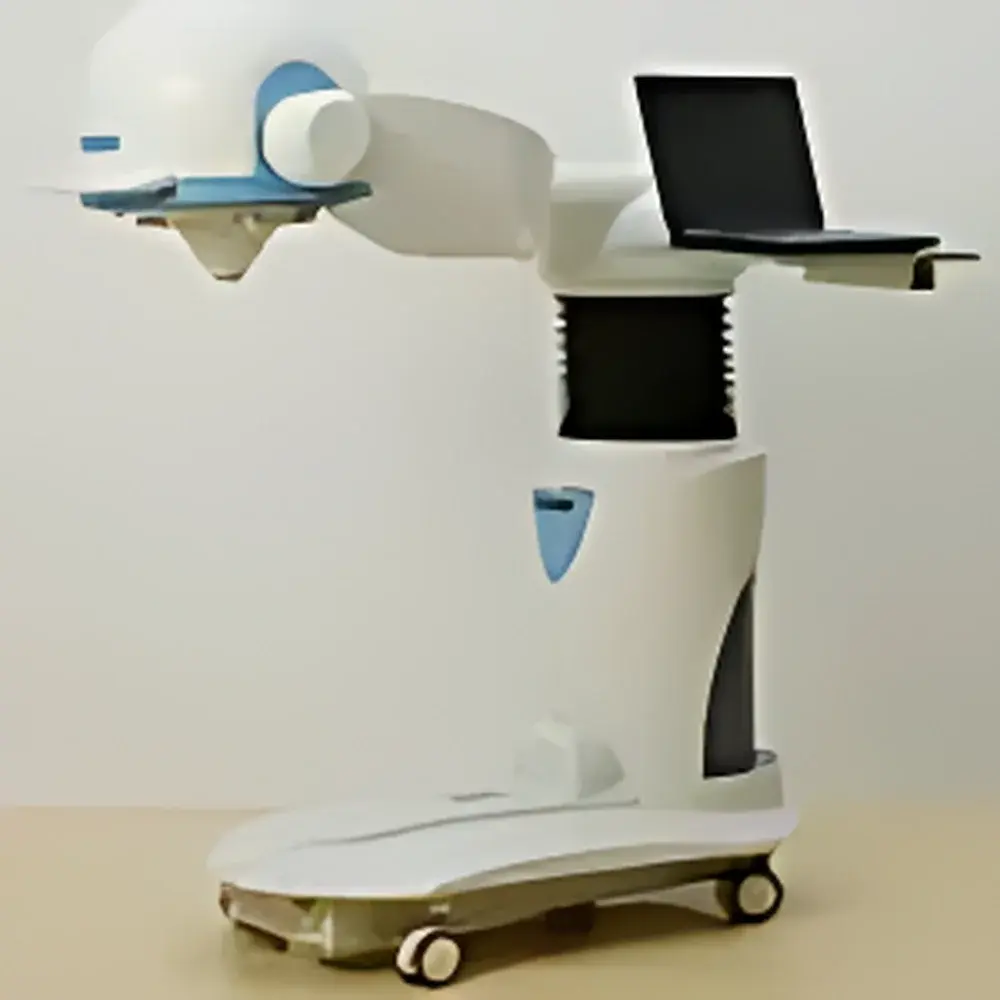
BHP6602 Compact Gamma Camera
| Brand | Hamamatsu Photonics (BHP) |
|---|---|
| Model | BHP6602 |
| Type | Compact Planar Gamma Camera for Small-Animal and Human Thyroid/Parathyroid Imaging |
| Origin | Hebei, China |
| Regulatory Approvals | NMPA (ex-SFDA) Certified, FDA 510(k) Cleared |
| Field of View (FOV) | ≥150 mm |
| Energy Range | 70–364 keV (optimized for ⁹⁹ᵐTc, ¹²³I, ¹³¹I) |
| Intrinsic Spatial Resolution | ≤3.8 mm FWHM |
| Maximum Count Rate | ≥150 kcps |
| Intrinsic Uniformity | ≤±3.0% integral, ≤±0.5% differential |
| Intrinsic Spatial Linearity Error | ≤0.4 mm |
| Dimensions (L×W×H) | 1192 × 804 × 1268 mm (low position) / 1468 mm (high position) |
| Weight | 147 kg |
| PACS Integration | Yes |
| Software Interface | Full Chinese GUI with quantitative analysis modules for thyroid area/weight, renal time-activity curves, gated blood pool, and static bone imaging |
Overview
The BHP6602 Compact Gamma Camera is a planar nuclear imaging system engineered for high-fidelity, low-dose scintigraphy in both preclinical small-animal studies and targeted human clinical applications—particularly thyroid, parathyroid, renal, and cardiac functional assessments. Based on a NaI(Tl) scintillation detector coupled with position-sensitive photomultiplier tubes (PMTs) and digital pulse processing architecture, the BHP6602 employs parallel-hole collimation to achieve intrinsic spatial resolution ≤3.8 mm FWHM across a ≥150 mm circular field of view. Its energy discrimination circuitry supports dual-peak windowing for simultaneous or sequential acquisition of isotopes such as ⁹⁹ᵐTc (140 keV), ¹²³I (159 keV), and ¹³¹I (364 keV), enabling robust quantification under variable background and scatter conditions. Designed for regulatory compliance from inception, the system meets NMPA Class II medical device requirements and holds FDA 510(k) clearance (K220238), confirming its safety, performance, and software validation per IEC 62304 and IEC 62366-1.
Key Features
- Modular height-adjustable gantry (1268 mm low / 1468 mm high) supporting bedside and dedicated room deployment—critical for ICU, oncology, and VIP patient workflows.
- Compact footprint (3.5 × 2.5 m² minimum floor space) optimized for space-constrained nuclear medicine suites or hybrid imaging labs.
- DICOM 3.0-compliant acquisition and export engine, fully interoperable with enterprise PACS, RIS, and EMR systems without proprietary middleware.
- Real-time count-rate compensation and dead-time correction algorithms ensuring linearity up to ≥150 kcps—essential for dynamic renal studies and first-pass cardiac imaging.
- Intrinsic uniformity stability ≤±3.0% (integral) and spatial linearity error ≤0.4 mm—validated per NEMA NU 1-2018 protocols for clinical reproducibility.
- Integrated quantitative analysis suite: thyroid area/weight calculation, time-activity curve derivation (TAC), glomerular filtration rate (GFR) estimation, left ventricular ejection fraction (LVEF) via gated blood pool, and semi-quantitative bone uptake ratios.
Sample Compatibility & Compliance
The BHP6602 accommodates both human patients (including pediatric and immobilized subjects) and small-animal models (mice, rats, rabbits) using optional animal-specific collimators and positioning trays. It supports standard radiopharmaceuticals including ⁹⁹ᵐTc-pertechnetate (thyroid), ⁹⁹ᵐTc-MAG3 (renal), ⁹⁹ᵐTc-RBC (gated blood pool), and ⁹⁹ᵐTc-MDP (bone). All hardware and firmware comply with ISO 13485:2016 quality management standards. Clinical software modules are designed to support audit trails, electronic signatures, and data integrity controls aligned with FDA 21 CFR Part 11 and GLP/GMP documentation requirements. Device registration includes full technical documentation per MDR Annex II and III for CE-marked configurations (pending EU authorization).
Software & Data Management
The native acquisition and analysis platform features a fully localized Chinese-language GUI—designed for rapid operator onboarding without translation latency—while exporting all metadata, raw projection data, and processed images in vendor-neutral DICOM format. Quantitative modules undergo annual traceable calibration using NIST-traceable point sources and uniform flood phantoms. Raw list-mode data export enables third-party reconstruction (e.g., OS-EM) and kinetic modeling (e.g., Patlak, Rutland). Audit logs record user ID, acquisition parameters, calibration timestamps, and image modification history—fully compliant with hospital IT security policies and regional data sovereignty regulations.
Applications
- Thyroid scintigraphy: static imaging, area/weight quantification, and 24-hr radioiodine uptake calculation.
- Parathyroid localization: dual-phase ⁹⁹ᵐTc-sestamibi subtraction imaging with anatomical correlation.
- Dynamic renal scintigraphy: split-function GFR assessment, cortical transit time, and obstructive uropathy evaluation.
- Gated equilibrium radionuclide angiography (ERNA): LVEF, end-diastolic/systolic volumes, and regional wall motion analysis.
- Small-animal longitudinal studies: serial thyroid uptake in murine autoimmune models, renal perfusion changes post-nephrectomy, and joint inflammation tracking in arthritis models.
- Orthopedic imaging: focal bone turnover assessment in wrist, knee, and temporomandibular joints.
FAQ
Does the BHP6602 support quantitative SPECT acquisition?
No—the BHP6602 is a planar gamma camera only. SPECT functionality requires mechanical rotation and dedicated reconstruction software, which are not part of this model’s design scope.
Is the system compatible with PET radiotracers such as ¹⁸F-FDG?
No—its energy windowing and detector sensitivity are optimized for gamma-emitting isotopes in the 70–364 keV range; it does not detect 511 keV annihilation photons.
Can raw projection data be exported for offline processing?
Yes—list-mode and frame-based raw data are exportable in DICOM-RT and ASCII formats for use with MATLAB, Python (PyDicom), or commercial reconstruction toolkits.
What collimator options are available for small-animal imaging?
Hamamatsu offers interchangeable parallel-hole collimators with 1.5 mm, 2.0 mm, and 3.0 mm septal thicknesses, each validated for spatial resolution and sensitivity trade-offs per NEMA NU 4-2008.
How is system calibration maintained over time?
Daily uniformity floods and weekly center-of-rotation (COR) checks are automated; full QC testing—including resolution, linearity, and count-rate linearity—is guided by embedded NEMA NU 1-2018 test protocols within the service menu.



