
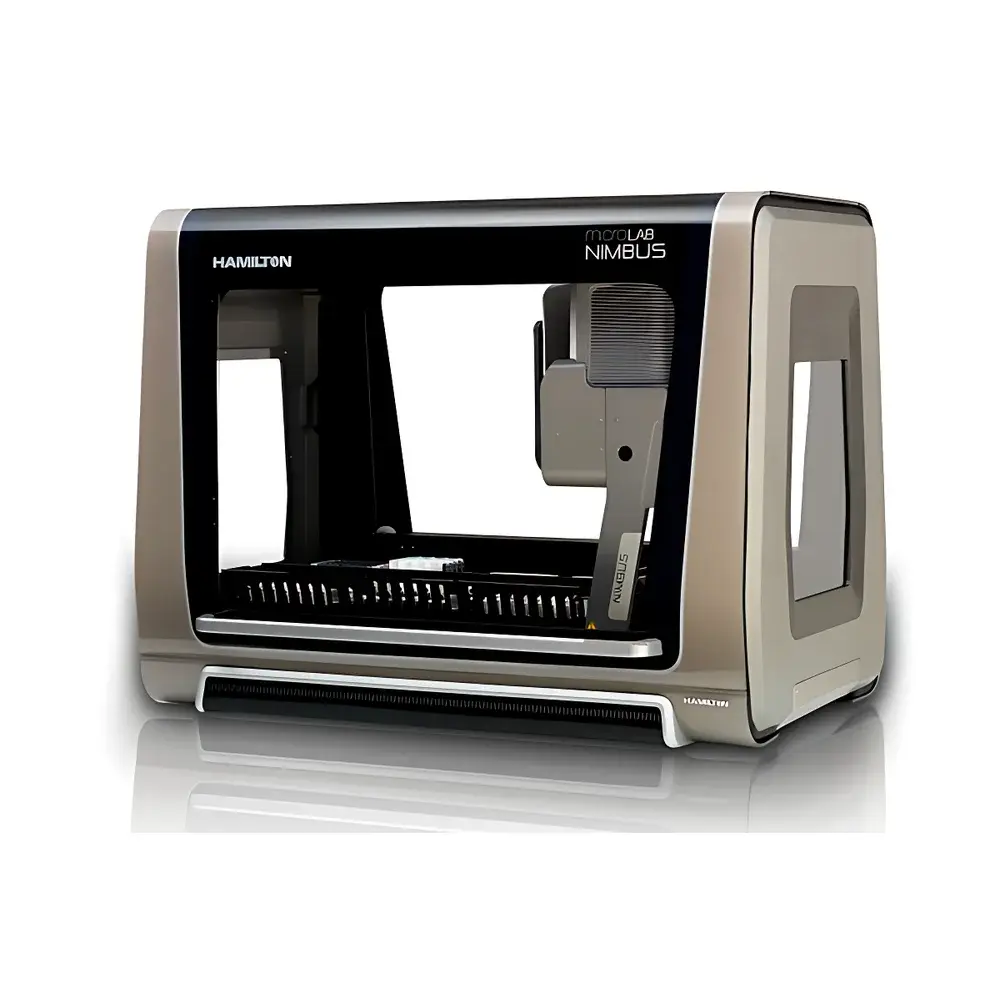
Hamilton Microlab NIMBUS 4 Automated Liquid Handling Workstation
| Brand | Hamilton |
|---|---|
| Origin | USA |
| Manufacturer Type | Original Equipment Manufacturer (OEM) |
| Product Origin | Imported |
| Model | Microlab NIMBUS 4 |
| Deck Positions | 11 |
| Pipetting Accuracy | ±5% |
| Pipetting Range | 0.5–1000 µL |
| Throughput Configuration | 4-channel independent pipetting |
| Dimensions (W×D×H) | 1041 × 749 × 876 mm |
Overview
The Hamilton Microlab NIMBUS 4 is a compact, modular, and benchtop-integrated automated liquid handling workstation engineered for precision, reproducibility, and workflow agility in modern life science and clinical laboratories. Unlike large-scale integrated robotic platforms designed for end-to-end assay automation, the NIMBUS 4 implements a focused, task-optimized architecture based on positive-displacement or air-displacement pipetting principles—depending on selected tip type and configuration—enabling reliable handling of aqueous, viscous, volatile, and low-volume samples across diverse assay formats. Its core design philosophy centers on “right-sized automation”: delivering robust performance at low-to-medium throughput without compromising footprint efficiency or operational simplicity. The system operates under closed-loop motion control with calibrated Z-axis positioning and real-time pressure sensing (where applicable), ensuring consistent aspiration and dispense behavior across its full 0.5–1000 µL range.
Key Features
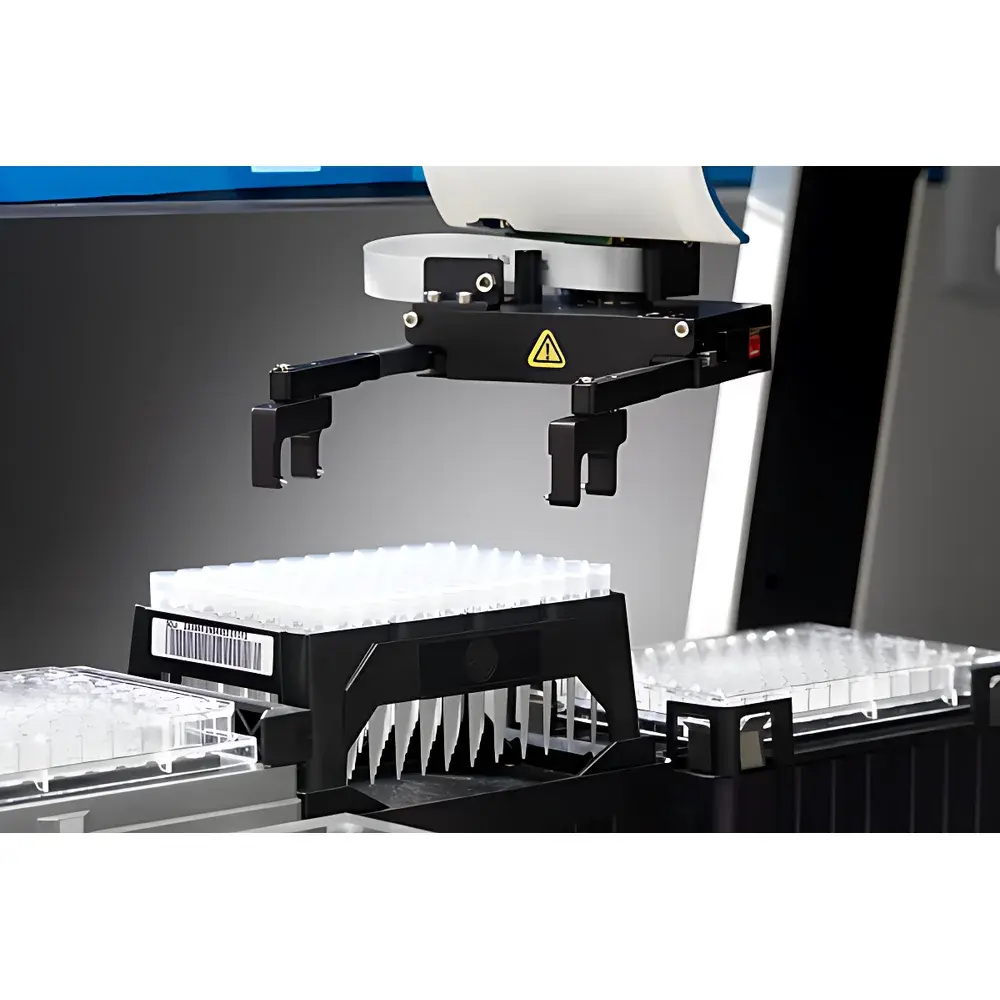
- Modular 4-channel pipetting arm with independently addressable channels, supporting simultaneous or staggered dispensing to maximize flexibility in plate filling, serial dilution, or reagent addition workflows.
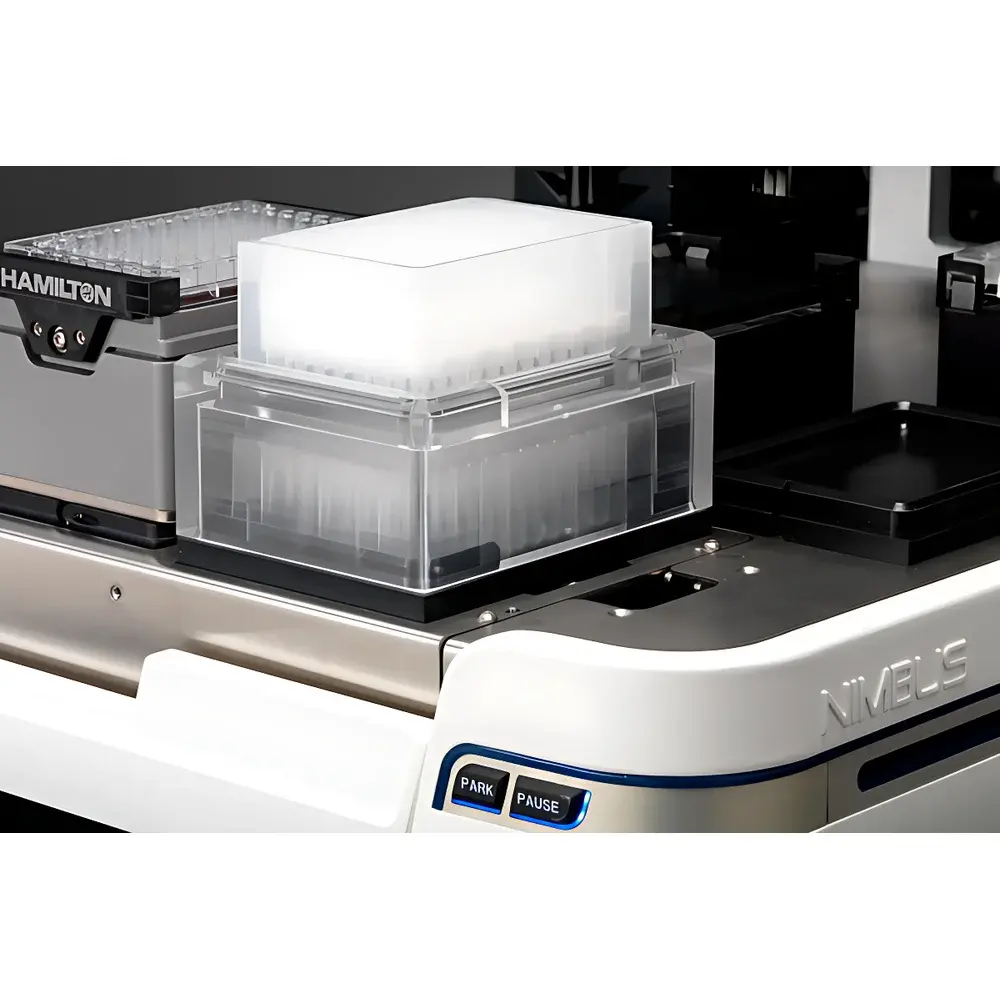
- 11-position deck layout optimized for standard SBS-format labware including 96-well and 384-well plates, tube racks, reservoirs, and custom accessories—fully configurable via Hamilton VENUS software.
- Compact physical footprint (1041 × 749 × 876 mm) enables seamless integration into constrained benchtop environments, biosafety cabinets, or ISO-classified cleanrooms without requiring dedicated infrastructure.
- Calibrated volumetric accuracy of ±5% across the entire operating range (0.5–1000 µL), validated per ISO 8655-2 and ASTM E1154 standards using gravimetric methods and traceable reference weights.
- Tool-free tip ejection and rapid head exchange mechanism supports fast transition between protocols or tip types (e.g., filtered vs. non-filtered, low-retention, or conductive tips).
- Integrated barcode reader option (optional) enables sample tracking and audit-ready log generation compliant with GLP and 21 CFR Part 11 requirements when paired with appropriate software configurations.
Sample Compatibility & Compliance
The NIMBUS 4 accommodates a broad spectrum of sample matrices—including cell suspensions, serum, plasma, PCR master mixes, enzyme solutions, and organic solvents—with minimal carryover (<0.1%) and no cross-contamination between channels when operated within specified maintenance intervals. All wetted components are chemically resistant to common laboratory reagents (e.g., ethanol, DMSO, 1 M NaOH, 10% bleach) and certified free of detectable RNase/DNase activity. System compliance includes adherence to IEC 61000-6-2 (electromagnetic immunity) and IEC 61000-6-3 (emission), CE marking for laboratory equipment, and RoHS 2 directive conformance. For regulated environments, optional validation packages support IQ/OQ/PQ documentation aligned with USP , ISO/IEC 17025, and FDA guidance on computerized system validation.
Software & Data Management
Controlled exclusively through Hamilton’s VENUS software platform (v3.5+), the NIMBUS 4 supports intuitive drag-and-drop protocol building, parameter-driven method templates, and version-controlled script libraries. VENUS provides full audit trail functionality—including user login history, method modification timestamps, run logs, and electronic signatures—meeting ALCOA+ data integrity principles. Export options include CSV, Excel, and XML formats compatible with LIMS integration (via HL7 or REST API extensions). Raw instrument logs and calibration records are stored locally with optional network backup; all data storage complies with HIPAA-compliant encryption standards when deployed in healthcare-associated settings.
Applications
- High-fidelity qPCR and RT-qPCR setup with precise master mix distribution and template dilution.
- Cell-based assay preparation, including seeding, cytokine addition, and compound titration in 96- and 384-well formats.
- Automated ELISA and immunoassay plate coating, blocking, and wash steps when integrated with compatible washer modules.
- Biobanking operations involving sample aliquoting, normalization, and cryovial labeling workflows.
- Quality control testing in pharmaceutical manufacturing, including dissolution media preparation and stability-indicating assay setup.
- Academic research labs performing iterative screening campaigns where rapid method iteration outweighs need for ultra-high throughput.
FAQ
What is the minimum and maximum pipetting volume supported by the NIMBUS 4?
The NIMBUS 4 operates from 0.5 µL to 1000 µL per channel, with optimal accuracy achieved between 5 µL and 1000 µL depending on tip selection and liquid class.
Can the NIMBUS 4 be integrated with third-party devices such as plate readers or incubators?
Yes—through Hamilton’s open API and VENUS’ hardware abstraction layer, users can configure external device triggers, status polling, and synchronized timing for peripheral instruments.
Is routine calibration required, and how often should it be performed?
Gravimetric calibration is recommended every 3 months or after 500 pipetting cycles, whichever occurs first; full calibration reports are generated and archived automatically within VENUS.
Does the system support variable tip spacing for non-standard plate layouts?
No—the NIMBUS 4 uses fixed-pitch tip spacing compatible with SBS-standard labware; however, custom deck layouts and offset positioning can be defined in VENUS to accommodate non-SBS containers.
What level of IT security does the NIMBUS 4 offer for regulated environments?
When configured with VENUS Enterprise Edition, the system supports role-based access control, encrypted database storage, electronic signatures, and 21 CFR Part 11-compliant audit trails with immutable logging.



