
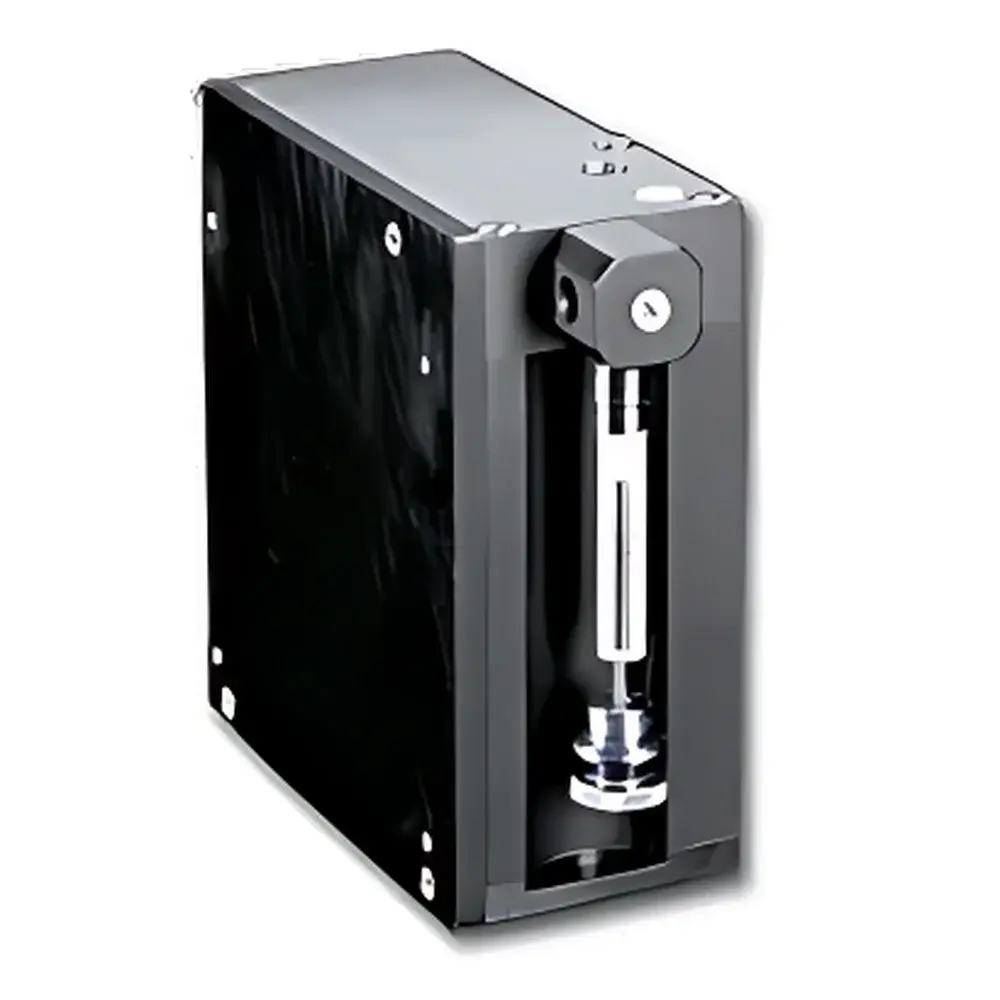
Hamilton PSD/3 Precision Syringe Pump
| Brand | Hamilton |
|---|---|
| Origin | Imported |
| Manufacturer Type | Authorized Distributor |
| Model | PSD/3 |
| Power Supply | 24 VDC (±5%), 1 A typical / 2 A peak |
| Syringe Compatibility | Hamilton GASTIGHT® Half-Height Instrument Syringes (12.5 µL – 12.5 mL) |
| Fluid Contact Materials | Glass, PTFE, CTFE |
| Drive Mechanism | Closed-loop DC servo motor with self-lubricating wear-compensating lead screw |
| Stroke | 30 mm |
| Stroke Time Range | 0.5 s – 60 min (system-configurable) |
| Resolution | Up to 30,000 increments per full stroke |
| Accuracy | ±1.0% at >30% stroke, ±1.2% at 5% stroke (syringe-dependent) |
| Precision | ±0.2% at >30% stroke, ±0.5% at 5% stroke (syringe-dependent) |
| Valve Type | Hamilton HV plug valve |
| Port Sizes | 1.0 mm, 1.5 mm, or 1.8 mm ID |
| Valve Positions | 2-position standard (90°), configurable up to 24 positions (15° increments) |
| Valve Fluid Path | PTFE & CTFE |
| Fittings | 1/4"-28 male tube fittings with flared FEP or PTFE tubing |
| Valve Actuation Time | 390 ms per 90° rotation |
| Operating Temp | 15–35°C |
| Operating Humidity | 20–90% RH (non-condensing) |
| Storage Temp | −20–70°C |
| Storage Humidity | 20–95% RH |
| Communication | RS-232C, 9600 baud, Hamilton Reno Protocol 1 or Bonaduz DIN Protocol |
| Daisy Chain Capacity | Up to 16 modules |
| Onboard Memory | FLASH storage for user methods |
| I/O | 1 TTL I/O port, 1 auxiliary input (e.g., hand probe) |
| Programmable Parameters | Position, speed, prime speed, backlash compensation, on-the-fly speed change, delay timing, valve position/speed |
| Firmware | In-system programmable FLASH |
Overview
The Hamilton PSD/3 is a high-precision, microprocessor-controlled syringe pump engineered for reproducible, low-volume fluid delivery in analytical, pharmaceutical, and life science applications. Unlike peristaltic or diaphragm-based pumps, the PSD/3 employs a closed-loop DC servo-driven linear actuator coupled with Hamilton’s proprietary GASTIGHT® half-height syringe platform—enabling accurate displacement control via direct plunger positioning rather than pressure or flow rate inference. Its design adheres to core principles of volumetric dosing: displacement accuracy is determined by mechanical resolution, syringe geometry, and thermal stability—not inferred from downstream sensors. This makes the PSD/3 particularly suited for applications demanding trace-level repeatability, such as HPLC sample injection, microfluidic actuation, automated assay dispensing, and controlled reagent addition in kinetic studies.
Key Features
- True closed-loop position control using an encoder-equipped DC servo motor and wear-compensating lead screw assembly—eliminating drift and backlash without lubrication.
- Configurable resolution up to 30,000 steps over 30 mm stroke, supporting both coarse priming and fine incremental dispensing within a single method.
- Full compatibility with Hamilton GASTIGHT® half-height syringes (12.5 µL to 12.5 mL), ensuring gas-tight performance and chemical resistance across aggressive solvents including DMSO, acetonitrile, and concentrated acids/bases.
- Modular HV plug valves with PTFE/CTFE wetted surfaces and snap-in/out cartridge design—supporting rapid reconfiguration between 2-, 4-, 6-, or 24-position configurations (in 15° increments).
- Onboard FLASH memory stores user-defined methods, including multi-step sequences with independent delays, prime cycles, backlash compensation, and real-time speed modulation.
- RS-232C interface compliant with Hamilton Reno Protocol 1 and Bonaduz DIN Protocol, enabling seamless integration into LabVIEW, MATLAB, or custom SCADA environments; supports daisy-chaining of up to 16 units on a single serial bus.
- Industrial-grade environmental tolerance: operational range of 15–35°C and 20–90% non-condensing humidity ensures stable performance in shared lab spaces and QC environments subject to HVAC fluctuations.
Sample Compatibility & Compliance
The PSD/3 maintains fluid integrity through chemically inert wetted materials—borosilicate glass barrels, PTFE/CTFE seals, and fluoropolymer tubing—validated per USP Class VI and ISO 10993-5 cytotoxicity standards. Its syringe mounting system prevents axial misalignment, minimizing shear-induced degradation of sensitive biologics (e.g., proteins, viral vectors, or liposomal suspensions). While not inherently 21 CFR Part 11-compliant as a standalone device, the pump supports audit-trail-capable host software when paired with validated control systems meeting GLP/GMP data integrity requirements. It conforms to IEC 61000-6-2 (immunity) and IEC 61000-6-3 (emissions) for electromagnetic compatibility in regulated laboratory settings.
Software & Data Management
The PSD/3 operates autonomously via stored FLASH methods but is fully controllable via ASCII command sets transmitted over RS-232. Host software can initiate, pause, resume, or abort sequences while querying real-time status (position, valve state, error flags). All programmable parameters—including syringe-specific calibration offsets, backlash correction values, and valve dwell times—are retained across power cycles. The auxiliary TTL input enables hardware-triggered execution (e.g., synchronization with spectrometer acquisition or fraction collector signals), and the dedicated TTL I/O port supports external event signaling. Firmware updates are performed in-system via serial interface, preserving configuration integrity during revision upgrades.
Applications
- HPLC and UHPLC autosampler integration for precise loop fill and injection volume control.
- Automated liquid handling in ELISA, qPCR setup, and cell culture media exchange protocols requiring sub-microliter accuracy.
- Controlled reagent infusion in stopped-flow kinetics, electrochemical analysis, and reaction calorimetry.
- Microfluidic chip priming and pressure-balanced flow generation in organ-on-chip platforms.
- Calibration standard delivery for gravimetric or photometric verification of analytical instrumentation.
- Process development support in API synthesis where stoichiometric addition timing and volume fidelity directly impact impurity profiles.
FAQ
What syringes are compatible with the PSD/3?
Only Hamilton GASTIGHT® half-height instrument syringes (catalog numbers ending in “-HH”) are mechanically and dimensionally supported—ranging from 12.5 µL to 12.5 mL. Standard full-height syringes or third-party models are not accommodated.
Can the PSD/3 be used in sterile or cleanroom environments?
Yes—the absence of internal lubricants, sealed electronics enclosure, and non-shedding fluoropolymer components meet ISO 14644-1 Class 7 (10,000) particulate requirements when operated with appropriate gowning and surface decontamination protocols.
Is firmware upgrade capability available in the field?
Yes—firmware revisions are delivered as HEX files and loaded via RS-232 using Hamilton’s standard update utility; no hardware modification or service visit is required.
How is accuracy verified across different syringe sizes?
Accuracy specifications are syringe-dependent and reflect combined contributions from mechanical resolution, plunger seal friction, and thermal expansion of glass barrels; Hamilton provides individual syringe calibration certificates upon request for GxP-critical deployments.
Does the PSD/3 support analog input for external flow feedback?
No—the PSD/3 is a displacement-controlled device and does not accept analog flow or pressure feedback signals; closed-loop operation is strictly positional, not flow-regulated.



