
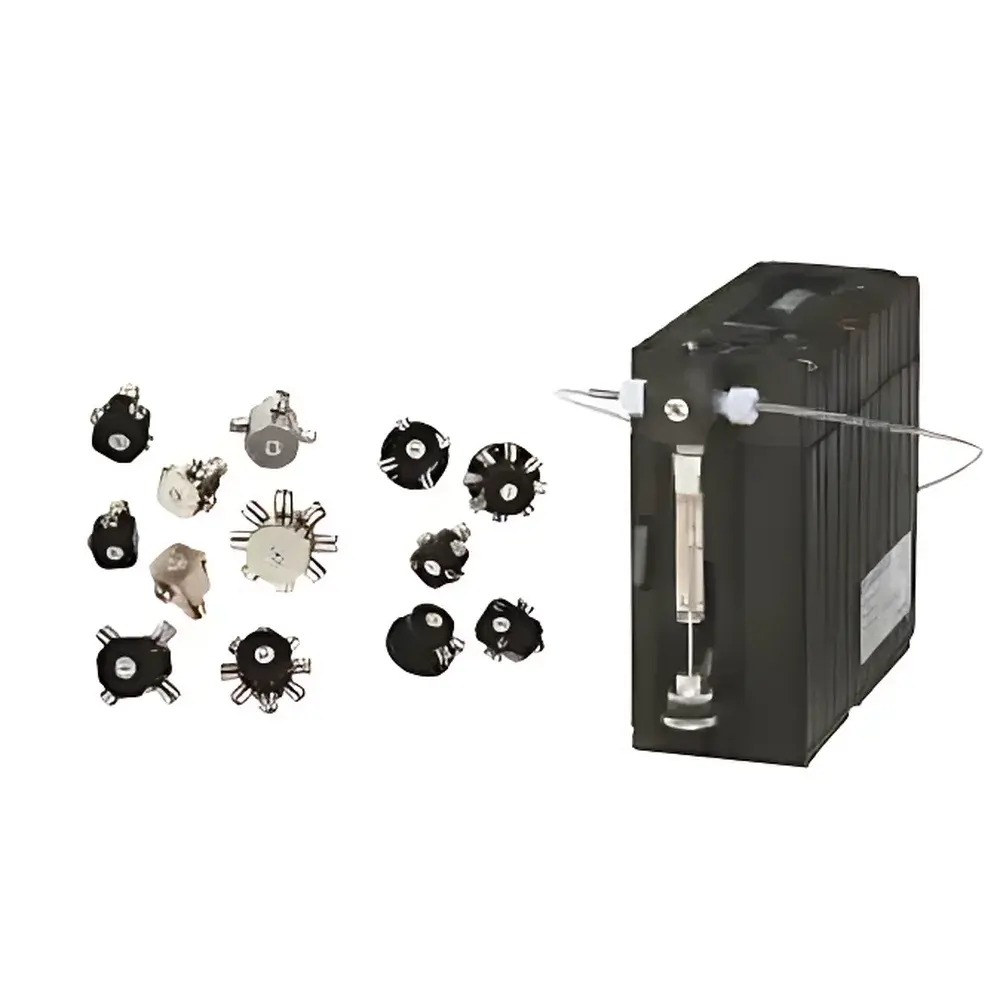
Hamilton PSD Series Precision Syringe Pump
| Brand | HAMILTON |
|---|---|
| Origin | Switzerland |
| Model | PSD Series |
| Power Supply | 24 VDC, ≤1 A |
| Syringe Compatibility | Hamilton gas-tight glass/PTFE/CTFE/UHMWPE syringes (25 µL to 25 mL) |
| Operating Temperature | 15–25 °C |
| Operating Humidity | 20–90% RH (non-condensing) |
| Communication Interface | RS-232 (1200–9600 baud), TTL I/O (6 in / 6 out) |
| Daisy Chain Capacity | Up to 16 modules |
| Accuracy | ±1.0% full scale |
| Dispense Time per Syringe | 2–60 seconds |
| Memory Storage | 8 user-defined methods (2 KB) |
Overview
The Hamilton PSD Series is a high-precision, microprocessor-controlled syringe pump system engineered for reproducible, low-flow-rate fluid delivery in analytical, pharmaceutical, and research laboratory environments. Unlike peristaltic or diaphragm-based pumps, the PSD Series employs a stepper motor-driven linear actuator that directly advances Hamilton-certified gas-tight syringes—eliminating tubing compression, pulsation, and elastomer degradation common in peristaltic systems. Its core measurement principle relies on precise positional control of the syringe plunger, translating rotational motor steps into volumetric displacement with traceable accuracy against NIST standards. Designed for integration into automated workflows—including HPLC sample introduction, microfluidic priming, electrophysiology perfusion, and controlled reagent addition—the PSD Series delivers stable flow rates from nanoliter-per-minute to milliliter-per-minute ranges, depending on syringe geometry and commanded dispense time.
Key Features
- Direct-drive linear actuation ensures minimal backslash, high positional repeatability, and long-term mechanical stability without consumable tubing.
- Full compatibility with Hamilton gas-tight syringes (25 µL to 25 mL), including glass, PTFE, CTFE, and UHMWPE variants—enabling chemically inert handling of aggressive solvents, biological buffers, and viscous reagents.
- Dual communication architecture: RS-232 serial interface (configurable baud rates: 1200–9600) supports command-based control via LabVIEW, Python, or custom SCADA systems; TTL I/O (6 inputs / 6 outputs) enables hardware-level synchronization with external triggers, detectors, or valve actuators.
- Modular daisy-chain topology allows up to 16 PSD units to operate under a single host controller—reducing cabling complexity and enabling coordinated multi-channel dispensing protocols.
- Onboard memory stores up to eight user-defined methods (e.g., step sequences, pause intervals, acceleration profiles), each configurable via downloadable ASCII text files—supporting GLP-compliant method versioning and audit-ready documentation.
- Thermally stabilized electronics and calibrated motion firmware ensure consistent performance across ambient temperatures of 15–25 °C and relative humidity up to 90% non-condensing—meeting ISO/IEC 17025 environmental requirements for accredited testing laboratories.
Sample Compatibility & Compliance
The PSD Series accommodates standard Hamilton syringe formats with Luer-lock or fixed-nipple terminations, supporting both aqueous and organic media without leaching or adsorption artifacts. Fluid contact materials (glass barrel, PTFE/CTFE plunger seals, stainless steel drive components) comply with USP Class VI biocompatibility requirements and are suitable for use in GMP-regulated environments when operated within validated method parameters. While the pump itself is not FDA 510(k)-cleared, its design adheres to IEC 61010-1 safety standards for laboratory electrical equipment. The RS-232 and TTL interfaces support integration into 21 CFR Part 11–compliant data acquisition systems when paired with appropriate software validation packages and electronic signature controls.
Software & Data Management
Hamilton provides a Windows-based configuration utility for method creation, parameter validation, and firmware updates. All commands follow ASCII-based SCPI-like syntax (e.g., “RUN”, “STOP”, “SET RATE=0.5 ML/MIN”), ensuring interoperability with third-party automation frameworks. Method files are stored in plain-text format with timestamps and checksums, facilitating version control and change tracking. When deployed in networked lab environments, the PSD Series supports time-stamped event logging (e.g., start/stop commands, error codes, syringe detection status) through serial echo or external data loggers—enabling alignment with ISO 17025 clause 7.7 (result reporting) and internal QA audit trails.
Applications
- HPLC and LC-MS autosampler interfacing for low-volume, high-precision injection of calibration standards and unknown samples.
- Controlled delivery in microreactor and organ-on-chip platforms requiring sub-microliter accuracy and programmable ramp profiles.
- Electrophysiology patch-clamp rigs where stable, pulse-free perfusion minimizes baseline drift during voltage-clamp recordings.
- Automated dissolution testing per USP , where timed, sequential addition of dissolution media or sink conditions must meet pharmacopeial precision thresholds.
- Calibration of flow sensors and gravimetric verification systems using NIST-traceable syringe volumes and verified dispense timing.
FAQ
What syringe sizes are supported by the PSD Series?
The PSD Series accepts Hamilton gas-tight syringes ranging from 25 µL to 25 mL, including 25, 50, 100, 250, 500 µL, 1, 2.5, 5, 10, and 25 mL models.
Is the PSD Series compatible with modern lab automation software?
Yes—it supports ASCII command protocol over RS-232 and can be integrated with LabVIEW, MATLAB, Python (pySerial), and commercial LIMS/ELN platforms via serial abstraction layers.
Does the pump require routine recalibration?
No scheduled recalibration is required; however, users should verify linearity and accuracy annually using traceable syringe volume checks and stopwatch-timed dispense tests per internal SOP or ISO/IEC 17025 guidelines.
Can multiple PSD units be synchronized for parallel dispensing?
Yes—up to 16 units may be daisy-chained and triggered simultaneously via TTL edge signals or coordinated RS-232 command streams.
What is the typical lifetime of the drive mechanism under continuous operation?
The stepper motor and lead-screw assembly are rated for >10 million cycles under nominal load conditions; mean time between failures exceeds 50,000 hours when operated within specified temperature and humidity limits.



