
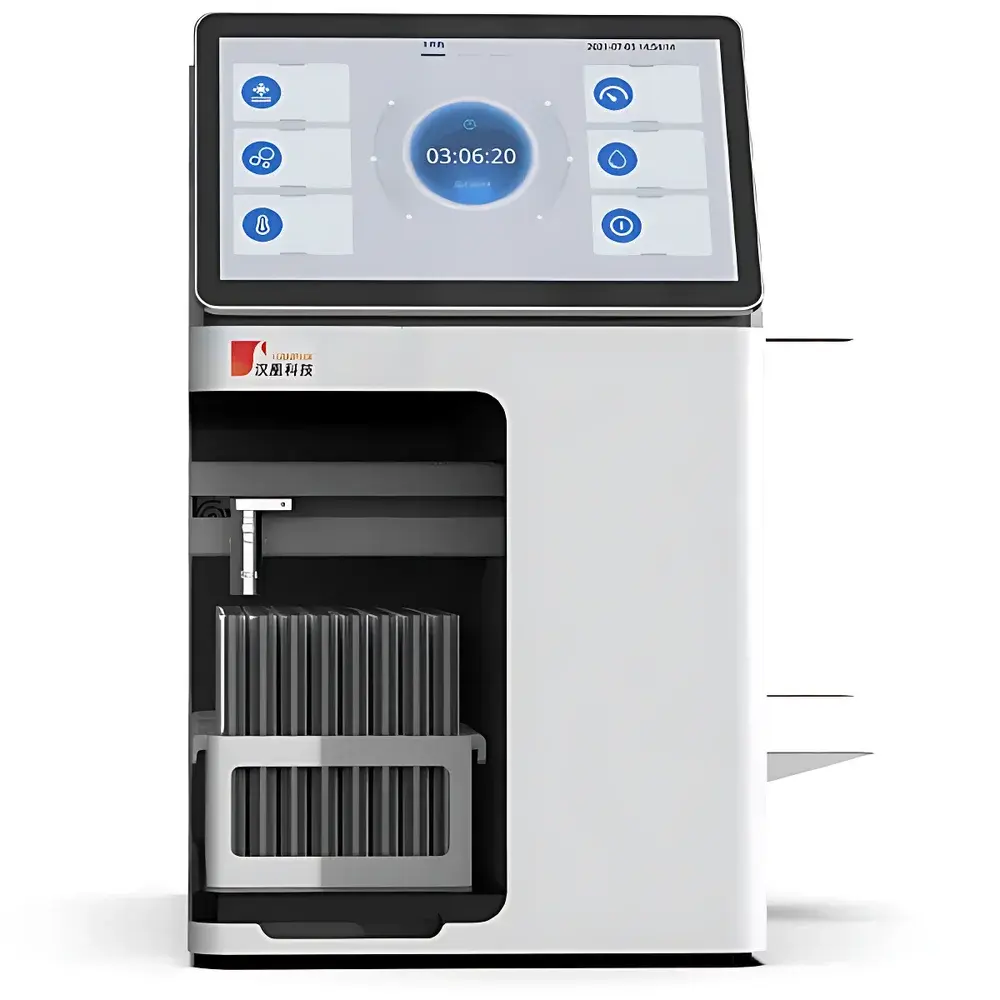
Hanbon Intepure-F 300 Medium-Pressure Preparative Liquid Chromatography System
| Brand | Hanbon |
|---|---|
| Origin | Jiangsu, China |
| Manufacturer Type | OEM Manufacturer |
| Product Category | Domestic |
| Model | Intepure-F 300 |
| Application Level | Laboratory-Scale |
| Instrument Type | Medium-to-Low Pressure Preparative HPLC System |
| Flow Rate Range | 1–300 mL/min |
| Flow Accuracy | ±1% |
| Flow Precision (RSD) | ±1% |
| Maximum Operating Pressure | 500 psi |
| Wavelength Range | 200–400 nm or 200–800 nm |
| Wavelength Repeatability | ±0.5 nm |
| Baseline Noise | ±5 × 10⁻⁵ AU (254 nm, Time Constant 0.75 s) |
| Data Acquisition Rate | 20 Hz |
Overview
The Hanbon Intepure-F 300 is a medium-pressure preparative liquid chromatography system engineered for robust, scalable purification of organic compounds, natural products, synthetic peptides, fermentation-derived metabolites, and early-stage pharmaceutical intermediates. Operating within a pressure range up to 500 psi, it bridges the performance gap between flash chromatography and analytical-scale HPLC—delivering high-resolution separations with gram-level throughput without requiring ultra-high-pressure infrastructure. Its core architecture integrates a dual-solvent gradient delivery system, a diode array detector (DAD) with full-spectrum UV monitoring (200–800 nm), and an open-loop fraction collector capable of precise, event-triggered collection across standardized and custom tube formats. Designed for laboratory environments where reproducibility, regulatory traceability, and method development flexibility are critical, the Intepure-F 300 adheres to fundamental principles of liquid-phase mass transport and retention kinetics—enabling reliable translation from analytical scouting to preparative isolation.
Key Features
- 15-inch capacitive touchscreen interface with real-time system status visualization—including pump pressure, flow rate, UV absorbance baseline, gradient profile, and fraction collection progress.
- High-precision dual-piston reciprocating pump with integrated gradient valve assembly, delivering ±1% flow accuracy and repeatability across the full 1–300 mL/min range.
- Diode Array Detector (DAD) with selectable wavelength ranges (200–400 nm or 200–800 nm), ±0.5 nm wavelength repeatability, and low baseline noise (±5 × 10⁻⁵ AU at 254 nm, 0.75 s time constant) for confident peak identification and purity assessment.
- Modular fraction collector supporting multiple collection modes: full-collection, waste-collection, threshold-based peak triggering, and user-defined retention time windows—compatible with tubes ranging from 13 mm to 30 mm diameter plus custom vessel configurations.
- Integrated solvent level sensors (mobile phase reservoirs and waste container), real-time pressure monitoring with automatic shutdown on overpressure events, and built-in purge air pump for post-run line flushing and residual solvent removal.
Sample Compatibility & Compliance
The Intepure-F 300 supports both normal-phase and reversed-phase chromatographic modes and is fully compatible with commercially available flash columns (e.g., silica, C18, amino, cyano, and ion-exchange media) across diameters from 10 mm to 80 mm. Its fluidic design accommodates sample loads ranging from milligram-scale discovery fractions to multi-gram purification batches. From a compliance standpoint, the system’s software architecture implements role-based user access control, electronic audit trails, and timestamped method logs—aligning with GLP documentation requirements and serving as a foundational platform for GMP-aligned purification workflows under FDA 21 CFR Part 11 readiness (when deployed with validated IT infrastructure and procedural controls). While not pre-certified to ISO/IEC 17025 or ASTM D7952, its hardware specifications meet standard benchmarks for medium-pressure preparative systems used in contract research organizations (CROs) and pharmaceutical R&D labs.
Software & Data Management
The embedded control software features a modular UI with clearly segmented functional zones: method editor, real-time chromatogram viewer, fraction mapping dashboard, and system diagnostics panel. It includes intelligent gradient recommendation based on TLC Rf values—allowing users to import scanned TLC images and auto-generate initial solvent gradients. All acquisition data are stored in vendor-neutral .csv and .chm formats; chromatograms and spectra are exportable as PNG or SVG. The software supports method pausing/resuming, gradient hold (dwell time adjustment), and dynamic re-injection sequencing during method optimization. Audit trail generation is enabled by default—recording all parameter changes, user logins, fraction triggers, and system alerts—with immutable timestamps and operator IDs. Data integrity is further reinforced through local database encryption and optional network backup integration.
Applications
- Purification of synthetic small molecules following solid-phase or solution-phase organic synthesis.
- Isolation of bioactive natural product fractions from plant, marine, or microbial extracts.
- Desalting and buffer exchange of synthetic or recombinant peptides prior to characterization.
- Removal of residual catalysts, protecting groups, or side-products in API intermediate refinement.
- Preparative-scale separation of enantiomers using chiral stationary phases (with compatible column selection).
- Method scouting and scale-up studies bridging analytical HPLC conditions to preparative throughput.
FAQ
What is the maximum column inner diameter supported by the Intepure-F 300?
The system is mechanically and hydraulically optimized for columns with inner diameters up to 80 mm, provided appropriate flow rates and backpressure limits are observed.
Does the DAD support spectral library matching?
Spectral matching functionality is not embedded in the base software but raw spectral data (.csv) can be exported for post-processing in third-party chemometric tools such as OpenChrom or ACD/Labs.
Can the system be integrated into a LIMS environment?
Yes—the instrument supports TCP/IP communication and exposes a defined API for metadata exchange; integration requires configuration by qualified IT personnel and validation per site-specific SOPs.
Is mobile phase degassing required externally?
While the system does not include an integrated online degasser, operation with pre-degassed solvents or external vacuum/purge degassers is recommended to minimize baseline drift and bubble-induced pressure fluctuations.
What validation documentation is provided with the system?
A Factory Acceptance Test (FAT) report, IQ/OQ protocol templates, and calibration certificates for pump and detector modules are supplied upon delivery; PQ execution remains the responsibility of the end-user lab.





