
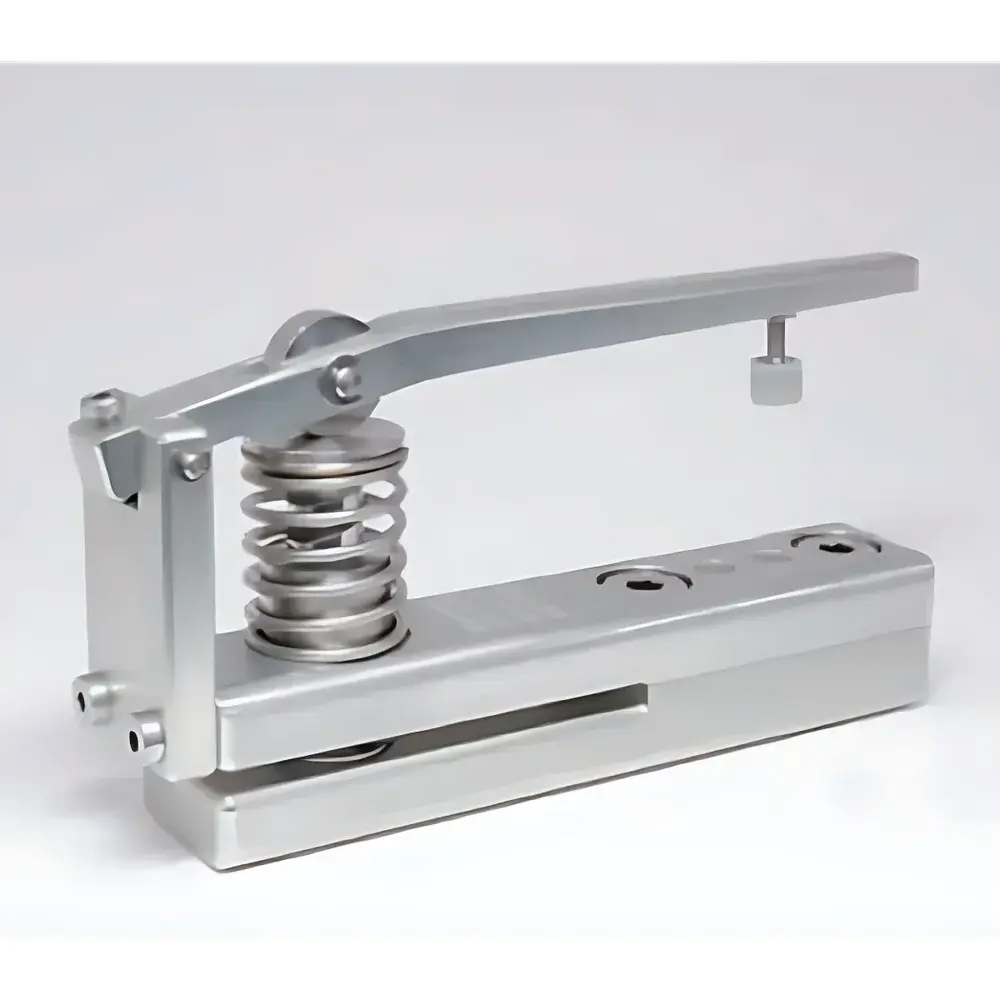
Handheld Electrode Punching Tool NOGAMI by TOYO Corporation
| Brand | TOYO Corporation |
|---|---|
| Origin | Japan |
| Model | NOGAMI |
| Cutting Thickness Range | 5 µm to 300 µm |
| Feed Mechanism | Manual |
| Maximum Sample Dimensions | Circular apertures Ø1 mm to Ø26 mm |
| Blade Clearance | Adjustable per material and thickness |
| Verticality Control | ≤ 5 µm deviation over 10 mm |
| Upper Blade Tolerance | ±2 µm, ±3 µm, or ±4 µm (specifiable in 1 µm increments) |
| Compatible Materials | Al, Cu, PP/PE separators, SUS304/SUS316, Ni, Ti, Li metal, solid electrolytes, anode composites (e.g., graphite on 10 µm Cu foil, total thickness 175 µm) |
Overview
The NOGAMI Handheld Electrode Punching Tool, engineered and manufactured by TOYO Corporation (Japan), is a precision manual die-punching instrument designed exclusively for the preparation of standardized electrode discs in battery R&D and quality control laboratories. Unlike conventional rotary or motorized punch tools, the NOGAMI system operates on a vertical-force-driven mechanical principle—leveraging calibrated spring-loaded actuation and ultra-rigid base alignment to ensure consistent, orthogonal penetration into layered electrode stacks. Its core function is the reproducible generation of circular or square specimens with controlled geometry, minimal burr formation, and preserved interfacial integrity—critical for subsequent electrochemical testing (e.g., coin-cell assembly, impedance spectroscopy, or SEM cross-section analysis). The tool is not a microtome in the histological sense; it does not slice continuously but performs discrete, high-fidelity blanking operations under defined mechanical load conditions. It meets the dimensional repeatability requirements specified in ISO 11357-2 (for thermal analysis sample prep) and ASTM D790 (flexural property specimen conditioning), and its blade geometry complies with JIS B 0601 surface finish standards for cutting edges used in thin-film metallurgy.
Key Features
- Precision-adjustable blade clearance: Enables optimization of shear force distribution across diverse composite structures—including multi-layer cathodes (NMC/Al), anodes (graphite/Cu), polymer separators (PP/PE), and solid-state electrolytes—minimizing delamination and edge cracking.
- Verticality-controlled actuation mechanism: Ensures blade descent perpendicularity within ±0.0005 mm/mm (5 µm per 10 mm), verified via optical collimation during factory calibration—essential for maintaining planar parallelism in punched electrodes intended for symmetric cell configuration.
- Modular upper blade specification: Available with nominal edge tolerances of ±2 µm, ±3 µm, or ±4 µm, selectable in 1 µm increments to match substrate ductility and coating adhesion characteristics.
- Dual-format compatibility: Supports both circular punches (Ø1–26 mm) and square punches (1×1–22×22 mm), accommodating standard coin-cell diameters (Ø14 mm, Ø15 mm, Ø16 mm, Ø25 mm) as well as custom pouch-cell tab sampling geometries.
- Tool-free blade exchange system: Facilitates rapid reconfiguration between material-specific upper/lower die sets without requiring torque wrenches or alignment jigs—reducing setup time and operator-induced variability.
Sample Compatibility & Compliance
The NOGAMI tool has been validated for use with metallic foils (Cu, Al, Ni, Ti, stainless steels), lithium metal, polymer-based separators, ceramic-coated membranes, and composite electrodes containing binders (PVDF, CMC/SBR), active materials (LFP, NMC, graphite, silicon), and conductive additives. It accommodates total stack thicknesses from 5 µm (ultra-thin current collectors) up to 300 µm (thick solid electrolyte laminates). All contact surfaces are electropolished stainless steel (SUS316), compliant with ISO 8502-3 for residue-free metalworking. The device requires no electrical power, making it suitable for inert-atmosphere gloveboxes (O₂/H₂O < 0.1 ppm) and Class 100 cleanroom environments. Documentation includes traceable calibration certificates per JIS Z 8401 and conformity statements aligned with IEC 61000-4-2 (ESD immunity).
Software & Data Management
As a fully manual, non-electronic instrumentation platform, the NOGAMI punching tool does not incorporate embedded firmware, connectivity interfaces, or digital data logging. However, its operation is fully compatible with laboratory information management systems (LIMS) and electronic lab notebooks (ELN) when paired with standardized SOP templates (e.g., SOP-BAT-027 “Electrode Disc Preparation for Half-Cell Testing”). Each unit ships with a physical logbook for recording punch date, operator ID, material batch number, blade set serial, and visual inspection notes—supporting GLP-compliant audit trails. Optional QR-coded blade tags enable traceability to individual sharpening cycles and wear history, satisfying FDA 21 CFR Part 11 requirements when integrated into validated workflows.
Applications
- Preparation of electrode discs for CR2032 coin-cell fabrication in Li-ion, Li-metal, and solid-state battery development.
- Isolation of representative sub-samples from roll-to-roll coated electrodes for SEM-EDS, XRD texture analysis, or porosity mapping.
- Generation of geometrically identical specimens for comparative cycling stability studies under controlled pressure and temperature protocols.
- Quality assurance sampling of incoming anode/cathode rolls prior to slitting and calendering—enabling rapid assessment of coating uniformity and foil integrity.
- Prototyping of miniaturized electrode architectures (e.g., patterned current collectors, graded thickness zones) via sequential masked punching.
FAQ
Is the NOGAMI tool compatible with glovebox integration?
Yes—the entire unit is constructed from vacuum-compatible, non-outgassing materials (SUS316 body, PTFE-coated handle components) and requires no external power or gas supply.
Can blade sets be re-sharpened or recalibrated onsite?
No—upper and lower blades are single-use, factory-calibrated assemblies. Replacement sets are serialized and supplied with individual metrology reports.
What is the recommended maintenance interval?
Visual inspection before each use; cleaning with isopropanol and lint-free wipes after every 50 punches; full blade replacement after 200 operations on copper foil or 100 operations on ceramic-coated separators.
Does TOYO provide application support for novel electrode formulations?
Yes—TOYO’s technical service team offers free pre-validation consultations, including blade clearance recommendations and punch-force profiling based on your material stack composition and thickness profile.
Is ISO/IEC 17025 accreditation available for punch validation services?
Yes—certified third-party verification of dimensional accuracy, edge quality, and repeatability is available upon request through TOYO’s designated calibration partner network in North America, EMEA, and APAC regions.
Related Products



