
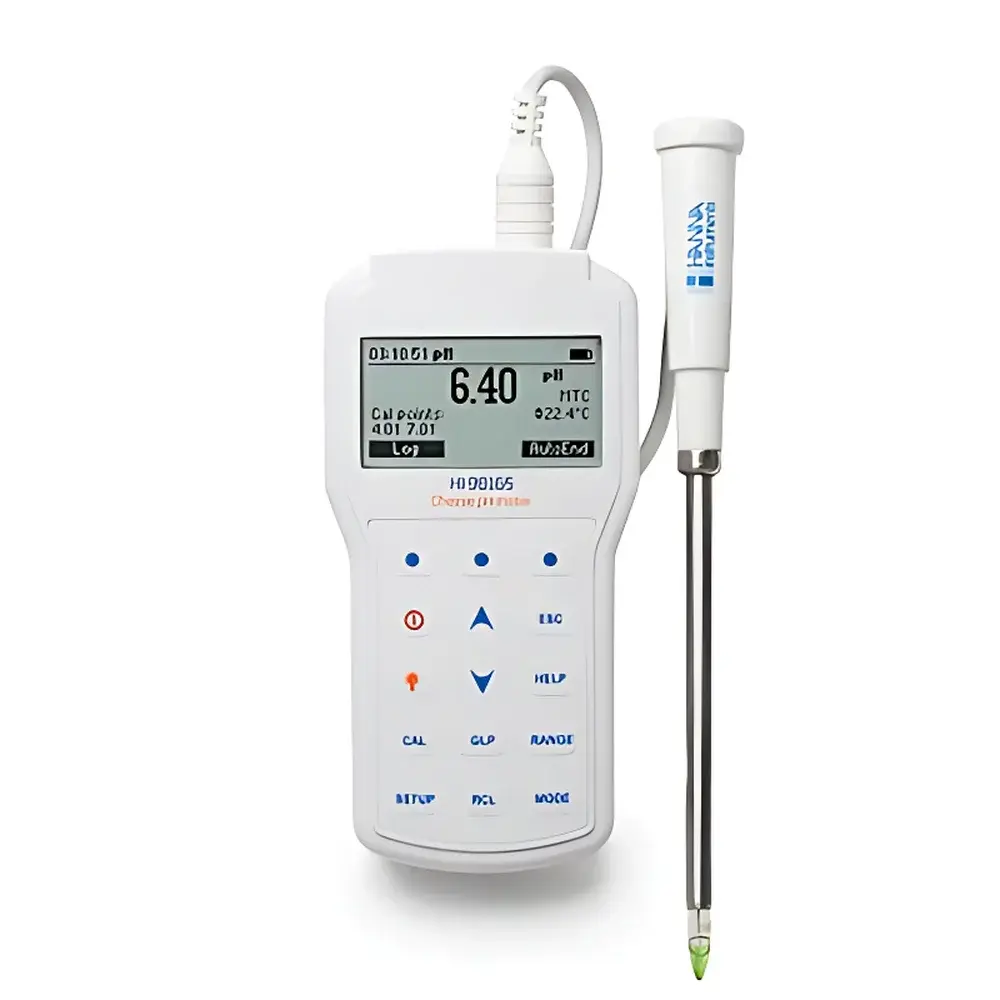
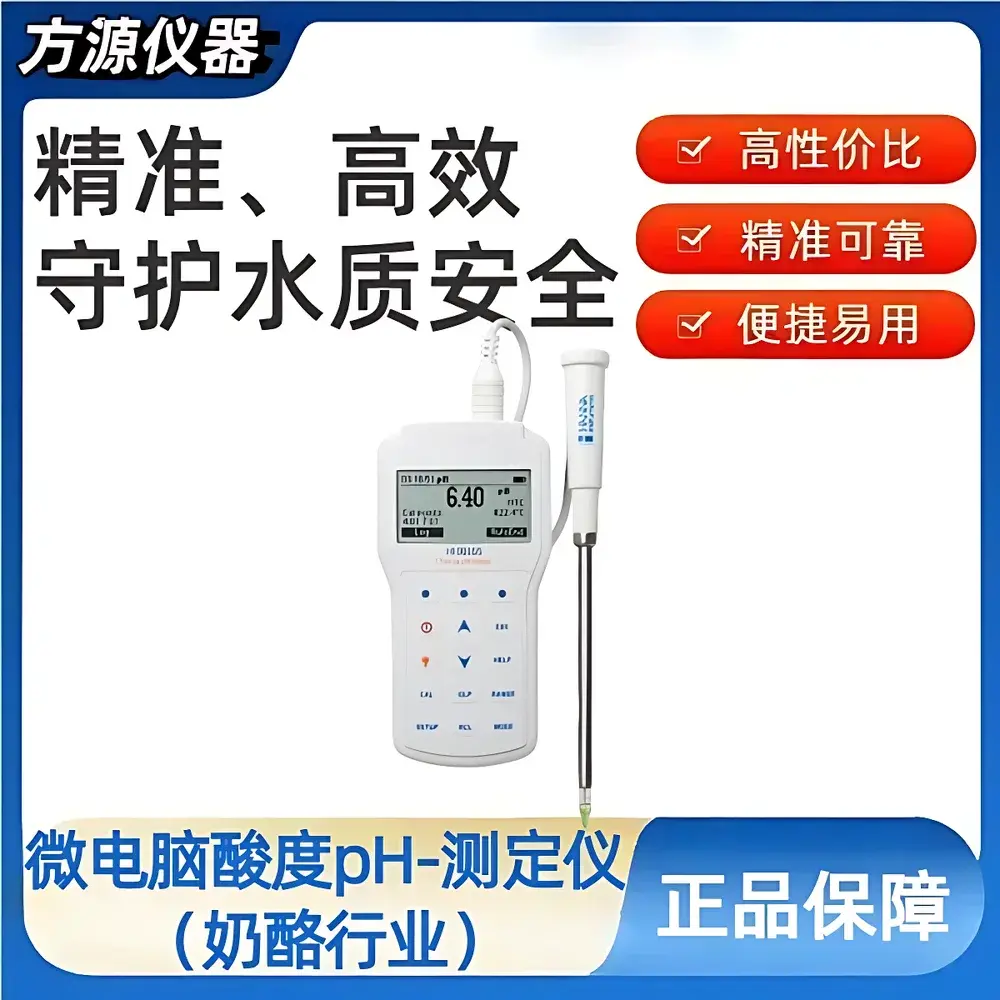
Hanna HI98165 Cheese-Specific Portable pH/mV/°C Meter
| Brand | Hanna Instruments |
|---|---|
| Origin | Italy |
| Model | HI98165 Portable pH/mV/Temperature Meter with Integrated Stainless Steel pH Electrode for Cheese Production |
| pH Range | -2.000 to 20.000 |
| mV Range | ±2000.0 |
| Temperature Range | -20.0 to 120.0 °C |
| Calibration | Up to 5-point auto-recognize + 5-point custom calibration |
| Built-in Standards | 1.68, 4.01, 6.86, 7.01, 9.18, 10.01, 12.45 pH |
| Resolution | 0.001 pH / 0.1 mV / 0.1 °C |
| Accuracy | ±0.002 pH / ±0.2 mV / ±0.4 °C |
| Electrode | FC2423 conical-tip stainless steel pH electrode with integrated Pt1000 temperature sensor |
| Data Logging | 200 records (100 pH + 100 mV) |
| Interface | USB (HI92000-15 software compatible) |
| Protection | IP67 |
| Power | 4×AAA batteries (BEPS low-battery warning) |
| Auto-off | Configurable (5/10/30/60 min or off) |
Overview
The Hanna HI98165 is a rugged, portable benchtop-grade pH/mV/temperature meter engineered specifically for quality control in artisanal and industrial cheese production environments. It operates on potentiometric measurement principles—detecting the voltage difference between a reference electrode and a glass-sensing electrode immersed in sample matrix—to deliver high-reproducibility pH readings across an extended range of –2.000 to 20.000 pH. Its integrated FC2423 conical-tip stainless steel pH electrode features a built-in Pt1000 temperature sensor, enabling simultaneous, real-time automatic temperature compensation (ATC) without external probes. Designed for repeated exposure to high-fat, high-salt, and protein-rich dairy matrices—including curd, whey, brine, and aged cheese surfaces—the instrument meets IP67 ingress protection standards and withstands routine sanitation cycles typical of GMP-aligned cheese facilities.
Key Features
- Extended-range pH measurement capability (–2.000 to 20.000 pH) with 0.001-pH resolution and ±0.002-pH accuracy at 25°C—critical for monitoring acidification kinetics during renneting, whey drainage, and ripening stages.
- Dual-mode calibration: up to five-point auto-recognize calibration using NIST-traceable standard buffers (1.68, 4.01, 6.86, 7.01, 9.18, 10.01, 12.45 pH), plus five-point user-defined calibration for non-standard dairy reference solutions.
- Sensor Check™ diagnostic system provides immediate visual feedback on electrode slope (%), offset (mV), and response time—enabling proactive maintenance and verification prior to critical QC checks.
- Auto-endpoint locking function freezes stable readings on the backlit graphical LCD, eliminating parallax error during manual data transcription in humid, fast-paced production areas.
- GLP-compliant data management: timestamped records include pH/mV values, temperature, calibration history, date/time stamp, and electrode ID—supporting audit readiness under ISO 22000, HACCP, and FDA 21 CFR Part 11 requirements when paired with HI92000-15 software.
- BEPS (Battery Error Prevention System) alerts users via flashing battery icon at ≤5% charge; configurable auto-off (5–60 min) extends operational runtime beyond 200 hours per battery set.
Sample Compatibility & Compliance
The HI98165 is validated for direct immersion in semi-solid and liquid dairy samples including fresh curd, acidified milk, brine solutions (up to 20% NaCl), and surface swabs from aged cheese rinds. Its FC2423 electrode employs a low-resistance glass membrane and clog-resistant conical tip optimized for viscous, particulate-laden matrices. The stainless steel body resists corrosion from organic acids (lactic, acetic), salt, and cleaning agents (peracetic acid, caustic soda). Device firmware and data logging architecture support traceability protocols required by EU Regulation (EC) No 852/2004, Codex Alimentarius CAC/RCP 1-1969, and US Grade “A” Pasteurized Milk Ordinance (PMO) Annex H. IP67 certification confirms dust-tight and temporary submersion resistance (1 m for 30 min), ensuring reliability in wet processing zones.
Software & Data Management
Data export is facilitated via USB interface to Windows-based HI92000-15 software, which enables batch reporting, trend analysis, and electronic signature capture. Each logged entry contains full metadata: measurement type (pH/mV), value, temperature, calibration status, operator ID (user-definable), and instrument serial number. Audit trail functionality logs all configuration changes, calibration events, and data deletions—meeting ALCOA+ (Attributable, Legible, Contemporaneous, Original, Accurate, Complete, Consistent, Enduring, Available) principles. Raw CSV exports are compatible with LIMS integration and statistical process control (SPC) platforms such as Minitab or JMP.
Applications
- Monitoring lactic acid fermentation rates during starter culture inoculation and bulk fermentation.
- Verifying pH thresholds for optimal rennet coagulation (e.g., target pH 6.4–6.6 for Cheddar; pH 5.2–5.4 for Mozzarella stretching).
- Validating acid development in brined cheeses (Feta, Halloumi) and surface-ripened varieties (Limburger, Taleggio).
- Testing whey pH pre- and post-ultrafiltration to assess protein solubility and mineral balance.
- Conducting incoming raw milk screening per ISO 9001 clause 8.5.2 and IFS Food Standard 6.2.2.
- Supporting shelf-life studies through accelerated aging trials with periodic pH/mV profiling.
FAQ
Is the FC2423 electrode suitable for measuring pH in high-fat cheese paste?
Yes—the conical geometry and stainless steel shaft minimize surface adhesion and facilitate rapid cleaning between samples. Its low-impedance glass formulation ensures stable response even in low-conductivity curd matrices.
Can calibration data be exported for regulatory review?
Yes—HI92000-15 software captures full calibration logs (buffer IDs, slopes, offsets, dates) with digital signatures and tamper-evident timestamps.
Does the meter support manual temperature input if ATC fails?
No—the FC2423 electrode integrates a Pt1000 sensor; manual temperature entry is disabled to prevent operator-induced error in compliance-critical workflows.
What is the recommended recalibration frequency for routine cheese QC?
Per ISO/IEC 17025:2017 Clause 7.7, recalibrate before each analytical session and after every 10 measurements—or immediately following exposure to extreme pH or high-salt conditions.
How does BEPS improve measurement integrity in field use?
By preventing erroneous low-voltage readings caused by depleted batteries, BEPS ensures metrological continuity without requiring constant battery replacement in remote dairy plants or mobile lab vans.




