
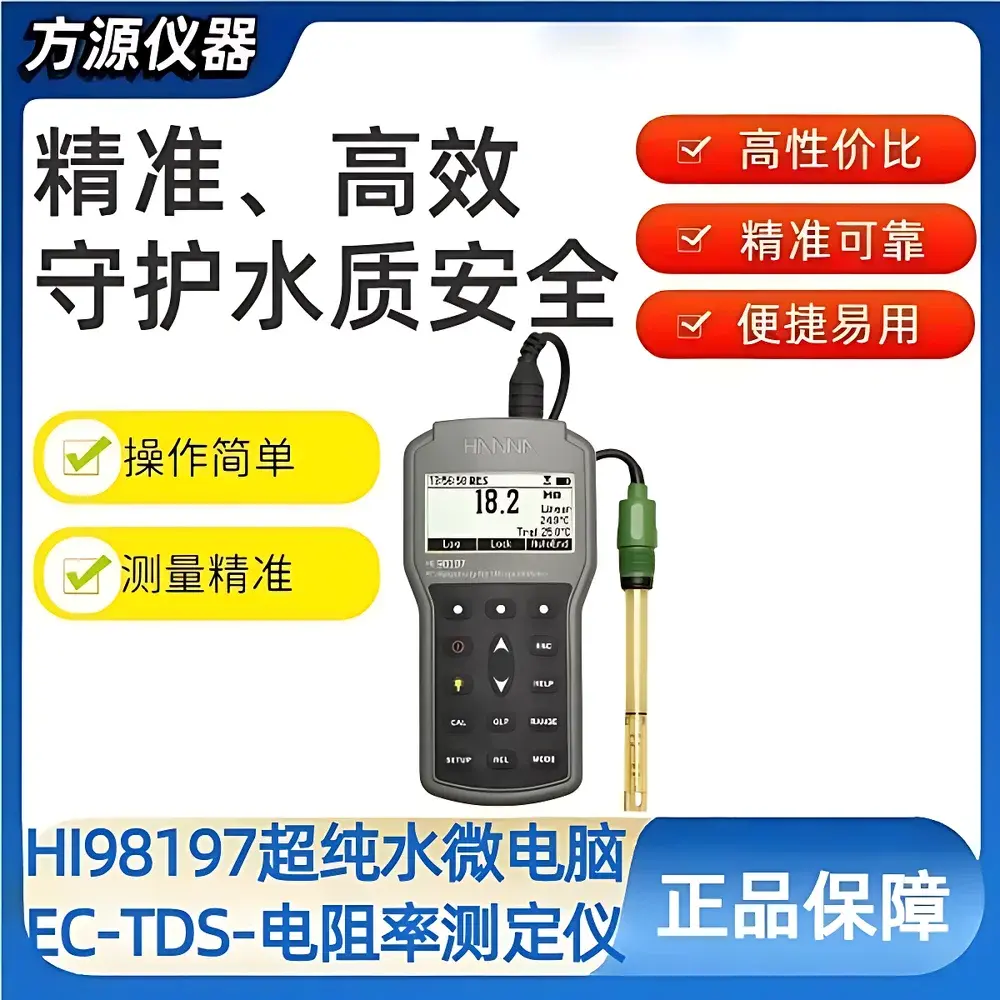
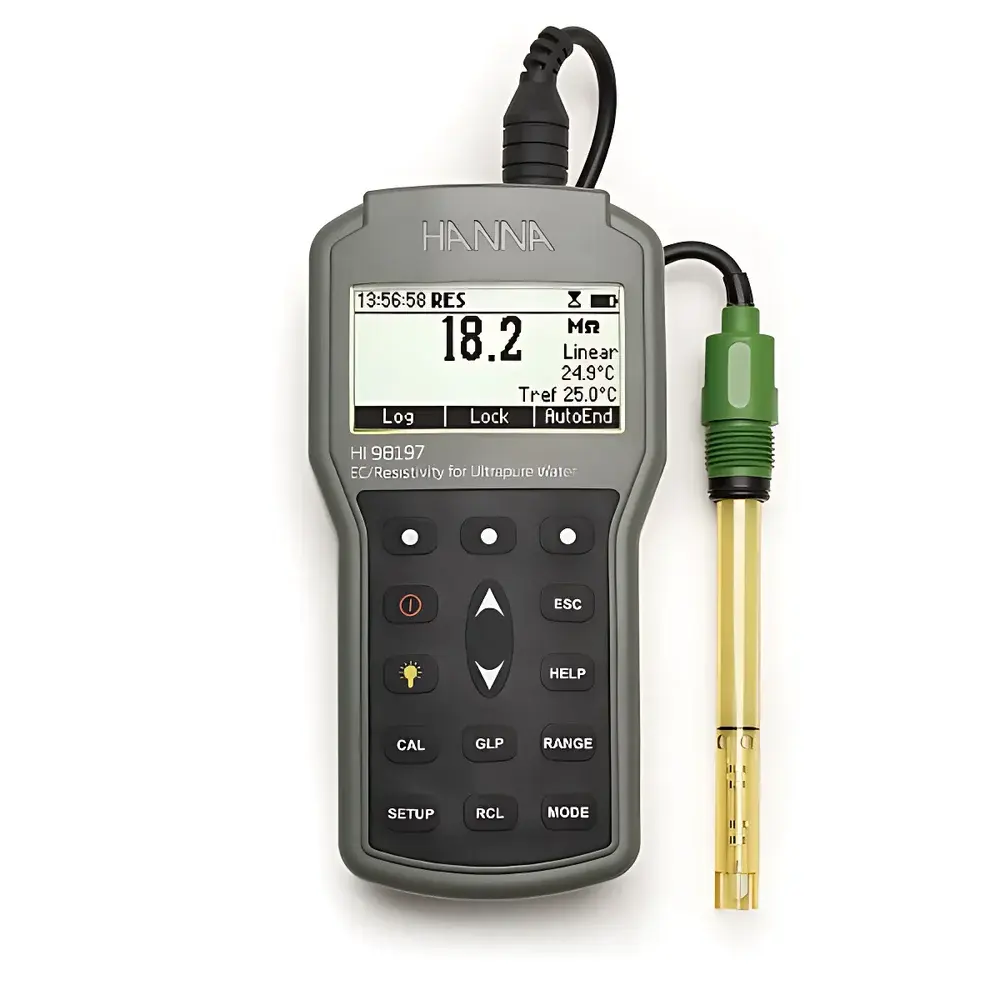
Hanna HI98197 Portable Ultra-Pure Water Conductivity/TDS/Resistivity/Salinity/°C Meter
| Brand | Hanna Instruments |
|---|---|
| Origin | Italy |
| Model | HI98197 |
| Instrument Type | Portable |
| Measurement Parameters | EC, TDS, Resistivity, NaCl %, PSU, ppt, °C/°F/K |
| EC Range | 0.000–9.999 µS/cm, 10.00–99.99 µS/cm, 100.0–999.9 µS/cm, 1.000–9.999 mS/cm, 10.00–99.99 mS/cm, 100.0–1000.0 mS/cm |
| EC Resolution | 0.001 / 0.01 / 0.1 µS/cm |
| EC Accuracy | ±1% of reading or ±0.01 µS/cm (whichever is greater) |
| TDS Range | 0.000–9.999 ppm to 100.0–400.0 ppt |
| Resistivity Range | 1.0 Ω·cm to 100.0 MΩ·cm |
| Salinity Modes | NaCl % (0.0–400.0%), PSU (0.00–42.00), Seawater ppt (0.00–80.00) |
| Temperature Range | −20.0 to 120.0°C |
| Temp Accuracy | ±0.2°C |
| Calibration | 5-point auto-recognizing EC calibration |
| Electrode | HI763123 platinum 4-ring conductivity probe with integrated Pt1000 sensor, DIN connector, 1 m cable |
| Flow Cell | HI605453 AISI 316 stainless steel low-conductivity flow cell |
| Data Storage | 400 manual + 1000 logged readings |
| Compliance | USP <645>, ISO 7888, GLP |
| Protection Rating | IP67 |
| Power | 4×AA batteries |
Overview
The Hanna HI98197 is a high-precision, portable multi-parameter meter engineered for ultra-pure water quality monitoring in pharmaceutical, semiconductor, power generation, and laboratory environments. It employs four-electrode (tetrapolar) conductivity measurement—eliminating polarization errors and contact resistance effects—to deliver trace-level accuracy in low-conductivity matrices (down to 0.001 µS/cm). Unlike two-electrode systems, the HI763123 platinum 4-ring probe ensures stable, drift-free measurements across the full resistivity range up to 100.0 MΩ·cm—critical for verifying compliance with ASTM D1125, ISO 3696 Grade 1, and USP purified water specifications. The instrument operates on absolute (non-temperature-compensated) and temperature-compensated modes, supporting linear, non-linear (0–36°C), and reference-temperature-based compensation per ISO 7888. Its integrated Pt1000 temperature sensor enables simultaneous, synchronized temperature measurement with ±0.2°C accuracy—essential for valid resistivity calculation at 25°C.
Key Features
- Four-ring platinum conductivity electrode (HI763123) with built-in Pt1000 sensor and DIN interface, optimized for ultra-low conductivity (<1 µS/cm) stability and reproducibility
- Dedicated AISI 316 stainless steel flow cell (HI605453) enabling closed-loop, air-free measurement—preventing CO₂ absorption and surface contamination during ultrapure water analysis
- Automatic range selection and unit conversion across six EC ranges (0.001 µS/cm to 1000 mS/cm), seven resistivity decades (1.0 Ω·cm to 100.0 MΩ·cm), and dual salinity reporting (PSU, ppt, % NaCl)
- USP -compliant operation with configurable temperature compensation models, reference temperatures (15°C, 20°C, 25°C), and selectable TDS conversion factors (0.40–1.00)
- GLP-compliant data management: timestamped calibration logs, electrode constant tracking, user-defined calibration points, and audit-ready metadata storage
- IP67-rated rugged housing with backlit graphical LCD, intuitive on-screen calibration prompts, and auto-endpoint hold for stable readings
Sample Compatibility & Compliance
The HI98197 is validated for use with deionized (DI), reverse osmosis (RO), distilled, and ultrapure water streams where resistivity ≥18.2 MΩ·cm at 25°C is required. Its flow-cell configuration meets ASTM D5127 and EP 2.2.39 recommendations for continuous monitoring of high-purity water distribution systems. The meter supports regulatory workflows under FDA 21 CFR Part 11 (when paired with HI92000-15 software), EU GMP Annex 11, and ISO/IEC 17025-accredited laboratories. All calibrations are traceable to NIST-certified standards (e.g., HI7031L, HI7037L), and resistivity values are calculated using the internationally accepted formula: ρ = K × (R − R₀), where K is the cell constant (0.010–10.000 cm⁻¹), R is measured resistance, and R₀ is lead resistance offset.
Software & Data Management
Data export and system validation are enabled via USB interface and HI92000-15 PC software—a platform compliant with FDA 21 CFR Part 11 for electronic records and signatures. The software provides full audit trail functionality: user login history, calibration event logs with before/after deviation reports, measurement metadata (date/time, operator ID, electrode ID, temperature), and automated PDF report generation. Internal memory stores 400 manually triggered readings and up to 1000 time-stamped logged entries, with programmable intervals from 5 seconds to 3 hours. Stored datasets include raw EC, compensated EC, resistivity, TDS, salinity mode, temperature, and measurement status flags (e.g., “out-of-range”, “calibration due”).
Applications
- Pharmaceutical water systems: USP verification of Purified Water (PW) and Water for Injection (WFI) conductivity limits at 25°C
- Semiconductor fab UPW loops: real-time resistivity trending for point-of-use (POU) validation per SEMI F63
- Power plant boiler feedwater: detection of ionic breakthrough in mixed-bed ion exchange resins
- Research laboratories: calibration of reference electrodes, preparation of trace-metal-free standards, and validation of Milli-Q® and similar purification systems
- Environmental monitoring: low-salinity estuarine profiling and glacial meltwater characterization using PSU and non-linear compensation
FAQ
Does the HI98197 meet USP requirements for purified water testing?
Yes—the instrument implements all mandatory USP parameters: temperature-controlled measurement at 25°C, automatic resistivity calculation, non-linear temperature compensation per ISO 7888, and documented calibration traceability.
Why is a flow cell required for ultrapure water measurements?
Exposure to ambient air introduces CO₂ dissolution, forming carbonic acid that artificially elevates conductivity by 0.05–0.1 µS/cm. The HI605453 flow cell maintains a sealed, laminar-flow path to eliminate this error source.
Can the HI98197 measure true resistivity without temperature compensation?
Yes—selecting “NoTC” mode disables temperature correction, allowing direct measurement of absolute resistivity for thermodynamic modeling and material compatibility studies.
What is the minimum detectable conductivity for reliable resistivity calculation?
At 25°C, the instrument achieves ±0.01 µS/cm resolution in the 0.000–9.999 µS/cm range, enabling accurate resistivity determination down to 18.24 MΩ·cm—the theoretical limit for Type I ultrapure water.
Is electrode constant verification required between calibrations?
GLP protocols recommend recording the measured cell constant after each calibration; the HI98197 stores this value automatically and alerts users if deviation exceeds ±2% from the nominal K-value.




