
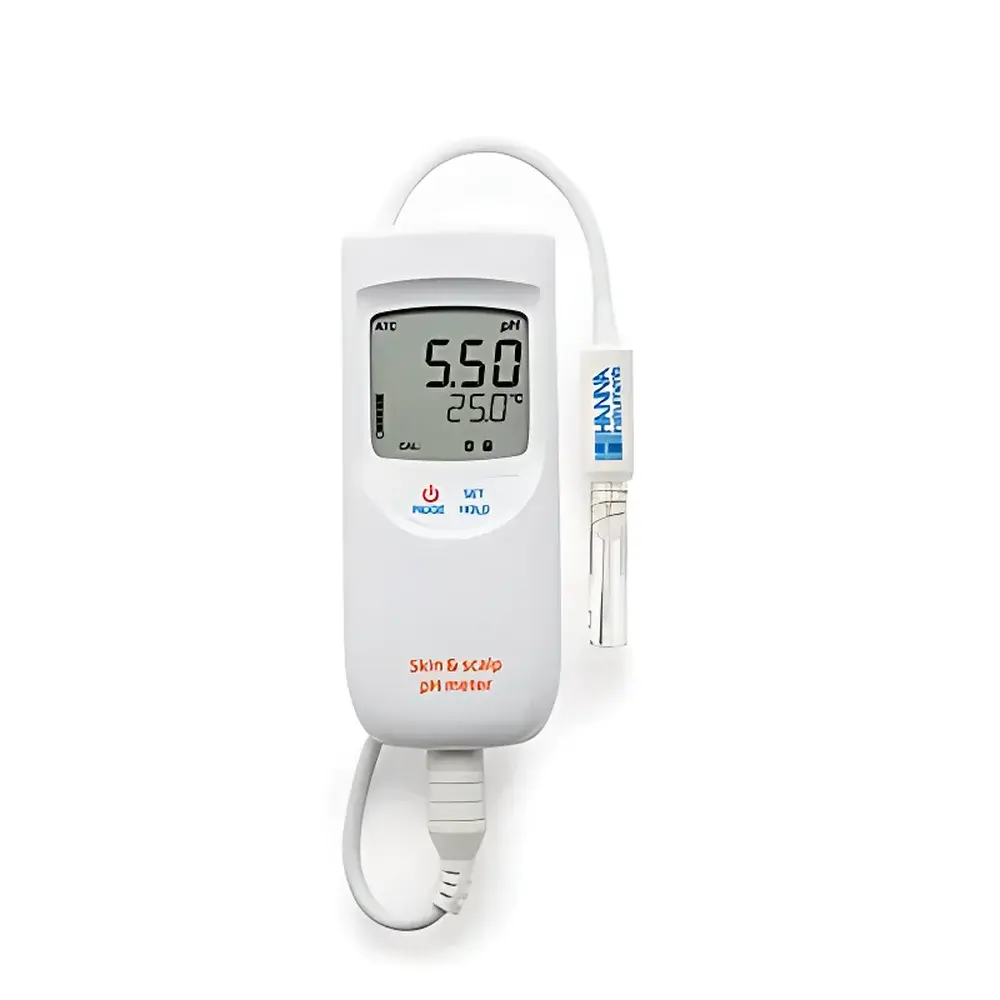
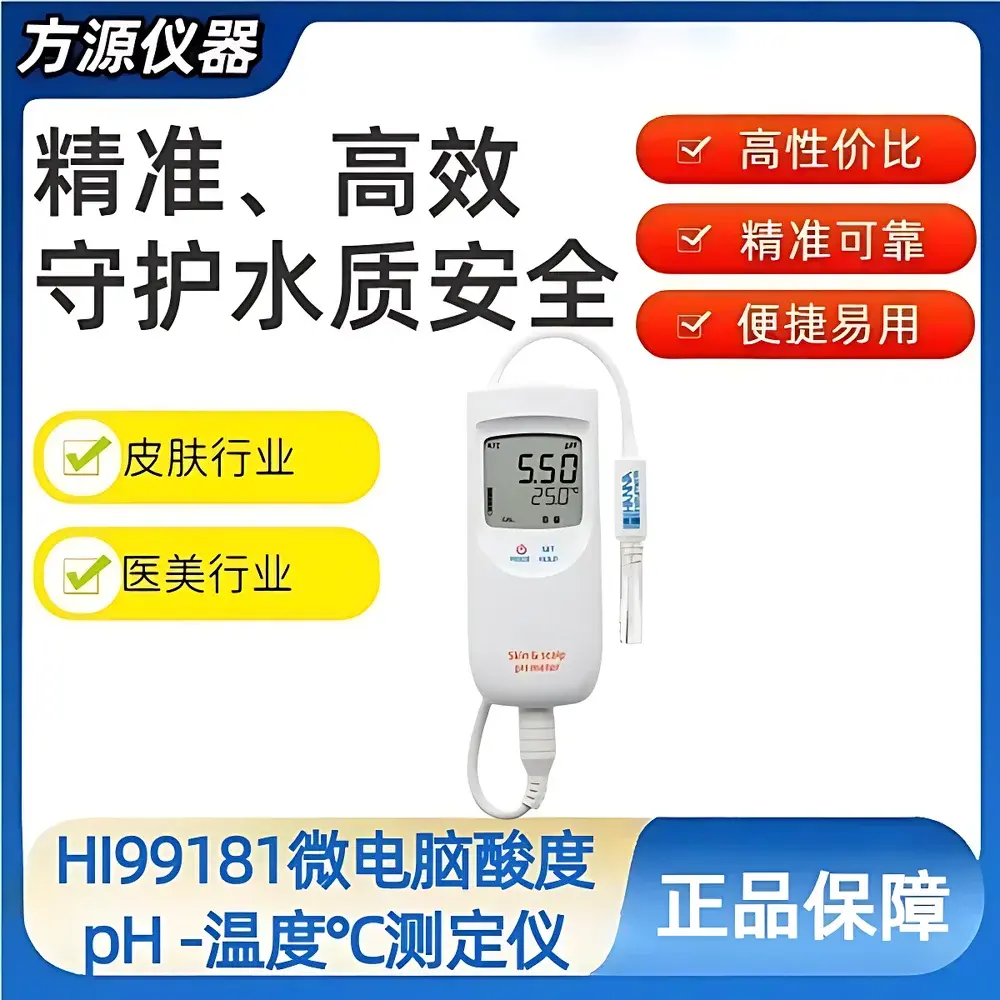
Hanna HI99181 Portable pH and Temperature Meter for Dermatology & Cosmetics
| Brand | Hanna Instruments |
|---|---|
| Origin | Italy |
| Model | HI99181 |
| Instrument Type | Portable |
| Parameter Type | Single-parameter (pH + °C) |
| pH Range | -2.00 to 16.00 pH |
| pH-mV Range | ±825 mV |
| Temperature Range | -5.0 to 105.0°C |
| pH Resolution | 0.01 / 0.1 pH |
| pH Accuracy | ±0.02 |
| mV Resolution | 1 mV |
| mV Accuracy | ±1 mV |
| Temperature Resolution | 0.1°C / 0.1°F |
| Temperature Accuracy | ±0.5°C (up to 60°C), ±1.0°C (remainder) |
| Electrode | HI14143/50 integrated amplifier & temperature sensor flat-tip glass pH electrode with DIN waterproof connector |
| Auto-Temperature Compensation (ATC) | -5.0 to 105.0°C |
| Calibration | 1–2 point automatic, with built-in standard sets (4.01/7.01/10.01 pH or 4.01/6.86/9.18 pH) |
| IP Rating | IP67 |
| Power | 3 × 1.5 V AAA batteries |
| Auto-Off | After 8 minutes of inactivity |
| Dimensions | 154 × 63 × 30 mm |
| Weight | 196 g |
Overview
The Hanna HI99181 is a purpose-engineered portable pH and temperature meter designed specifically for non-invasive surface and semi-solid sample analysis in dermatological research, cosmetic formulation, skincare product quality control, leather processing, paper manufacturing, and emulsion stability testing. Unlike general-purpose benchtop or laboratory pH meters, the HI99181 integrates a custom flat-tip glass pH electrode (HI14143/50) with an embedded solid-state temperature sensor and signal amplifier—enabling direct, reproducible contact measurements on skin surfaces, cream matrices, gel phases, and porous or uneven substrates without sample dissolution or dilution. Its measurement principle relies on potentiometric detection of hydrogen ion activity across a pH-sensitive glass membrane, referenced against a stable internal Ag/AgCl reference system, with real-time automatic temperature compensation (ATC) applied per NIST-traceable algorithms. The extended pH range (–2.00 to 16.00) supports highly acidic toners, alkaline cleansers, and aggressive industrial process streams, while the ±825 mV mV mode facilitates redox potential verification and electrode diagnostics per ASTM D1129 and ISO 10523 protocols.
Key Features
- Flat-tip glass composite electrode (HI14143/50) optimized for low-pressure surface contact—minimizes sample deformation and eliminates air-pocket errors common with spherical tips on viscous or heterogeneous media.
- Sensor Check™ diagnostic function provides real-time electrode health assessment, including slope (%), offset (mV), and response time—critical for GLP-compliant documentation and audit readiness.
- Large backlit LCD displays simultaneous pH, mV, and temperature readings with intuitive status icons—including stability indicator (disappears upon reading stabilization) and battery-level warning via BEPS™ (Battery Error Prevention System).
- Dual calibration modes: auto-buffer recognition for 1- or 2-point calibration using either the EU-standard set (4.01, 7.01, 10.01 pH) or USP/ISO-aligned set (4.01, 6.86, 9.18 pH), ensuring traceability to national metrology institutes.
- Rugged IP67-rated housing withstands dust ingress and immersion up to 1 m for 30 minutes—validated per IEC 60529—making it suitable for humid production floors, cleanroom anterooms, and mobile clinical assessments.
- Two-button interface enables rapid navigation between measurement, calibration, and setup menus—no menu diving or multi-level scrolling required for routine operation.
- HOLD function freezes displayed values for manual transcription or camera-based data capture; auto-off after 8 minutes preserves battery life without compromising measurement continuity.
Sample Compatibility & Compliance
The HI99181 is validated for direct-contact measurement on intact human skin (in vivo and ex vivo), cosmetic emulsions (O/W and W/O), hydrogels, facial mists, shampoos, leather tanning baths, and buffered paper coatings. Its flat-tip geometry conforms to ISO 16234-2 (non-invasive skin pH measurement) and aligns with ASTM E2912 guidance for topical product characterization. All electrical components comply with CE marking requirements under the EMC Directive 2014/30/EU and Low Voltage Directive 2014/35/EU. While not FDA-cleared as a medical device, its performance specifications meet analytical criteria outlined in USP “Acid-Base Titrations” and EP 2.2.3 “pH Measurement” for non-sterile pharmaceutical excipient testing. Data integrity is supported through manual recording workflows compatible with 21 CFR Part 11–aligned lab notebooks and QC logbooks.
Software & Data Management
The HI99181 operates as a standalone instrument with no proprietary software dependency—eliminating driver installation, license management, or cloud synchronization overhead. All calibration events, date/time stamps, and Sensor Check™ diagnostics are retained in non-volatile memory and accessible via on-device review. For regulated environments, users may integrate readings into LIMS or ELN systems via manual entry or optical character recognition (OCR) from the LCD display. Calibration records—including buffer IDs, measured mV, slope, and offset—can be documented per ISO/IEC 17025 clause 7.7 for method validation and equipment qualification. The absence of Bluetooth or USB connectivity ensures electromagnetic compatibility in MRI-adjacent clinics and RF-sensitive R&D labs.
Applications
- Dermatology clinics: Monitoring stratum corneum pH shifts pre- and post-treatment with retinoids, AHAs, or barrier-repair formulations.
- Cosmetic R&D labs: Screening pH drift during accelerated stability studies (40°C/75% RH) per ICH Q1A(R2).
- QC release testing: Verifying batch-to-batch consistency of toners, micellar waters, and cleansing balms against internal specifications (e.g., pH 4.5–5.5).
- Leather finishing: Quantifying acid pickling bath uniformity and neutralization endpoint in chrome tanning lines.
- Paper coating QA: Assessing pH-dependent binder activation in pigment dispersion layers prior to calendering.
- Academic teaching: Demonstrating electrode kinetics, liquid junction potential effects, and ATC necessity using standardized buffer series.
FAQ
Is the HI99181 suitable for measuring pH of thick creams or ointments?
Yes—the HI14143/50 flat-tip electrode is engineered for minimal penetration depth and high surface-area contact, enabling reliable readings on semi-solids without excessive pressure or sample disruption.
Does the meter support GLP-compliant calibration logging?
While it does not generate electronic audit trails, all calibration parameters (buffer ID, slope, offset, date/time) are viewable on-screen and can be transcribed into bound, signed, and dated GLP notebooks per FDA guidance.
Can the HI14143/50 electrode be used with other Hanna meters?
It features a standardized DIN waterproof connector and is compatible with all Hanna instruments supporting that interface, including HI98107, HI98127, and HI98130 series—though ATC functionality requires matching firmware support.
What is the recommended recalibration frequency for routine QC use?
Per ISO 17025 and internal SOPs, recalibrate before each analytical session or every 2 hours during continuous use; verify electrode performance daily using Sensor Check™.
How is temperature accuracy maintained across the full –5.0 to 105.0°C range?
The integrated Pt1000 RTD sensor is factory-calibrated against NIST-traceable standards; accuracy degrades slightly above 60°C due to thermal expansion effects in the glass junction—hence the tiered specification (±0.5°C ≤60°C; ±1.0°C >60°C).





