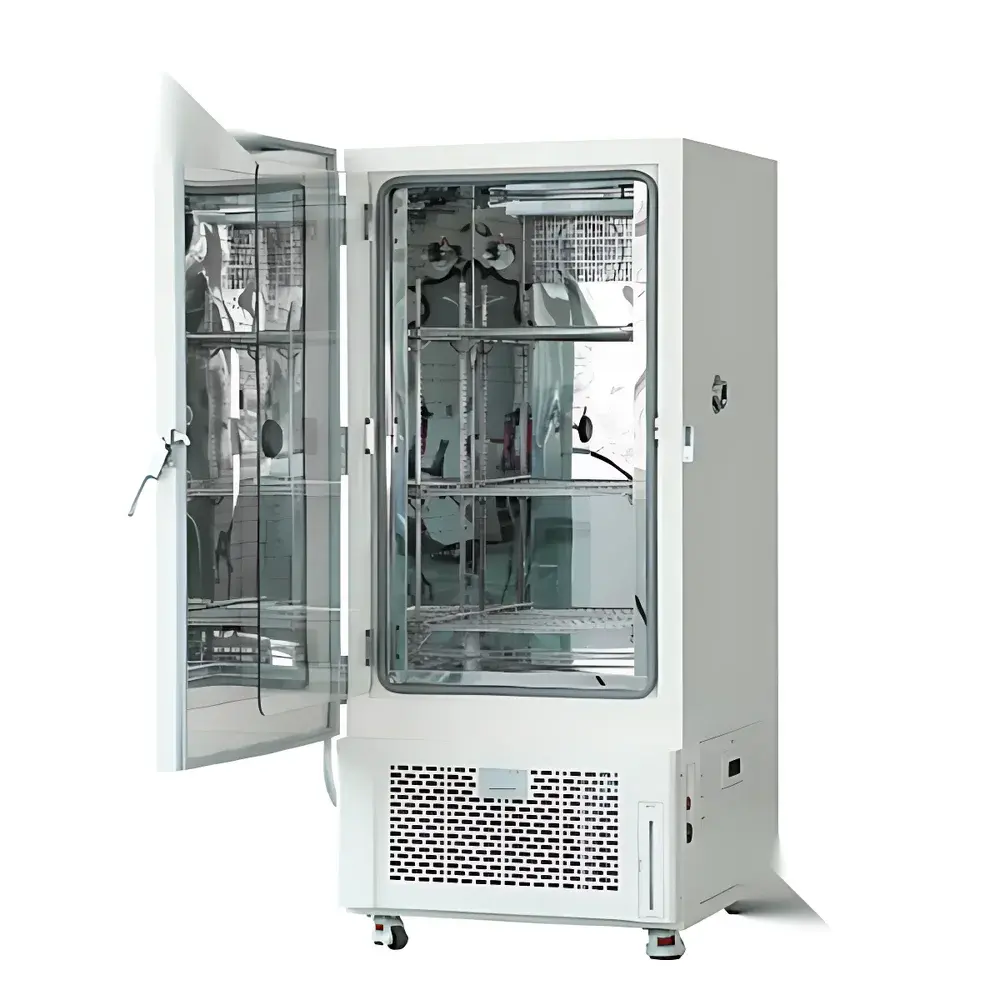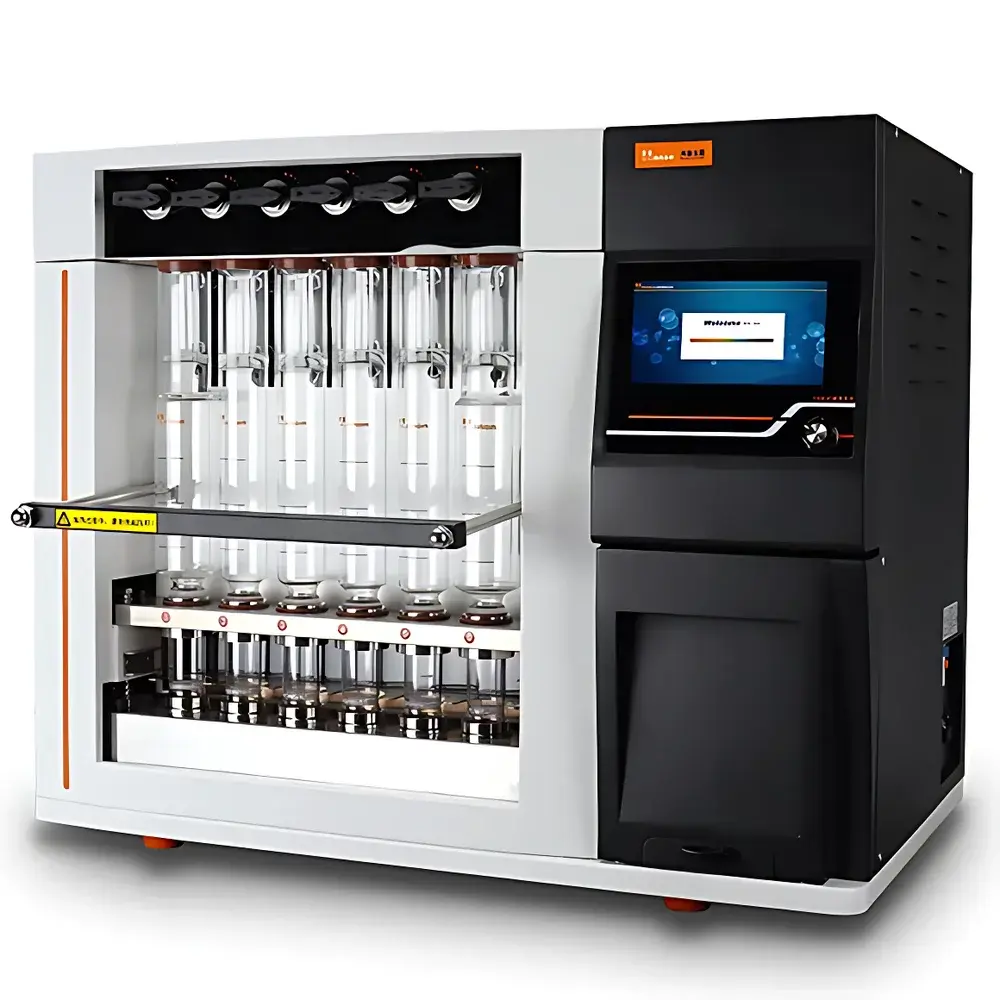
Hanon F800 Semi-Automatic Fiber Analyzer
| Brand | Hanon |
|---|---|
| Model | F800 |
| Origin | Shandong, China |
| Type | Semi-Automatic Fiber Analyzer |
| Compliance | GB/T 5515, GB/T 6434 |
| Sample Capacity | 6 samples/batch |
| Sample Weight Range | 0.5–3 g |
| Detection Range | 0.1–100% |
| Repeatability | ≤0.4% (for crude fiber <10%), ≤1% (for crude fiber ≥10%) |
| Heating Method | Integrated Infrared Heating |
| Preheating Time (Distilled Water) | 10–12 min |
| Boiling Time | 13–15 min |
| Rated Power | 2.2 kW |
| Voltage/Frequency | 220 VAC ±10%, 50 Hz |
| Dimensions | 776 × 476 × 644 mm |
| Optional Accessory | F800-B Cold Extraction Unit |
Overview
The Hanon F800 Semi-Automatic Fiber Analyzer is an engineered solution for standardized determination of dietary and structural fiber components in agricultural, feed, food, and botanical matrices. It implements classical gravimetric methodologies—specifically the Weende method for crude fiber and the Van Soest detergent system for neutral detergent fiber (NDF), acid detergent fiber (ADF), cellulose, hemicellulose, and lignin—under controlled thermal and solvent extraction conditions. The instrument operates on the principle of sequential acid-base digestion followed by filtration, drying, and ashing to isolate insoluble residue fractions. Its design adheres to internationally recognized analytical frameworks adapted in China’s national standards GB/T 5515 (crude fiber) and GB/T 6434 (fiber in feed), ensuring traceable, inter-laboratory comparable results suitable for quality control, nutritional labeling, and regulatory documentation in animal nutrition and agri-food sectors.
Key Features
- Integrated infrared heating system ensures uniform, rapid, and reproducible crucible heating—minimizing thermal gradients and enhancing solvent extraction consistency and recovery rates.
- Embedded temperature control firmware developed in-house by Hanon delivers precise, stable, and uniform thermal regulation across all digestion stages (acid, base, and rinse).
- Programmable timer with bidirectional counting (forward/backward) and real-time audible/visual end-of-cycle alerts enables strict protocol adherence and efficient workflow management.
- F800-B Cold Extraction Unit (optional) features a pull-out solvent reservoir for safe, ergonomic reagent handling; corrosion-resistant fluid path design isolates aggressive solvents (e.g., acetone, sulfuric acid) from pump mechanisms.
- Crucible reverse-flush function prevents sample cake formation and clogging during vacuum filtration—critical for high-fat or mucilaginous samples requiring prior defatting.
- Overfill protection and adjustable crucible heating power allow dynamic optimization of energy use and process speed without compromising analytical integrity.
- Pre-heating function reduces total cycle time by up to 25%, accelerating throughput without sacrificing repeatability.
- Standardized crucible set includes five interchangeable sizes (e.g., 25 mL, 40 mL, 60 mL) to accommodate heterogeneous sample densities and particle distributions.
Sample Compatibility & Compliance
The F800 supports a broad spectrum of solid organic matrices—including alfalfa hay, soybean meal, corn silage, cereal grains, bakery by-products, algae biomass, and herbal extracts—provided they are homogenized and moisture-controlled per AOAC or ISO 6498 guidelines. It accommodates samples with fat content up to 15% when paired with the F800-B cold extraction unit for pre-removal of lipids using petroleum ether or diethyl ether. All operational parameters comply with GB/T 5515 (crude fiber) and GB/T 6434 (feed fiber), and the methodology is harmonized with AOAC Official Methods 962.09 (crude fiber) and 978.10 (NDF/ADF), as well as ISO 6865 (animal feeding stuffs – fiber analysis). Instrument validation protocols support GLP-compliant documentation and can be extended to meet internal audit requirements for feed mill certification (e.g., GMP+ B4, FAMI-QS).
Software & Data Management
The F800 utilizes a dedicated embedded control interface with non-volatile memory for storing up to 20 user-defined methods. Each method retains independent settings for heating ramp profiles, digestion durations, rinse volumes, and vacuum filtration thresholds. While the base system does not include PC connectivity or LIMS integration, optional RS-232 or USB-to-serial adapters enable manual data export for external recordkeeping. Audit trails—comprising operator ID (manually entered), start/end timestamps, batch IDs, and deviation flags—are retained locally for minimum 90 days. For laboratories operating under FDA 21 CFR Part 11 or EU Annex 11, third-party validation packages (IQ/OQ/PQ) and electronic signature modules are available upon request through Hanon’s international technical support team.
Applications
- Quality assurance of compound feeds, premixes, and raw materials in commercial feed mills.
- Nutritional profiling of forages and silages for dairy and beef rations in precision livestock farming.
- Regulatory compliance testing for fiber declarations on packaged food and dietary supplement labels (e.g., “high-fiber” claims per GB 28050).
- Research applications in plant physiology, bioenergy crop evaluation (e.g., lignocellulosic biomass digestibility), and gut health studies involving fermentable fiber quantification.
- Method development and cross-validation against near-infrared spectroscopy (NIRS) calibration models.
FAQ
Does the F800 comply with international fiber analysis standards beyond Chinese national standards?
Yes—the methodology aligns with AOAC 962.09, AOAC 978.10, and ISO 6865. Validation reports and comparative inter-laboratory study data are available upon request.
Can the F800 perform lignin quantification without the F800-B cold extraction unit?
No—lignin determination via the Klason method requires prior lipid removal for fatty samples. The F800-B unit is mandatory for reliable lignin results when analyzing oilseed meals or high-fat forages.
Is routine calibration required for temperature or timing accuracy?
The infrared heating module and timer are factory-calibrated and require no user recalibration. Annual verification using NIST-traceable thermocouples and stopwatches is recommended for GLP/GMP environments.
What maintenance intervals are recommended for vacuum filtration components?
Crucible gaskets and filter membranes should be replaced after every 50 cycles; vacuum pump oil (if equipped) requires change every 200 hours of operation.
Are consumables such as crucibles and filters supplied by Hanon?
Yes—Hanon provides certified ceramic crucibles (Gooch-type), glass fiber filters (Whatman GF/A equivalent), and acid/base-resistant tubing kits compatible with ASTM D1193 Type II water and reagent-grade solvents.