
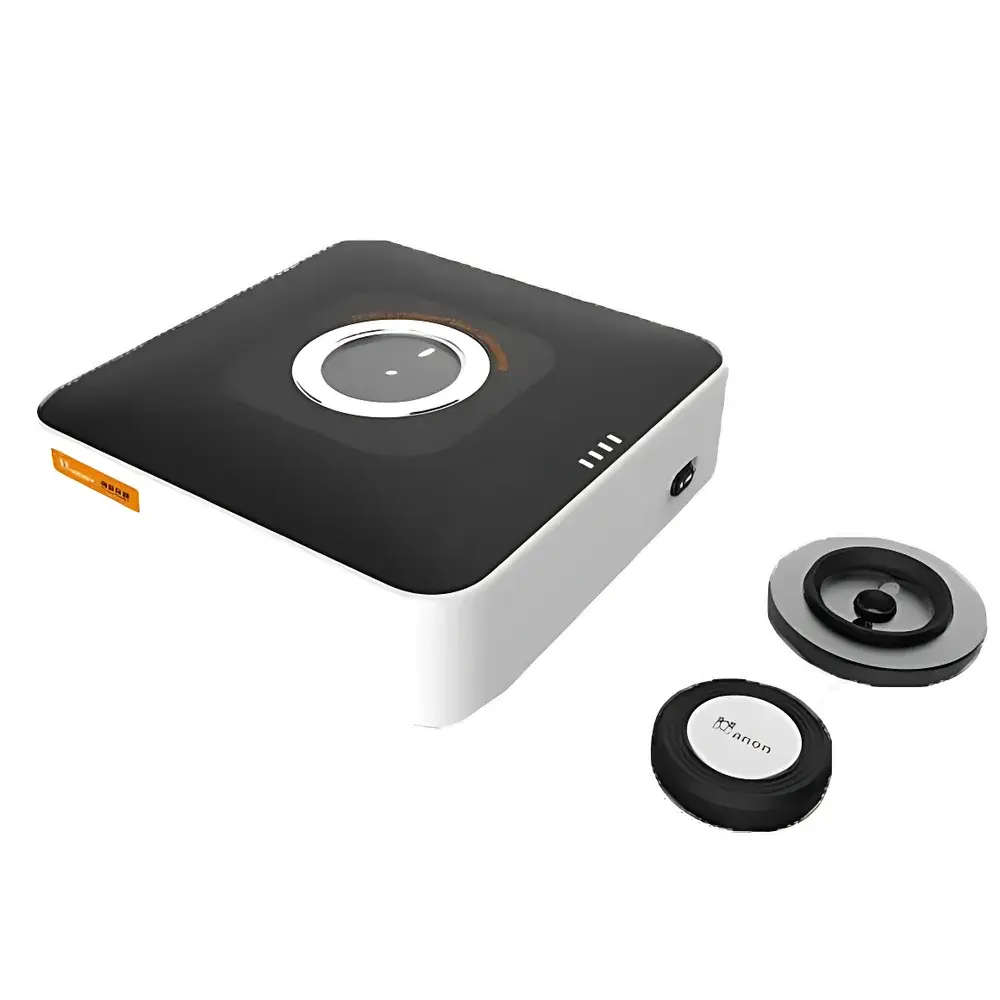
Hanon N110 Intelligent Miniature Near-Infrared Spectrometer
| Brand | Hanon |
|---|---|
| Origin | Shandong, China |
| Model | N110 |
| Instrument Type | Portable NIR Spectrometer |
| Principle | MEMS-based Micro-Grating Monochromator with Array Detector |
| Wavelength Range | 640–1050 nm (Reflectance), 340–750 nm (Transmittance) |
| Optical Resolution | ≤20 nm (Reflectance), ≤14 nm (Transmittance) |
| Wavelength Repeatability | ±0.5 nm |
| Noise Level | ≤60 µAU |
| Signal-to-Noise Ratio | ≥7500 |
| Operating Temperature | 5–40 °C |
| Relative Humidity | <85% RH (recommended <75% RH) |
| Dimensions (L×W×H) | 179 × 126.5 × 52.6 mm |
| Weight | 215 g |
| Power Supply | DC 5 V / 1000 mA |
| Tungsten Lamp Current | 400 mA × 2 |
| Sampling Modes | Reflectance Ratio, Transmittance |
| Data Acquisition Interval | Configurable via Hanir Software |
| Scan Speed | Up to 10 spectra/sec (typical, dependent on integration time) |
| Software Platform | Android-based Hanir v3.x with GLP-compliant audit trail logging |
| Chemometrics Engine | Integrated MEMS-optimized PLS and PCA algorithms |
| Compliance | Supports ASTM E1655, ISO 12099, and USP <857> spectral data handling conventions |
Overview
The Hanon N110 Intelligent Miniature Near-Infrared Spectrometer is a compact, field-deployable analytical instrument engineered for rapid, non-destructive quantitative and qualitative analysis in laboratory, agricultural, and educational environments. Built upon a micro-electro-mechanical systems (MEMS) platform, the N110 integrates a precision spherical grating monochromator and a high-sensitivity linear photodiode array detector. This architecture enables robust spectral acquisition across two distinct optical paths: reflectance mode (640–1050 nm) for solid and semi-solid samples such as fruits and grains, and transmittance mode (340–750 nm) for liquids and powdered matrices. Unlike traditional benchtop NIR systems, the N110 delivers laboratory-grade spectral fidelity in a palm-sized form factor—measuring just 179 × 126.5 × 52.6 mm and weighing 215 g—without compromising optical stability or signal integrity. Its dual-wavelength capability, coupled with factory-calibrated wavelength repeatability of ±0.5 nm, ensures traceable spectral alignment across instruments and over time—critical for method transfer and multi-site validation.
Key Features
- MEMS-driven micro-grating monochromator enabling high optical throughput and mechanical durability under thermal and vibrational stress
- Dual-mode optical configuration: calibrated reflectance ratio and transmittance measurement pathways
- Optical resolution ≤20 nm (reflectance) and ≤14 nm (transmittance), optimized for broad-band NIR and visible-NIR chemometric modeling
- Low-noise detection system with ≤60 µAU baseline noise and ≥7500 signal-to-noise ratio at peak intensity (integration time = 100 ms)
- USB-powered operation (DC 5 V / 1000 mA) with integrated dual tungsten lamps (400 mA × 2) for stable broadband illumination
- Android-native Hanir software v3.x supporting full GLP-compliant workflow: user authentication, electronic signatures, version-controlled method storage, and immutable audit trails per FDA 21 CFR Part 11 Annex 11 requirements
- Real-time spectral acquisition at up to 10 spectra per second, configurable integration time (1–1000 ms), and programmable data sampling intervals
Sample Compatibility & Compliance
The N110 supports diverse sample geometries through modular accessories—including fruit cradles with integrated pressure-sensing contact plates, liquid cuvette holders (10 mm pathlength), and powder sample cells with quartz windows. All attachments are mechanically registered to maintain consistent optical geometry and minimize inter-unit variability. The system complies with key international standards governing spectral instrumentation and chemometric validation: ASTM E1655 (standard practices for NIR quantitative analysis), ISO 12099 (cereals and animal feeding stuffs—guidelines for NIR calibration), and USP (spectroscopic identification and quantitation). Raw spectral data are stored in vendor-neutral .jdx and .spc formats, ensuring interoperability with third-party chemometrics platforms such as Unscrambler X, Pirouette, and MATLAB-based PLS toolboxes. Calibration models—including pre-validated PLS regressions for soluble solids content (SSC) in apple, pear, peach, and mango, and fat content in sesame and rapeseed—are distributed as encrypted .mod files with embedded metadata (sample matrix, reference method, RMSECV, and LOQ).
Software & Data Management
Hanir software operates natively on Android 8.0+ tablets and Windows PCs (via ADB bridge), providing a unified interface for instrument control, spectral preprocessing, model deployment, and report generation. Core functions include dark current subtraction, reference spectrum acquisition, real-time spectral overlay, baseline correction (Savitzky-Golay, Asymmetric Least Squares), and first-/second-derivative transformation. All spectral acquisitions are timestamped, geotagged (if enabled), and linked to operator ID and sample ID. Audit logs record every parameter change, model load event, and result export—retained for ≥36 months with SHA-256 hash integrity verification. Export options include CSV (intensity vs. wavelength), PDF analytical reports with embedded spectra and statistical confidence intervals, and XML metadata packages compliant with ISA-Tab specifications for FAIR data principles.
Applications
- Non-destructive quality assessment of horticultural produce: SSC (°Brix), dry matter, acidity, and firmness prediction in intact apples, pears, peaches, and mangos
- Rapid oilseed analysis: fat/oil content quantification in sesame, rapeseed, soybean, and sunflower seeds without solvent extraction
- Pharmaceutical raw material identification: excipient verification (lactose, microcrystalline cellulose, starch) using spectral library matching and Mahalanobis distance scoring
- Food authenticity screening: detection of adulteration in honey, olive oil, and powdered dairy products via PCA outlier analysis
- Teaching and method development: ideal platform for undergraduate spectroscopy labs due to its portability, intuitive interface, and open API for Python/MATLAB scripting
FAQ
What spectral formats does the N110 support for export and third-party analysis?
The instrument exports spectra in JCAMP-DX (.jdx), Galactic (.spc), and plain-text CSV formats. All contain wavelength calibration coefficients, detector response metadata, and acquisition parameters required for reproducible chemometric modeling.
Can the N110 be validated for GMP-regulated environments?
Yes—Hanir software includes IQ/OQ documentation templates, electronic signature support, and full 21 CFR Part 11 compliance features including role-based access control, audit trail review, and data integrity assurance.
Is custom accessory development available for specialized sample types?
Hanon offers OEM engineering services for application-specific optical interfaces, including fiber-optic probes, flow cells, and high-temperature sample stages—subject to NDA and feasibility assessment.
How is wavelength calibration maintained over time and temperature drift?
The MEMS grating is thermally stabilized via passive heat-sinking design; factory calibration includes temperature-dependent correction coefficients applied in real time by Hanir software across the 5–40 °C operating range.
Does the system support remote monitoring or cloud-based model updates?
Via optional Hanir Cloud Connect module, users may push spectral datasets to secure AWS-hosted repositories, trigger automated model retraining, and deploy updated calibrations OTA to fleet-deployed units.





